

The quickest way to reduce cloud costs can become an expensive mistake if it undermines performance or reliability. Effective cloud spend optimization isn’t about cutting resources indiscriminately. It’s about understanding what workloads need, what they deliver, and where spending no longer supports business priorities.
If your cloud bill is difficult to explain across teams, visibility and ownership may be part of the problem. Without clear accountability, potential waste can go unaddressed. Changes made without workload context can introduce risk. The goal is to make spending easier to understand and act on without compromising the services your business depends on.
This guide explains how to identify cost opportunities, prioritize changes by value and risk, and establish controls that adapt as workloads evolve. You’ll learn how to improve cost visibility, review resource use with performance in mind, and build an ongoing optimization practice instead of relying on a one-time cleanup. With a clear process, cost analysis can connect infrastructure decisions to business priorities and support more deliberate cloud investment.
Key Takeaways
- Start with billing, usage, architecture, and ownership data. Check recurring patterns against unusual charges before changing resources.
- Weigh each potential change against its business value, implementation effort, reliability risk, and reversibility.
- Use a repeatable cycle to measure costs, assign accountability, prioritize action, and review results as workloads and business needs evolve.
- Include finance, engineering, and business stakeholders so spending data is interpreted alongside workload needs and priorities.
- Consider consulting support when cost ownership is unclear or progress has stalled. Match the scope of help to the need, from assessment to ongoing management.
Cloud Spend Optimization Starts with Understanding Where the Money Goes
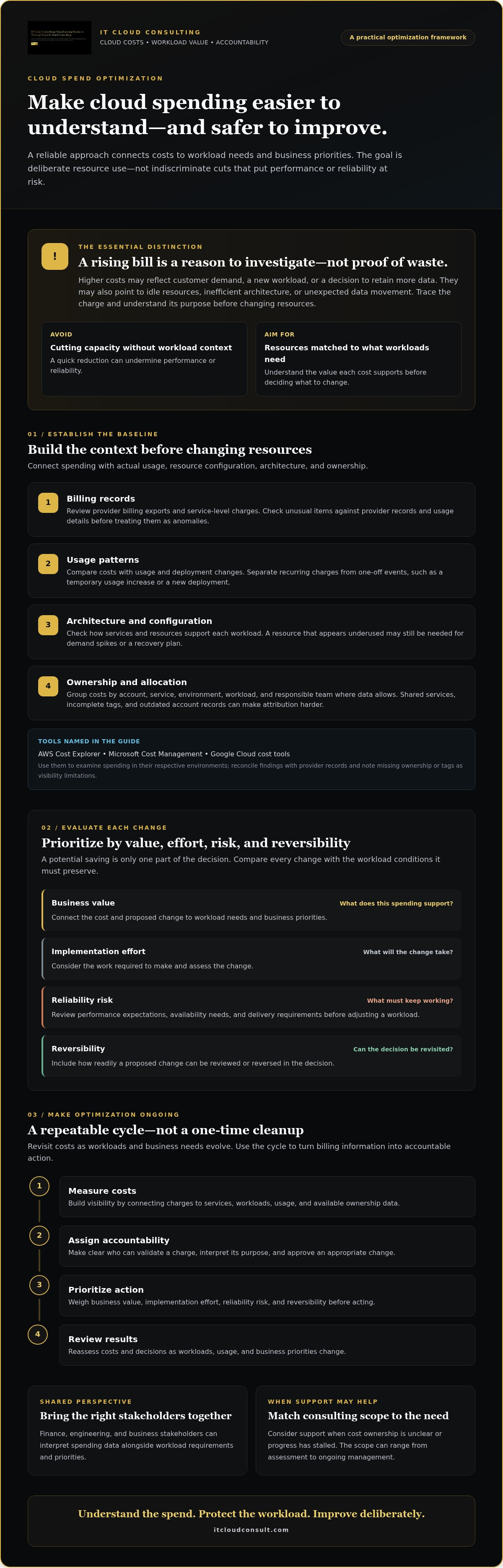
Cloud spend optimization aligns cloud resources and costs with workload requirements and business priorities. It isn’t indiscriminate cost cutting. Reducing capacity without understanding a service’s needs can undermine performance or reliability. Leaving every resource untouched, on the other hand, can allow avoidable expenses to persist. The objective is to use resources deliberately and understand the value each cost supports.
A rising bill is a reason to investigate, not proof of waste. Increased usage may reflect customer demand, a newly launched workload, or a decision to retain more data. The change could also come from idle resources, inefficient architecture, or data movement that isn’t obvious in a high-level bill. Trace charges to the services, workloads, and teams behind them, then assess whether the spending matches intended use.
This analysis can be difficult when an organization has multiple cloud accounts, environments, and provider services. A shared database or network service, for example, may support several teams while appearing as a single charge. Without allocation rules, teams may not know their share or who can approve a change. A foundational overview of cloud computing explains the on-demand model behind this complexity: resources can be provisioned as needs change, so costs can shift with consumption.
What does cloud spend optimization include?
Optimization brings together three connected practices: cost visibility, resource efficiency, and financial accountability. Visibility clarifies what the organization is paying for. Efficiency tests whether resources and architecture fit the workload. Accountability assigns people to review costs and make informed decisions. Together, these practices turn billing data into useful operational context.
A review may examine consumption patterns, architecture choices, and operating practices, such as how environments are used or how shared services are allocated. The right action depends on workload requirements and provider configurations. A resource that appears underused may still be necessary for a predictable demand spike or recovery plan, so review its purpose and usage context before approving a change.
Why cloud costs become difficult to manage
Usage-based charges change as applications scale, development and test environments are created or retired, and demand fluctuates. A monthly total can conceal these shifts, especially when billing spans accounts or combines several services. Compare charges with usage and deployment changes to separate expected growth from patterns that need closer review.
Ownership data matters, too. Shared services can serve multiple teams, while incomplete tags or outdated account records can make attribution slower. When these gaps exist, teams may identify a charge without knowing who can validate its purpose or safely adjust it. Establishing clear ownership makes the investigation more actionable.
Build a Reliable Cloud Cost Baseline Before Changing Resources
Before proposing a change, establish what the organization spends, what that spending supports, and what each workload needs to operate reliably. A decision-ready baseline connects billing records with actual usage, resource configuration, architecture, and ownership. Without that context, a charge may look excessive simply because demand has grown or a new environment has been added.
Review a consistent time period and separate recurring charges from one-off events, such as a temporary increase in usage or a new deployment. Check unusual items against provider billing records and usage details before treating them as anomalies. Then group costs by account, service, environment, workload, and responsible team where the available data allows. This gives teams a more useful view than a single organization-wide total.
Which cloud cost data should teams review?
Start with provider billing exports and service-level usage, then compare them with resource configurations and relevant purchasing commitments. AWS Cost Explorer, Microsoft Cost Management, and Google Cloud cost tools can help teams examine spending within their respective environments. Reconcile findings with provider records, and note missing tags or ownership details as visibility limitations rather than assuming the data is complete.
For each workload, record the conditions a cost change must preserve, including performance expectations, availability needs, and delivery requirements. A resource’s configuration and usage pattern can’t be evaluated in isolation from the service it supports. This baseline helps teams identify what to investigate while avoiding premature changes that could disrupt operations.
How to connect cloud spend to business value
A total bill shows the amount spent, but not whether the organization received appropriate value. Select a unit measure that fits the workload, such as cost per transaction or cost per customer, and track it alongside total spend. Compare consistent periods and note changes in demand, workload scope, or service activity that could explain a shift.
Cost context matters more than the bill total alone because it reveals what spending supports and how the expense changes with business activity. For example, a higher monthly charge may be reasonable if transaction volume also increased and service requirements were met. If the bill rises while demand remains stable, investigate underlying usage and architecture before deciding what to adjust.
A structured baseline makes cloud spend optimization evidence-based. Teams can compare the current state with business needs, identify unanswered questions, and validate proposed changes against operational requirements. If connecting cost data to infrastructure priorities proves difficult, cloud cost and infrastructure guidance may help bring those considerations together.
Prioritize Cloud Cost Changes by Value, Risk, and Reversibility
Once potential opportunities are visible, rank them by more than their apparent cost impact. Consider expected value, effort, operational risk, and how easily a change can be reversed. Start with actions that clarify usage or address a well-understood inefficiency. Architecture changes and purchasing commitments carry more risk and need stronger evidence and review.
The ranking below is a starting point, not a universal savings forecast. An opportunity’s impact depends on verified usage, workload requirements, provider configuration, and contractual constraints.
| Priority | Opportunity | Expected impact | Effort | Risk | Validation method |
|---|---|---|---|---|---|
| 1 | Investigate idle or underused resources | Variable | Low | Low after confirming ownership and purpose | Check usage history, workload owner, and service requirements before acting |
| 2 | Review storage, data transfer, and service configuration | Variable | Moderate | Moderate if data access or service behavior changes | Compare configuration and consumption with retention, access, and performance needs |
| 3 | Change workload architecture or resource capacity | Potentially higher, workload-dependent | High | Higher if service behavior or reliability is affected | Test under representative conditions and monitor agreed service measures |
| 4 | Commit to a purchasing option | Depends on sustained usage and terms | Moderate to high | Higher if demand changes or terms limit flexibility | Review historical demand, future plans, and contractual conditions |
Which opportunities should teams investigate first?
Begin with investigation, not deletion. Before changing an idle resource, confirm that it has an accountable owner and no scheduled, recovery, or other workload purpose. Next, assess storage, data transfer, and service configuration against actual access patterns and application needs. Purchasing commitments need deeper analysis: review demand patterns and contractual terms first, since an attractive rate may not suit variable or uncertain usage.
How to protect performance while optimizing spend
Define service, availability, and latency requirements before changing capacity or architecture. Make a controlled change, observe it under representative workload conditions, and compare results with agreed measures. If performance or reliability moves outside acceptable limits, pause or reverse the change before expanding it. This staged approach makes cloud spend optimization a disciplined trade-off rather than a cost-cutting exercise.
For a broader view of how technical choices connect with organizational priorities, see this cloud optimization consulting guide.
Make Cloud Spend Optimization a Repeatable FinOps Practice
A cost review creates value only when findings lead to clear decisions and follow-through. Treat cloud financial management as a recurring operating cycle: measure spend and service outcomes, assign ownership, prioritize changes, implement them with appropriate safeguards, and review the results. Repeat the cycle as workloads, demand, and business priorities change.
Each group brings distinct context. Finance can interpret budgets, forecasts, and cost allocation. Engineering can assess architecture, usage, and technical risk. Business stakeholders can explain workload importance, customer needs, and delivery priorities. Shared accountability turns cloud cost management from a billing exercise into a sustained practice of aligning resources with business value.
How should teams assign cloud cost ownership?
Name accountable owners for workloads and shared platforms, and clarify who can approve or implement optimization decisions. Agree on tagging and allocation practices that reflect the organization’s cloud structure, then document how teams should use them. If a shared charge can’t be attributed confidently, flag it for review with relevant stakeholders rather than assigning it arbitrarily. Clear ownership makes the next action visible, even when that action is further investigation.
Which measures show whether optimization is working?
Track cost and operational results together. A lower bill alone doesn’t establish success if workload demand also fell or service quality declined. Use a consistent review that considers:
- Spend: Total costs, changes over time, and the status of planned actions.
- Efficiency: Workload-appropriate unit costs, such as cost per transaction, alongside relevant usage trends.
- Service outcomes: Performance and reliability indicators tied to the workload’s requirements.
- Accountability: The owner, decision, and current status for each optimization action.
Review these measures together to distinguish a meaningful efficiency gain from a reduction that shifts risk elsewhere. A lower unit cost may be encouraging, for example, but consider it alongside service performance and changes in demand. Record the rationale and result of each decision so teams can learn from it and make future reviews more precise.
Maintaining this cadence takes ongoing attention as infrastructure and business needs evolve. For context on the role of continuing operational support, see this managed cloud services buying guide. If your team needs help connecting cost reviews with cloud priorities, explore ongoing cloud support.
When Cloud Spend Optimization Consulting Can Accelerate Progress
Outside guidance may help when teams can’t agree on who owns a cost, recommendations repeatedly stall, or billing information is difficult to connect with workload requirements. A consultant can bring financial, infrastructure, and business context into the same review, helping an organization clarify what to investigate and how to move forward. Internal teams should still validate recommendations against their operational realities.
What to expect from a cloud optimization engagement
An engagement can begin with an assessment of business goals, the cloud environment, available cost data, and operational requirements. Recommendations can then be prioritized with relevant risks, dependencies, and validation steps. If the organization wants help applying agreed changes, implementation support may be appropriate. Ongoing cloud support can help maintain visibility as needs evolve. Agree on scope and expected outcomes based on the environment, available information, and organizational priorities.
Useful recommendations depend on access to relevant billing, usage, architecture, and workload context. They also need review by the people accountable for service performance and business outcomes. If data is incomplete or constraints are unclear, identifying those gaps is part of establishing a responsible path, not a reason to assume a particular saving is achievable.
How to prepare for an initial consulting conversation
A few practical details can make the discussion more focused. Bring recent billing information, a brief description of key workloads, and known constraints such as performance, availability, or delivery needs. Identify who can speak to finance, cloud operations, and workload outcomes. You don’t need a complete diagnosis. Clear questions and known ownership gaps help set the right scope.
Cloud spend optimization consulting is most useful when it connects cost analysis to infrastructure decisions and business priorities, rather than treating a bill total as the whole problem. IT Cloud Consulting advises organizations on cloud adoption, infrastructure optimization, and ongoing support, with scope shaped around the organization’s needs.
If you’re considering next steps, discuss cloud optimization with IT Cloud Consulting and outline the cost and infrastructure priorities your team wants to address.
Turn Cloud Cost Insight Into Lasting Progress
Cloud spend optimization delivers lasting value when teams connect cost decisions to workload needs and business priorities. A reliable baseline makes spending easier to interpret, and a measured approach helps teams weigh potential changes against performance and reliability. Regular review, clear ownership, and follow-through keep decisions relevant as workloads evolve.
The next step doesn’t need to be a sweeping overhaul. Start with the cost questions that matter most, clarify who can assess them, and use evidence to guide action. IT Cloud Consulting can help organizations develop strategic cloud guidance and roadmaps, assess and optimize existing infrastructure, and maintain visibility through ongoing technical assistance, monitoring, and management.
Ready to connect cloud costs with your infrastructure priorities? Discuss your cloud optimization priorities with IT Cloud Consulting. Start with a clear direction, accountable teams, and informed decisions that keep business needs in view.
Frequently Asked Questions
What is cloud spend optimization?
Cloud spend optimization aligns cloud resource use and costs with workload requirements and business priorities. It involves understanding which services drive spending, assessing whether their configurations suit current needs, and deciding where adjustments make sense. The goal isn’t simply to lower the bill. Spending can rise for valid reasons, such as increased demand, so optimization focuses on using resources effectively while meeting performance, availability, and delivery expectations.
How can a business reduce cloud spending without affecting performance?
Base changes on observed usage and documented workload requirements, not assumptions about what a resource needs. Assess a proposed adjustment in a controlled way, compare results against agreed performance and reliability measures, and expand only when evidence supports it. Keep a clear way to reverse a change if service outcomes worsen. This approach helps teams pursue efficiencies while protecting the experience and operational capacity their workloads must provide.
What is the difference between cloud cost optimization and FinOps?
Cloud cost optimization describes the work of improving how cloud resources are used in relation to their cost and purpose. FinOps is the collaborative operating practice that brings financial, technical, and business perspectives into cloud spending decisions. It can include cost optimization while also establishing shared processes for visibility, planning, accountability, and review. In brief, optimization is an outcome teams pursue; FinOps helps create the habits and coordination to pursue it continuously.
Which cloud costs should an organization review first?
Start with cost categories that are large, changing unexpectedly, or difficult to attribute, then trace them to services and workloads. Review compute, storage, data transfer, and managed services alongside resource configuration and usage. Check whether shared charges have clear owners, and verify unusual items against provider billing records. Prioritize investigation before making changes: a cost category may reflect necessary capacity or demand, not inefficiency.
How often should cloud spending be reviewed?
Set a regular review cadence that matches the pace and variability of your workloads, and examine billing as each provider’s records become available. A monthly review can help teams identify broader trends and track actions, while significant workload changes or unexpected usage may warrant earlier investigation. Pair scheduled reviews with appropriate cost monitoring so emerging issues don’t wait for the next meeting. Most importantly, make review a defined responsibility.
Can cloud optimization reduce spending without a cloud migration?
Yes. Organizations can assess existing cloud environments and adjust resource use, configurations, or operating practices without moving workloads to another platform. The right options depend on how each workload is built, used, and constrained. First establish what the service needs to deliver, then evaluate potential changes within the current environment. A migration may be relevant to broader strategy, but it isn’t a prerequisite for examining current cloud costs.
When should a company hire cloud spend optimization consultants?
Consider outside guidance when teams can’t identify who owns costs, analysis has stopped producing action, or internal capacity makes it difficult to assess infrastructure and spending together. IT Cloud Consulting provides strategic cloud advisory, assessment and optimization of existing infrastructure, implementation support, and ongoing technical assistance, monitoring, and management. The scope should reflect your environment and objectives. Bring relevant billing information, workload context, and operational constraints so accountable teams can evaluate recommendations.


