

Flexera estimates that 29% of cloud spending was wasted in 2026, highlighting how easily unused capacity and mismatched resources can inflate a bill. The most effective cloud cost reduction strategies don’t start with indiscriminate cuts. They match each optimization to workload value, ownership, and performance requirements.
If your cloud bill is difficult to explain or allocate, it can be hard to see where savings are possible. Oversized or idle resources may be hiding in the mix, but cutting costs without a clear plan can create performance or reliability risks.
This guide covers seven practical ways to identify cost drivers, prioritize savings, and reduce waste while maintaining service requirements. You’ll learn how to improve visibility, rightsize resources, address idle capacity, and make optimization an ongoing practice. Each strategy connects cost decisions with accountability and operational needs, giving teams a repeatable approach to cloud spending.
Key Takeaways
- Trace spending to specific teams, services, and workloads before deciding where to act.
- Consider rightsizing, removing idle resources, and tuning storage, while checking each change against workload needs.
- Compare potential savings with implementation effort and operational risk. Start with changes that are easier to reverse.
- Give each optimization an owner, deadline, risk assessment, and measure for validating its impact.
- Schedule recurring reviews across engineering, finance, operations, and business owners to keep decisions aligned as needs change.
Cloud cost reduction strategies start with visibility into what drives spend
A cloud bill shows what an organization spent, but not always why. Charges can span accounts, services, environments, applications, and teams, making it difficult to separate essential capacity from avoidable waste. Effective cloud cost reduction strategies start with a baseline that connects spending to the workloads and business purposes behind it.
Cloud cost optimization is the ongoing practice of aligning cloud resource usage and spending with workload requirements and business priorities. The goal is not simply to lower a bill. It is to control unnecessary spend while preserving the performance, reliability, and capacity that services need. Cloud services make resources easy to provision, but that flexibility also creates challenges of managing cloud spend when usage and ownership are unclear.
What should a cloud cost baseline include?
Bring billing data together with resource utilization, workload purpose, and ownership. Organize the information by account, service, environment, application, and accountable owner so teams can trace charges to the work they support. Consistent tags or labels for teams, applications, environments, and cost centers make comparisons more useful over time.
Some costs reflect deliberate investment, not waste. Compare usage over time to distinguish recurring excess capacity from planned growth, seasonal demand, and one-time project costs. If a charge has no clear owner, treat it as a visibility gap first. Assigning blame before establishing ownership can lead to poor decisions while leaving the data problem unresolved.
How do teams identify the biggest cost drivers?
Rank services and workloads using several factors, not spend alone: total cost, rate of growth, business criticality, and potential for optimization. A high-cost workload may be essential and well used, while a smaller but rapidly growing charge may deserve closer attention. Comparing usage across billing periods can help distinguish persistent costs from temporary spikes related to seasonal demand or project activity.
For each major cost driver, ask what the resource supports, who owns it, how consistently it is used, and whether its capacity matches its purpose. This turns a billing report into a prioritized investigation rather than a list of charges to cut. If cost data does not reveal clear priorities, an infrastructure assessment can connect spending patterns with workload and performance needs. Explore the cloud optimization consulting guide for more on how structured optimization planning can support business goals.
Seven cloud cost reduction strategies that preserve performance
Once the main cost drivers are visible, match each action to a specific kind of waste and verify its effect before applying the change more broadly. These cloud cost reduction strategies are not blanket cuts. The aim is to align resource use with demand while protecting the service each workload must deliver. The IEEE Computer Society also outlines practical cloud cost optimization strategies, including rightsizing and storage optimization.
Cloud optimization should reduce unnecessary resource use without degrading the performance or reliability a workload requires. For every change, define a cost measure and an operational measure, such as utilization alongside response time or service availability.
Which infrastructure changes can reduce avoidable consumption?
Start with resource use and purpose. Compare compute sizing with observed utilization and application requirements. Review storage against access needs and retention policies. Consider larger architecture changes only when workload evidence supports the effort and operational risk.
- Rightsize compute: Focus on resources that are consistently underused for their workload. The trade-off is less capacity headroom, so validate the change against utilization and application performance.
- Remove idle resources: Look for unattached volumes, unused snapshots, and other resources without an active purpose. Confirm ownership and retention needs first, then check that removal will not disrupt a dependent workload.
- Tune storage: Match data placement and retention to access patterns, and identify redundant or unnecessarily retained data. Lower-cost storage may affect retrieval time or access flexibility, so confirm access requirements before changing tiers.
- Improve architecture: Review workload design when evidence points to persistent inefficiency. Redesign takes effort and can introduce operational risk, so compare resource consumption and service behavior before and after the change.
When do automation and purchasing choices help?
Automation can align capacity with demand, but teams need to understand workload dependencies and operating requirements first. Test schedules and scaling behavior before relying on them for production workloads.
- Optimize commitments: Consider discounts tied to committed usage only when demand is stable and well understood. Check forecast reliability and flexibility or cancellation terms, then compare realized savings with actual usage.
- Automate schedules: Schedule nonproduction resources around confirmed operating hours and dependencies. To avoid interrupting needed work, verify schedules with owners and check that resources stop and restart as intended.
- Govern usage: Set ownership, budgets, and usage alerts to make unexpected consumption visible. Poorly calibrated controls can constrain legitimate work, so review exceptions and confirm teams can still meet workload requirements.
Autoscaling can add or release capacity as demand changes, while schedules can reduce resources during known quiet periods. Set scaling thresholds to preserve responsiveness, then validate cost and application behavior under changing demand. If workload trade-offs are difficult to assess, cloud optimization can help connect infrastructure decisions with business and performance requirements.
How to prioritize cloud savings without creating performance or reliability risks
The fastest cost cut isn’t always the best optimization. Removing capacity from a critical workload may lower spend briefly but lead to slower response times, service interruptions, or recovery challenges. Prioritize cloud cost reduction strategies by weighing potential savings against business criticality, evidence of underuse, operational risk, and how easily the team can reverse a change.
Use a comparison like the one below to make trade-offs visible. Treat each opportunity as a candidate for review, not an instruction to act immediately.
| Action | Likely opportunity | Effort | Operational risk | Validation method |
|---|---|---|---|---|
| Remove confirmed idle resources | Reduce spend on resources with no active purpose | Low to moderate | Low after checking ownership and dependencies | Confirm resource status and compare spend after removal |
| Right-size oversized resources | Match capacity more closely to observed demand | Moderate | Moderate if reduced headroom affects service | Review utilization, latency, errors, and availability |
| Review storage and retention | Address redundant or unnecessarily retained data | Moderate | Moderate if access or recovery needs are overlooked | Check retrieval requirements and recovery expectations |
| Redesign workload architecture | Address persistent inefficiency supported by workload evidence | High | Higher because changes may affect dependencies | Compare cost and service indicators through staged testing |
Which optimization actions should be reviewed first?
Start with clearly idle or orphaned resources, but confirm who owns them and whether another workload depends on them. Next, investigate oversized resources using representative periods that include normal peaks and relevant seasonal patterns. A single low-usage snapshot can misrepresent actual needs. Consider architecture changes only when their expected value justifies the engineering effort and operational risk.
How can teams prove that savings are safe?
Before changing a production workload, record its cost and service baseline. Agree on success measures with the accountable owner, including spend, latency, availability, error rates, and user experience where relevant. Consider recovery requirements and get owner approval before proceeding.
Apply changes in stages, monitor results, and define rollback criteria in advance. If service indicators move outside agreed limits, pause or reverse the change rather than treating lower spend as success. After each stage, compare actual spending and service measures with the original baseline over a meaningful period. This helps teams distinguish durable savings from a temporary billing shift and provides evidence to refine or repeat the optimization.
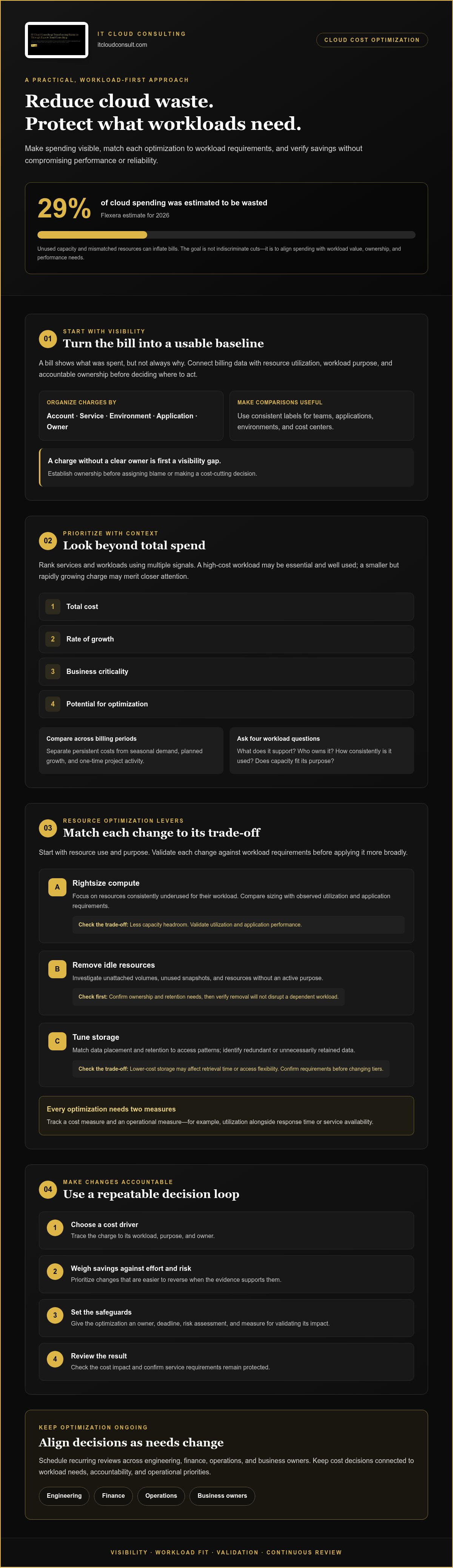
A practical process for implementing and measuring cloud cost reduction
Turn recommendations into managed work, not an unowned list. A repeatable sequence helps teams test cloud cost reduction strategies against financial goals and service requirements:
- Baseline: Record current spend, usage patterns, and relevant service indicators using consistent allocation rules.
- Prioritize: Group recommendations by expected impact, confidence, effort, risk, and dependencies.
- Assign: Name a technical owner and business owner. Document the deadline, expected outcome, and risk for each action.
- Test: Apply a change in a controlled way, starting with configuration updates that are easier to reverse. Plan longer-term architectural work separately.
- Validate: Compare post-change spending and service measures with the baseline, accounting for usage changes and billing terms.
- Repeat: Review results on an agreed cadence, close completed actions, and reassess new cost signals.
How should teams turn findings into a prioritized action plan?
Rank recommendations by likely value and confidence, then account for implementation effort, operational risk, and dependencies. Separate immediate configuration changes from architectural improvements that need planning and engineering work. Give every item a named owner and deadline so it does not become an unassigned backlog. Budgets and anomaly alerts can surface changes that need investigation, but a threshold breach is a prompt to review, not proof of waste.
Realized savings depend on whether a recommendation is implemented, how resource usage changes afterward, and how provider billing terms apply. A forecast is a planning estimate, not a guaranteed reduction. Keep assumptions visible so teams can explain differences between expected and actual results.
Which measures show whether optimization is working?
Track spending trends alongside workload context, using the same allocation rules before and after each change. Pair financial measures with availability, response time, capacity, and delivery indicators. A lower compute bill, for example, is not a successful outcome if response times worsen beyond the workload’s requirements.
Document exceptions when a higher-cost design supports a justified business need, such as required capacity or recovery requirements. This preserves accountability without treating every above-baseline expense as waste. Review exceptions as conditions change rather than removing safeguards to meet a spending target.
If your team needs help connecting infrastructure findings to a measured optimization plan, review this cloud optimization consulting guide. For support assessing and implementing cloud optimization, explore cloud optimization support.
Make cloud cost reduction a continuous operating practice
A one-time cleanup can address waste visible today, but it cannot account for changing workloads, new teams, seasonal demand, or shifting business priorities. Sustainable cloud cost reduction strategies need regular reviews that turn new cost information into clear decisions, assigned actions, and follow-up.
Bring engineering, finance, operations, and accountable business owners into the review. Engineering and operations can explain workload behavior and service requirements. Finance can clarify allocation and budget context, while business owners can confirm priorities. Together, they can decide whether an optimization remains appropriate as usage evolves.
What does effective cloud cost governance look like?
Governance creates shared expectations for how teams manage and explain cloud spend. Define what counts as an owner, how costs are allocated, how budgets are reviewed, and who approves material changes. Set tagging standards that make resources traceable to teams, applications, environments, or cost centers.
Use recurring reviews to examine anomalies and outstanding recommendations, record decisions, and assign follow-up actions. Budgets and alerts can prompt investigation, but context matters: an increase may reflect planned growth rather than waste. Apply guardrails according to workload criticality, so a low-risk development environment and a business-critical service are not managed as if their requirements were identical. Document exceptions, including the rationale and conditions for reviewing them again.
When should an organization seek cloud optimization consulting?
Outside expertise may be useful when teams cannot explain where spending is going, ownership is unclear, or potential savings are difficult to weigh against performance and reliability requirements. An infrastructure assessment can connect cost patterns with workload purpose and business needs, while strategic guidance can help teams decide which recommendations merit action.
Consulting can also support the transition from assessment to implementation and ongoing operational oversight when internal capacity is limited. The goal is to help the organization make informed cost decisions, not to pursue cuts without regard for service needs. Keep the review process proportionate, with clear owners and a cadence that fits how quickly workloads and priorities change.
If you’re looking to align cloud spend with performance and business goals, consider discussing your optimization priorities with IT Cloud Consulting.
Turn cloud savings into lasting progress
Effective cloud cost reduction strategies do more than lower a bill. They connect spending to workload needs, prioritize changes according to risk and value, and measure savings alongside performance and reliability. A clear baseline and accountable owners help teams make informed adjustments, while regular reviews keep optimization aligned with changing business priorities.
When cost data does not reveal where to focus, an expert assessment can help clarify next steps. IT Cloud Consulting provides cloud infrastructure assessment and optimization, along with implementation support and ongoing cloud management, to help align optimization work with operational requirements.
Discuss a cloud optimization assessment with IT Cloud Consulting to identify practical opportunities and plan the next steps. A measured, repeatable approach can help your organization manage cloud spending while continuing to support the services its business depends on.
Frequently Asked Questions
What are the most effective cloud cost reduction strategies?
The most effective cloud cost reduction strategies combine cost visibility with targeted changes, such as rightsizing resources, removing idle capacity, managing storage lifecycles, automating around demand, and evaluating purchasing commitments. The right mix depends on workload behavior and business requirements. Start with a baseline, rank opportunities by evidence and risk, then measure spending and service performance after each change.
How can I reduce cloud costs without affecting performance?
Measure resource utilization and service indicators before changing a workload. Use data from representative periods, confirm dependencies with workload owners, and make changes in stages with monitoring and clear rollback criteria. Track costs alongside latency, availability, and error rates. This helps distinguish capacity that can be reduced from resources needed to meet performance, reliability, or business requirements. If service indicators worsen, pause and reassess the change.
Can rightsizing cloud resources cause outages?
Yes, rightsizing can increase outage risk if teams overlook demand patterns, workload dependencies, or recovery requirements. Review representative usage rather than relying on a single snapshot, and involve the people responsible for the workload. Test changes in a controlled sequence, monitor service indicators, and define rollback conditions before deployment. Rightsizing means matching resources to demonstrated needs, not automatically choosing the smallest available option.
How much can a business save with cloud cost optimization?
There’s no dependable universal savings figure because results vary with architecture, usage patterns, provider billing terms, and the amount of avoidable capacity. Build a baseline and identify specific opportunities before estimating potential impact. Treat projections as hypotheses, not promises. After implementation, compare billing data and service indicators with the baseline to determine realized savings and whether workload performance remained within requirements.
What is the difference between cloud cost optimization and FinOps?
Cloud cost optimization describes technical and operational actions that improve how cloud resources are used. FinOps is a broader operating practice that helps finance, engineering, and business teams share accountability for cloud value. The two complement each other: optimization changes infrastructure or usage, while FinOps supports visibility, informed decisions, and ongoing governance. Together, they help organizations connect spending with workload needs and business priorities.
Are cloud commitment discounts always a good way to reduce costs?
No. Commitments may suit stable, well-understood usage, but they can be a poor fit when demand, architecture, or business needs are changing. Review usage history, forecasts, flexibility or cancellation terms, and planned workload changes before committing. Compare potential benefits with the risk of paying for capacity the organization does not use. Reassess assumptions if actual usage diverges from the forecast.
How often should a company review its cloud costs?
Set a review cadence that reflects how quickly workloads, spending, and business priorities change. Monitor anomalies as they arise, then hold structured recurring reviews of cost allocation, resource ownership, optimization recommendations, budgets, and service outcomes. Review more frequently during volatile spending, major workload changes, or periods of unclear accountability. Treat alerts as prompts to investigate, not automatic proof that a cost is wasteful.


