
A cloud consultant isn't just a technical vendor for a migration project; they're the architect of your organizational evolution. In an era where misconfigurations cause the majority of breaches and the 2026 ISO/IEC 27017 standards demand rigorous security controls, your choice of partner determines whether you scale or stagnate. Understanding how to choose a cloud consultant requires looking beyond basic certifications to find a strategist who bridges the gap between your current infrastructure and an optimized future state.
You've likely felt the anxiety of cloud costs spiraling out of control or feared that a generic solution won't fit your unique business model. It's a valid concern, as technical debt often accumulates when execution lacks a long-term roadmap. This guide promises to master the selection process, ensuring you find a partner that delivers predictable spending and a scalable architecture. We'll break down the essential criteria for vetting expertise, from AI-driven security capabilities to the strategic roadmap development that turns cloud adoption into a competitive advantage.
Key Takeaways
- Define the cloud consultant as a strategic advisor who orchestrates complex ecosystems rather than just providing simple storage solutions.
- Learn why prioritizing refactoring and replatforming over basic lift-and-shift methodologies prevents technical debt and ensures long-term scalability.
- Discover the specific vetting framework and critical questions required to evaluate a partner's multi-cloud proficiency and operational scale.
- Master how to choose a cloud consultant who acts as a visionary architect, bridging the gap between your current infrastructure and an optimized future state.
- Identify the shift toward proactive optimization and managed support that aligns technical execution with your broader organizational evolution.
What is a Cloud Consultant and Why is Selection Critical in 2026?
To understand What is a Cloud Consultant in the current market, one must look beyond basic technical support. A cloud consultant is a strategic advisor who aligns cloud technology with business potential, ensuring that every architectural decision serves a specific commercial objective. By 2026, the role has shifted from managing simple storage to orchestrating complex ecosystems where AI, data sovereignty, and multi-cloud environments intersect. A cloud consultant acts as a catalyst for organizational modernization, transforming technical infrastructure into a high-performance engine for business growth.
The stakes for this decision have never been higher. Selecting the wrong partner often results in more than just minor downtime; it creates deep security gaps and mounting technical debt that can take years to resolve. When businesses miscalculate how to choose a cloud consultant, they often find themselves trapped in proprietary ecosystems with misaligned spending that drains resources without delivering scalability. Professional advisory ensures that your transition to the cloud is an evolution, not just a relocation of legacy problems.
The Difference Between a Vendor and a Strategic Partner
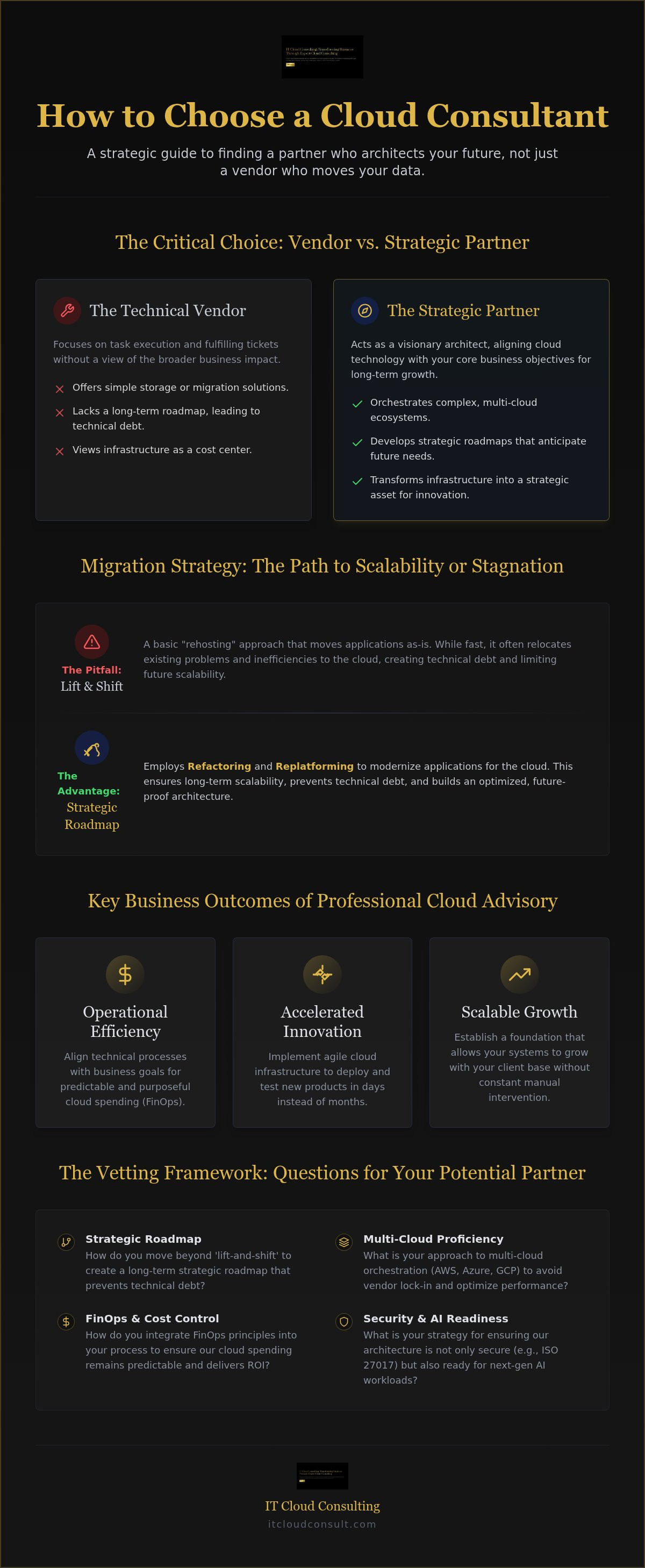
Traditional vendors typically focus on task execution, fulfilling specific tickets without questioning the broader impact on your business model. In contrast, a strategic partner functions as a visionary architect. They don't just move data; they architect long-term roadmaps that anticipate future needs. This business-centric approach is vital because technical excellence alone cannot solve organizational inefficiencies. A consultant who understands your specific industry vertical can identify compliance requirements and operational bottlenecks that a generalist might overlook, ensuring the solution fits your unique workflow.
Key Business Outcomes of Professional Cloud Advisory
Engaging with professional advisory services leads to measurable organizational benefits that extend far beyond the IT department. By removing legacy bottlenecks, firms can realize latent potential and pivot faster in volatile markets. Key outcomes include:
- Accelerated Innovation: Implementing agile cloud infrastructure allows teams to deploy and test new products in days rather than months.
- Operational Efficiency: Linking technical processes directly to business results ensures that cloud spending remains predictable and purposeful.
- Scalable Growth: Establishing a foundation through strategic cloud adoption ensures your systems grow alongside your client base without requiring constant manual intervention.
Ultimately, knowing how to choose a cloud consultant is about finding a guide who views your infrastructure as a strategic asset. This partnership allows your leadership team to focus on core competencies while the consultant manages the complexities of a modern, optimized future state.
Evaluating Technical Expertise and Strategic Vision
Technical proficiency is the foundation of any successful partnership, but in 2026, it must be paired with a forward-looking strategic vision. When determining how to choose a cloud consultant, you should prioritize candidates with a demonstrated track record in strategic cloud adoption. This involves more than just moving workloads; it requires an understanding of how multi-cloud environments, spanning AWS, Azure, and Google Cloud, can be orchestrated to avoid vendor lock-in. A consultant's approach to cloud optimization consulting should focus on FinOps principles and AI readiness, ensuring your infrastructure remains lean while supporting next-generation workloads.
True expertise manifests in the ability to handle complex enterprise transformations that bridge the gap between legacy systems and modern architectures. While many providers claim technical depth, a visionary architect will demonstrate how specific technical choices lead to tangible business outcomes. If you're looking for a partner to guide your transition, our team at IT Cloud Consulting specializes in these high-level strategic roadmaps.
Certifications vs. Real-World Execution
Official partnerships, such as the AWS Partner Network or Microsoft Solutions Partner status, serve as a baseline for technical competency. However, certifications are only the starting point. When evaluating a cloud consultant's technical expertise, look for case studies that highlight cause-and-effect results. Can they prove how a specific refactoring project reduced operational latency or lowered monthly spend by a specific margin? Verifying a consultant’s expertise in legacy system modernization requires evidence of their ability to untangle monolithic applications without disrupting core business functions.
Security and Compliance Frameworks
Security is no longer a final step in the migration process; it's a fundamental architectural requirement. A dependable guide will integrate a proactive cloud security assessment checklist into the earliest stages of planning. This ensures that data integrity is maintained through every migration phase. You must also verify their experience with industry-specific regulations like HIPAA, GDPR, or SOC2. In the 2026 landscape, where data regulations vary significantly across jurisdictions, your consultant must possess the precision needed to maintain compliance across a distributed cloud footprint. This level of detail is a critical factor in how to choose a cloud consultant who can protect your brand's reputation.
Strategic Roadmap vs. Lift-and-Shift Methodologies
Many organizations view the cloud as a destination rather than a platform for continuous evolution. This misconception often leads to "lift-and-shift" migrations, where legacy applications are moved to the cloud without modification. While this approach offers a fast path to migration, it typically replicates on-premise inefficiencies in a more expensive environment. Without optimization, these workloads fail to leverage cloud-native benefits, resulting in bloated spending and rigid infrastructure. A strategic partner understands that moving to the cloud is an opportunity to realize latent potential through more sophisticated methodologies.
Modern enterprises require the "refactor" or "replatform" approaches to achieve true modernization. Refactoring involves modifying application code to take full advantage of cloud-native features like auto-scaling and serverless computing. Replatforming makes minimal changes to leverage cloud-managed services without a complete rewrite. A consultant who prioritizes an enterprise cloud transformation roadmap acts as a visionary architect, ensuring technical execution supports long-term business goals. When evaluating how to choose a cloud consultant, their commitment to these strategic methodologies should be your primary filter. A structured roadmap guarantees operational efficiency from the first day of deployment.
The Long-Term Impact of Architectural Choices
Decisions made during the initial migration phase dictate your future agility. Poor architectural choices lead to "Cloud Sprawl," where unmanaged and underutilized resources proliferate, creating security risks and financial waste. A professional guide prevents this by linking early architectural decisions to your future managed cloud services needs. This foresight ensures your systems remain scalable and agile as your organization grows, avoiding the need for costly rework later in your journey.
FinOps and Cost Transparency
Cost-efficiency is a byproduct of intentional design, not an afterthought. A strategic consultant builds cost transparency into your roadmap by applying FinOps principles from the start. This approach emphasizes continuous optimization rather than a one-time setup; it ensures that every dollar spent on cloud resources yields a measurable business result. Professional advisory eliminates hidden costs by rightsizing instances and identifying redundant services. Mastering how to choose a cloud consultant means finding a partner who treats financial clarity as a core component of technical performance.
The Vetting Framework: Questions to Ask Your Potential Partner
Selecting the right partner is a high-stakes decision that requires a methodical vetting process. A fundamental step in learning how to choose a cloud consultant is shifting the focus from technical checklists to strategic alignment. You aren't just hiring a technician; you're selecting a guide who will influence your organization's trajectory for years. This framework ensures you identify a partner capable of bridging the gap between your current infrastructure and an optimized future state.
- Step 1: Inquire about their specific experience with your scale of operation. Enterprise complexities differ significantly from mid-market needs; ensure they've managed similar architectural weights.
- Step 2: Ask for a breakdown of their migration and optimization methodology. They should provide a clear cause-and-effect roadmap rather than a vague list of tasks.
- Step 3: Evaluate their communication rhythm and project management tools. A reliable partner uses structured reporting to maintain transparency and momentum throughout the project lifecycle.
- Step 4: Request references that specifically mention business outcome realization. Look for proof that their work led to predictable spending or increased operational agility.
- Step 5: Review their approach to cloud infrastructure consulting and ongoing support. A visionary architect plans for what happens after the initial migration is complete.
Red Flags in Cloud Consulting Proposals
Vague pricing models often signal a lack of transparency in managed service fees, which can lead to the cost spiraling issues many leaders fear. You should also be wary of any consultant who over-promises on timelines without conducting a thorough assessment phase. A "one-size-fits-all" approach is perhaps the most dangerous red flag; it suggests the consultant prioritizes their own internal templates over your specific business objectives. Professional advisory requires a custom-built strategy that respects your unique operational constraints.
Assessing the "Human Element" and Cultural Fit
A truly effective consultant acts as a seamless extension of your internal IT team. This relationship thrives on a shared professional register and a commitment to knowledge transfer. You don't want a partner who builds "black box" solutions; you want a guide who empowers your staff to manage the new environment effectively. Ensuring their cultural fit is just as important as their technical proficiency when deciding how to choose a cloud consultant. If you're ready to evolve your infrastructure with a partner focused on your long-term success, consider reaching out to IT Cloud Consulting to discuss your specific roadmap.
Modernizing Your Enterprise with IT Cloud Consulting
IT Cloud Consulting functions as the vital bridge between your current legacy infrastructure and a fully optimized future state. While previous sections detailed the criteria for how to choose a cloud consultant, the actual realization of your organizational potential depends on a partner who can translate high-level strategy into technical execution. We don't just provide a service; we architect a transformation that aligns your digital footprint with your long-term business trajectory. By focusing on Strategic Cloud Adoption, we ensure that every migration phase is purposeful, secure, and scalable.
Our methodology centers on the concept of evolution. We recognize that the cloud is not a static environment but a dynamic ecosystem that requires constant attention. Through Cloud Optimization and Ongoing Cloud Support, we maintain the operational health of your infrastructure, preventing the cost spiraling and security vulnerabilities that often plague unguided migrations. This commitment to continuous improvement ensures that your technical processes remain directly linked to your organizational benefits, allowing you to transition from legacy limitations to cloud-native potential.
Our Approach to Strategic Evolution
We begin by identifying the latent potential hidden within your current systems. Our professional advisory services utilize a cause and effect structure to connect specific infrastructure changes with broader business results. This isn't a generic technical task; it's a deep dive into your specific industry vertical to remove legacy bottlenecks and establish a foundation for growth. Our cloud optimization strategies are built on FinOps principles, ensuring that your cloud spending remains predictable and transparent. We view every client engagement as a long-term partnership, positioning ourselves as a strategic extension of your internal team rather than a mere vendor.
Next Steps for Your Cloud Journey
The path to modernization starts with a comprehensive evaluation of your current environment. When you partner with us, the first 90 days are dedicated to establishing a firm foundation. We conduct a thorough assessment phase to build a custom roadmap, followed by the initial execution of high-impact optimizations. This methodical pace builds trust through clarity and comprehensive coverage. If you're ready to secure your infrastructure and master how to choose a cloud consultant by selecting a visionary architect, our team is ready to guide you. Schedule your strategic cloud assessment with IT Cloud Consulting today to begin your organizational evolution.
Securing Your Path to Strategic Modernization
The transition from legacy infrastructure to an optimized future state requires more than technical execution; it demands a visionary architect. By prioritizing strategic roadmaps over simple migrations and asking the right vetting questions, you ensure your organization remains agile in an increasingly complex landscape. Mastering how to choose a cloud consultant is the most critical step in protecting your brand from security gaps and misaligned spending while establishing a foundation for sustainable growth.
IT Cloud Consulting provides nationwide professional advisory for complex cloud environments, specializing in Strategic Cloud Adoption and Optimization. Our focus remains on long-term enterprise ROI and performance, ensuring your technology acts as a strategic extension of your team. We're committed to your long-term organizational success and the realization of your latent potential. Begin your organizational evolution with a strategic cloud assessment from IT Cloud Consulting. The path toward a modernized, high-performance future is within your reach, and we're ready to guide you every step of the way.
Frequently Asked Questions
What is the typical ROI for cloud consulting services?
ROI manifests through long-term enterprise performance and the elimination of technical debt. By 2026, professional advisory focuses on performance and cost-efficiency optimization to ensure every technical process links to an organizational benefit. While specific dollar amounts vary by scale, businesses typically see a reduction in wasted resources and an acceleration in innovation cycles. This strategic alignment allows leadership to realize latent potential that legacy systems often bottleneck.
How do cloud consultants ensure data security during a migration?
Consultants ensure data security by integrating proactive assessment checklists into the earliest migration phases. This includes adhering to the 2026 ISO/IEC 27017 standards and maintaining data integrity throughout the transition. A visionary architect prioritizes prevention-first tooling and automated security controls rather than simple alerts. This methodical approach protects your brand's reputation and ensures compliance with complex regulations like GDPR or the US CLOUD Act.
Can a cloud consultant help reduce my existing AWS or Azure bill?
Yes, cloud optimization is a core component of professional advisory. A consultant evaluates your existing infrastructure to identify rightsizing opportunities and eliminate redundant services. By applying FinOps principles and continuous monitoring, they turn unpredictable monthly costs into a sustainable, purpose-driven expense. This process is a key part of how to choose a cloud consultant who can deliver measurable financial transparency and long-term enterprise ROI.
What is the difference between a managed service provider and a cloud consultant?
A managed service provider typically focuses on tactical maintenance and keeping systems operational. In contrast, a cloud consultant acts as a strategic advisor and visionary architect who aligns technical execution with your long-term organizational evolution. While some firms offer both, the consulting role is fundamentally about roadmap development and strategic cloud adoption. This high-level perspective ensures that your infrastructure supports future growth rather than just maintaining the current state.
How long does a typical cloud transformation roadmap take to implement?
Implementing a comprehensive transformation roadmap is a methodical process that typically begins with a thorough assessment phase. While the first 90 days often focus on high-impact optimizations and establishing a foundation, a full enterprise evolution can take several months to a year depending on complexity. The goal is to move from a legacy environment to an optimized future state through a series of purposeful building blocks rather than a rushed migration.
Do I need a cloud consultant if I already have an internal IT team?
Engaging a consultant is highly beneficial even with an internal IT team because they act as a strategic extension of your staff. Internal teams are often focused on daily operations, while a consultant provides the big picture perspective and specialized expertise required for complex modernization. This partnership empowers your internal staff through knowledge transfer and allows them to focus on core competencies while the consultant manages the architectural roadmap.
What certifications should I look for in a cloud consulting company?
You should prioritize partnerships with major providers, such as the AWS Partner Network or Microsoft Solutions Partner status. Additionally, look for firms that demonstrate compliance with modern security standards like ISO/IEC 27017:2026. When determining how to choose a cloud consultant, verify that these certifications are backed by case studies showing real-world execution. Technical proficiency is a baseline, but the ability to architect complex transformations is what differentiates a high-value partner.
How do cloud consultants handle multi-cloud or hybrid environments?
Cloud consultants manage multi-cloud or hybrid environments by orchestrating disparate systems into a unified, high-performance ecosystem. This approach prevents vendor lock-in and ensures data sovereignty by leveraging the strengths of different platforms like AWS, Azure, or Google Cloud. A strategic roadmap identifies which workloads belong in specific environments to maximize efficiency and security. This orchestration is essential for modern enterprises that require both on-premise stability and cloud-native agility.


