
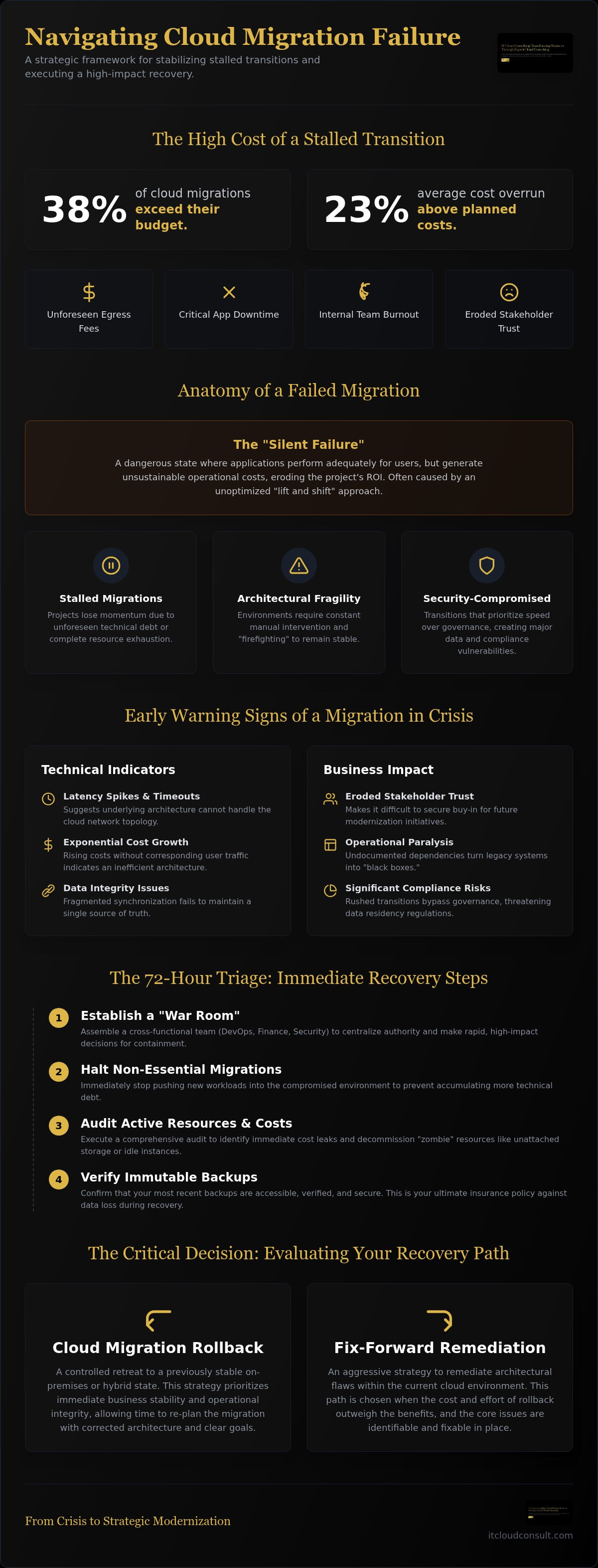
38% of cloud migrations exceed their initial budget, often by an average of 23% above planned costs, leaving enterprise leaders to manage unforeseen egress fees and critical application downtime. It's a frustrating reality when a transformation designed for agility instead creates internal team burnout and erodes executive confidence. You likely entered this transition with a vision of modernization, only to find your progress stalled by architectural failures that require a decisive cloud migration rollback strategy to protect your core operations.
Restoring momentum requires more than a technical patch; it demands a strategic pivot toward stability. This article provides a comprehensive framework to stabilize your stalled transition, diagnose critical failures, and execute a high-impact recovery plan. We'll explore how to build a risk-mitigated remediation roadmap that addresses latent systemic issues while prioritizing long-term efficiency. By shifting from speed-first execution to stability-first architecture, you can secure your organization's technological trajectory and regain the trust of your stakeholders.
Key Takeaways
- Identify the "silent failures" of cloud migration where technical performance masks unsustainable operational costs and an eroded return on investment.
- Execute a 72-hour triage by establishing a cross-functional war room to halt technical debt and stabilize immediate business operations.
- Determine the most efficient recovery path by weighing a controlled cloud migration rollback strategy against a fix-forward remediation of architectural flaws.
- Bridge internal expertise gaps through specialized support to ensure proactive monitoring and a risk-mitigated path toward environmental stability.
- Transform emergency remediation into a long-term roadmap for strategic cloud adoption that prioritizes scalable architecture and organizational evolution.
Understanding the Anatomy of a Failed Cloud Migration
Enterprise cloud migration failure is rarely a binary state of "up" or "down." Instead, it represents a fundamental mismatch between technical execution and the expected business return on investment. While a system might technically reside in the cloud, it's considered a failure if it lacks the scalability, security, or cost-efficiency required to support organizational growth. When these gaps become insurmountable, leadership must transition from hopeful persistence to a structured cloud migration rollback strategy to preserve the integrity of the business.
A particularly dangerous scenario is the "silent failure." In this state, applications perform adequately from a user perspective, yet they generate unsustainable operational costs that cannibalize the project's budget. This often stems from an over-reliance on the "lift and shift" model. In 2026, simply moving legacy workloads without modernization often triggers a recovery crisis because these systems aren't optimized for cloud-native features like AI-ready infrastructure or automated scaling. We categorize these failures into three primary types:
- Stalled Migrations: Projects that lose momentum due to unforeseen technical debt or resource exhaustion.
- Architectural Fragility: Environments that require constant manual intervention and "firefighting" to remain stable.
- Security-Compromised Environments: Transitions that prioritize speed over governance, creating vulnerabilities that threaten data sovereignty.
Technical Indicators of a Migration in Crisis
Identifying a failing migration early requires a focus on specific telemetry and financial data. You'll often see unpredicted latency spikes or application timeouts immediately following a cutover, suggesting that the underlying architecture isn't handling the cloud network topology correctly. Another red flag is the exponential growth in cloud consumption and egress billing. If costs rise without a corresponding increase in user traffic, your environment is likely inefficiently architected. Finally, data integrity issues caused by fragmented synchronization between on-premises and cloud environments indicate that your hybrid strategy is failing to maintain a single source of truth.
The Business Impact of Unsuccessful Cloud Adoption
The consequences of a failed migration extend far beyond the IT department. It rapidly erodes stakeholder trust, making it difficult to secure buy-in for future modernization initiatives. Operational paralysis often follows when undocumented system dependencies turn legacy applications into "black boxes" that no one understands. Additionally, rushed transitions frequently bypass established governance guardrails. This introduces significant compliance risks, especially regarding data residency regulations that have become more stringent in 2026. A proactive cloud migration rollback strategy serves as a necessary safeguard, allowing you to reset and re-align with your strategic goals before the damage becomes permanent.
The 72-Hour Triage: Immediate Steps for Migration Recovery
When a migration enters a critical state of failure, the first 72 hours are decisive for organizational containment. This period isn't about implementing long-term fixes; it's about stopping the bleeding and stabilizing the environment. The most effective response begins with the establishment of a "War Room." This cross-functional leadership team must include representatives from DevOps, Finance, and Security to ensure that technical decisions align with fiscal reality and governance requirements. By centralizing authority, you can make the rapid, high-impact decisions necessary to determine if a cloud migration rollback strategy is the most viable path forward.
Immediate tactical containment requires halting all non-essential migration waves. Pushing additional workloads into a compromised or inefficient environment only accelerates the accumulation of technical debt. During this pause, teams must execute a comprehensive audit of active cloud resources. This audit identifies immediate cost leaks and confirms the status of immutable backups. Ensuring these backups are accessible and verified is your ultimate insurance policy against data loss during the recovery process.
Stabilizing the Financial Perimeter
Financial volatility is often the most visible symptom of a failing transition. You must immediately identify and decommission "zombie" resources, such as unattached storage volumes or idle instances that contribute nothing to production. Configuring real-time cost alerts and rigid budget guardrails within your cloud provider console provides the visibility needed to prevent further overruns. Additionally, reviewing data egress patterns helps eliminate unnecessary cross-region transfer fees, which can quickly spiral out of control during a disorganized cutover. If your internal team is overwhelmed by these complexities, engaging with ongoing cloud support can provide the steady hand needed to navigate the crisis.
Technical Stability and Dependency Mapping
Stabilization also requires a deep-dive analysis of your new environment's internal architecture. You need to perform a comprehensive dependency mapping to uncover hidden bottlenecks that cause latency or timeouts. Analyzing API call volumes and database query performance often reveals suboptimal integration points where legacy code struggles with cloud-native latency. Utilizing a formal cloud architecture review allows you to pinpoint foundational flaws in your landing zone. This methodical approach ensures that your cloud migration rollback strategy or remediation plan is built on a verified understanding of the current state, rather than assumptions made during the initial deployment.
Rollback vs. Fix-Forward: Evaluating Your Recovery Path
Choosing the right path after a stalled transition is a high-stakes decision that dictates your organization's technical debt for years. You must choose between a strategic rollback, which is a controlled retreat to the source environment to restore continuity, and fix-forward remediation, where you address architectural flaws while remaining within the cloud environment. A well-defined cloud migration rollback strategy isn't a sign of defeat; it's a sophisticated risk-management tool used to preserve business operations when the current environment threatens the bottom line.
Evaluating the risk-reward ratio requires a cold analysis of data volume, downtime tolerance, and available engineering resources. To facilitate this, enterprises should establish a "Point of No Return" framework for critical workloads. This framework identifies specific milestones where a rollback becomes technically impossible or financially ruinous, such as when data gravity in the cloud exceeds the bandwidth available for egress or when primary databases have drifted too far from the legacy source of truth to be reconciled.
When to Execute a Strategic Rollback
A rollback is often the most logical choice in situations involving critical data corruption that cannot be remediated within the new environment. If the current operational costs significantly exceed the business value of the workload, or if severe security violations create immediate compliance risks, a retreat provides the necessary isolation to re-group. In these cases, the speed of restoring a known-good state on-premises outweighs the potential benefits of staying in a broken cloud landing zone. It allows your team to stop the financial hemorrhaging and re-evaluate the migration roadmap from a position of stability.
The Strategic Case for Fix-Forward Remediation
Fix-forward remediation is preferable when the source infrastructure has already been decommissioned or repurposed, making a return physically impossible. It's also the ideal path when failures are rooted in simple configuration errors or resource misalignments rather than fundamental architectural mismatches. In many instances, specialized cloud optimization consulting can deliver rapid stability and ROI by refactoring inefficient services and rightsizing the environment. This approach allows you to evolve through the crisis, turning a technical setback into an opportunity for genuine infrastructure modernization without the disruption of a full retreat.
Implementing a Strategic Remediation Framework
Once you've decided between a fix-forward path and a cloud migration rollback strategy, the focus shifts to disciplined execution. Remediation is not just about fixing broken code; it's about re-aligning the entire migration roadmap with updated business objectives and realistic budget constraints that reflect current market conditions. This stage involves a deliberate refactoring of legacy components into cloud-native services to eliminate the performance bottlenecks that likely caused the initial failure. By deploying a phased cutover plan with rigorous testing gates, you minimize future operational disruption and ensure that each step forward is validated against production-grade requirements. This methodical approach transforms the recovery process from a desperate patch into a strategic modernization effort.
Bridging the Skills and Expertise Gap
Initial failures often trace back to deep-seated knowledge silos where internal teams lack the specialized expertise required for complex cloud environments. You must objectively determine whether to invest in intensive internal upskilling or to partner with external advisory firms for immediate relief. Leveraging managed cloud services allows your organization to inject expert-level oversight into your remediation efforts immediately, providing the technical depth needed to solve architectural mismatches. Establishing a Cloud Center of Excellence (CCoE) further ensures that governance and best practices are centralized, preventing the fragmented decision-making that often leads to a stalled transition and redundant technical debt.
Architecting for Long-Term Resilience
True recovery transforms a fragile environment into a resilient, forward-looking infrastructure. This requires a transition from manual management to a robust Infrastructure as Code (IaC) model, ensuring consistency and repeatability across all stages of the remediation. Before finalizing your recovery, utilize an enterprise cloud security assessment checklist to harden the remediated environment against modern threats and ensure data sovereignty compliance. Implementing automated monitoring and self-healing protocols creates a proactive system health posture, significantly reducing the "firefighting" that often consumes DevOps resources. To ensure your framework is built on a foundation of expert architectural principles, consider a partner specializing in Strategic Cloud Adoption to guide your organization through this critical stage of evolution.
Turning Failure into Evolution: The Path to Strategic Modernization
A recovery project shouldn't simply return your systems to their previous state. It serves as a transformative catalyst to build a more scalable and efficient organization than existed before the crisis. By analyzing why the initial transition stalled, leadership can transition from emergency remediation into a long-term strategic cloud adoption roadmap that prioritizes architectural integrity over raw speed. This shift embeds continuous cost and performance optimization into your core operational culture, ensuring that future expansions are both predictable and profitable. The lessons learned from a cloud migration rollback strategy or a complex fix-forward project provide the precise data needed to inform a broader enterprise cloud transformation, turning a temporary setback into a foundational success.
Evolution requires moving beyond the "lift and shift" mentality that often triggers these crises. Instead of viewing the cloud as a destination, successful organizations treat it as an evolving platform for innovation. This perspective allows you to refactor legacy limitations into modern advantages, such as automated scaling and AI-ready data structures. When you align your technical recovery with these higher-level business goals, the remediated environment becomes a driver of competitive advantage rather than a source of technical debt.
The Role of Managed Cloud Support in Recovery
Maintaining system health post-recovery requires a move away from reactive troubleshooting. Managed cloud support provides 24/7 proactive monitoring that identifies technical instability before it affects end-user productivity. This oversight significantly reduces the operational burden on your internal teams, allowing them to pivot their focus from maintenance to core business innovation. Ongoing technical assistance ensures that the remediated environment remains optimized as your traffic patterns and business needs evolve, providing a safety net that prevents the recurrence of past failures and secures your digital future.
Accelerating Growth through Professional Advisory
Partnering with seasoned cloud architects allows for the development of a customized roadmap that aligns your technical capabilities with your high-level business vision. Strategic planning mitigates future migration risks by establishing clear milestones and rigorous testing protocols that ensure predictable outcomes. IT Cloud Consulting works as a strategic partner to orchestrate these recoveries, providing the "big picture" perspective and technical proficiency required for execution. By leveraging professional advisory, you can move past the limitations of your initial deployment and realize the full potential of a modernized, cloud-native infrastructure.
Securing Your Digital Future Through Strategic Recovery
Recovering from a stalled transition is a defining moment for enterprise leadership. Success depends on moving beyond reactive firefighting to implement a structured remediation framework. By prioritizing rapid triage and performing a cold evaluation of your technical architecture, you can stabilize costs and restore stakeholder confidence. Whether your path involves a controlled retreat or a refactored advancement, a decisive cloud migration rollback strategy ensures that business continuity remains the top priority.
True modernization emerges from the lessons of these complex challenges. IT Cloud Consulting provides authoritative strategic guidance for complex enterprise transformations, offering deep expertise in multi-cloud and hybrid infrastructure modernization. Our comprehensive cloud optimization and managed support services empower your organization to transform a technical crisis into a catalyst for long-term growth. Partner with IT Cloud Consulting for expert cloud migration recovery and strategic advisory. It's a journey from instability to evolution, and your organization's most resilient chapter is just beginning.
Frequently Asked Questions
How do I determine if my cloud migration has officially failed?
Identify failure by looking beyond simple uptime metrics. A migration fails when technical execution doesn't meet the expected business ROI. Primary indicators include unsustainable operational costs, eroded stakeholder trust, or significant security gaps. If your cloud spend is rising without corresponding traffic growth, you've likely hit a "silent failure." In these cases, a cloud migration rollback strategy might be necessary to stabilize the financial perimeter before you attempt to re-architect for long-term efficiency.
Is a rollback always possible for complex enterprise workloads?
A rollback isn't always feasible once you pass a certain point of technical complexity. Once you pass the "Point of No Return," data gravity or decommissioned legacy hardware can make a retreat impossible. Large-scale enterprise portfolios often face high egress bandwidth constraints that prevent a rapid return to on-premises environments. In these scenarios, a fix-forward remediation is usually the only viable path. This involves refactoring applications within the cloud to address architectural flaws directly.
What are the typical costs associated with a failed migration recovery?
Recovery costs vary based on the complexity of the architectural flaws and the extent of the rework required. While industry reports show that 38% of migrations exceed their initial budget, the real cost of failure includes application downtime, unforeseen egress fees, and lost end-user productivity. You must also account for the technical debt accumulated by rushing the initial transition. Avoiding these overruns requires proactive cloud optimization and a roadmap that aligns technical spend with actual business value.
Can a failed migration be fixed without hiring external cloud consultants?
Fixing a failure internally is possible but carries high risks for the organization. Internal teams often face burnout due to a lack of specialized expertise in complex cloud-native architectures. Relying solely on existing staff can lead to recurring failures if the original knowledge gaps aren't addressed. Leveraging specialized managed cloud support provides the necessary oversight to diagnose failures objectively. This allows your internal developers to focus on core business innovation while experts handle technical stabilization.
What are the most common causes of migration failure in 2026?
In 2026, failures often stem from ignoring data sovereignty and the complexities of AI-ready infrastructure. Many organizations attempt a "lift and shift" without preparing for vector search or Retrieval-Augmented Generation requirements. Additionally, new regulations like the EU AI Act, which began enforcement on August 2, 2026, demand strict data governance. Failing to account for these residency and compliance guardrails during the initial planning phase frequently leads to stalled transitions that require a complete strategic pivot.
How should I communicate a migration failure to executive stakeholders?
Communicate failure by focusing on the strategic pivot rather than the technical error. Present a clear remediation roadmap that highlights how the current pause will protect the organization's financial health. Use data to illustrate the gap between projected ROI and current costs. By framing the situation as a transition from speed-first execution to stability-first architecture, you can restore executive confidence. Emphasize that the goal is a risk-mitigated environment that secures the organization's long-term digital future.
What is the primary difference between a stalled migration and a failed one?
A stalled migration is a loss of momentum, while a failed migration is a fundamental mismatch with business goals. Stalled projects often wait for resources or technical clarity but might still be architecturally sound. A failed migration technically functions but generates unsustainable costs or operational fragility. Both scenarios may benefit from a cloud migration rollback strategy if the current trajectory threatens business continuity. Identifying which state you're in helps determine whether you need a simple push or a total reversal.
How can we prevent future cloud migrations from requiring a rollback?
Prevention starts with a rigorous strategic cloud adoption framework. Establishing a Cloud Center of Excellence (CCoE) ensures that governance, security, and cost-efficiency are baked into the plan from day one. Utilizing automated monitoring and self-healing protocols helps maintain system health as you scale. Regular cloud architecture reviews also identify potential bottlenecks before they become critical failures. This proactive approach minimizes the risk of needing a rollback and ensures your modernization efforts deliver consistent, predictable business value.


