
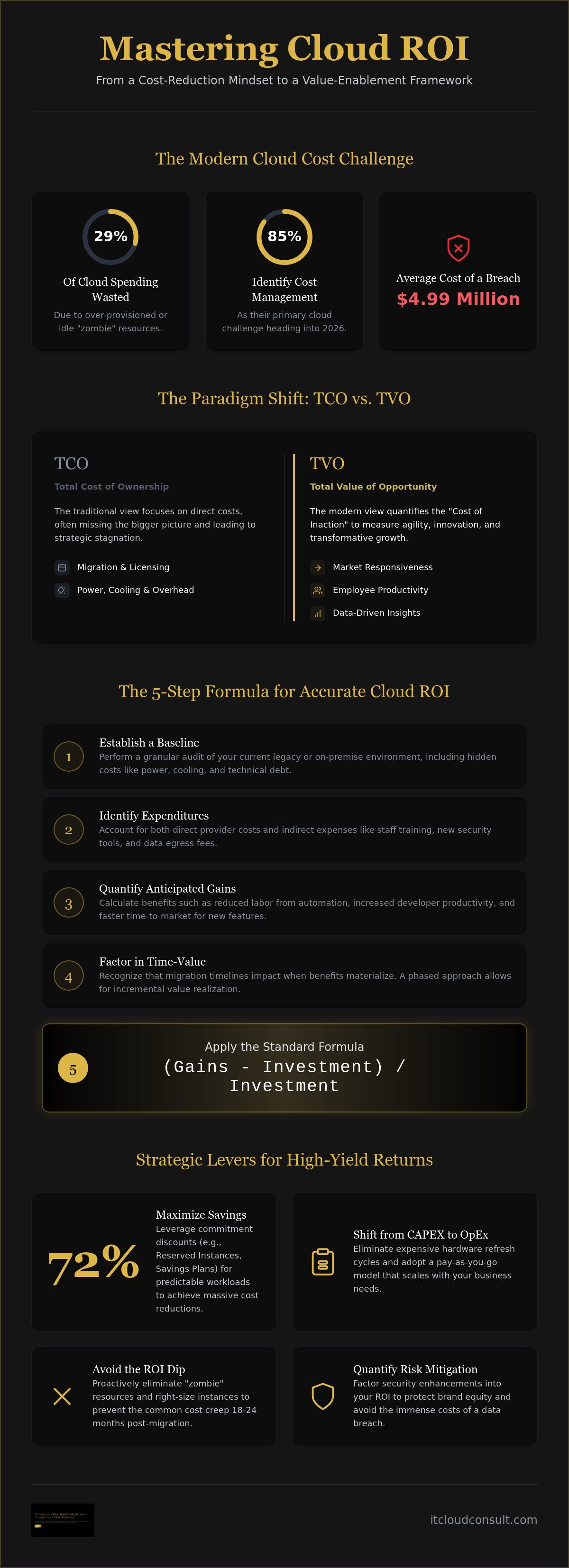
With an estimated 29% of cloud spending wasted and 85% of organizations identifying cost management as their primary challenge in 2026, the era of "growth at any cost" has officially ended. You've likely felt the mounting pressure from leadership to show immediate results, yet find yourself struggling to translate technical agility or innovation into concrete dollar terms. It's frustrating when unexpected cloud sprawl leads to budget overruns that obscure the true potential of your digital infrastructure.
We understand that realizing the latent value of your environment requires more than just a simple spreadsheet; it demands a visionary framework. This article teaches you how to calculate cloud roi by bridging the gap between immediate cost savings and long term strategic evolution. You'll gain a repeatable formula that aligns IT performance with business growth and a clear roadmap for continuous cost optimization. From mitigating the $4.99 million average cost of a data breach to leveraging commitment discounts for 72% savings, we'll break down the components of a modern, high yield cloud strategy.
Key Takeaways
- Shift your perspective from simple cost reduction to a value-enablement model that measures how cloud infrastructure drives long-term business evolution.
- Master the step-by-step methodology for how to calculate cloud roi by establishing accurate legacy baselines and accounting for both direct and indirect expenditures.
- Quantify the financial impact of risk mitigation and security enhancements to protect your organization’s brand equity and customer trust.
- Identify and eliminate "zombie" resources and over-provisioned instances to prevent the common ROI dip that occurs 18-24 months after initial migration.
- Develop a phased migration roadmap and a compelling business case to ensure leadership alignment and minimize financial risk during your transformation.
Redefining Cloud ROI in the Era of Modernization
In its most fundamental form, Cloud ROI is the ratio of net business benefits to total investment costs. However, the complexity of 2026 infrastructures means this calculation has evolved far beyond a simple accounting exercise. Modern organizations must transition from a narrow cost-reduction mindset toward a value-enablement perspective. This shift is essential because understanding how to calculate cloud roi now involves quantifying the agility required to deploy generative AI or the resilience needed to meet new regulatory standards like the EU's Digital Operational Resilience Act (DORA).
Strategic Cloud Consulting plays a pivotal role in this transition. It acts as a dependable guide to identify value drivers that often remain hidden behind technical jargon. By focusing on the realization of latent potential, businesses can move past the initial migration phase and into a state of continuous evolution.
Total Cost of Ownership (TCO) vs. Total Value of Opportunity (TVO)
Traditional metrics often focus exclusively on the Total Cost of Ownership (TCO). This includes the tangible expenses of migration, licensing, and operational overhead. While these numbers are vital, focusing solely on TCO leads to strategic stagnation. To truly grasp Cloud Computing Economics, leaders must look toward the Total Value of Opportunity (TVO). This framework quantifies the "Cost of Inaction," which is the revenue and market share lost when legacy systems prevent you from responding to rapid shifts in consumer demand.
TVO accounts for the following critical factors:
- Market Responsiveness: The speed at which your team can launch new features or services.
- Employee Productivity: Time saved through automated workflows and modern collaboration tools.
- Data-Driven Insights: The financial impact of using real-time analytics to optimize supply chains or customer acquisition.
Ignoring these elements results in an incomplete picture. A comprehensive ROI analysis must weigh the cost of modernization against the potential for transformative growth.
The Strategic Imperative: ROI as a Roadmap
ROI isn't just a backward-looking report; it's a forward-looking roadmap. By utilizing precise metrics, you can prioritize modernization initiatives that offer the highest impact. This alignment ensures that every dollar spent on IT infrastructure directly supports high-level corporate objectives. When you master how to calculate cloud roi, you gain the clarity needed to decide which legacy applications to retire and which to re-architect for the future.
This methodical approach builds trust with leadership. It transforms cloud adoption from a line-item expense into a primary driver of enterprise valuation. By connecting technical processes to organizational benefits, you create a sense of momentum that sustains long-term development and secures the resources necessary for ongoing innovation.
The Core Components of a Comprehensive ROI Calculation
Quantifying the financial impact of modernization requires a methodical, five-step approach. Organizations often stumble by focusing only on the monthly provider invoice, yet a true understanding of how to calculate cloud roi demands a deeper look at both tangible and intangible variables. By following a structured framework, you can transform abstract technical goals into a defensible business case that resonates with stakeholders.
Your journey begins with Step 1: Establishing a baseline. This requires a granular audit of your current legacy cloud or on-premises environment, accounting for power, cooling, and the "technical debt" of aging systems. Step 2 involves identifying expenditures, covering both direct provider costs and indirect expenses like staff training or data egress fees. In Step 3, you quantify anticipated gains, such as reduced labor hours through automation. Step 4 factors in the time-value of money, recognizing that migration timelines impact when benefits actually materialize. Finally, Step 5 applies the standard formula: (Gains - Investment) / Investment. This simple equation, when backed by rigorous data, provides the steady assurance leadership requires.
Direct Cost Reductions and Avoidance
One of the most immediate impacts of cloud adoption is the elimination of capital expenditure (CAPEX) cycles. Instead of massive hardware refreshes every few years, you transition to an operational expenditure (OpEx) model that scales with your needs. This shift reduces your physical data center footprint and slashes utility costs. Organizations can further enhance these savings by utilizing strategic cloud optimization to access commitment discounts, which can reduce costs by up to 72% for long-term workloads. Lowering maintenance fees through managed support also ensures that your internal team isn't bogged down by routine hardware upkeep.
Operational Efficiency Gains
Efficiency is the engine of long-term ROI. By measuring the impact of automated provisioning and scaling, teams can redirect their focus from manual maintenance to high-value innovation. You should also quantify reduced downtime; improved system availability directly prevents the revenue loss associated with service interruptions. A critical metric for 2026 is "Developer Velocity." This measures how quickly your team can bring new features to market. When developers spend less time managing infrastructure and more time writing code, the resulting acceleration in product cycles becomes a primary driver of enterprise value. Mastering how to calculate cloud roi means capturing these velocity gains as a core component of your financial success.
Beyond the Spreadsheet: Quantifying Intangible Business Value
While direct savings are the easiest to track, the most profound returns often reside in the intangible benefits of a modernized infrastructure. Risk mitigation serves as a primary stabilizer for long term financial returns. By investing in cloud native security, you don't just avoid the record high average cost of a data breach; you actively enhance brand equity and customer trust. This trust is a corporate currency that drives long term retention and market share in a competitive landscape.
Business continuity and disaster recovery are often viewed as simple insurance policies. However, in a 2026 environment, they're strategic assets. The ability to maintain operations during a regional outage or a cyberattack ensures that revenue streams remain uninterrupted. Similarly, cloud scalability allows an organization to capitalize on sudden market shifts. When you evaluate how to calculate cloud roi, you must factor in the revenue captured by scaling up to meet a 300% surge in demand within minutes, a feat that's impossible for legacy systems.
Modernization and Innovation Potential
The "AI Dividend" is perhaps the most significant intangible of the current era. A cloud ready data architecture is the prerequisite for generative AI adoption. Without it, your organization faces the high cost of data silos and fragmented insights. Transitioning to these modern environments also helps in attracting top talent. Elite professionals seek out workplaces that utilize forward looking tools, which reduces recruitment costs and turnover. For a deeper look at these transitions, see our Strategic Cloud Adoption: A Comprehensive Guide to Enterprise Modernization.
ESG and Sustainability Metrics
Environmental, Social, and Governance (ESG) metrics have moved from the periphery to the core of corporate strategy. As you analyze how to calculate cloud roi, consider how energy efficiency translates into corporate sustainability credits. Optimized resource consumption reduces your carbon footprint while lowering utility bills. With the 2026 environmental reporting requirements approaching, having automated, cloud based tracking of your energy usage provides a distinct financial advantage. This precision ensures compliance and positions your business as a leader in sustainable modernization.
Avoiding the Cloud Sprawl Trap: ROI for Mature Infrastructure
Many organizations celebrate a successful migration only to see their financial returns erode within the first two years. This phenomenon, typically occurring 18-24 months post-migration, is driven by unmanaged growth and a lack of ongoing governance. As environments scale, the accumulation of "zombie" resources—idle instances or unattached storage volumes—creates a silent drain on capital. Over-provisioned instances, where allocated capacity far exceeds actual demand, further dilute the efficiency gains achieved during the initial transition.
Recovering this lost value requires a transition from a migration mindset to an optimization mindset. When you evaluate how to calculate cloud roi for a mature environment, you must factor in the cost of technical debt and the potential savings from refined resource management. Engaging with Cloud Optimization Consulting: A Strategic Guide to Maximizing Enterprise ROI in 2026 provides the necessary framework to reclaim these margins and ensure your infrastructure remains a high-performing asset.
The FinOps Framework for Continuous Return
Accountability is the cornerstone of sustained ROI. By establishing a FinOps framework, organizations implement tag-based cost allocation that assigns financial responsibility to specific products or departments. This visibility bridges the historical gap between engineering teams and finance departments, ensuring that technical choices align with fiscal realities. Automated rightsizing and the strategic utilization of spot instances, which offer savings of up to 90%, transform cloud management into a precision operation. These actions don't just cut costs; they ensure that every dollar spent is directly contributing to a business outcome.
Legacy Debt and Modernization ROI
The "lift-and-shift" approach often serves as a fast entry point to the cloud, but it rarely captures the full economic benefits of modernization. Maintaining these legacy workloads in a cloud environment is often more expensive than on-premises due to inefficient resource consumption. Refactoring applications for cloud-native performance represents a significant lever for increasing long-term ROI. By utilizing managed services to eliminate operational silos, you reduce the labor burden on your internal teams. This shift allows your architects to focus on innovation rather than routine maintenance. If your monthly expenditures have outpaced your business growth, it's time to leverage professional cloud optimization to restore your strategic trajectory.
Executing Your Cloud Transformation with Strategic Precision
Achieving a sustainable return on investment requires more than technical proficiency; it demands absolute alignment between your infrastructure and your corporate vision. Building a compelling business case for leadership involves translating the technical metrics discussed in previous sections into a narrative of enterprise evolution. When you present how to calculate cloud roi to stakeholders, focus on the transition from a rigid cost center to a dynamic engine of growth. This clarity secures the necessary buy-in to pursue modernization with confidence and precision.
Mitigating financial risk is best achieved through a phased migration approach. Rather than attempting a "big bang" transition, successful organizations move in calculated waves. This methodology allows for the immediate capture of efficiency gains while providing the flexibility to refine your strategy based on real-time performance data. Professional advisory services serve as a force multiplier in this process, ensuring that your initial steps are architected for maximum scalability and fiscal health.
Architecting for Long-Term Success
A visionary infrastructure is not built in a single quarter. It requires a comprehensive 3-to-5-year cloud evolution roadmap that anticipates technological shifts and market demands. This long-term perspective ensures that your environment remains resilient as generative AI and data analytics continue to reshape the competitive landscape. By integrating continuous optimization into your IT lifecycle, you prevent the ROI erosion often seen in stagnant architectures. For a deeper analysis of this process, explore our Cloud Infrastructure Consulting: A Strategic Guide to Enterprise Modernization.
The IT Cloud Consulting Advantage
Our approach to strategic cloud adoption is designed to bridge the gap between complex infrastructure and measurable business results. We understand that the decision to engage professional advisory services is a financial one. In most enterprise scenarios, our advisory fees are quickly offset by immediate infrastructure savings identified during the initial optimization phase. This creates a self-funding model for modernization where the realized gains support ongoing innovation.
Beyond the initial migration, our ongoing managed support ensures that your calculated ROI is actually realized over a 5-year horizon. We act as your dependable guide, maintaining high-performance standards and protecting your margins against the hidden costs of cloud sprawl. The path toward a modernized future begins with a clear understanding of your current state and a precise vision for what is possible. Partner with us to architect your cloud evolution.
Securing Your Enterprise Trajectory through Strategic Modernization
The transition from legacy infrastructure to a high-performance cloud environment is not merely a technical migration; it's a strategic evolution. By moving beyond basic cost-reduction metrics and embracing a value-enablement framework, your organization can unlock the latent potential of its digital assets. You now possess a comprehensive methodology for how to calculate cloud roi that accounts for both tangible savings and the intangible dividends of innovation, security, and agility.
Realizing these gains over a long-term horizon requires precision and a commitment to ongoing governance. Whether you're architecting an initial roadmap or seeking to recover margins lost to cloud sprawl, professional advisory services provide the steady assurance needed for execution. We provide authoritative cloud modernization roadmaps and specialized optimization to reduce monthly cloud spend, supported by managed services for continuous operational excellence.
Maximize your enterprise value with a Strategic Cloud Optimization Consultation.
The path toward a modernized future is clear. With the right framework and a dependable guide, your cloud investment will become the primary engine for your organization's long-term development.
Frequently Asked Questions
What is the most accurate formula for calculating cloud ROI?
The standard formula for how to calculate cloud roi is (Net Benefits - Total Investment) / Total Investment, expressed as a percentage. Net benefits include both direct cost savings and incremental revenue growth. Total investment must encompass migration expenses, monthly provider fees, and the labor required for ongoing management. This calculation provides a steady assurance that your digital transformation aligns with long term fiscal objectives and enterprise valuation.
How long does it typically take to see a positive ROI after cloud migration?
Most organizations begin to realize a positive return within 12 to 24 months, though the exact timeline depends on the complexity of your architecture. A common "ROI dip" often occurs between 18 and 24 months due to unmanaged growth or cloud sprawl. Implementing a phased migration approach and continuous optimization ensures that you achieve break-even faster while maintaining the momentum necessary for sustained financial performance and operational excellence.
What are the most common "hidden costs" that negatively impact cloud ROI?
Hidden expenditures often include data egress fees, premium support plans, and regional price variations that aren't immediately visible in basic quotes. Additionally, "zombie" resources and over-provisioned instances contribute to the estimated 29% of cloud spending that is currently wasted across the industry. Identifying these leaks is a critical step when you determine how to calculate cloud roi, as they can significantly dilute the efficiency gains of your modernization.
Can I calculate ROI for a hybrid cloud environment?
You can calculate ROI for hybrid environments by establishing a clear baseline of on-premises expenditures, such as power, cooling, and hardware maintenance, against your cloud operational expenses. Since 73% of organizations now operate a hybrid architecture, this multidimensional approach is essential. It allows you to weigh the stability of legacy systems against the scalability of the cloud, ensuring your infrastructure strategy supports both current needs and future evolution.
How do I quantify intangible benefits like "business agility" in an ROI report?
Quantifying agility requires translating technical speed into financial outcomes, such as "Developer Velocity" or "Time-to-Market" for new features. You can measure the revenue captured during market shifts that legacy systems would have missed. By applying a "Cost of Inaction" framework, you demonstrate how cloud native security and scalability protect brand equity and customer trust. These factors, while abstract, are primary drivers of long term enterprise value and market resilience.
What is the difference between Cloud ROI and TCO?
Total Cost of Ownership (TCO) focuses exclusively on the expenditures required to run your environment, including licensing and labor. In contrast, Cloud ROI is a broader metric that weighs those costs against the total financial benefits generated. While TCO helps you manage a budget, ROI proves the strategic value of the investment. Understanding this distinction is vital for transitioning from a cost reduction mindset to a value enablement perspective.
How does cloud optimization consulting improve my existing ROI?
Strategic optimization consulting improves ROI by identifying specific levers for cost reduction, such as commitment discounts that offer up to 72% savings. Consultants act as visionary architects who right-size your environment to eliminate waste and leverage spot instances for up to 90% lower costs. This expertise bridges the gap between technical complexity and business results, ensuring that your infrastructure remains lean, efficient, and aligned with your growth trajectory.
Is ROI the only metric I should use to evaluate cloud success?
While ROI is a powerful indicator, it should be utilized alongside metrics like Total Value of Opportunity (TVO) and ESG sustainability goals. You should also factor in risk mitigation, such as the avoidance of the $4.99 million average cost of a data breach. A balanced scorecard that includes system availability, employee productivity, and regulatory compliance provides a more comprehensive view of success than any single financial ratio can offer.


