
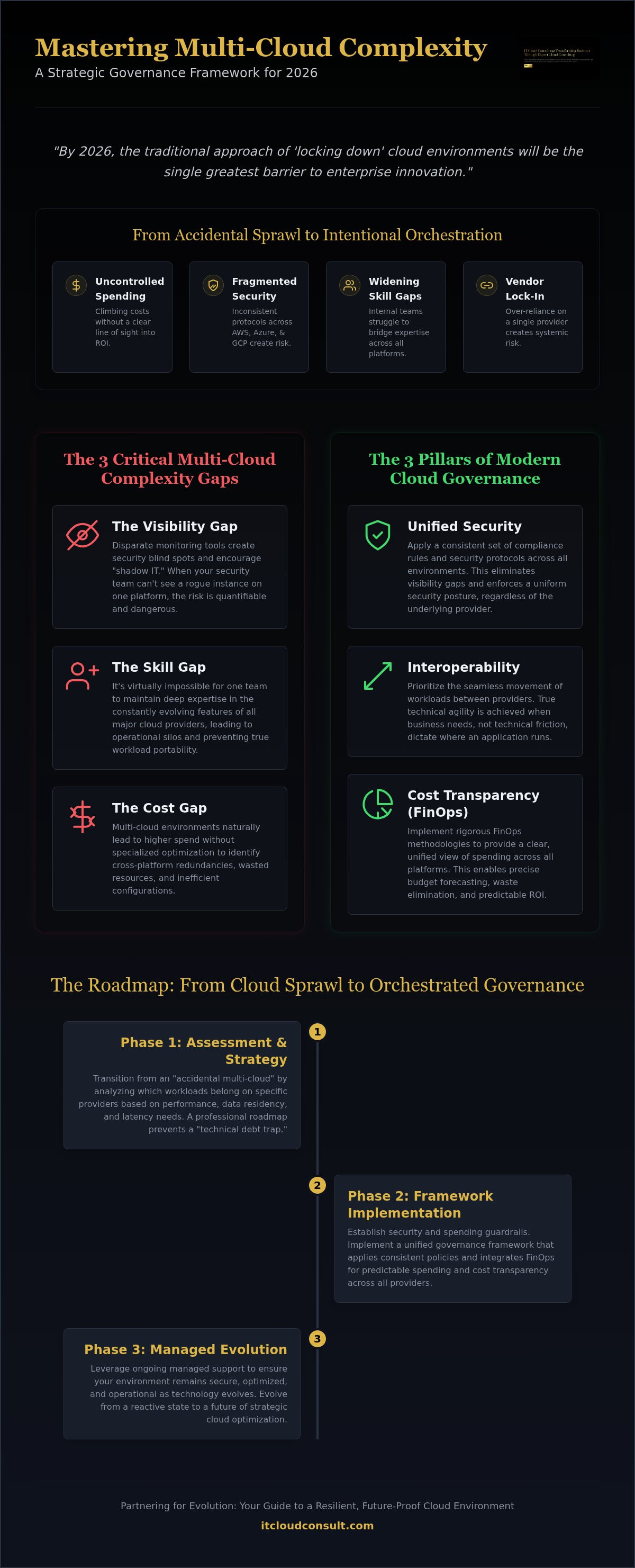
By 2026, the traditional approach of "locking down" cloud environments will be the single greatest barrier to enterprise innovation. Most organizations have realized that multi-cloud adoption is no longer a choice, yet they find themselves trapped between uncontrolled spending and fragmented security protocols. You've likely felt the strain of managing AWS, Azure, and GCP consoles simultaneously while your internal teams struggle to bridge the widening skill gap. It's exhausting to watch cloud costs climb without a clear line of sight into the actual ROI. Professional cloud governance consulting shouldn't be about restriction; it's about building a framework for orchestrated empowerment.
We agree that the current state of compliance fragmentation and vendor lock-in is unsustainable for long-term growth. This article promises to provide you with a strategic roadmap to master these complexities and maximize your enterprise ROI. You'll gain the insights needed to implement a unified governance framework that ensures high availability across all providers. We'll preview how to integrate FinOps for predictable spending and establish the workload portability required for true technical agility. This is your guide to evolving from a reactive state to a future of strategic cloud optimization.
Key Takeaways
- Learn how to transition from "accidental" multi-cloud sprawl to an intentional orchestration model that aligns with your specific business outcomes.
- Discover how professional cloud governance consulting identifies and closes critical visibility and skill gaps across AWS, Azure, and Google Cloud platforms.
- Master a strategic interoperability framework that leverages the unique strengths of each provider while eliminating the risk of vendor lock-in.
- Explore a structured roadmap for establishing security and spend guardrails that transform uncontrolled cloud costs into predictable ROI.
- Understand the necessity of ongoing managed support to ensure your multi-cloud environment remains secure and operational as technology evolves through 2026.
What is Multi-Cloud Governance Consulting in 2026?
Multi-cloud governance consulting represents a professional advisory service designed to align multiple cloud computing platforms with specific business outcomes and risk profiles. As we move into 2026, the industry has shifted away from "accidental multi-cloud" environments, which often resulted from uncoordinated departmental decisions or legacy acquisitions. Instead, the modern enterprise standard is intentional orchestration. This strategic evolution ensures that every platform within your ecosystem serves a distinct purpose while remaining under a unified management framework. It transforms a chaotic collection of services into a cohesive engine for digital growth.
Organizations are increasingly moving beyond single-vendor dependencies to mitigate systemic infrastructure risk. Relying on a single provider creates a point of failure that can paralyze a national enterprise during a regional outage or a sudden change in service terms. A specialized consultant acts as a neutral architect, balancing the competing strengths of AWS, Azure, and GCP to build a resilient, future-proof environment. This role is critical because it prevents the bias often found in provider-specific documentation. By positioning governance as the foundation, businesses can realize the latent potential of their digital assets without being tethered to a single vendor's proprietary roadmap.
The Core Pillars of Modern Cloud Governance
Effective cloud governance consulting focuses on three essential pillars to ensure operational excellence across disparate providers:
- Interoperability: We prioritize the seamless movement of workloads between providers, ensuring that technical friction doesn't hinder business agility or speed to market.
- Unified Security: Our approach applies a consistent set of compliance rules and security protocols across all environments, eliminating the visibility gaps often found when using separate provider consoles.
- Cost Transparency: By implementing rigorous FinOps methodologies, we provide a clear view of spending across all platforms, allowing for precise budget forecasting and waste elimination.
Why Strategy Must Precede Implementation
Launching cloud initiatives without a professional roadmap often leads to a "technical debt trap." This occurs when uncoordinated adoption results in redundant services, security vulnerabilities, and skyrocketing costs. To avoid this, your infrastructure must align with long-term enterprise cloud transformation goals. We analyze which workloads belong on specific providers based on performance requirements, data residency laws, and latency needs. This methodical approach ensures that your cloud evolution is purposeful, efficient, and directly linked to your organizational bottom line.
Overcoming the 3 Critical Multi-Cloud Complexity Gaps
The transition to a multi-cloud environment often creates operational friction that traditional IT models aren't equipped to handle. While the NIST Definition of Cloud Computing provides a clear baseline for service models, it doesn't account for the administrative burden of managing three major providers simultaneously. This complexity manifests as three critical gaps that can stall your progress and erode the benefits of modernization. When these gaps aren't addressed, your cloud evolution shifts from a strategic advantage to a source of technical debt.
The Visibility Gap occurs when disparate monitoring tools create security blind spots and encourage "shadow IT." When your security team can't see a rogue GCP instance because they're focused on AWS, the risk is quantifiable and dangerous. Next is the Skill Gap. It's virtually impossible for a single internal team to maintain deep expertise in the constantly evolving feature sets of AWS, Azure, and GCP. This leads to the "Operational Silo" effect, where teams become specialized in only one provider, effectively preventing true workload portability. Finally, the Cost Gap emerges because multi-cloud environments naturally lead to higher spend without specialized cloud optimization consulting to identify cross-platform redundancies and waste.
Closing the Visibility Gap with Unified Management
Standardizing logging and telemetry across all environments is no longer optional for the modern enterprise. A "single-pane-of-glass" dashboard provides the necessary health metrics to keep systems operational and secure. Cloud Sprawl is the primary enemy of operational efficiency in 2026, often hidden behind fragmented provider consoles. By centralizing visibility, you ensure that governance rules apply universally, regardless of where the workload lives. This unified approach allows for real-time risk assessment and faster incident response times.
Bridging the Skill Gap via Strategic Advisory
Maintaining a full-time specialist for every cloud nuance is an expensive and often futile endeavor for most organizations. Professional cloud governance consulting offers a way to access high-level expertise as needed, allowing your internal teams to focus on broader business goals. We help train your staff on cross-platform governance rather than just provider-specific buttons. Integrating managed cloud services ensures that your infrastructure remains stable while you scale. If you're ready to close these gaps, exploring strategic roadmap development is the next logical step in your evolution.
Evaluating Providers: A Strategic Interoperability Framework
Selecting a cloud provider used to be a binary choice dictated by existing vendor relationships. In 2026, the strategy has evolved toward a specialized interoperability framework where each platform is chosen for its specific architectural strengths. AWS remains the benchmark for massive scale and infrastructure depth. Azure provides the path of least resistance for enterprise integration within Microsoft ecosystems. GCP has established itself as the premier destination for AI and high-performance data analytics. Professional cloud governance consulting provides the blueprint for this evaluation, ensuring that your "Best-of-Breed" approach doesn't devolve into unmanaged complexity. By selecting services based on performance rather than vendor loyalty, you maintain the strategic leverage necessary for long-term growth.
Risk diversification is a cornerstone of this framework. Splitting critical data across providers ensures business continuity even during catastrophic provider-level outages. This isn't just about redundancy; it's about building a resilient ecosystem where no single point of failure can paralyze your national operations. Adapting your IT governance for cloud allows you to manage these distinct ecosystems under one strategic umbrella, transforming potential vulnerabilities into a distributed advantage.
Provider Comparison: AWS vs. Azure vs. GCP in 2026
Maximizing ROI requires a granular understanding of compute costs and egress fees, which often act as the hidden killers of multi-cloud budgets. While one provider might offer lower storage rates, their data transfer costs can quickly erase those savings if your workloads aren't optimized for inter-cloud traffic. Compliance mapping is equally critical. We evaluate which provider leads in specific industry certifications, such as HIPAA or SOC2, to ensure your data residency requirements are met without compromise. To minimize performance bottlenecks, we prioritize inter-cloud latency solutions, utilizing private interconnects like Direct Connect or ExpressRoute to maintain high-speed data flow between disparate environments.
Designing for Portability and Flexibility
Effective cloud governance consulting emphasizes that "Cloud Native" should never mean "Provider Locked." We utilize containers and serverless architectures to ensure your workloads can move between environments with minimal friction. This technical agility is supported by cloud infrastructure consulting that focuses on architecting provider-agnostic systems from the ground up. By leveraging open-source standards, you avoid the proprietary traps that often lead to escalating costs and operational paralysis. This approach ensures that your infrastructure remains a flexible asset, capable of evolving alongside the rapid shifts in the 2026 technological landscape.
The Roadmap: From Cloud Sprawl to Orchestrated Governance
Evolving from a state of cloud sprawl to orchestrated governance is not an overnight task; it is a deliberate transition that requires a structured methodology. Most enterprises find themselves managing a patchwork of environments that have grown organically rather than strategically. Our roadmap breaks this complexity into four distinct phases. Phase 1: Discovery and Assessment involves a comprehensive inventory of all existing strategic cloud adoption efforts to reveal hidden costs and security gaps. Phase 2 involves Governance Framework Design, where we establish the "guardrails" for security and spending. Phase 3 focuses on Architecture and Migration to reach an orchestrated state. Finally, Phase 4 implements Continuous Optimization, where FinOps becomes the engine for ongoing efficiency and cost control.
Establishing Multi-Cloud Governance Guardrails
Establishing these guardrails is a primary focus of professional cloud governance consulting. We help you define Identity and Access Management (IAM) policies that remain consistent across AWS, Azure, and GCP, preventing the "permission creep" that often leads to breaches. We also prioritize automating compliance checks. This ensures that every new deployment or configuration change automatically adheres to your cloud security assessment standards without requiring manual intervention. By standardizing tag schemas across all platforms, your organization gains the visibility needed for accurate cost allocation and reporting, transforming raw data into actionable business intelligence.
Executing the Migration Strategy
The execution of your migration strategy must be tailored to the unique requirements of each workload. This often involves making strategic decisions between Re-hosting, Re-platforming, or Re-architecting for a multi-cloud environment. Our goal is always to minimize downtime and eliminate data integrity risks during complex cross-cloud transfers. A Cloud Readiness Assessment is the non-negotiable starting point for migration. This assessment ensures that your infrastructure is prepared for the transition and that your team has the necessary skills to manage the new environment. If your organization is ready to move beyond sprawl and toward a more optimized future, we invite you to consult with our strategic architects to begin your transformation.
Partnering for Evolution: Managed Multi-Cloud Support
Multi-cloud adoption isn't a destination reached through a single migration project; it's a continuous state of evolution where technical requirements and provider capabilities shift monthly. Professional cloud governance consulting provides the initial framework, but maintaining that standard requires ongoing technical assistance to prevent operational decay. Managed services act as a stabilizing force, ensuring that the orchestrated state achieved during migration remains intact as your organization scales. By offloading routine maintenance to a dedicated partner, your internal teams can pivot toward high-value innovation rather than getting bogged down in patching or resource provisioning.
IT Cloud Consulting positions itself as a long-term strategic guide, moving beyond the traditional vendor relationship to become a partner in your organizational trajectory. We provide the continuous monitoring necessary to keep complex systems operational and secure 24/7 across every platform in your ecosystem. This steady assurance allows leadership to focus on expansion, knowing the underlying digital foundation is being managed by seasoned experts who understand both the big picture and the technical nuances. Our role is to ensure that your infrastructure remains an asset that fuels progress rather than a liability that requires constant troubleshooting.
The ROI of Managed Cloud Support
Investing in ongoing support yields a measurable return by reducing the operational overhead associated with managing disparate cloud platforms. We implement proactive health checks and automated patching to prevent outages before they impact your bottom line. Continuous cost optimization is a core component of this service. We ensure that your monthly cloud bill doesn't creep back up after the initial optimization phase by constantly tuning resource allocation. In a multi-provider environment, incident response requires expert triage to identify whether a failure resides in AWS, Azure, or GCP. Our managed support provides the specialized knowledge needed to resolve cross-cloud issues faster, which minimizes downtime and protects your enterprise reputation.
Future-Proofing Your Infrastructure
Your infrastructure must remain as dynamic as the market it serves. We conduct regular architecture reviews to incorporate emerging provider features and new AI capabilities that can give your business a competitive edge. This forward-looking approach ensures you're never stuck with legacy cloud configurations that hinder agility. As your business grows nationally, we help you scale your infrastructure dynamically without adding unnecessary management complexity. True evolution requires a partner who possesses both the technical proficiency for execution and the visionary perspective for strategic planning. Contact IT Cloud Consulting today for a professional assessment of your multi-cloud potential and take the next step in your digital development.
Orchestrating Your Multi-Cloud Future
Transitioning from fragmented cloud sprawl to an intentional, governed ecosystem is the only way to sustain enterprise growth through 2026. We've explored how a unified framework closes the visibility and skill gaps that often plague disparate AWS, Azure, and GCP environments. By prioritizing interoperability and continuous optimization, your infrastructure becomes a catalyst for innovation rather than a source of escalating technical debt. Professional cloud governance consulting provides the strategic clarity required to transform these complex systems into a cohesive, high-performance asset.
Our team offers authoritative guidance across all major providers and a proven track record in enterprise cloud optimization. We provide transparent managed support fees to ensure your long-term stability and operational excellence. Schedule a Strategic Multi-Cloud Consultation with IT Cloud Consulting to realize your organization's latent potential. The path to a modernized, resilient future is within reach, and we're here to guide your evolution every step of the way. You don't have to manage the complexities of multi-cloud alone when you have a dedicated partner committed to your long-term success.
Frequently Asked Questions
What is the primary benefit of a multi-cloud strategy for large enterprises?
The primary benefit of a multi-cloud strategy is the mitigation of systemic infrastructure risk and the prevention of operational paralysis. By distributing workloads across AWS, Azure, and GCP, large enterprises eliminate single points of failure that could lead to catastrophic downtime. This approach also allows organizations to leverage the unique technical strengths of each provider, ensuring that specific business outcomes are met with the most efficient services available in the market.
How does cloud governance consulting help reduce vendor lock-in?
Professional cloud governance consulting reduces vendor lock-in by architecting provider-agnostic systems that prioritize workload portability. We focus on open-source standards, containerization, and serverless architectures to ensure your digital assets aren't tethered to a single proprietary roadmap. This strategy maintains your long-term strategic leverage, allowing you to move services between platforms based on performance, cost, or compliance requirements without incurring massive re-platforming expenses or technical friction.
Is a multi-cloud strategy more expensive than using a single provider?
A multi-cloud strategy can lead to higher operational costs due to egress fees and management complexity if it isn't properly orchestrated. However, implementing a rigorous framework for cloud optimization ensures that these expenses are offset by superior resource allocation and competitive pricing. By utilizing a Best-of-Breed selection process, enterprises can avoid the hidden costs of over-provisioning on a single platform while maintaining a predictable ROI through transparent financial management.
How do you manage security across multiple different cloud platforms?
Managing security across disparate platforms requires a unified governance framework that establishes consistent Identity and Access Management policies. We utilize automated compliance checks and standardized telemetry to eliminate the visibility gaps that often occur when teams use separate provider consoles. This centralized approach ensures that a single set of security guardrails applies universally, protecting your national infrastructure against vulnerabilities regardless of which cloud environment currently hosts the active workload.
What role does FinOps play in a multi-cloud environment?
FinOps provides the necessary cost transparency and accountability required to manage spend across multiple cloud provider consoles. It allows organizations to implement standardized tagging schemas for accurate cost allocation and real-time reporting. Within a multi-cloud environment, FinOps ensures that cloud governance consulting recommendations are directly linked to financial outcomes, preventing budget creep and allowing leadership to make data-driven decisions about where to deploy capital for maximum efficiency.
How long does it take to develop and implement a multi-cloud strategy?
Developing and implementing a comprehensive multi-cloud strategy typically follows a phased roadmap that can span several months depending on the enterprise's current scale. The process begins with a non-negotiable Cloud Readiness Assessment to inventory existing assets and identify skill gaps. Following this discovery phase, we design the governance framework and execute the migration in controlled waves. This methodical pace ensures that systems remain operational and secure while the organization evolves.
Can a multi-cloud strategy help with regulatory compliance and data sovereignty?
Yes, a multi-cloud strategy is a powerful tool for meeting complex regulatory compliance and data sovereignty requirements. It allows enterprises to strategically place data and workloads within specific geographic regions or on providers that possess specialized industry certifications. This flexibility ensures that your national operations remain compliant with local laws and data residency mandates without sacrificing the overall agility or performance of your global infrastructure. It's a critical component of risk management.
What is the difference between hybrid cloud and multi-cloud?
The difference lies in the composition of the infrastructure environment. A hybrid cloud combines on-premise hardware with a public cloud provider, often acting as a bridge during a legacy migration. Multi-cloud refers to the intentional use of two or more public cloud platforms, such as AWS and Azure, to run different parts of a business. While hybrid models focus on connecting legacy systems to the cloud, multi-cloud strategies focus on optimizing performance across the entire public cloud ecosystem.


