
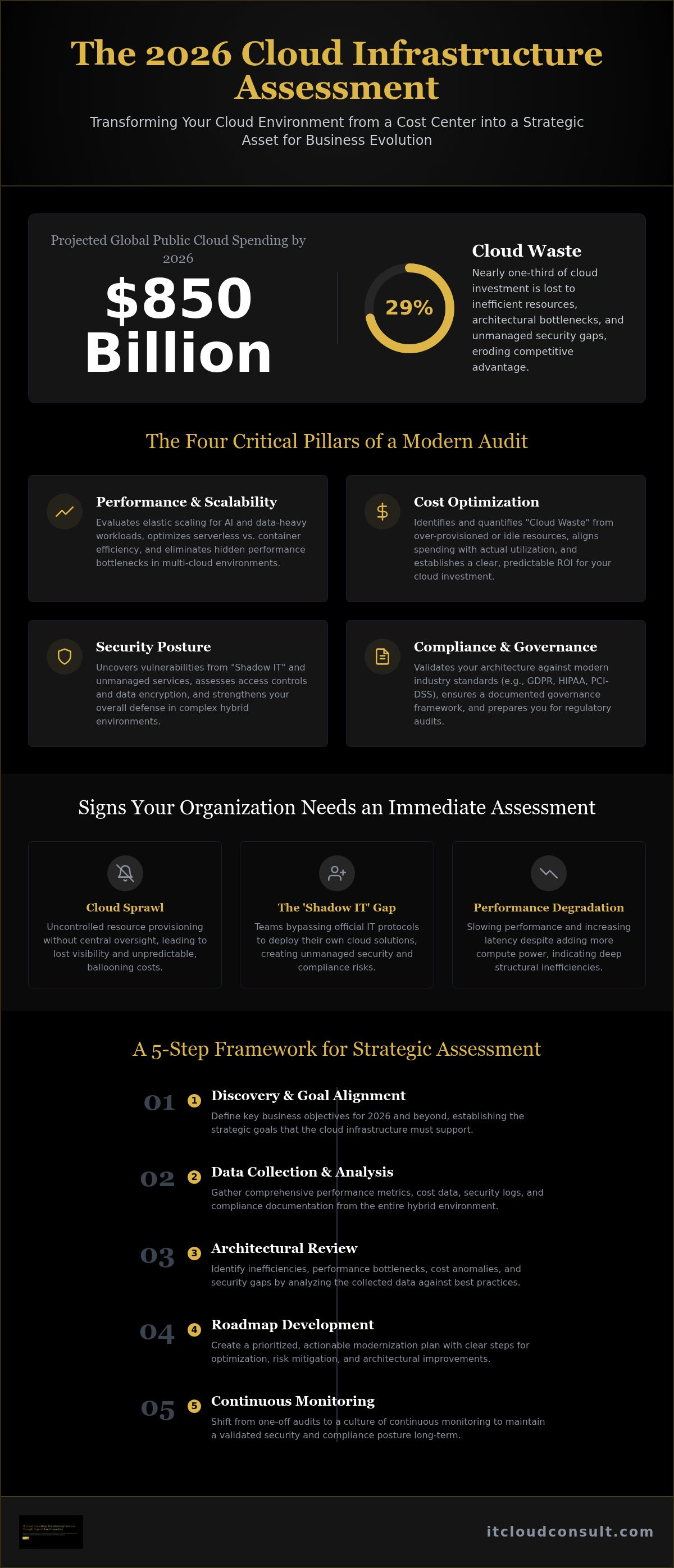
With global public cloud spending projected to reach $850 billion in 2026, it's sobering to realize that nearly 29% of that investment is effectively wasted on inefficient resources. For the modern enterprise, the question isn't just about presence in the cloud, but whether your current environment truly serves your strategic goals. A comprehensive cloud infrastructure assessment moves beyond simple cost-cutting to identify the architectural bottlenecks and security gaps that quietly erode your competitive advantage. It's the critical difference between merely hosting data and building a scalable engine for long-term innovation.
You likely recognize the friction of unpredictable monthly bills and the persistent anxiety of shadow IT creating unmanaged risks across a complex hybrid environment. It's frustrating to see technical debt accumulate when your organization requires agility to stay ahead. This guide demonstrates how a structured assessment transforms those liabilities into a high-performance blueprint for business evolution. We'll explore how to document clear ROI for your cloud spend, validate your compliance posture against modern standards, and establish a modernized roadmap that aligns technical execution with your visionary organizational goals.
Key Takeaways
- Master the four critical pillars of a modern infrastructure audit—Performance, Cost, Security, and Compliance—to ensure your environment supports high-level strategic growth.
- Learn how a comprehensive cloud infrastructure assessment identifies hidden architectural inefficiencies and the "Cloud Waste" that often compromises enterprise performance and budgets.
- Discover a systematic 5-step framework designed to transition your organization from reactive troubleshooting to a proactive, forward-looking roadmap for modernization.
- Understand the direct correlation between architectural integrity and long-term ROI, enabling you to transform technical debt into a scalable blueprint for business evolution.
- Explore why shifting from one-off audits toward a culture of continuous monitoring is essential for maintaining a validated security and compliance posture in 2026.
Defining the 2026 Cloud Infrastructure Assessment
A cloud infrastructure assessment is a holistic review of an organization's architecture, performance, and overarching strategy. It goes beyond checking if servers are running; it examines if the current setup supports the future state of the business. A cloud assessment is a strategic diagnostic tool used to align technical assets with 2026 business objectives. For organizations that have moved beyond basic migration, this process is the catalyst for true optimization, turning a static environment into a dynamic asset.
Many enterprises that completed their initial migrations find themselves in a state of stagnation. They've moved their workloads, but they haven't yet unlocked the efficiency of cloud-native operations. This is where a comprehensive architectural review differs from a simple "health check." While a health check might confirm that your instances are operational, an assessment evaluates whether your underlying cloud computing models are optimized for cost, security, and scalability. It's a deep dive into the structural integrity of your digital foundation.
The Evolution of Cloud Audits
Cloud audits were once treated as simple migration checklists. The focus was tactical: "Is the data moved?" or "Is the connection secure?". In 2026, the landscape has shifted toward complex modernization roadmaps. Enterprises now manage intricate multi-cloud and hybrid environments where a single failure point can disrupt global operations. Modern organizations require a "business-first" technical audit. This approach ensures every technical decision, from container orchestration to serverless deployment, directly facilitates a specific commercial outcome and supports long-term evolution.
Signs Your Organization Needs an Immediate Assessment
One of the primary indicators that an audit is overdue is the emergence of "Cloud Sprawl." This occurs when resources are provisioned across various departments without central oversight, leading to a total loss of operational visibility and rising costs. Another red flag is performance degradation that persists despite increasing your resource allocation. This suggests structural inefficiencies that cannot be solved by simply adding more compute power. It requires a fundamental rethink of how resources are utilized.
You should also look for the "Shadow IT" gap. When teams bypass official IT protocols to deploy their own cloud solutions, it creates unmanaged risks and security vulnerabilities. A professional cloud infrastructure assessment identifies these hidden pockets of activity. It brings them into a managed framework, ensuring every asset is visible, secure, and contributing to the organization's documented ROI. By addressing these gaps, you transform unmanaged risks into a scalable, high-performance blueprint for growth.
The Four Critical Pillars of a Modern Infrastructure Audit
A high-impact audit transcends simple resource monitoring. It evaluates the structural integrity of your environment across four interdependent pillars: Performance, Cost, Security, and Compliance. Within a strategic cloud adoption framework, these pillars function as a cohesive system where a failure in one inevitably compromises the others. An effective cloud infrastructure assessment doesn't just catalog existing errors; it uncovers the latent potential within your architecture to support future business evolution. It requires a visionary perspective to see how these elements combine to drive modernization readiness and long-term agility.
Architectural Performance and Scalability
Modern workloads in 2026, particularly those driven by AI and real-time data processing, demand a radical rethink of compute and storage configurations. Your assessment should scrutinize whether your current setup can scale elastically without accumulating technical debt that slows down future deployments. We evaluate the efficiency of serverless architectures against containerized environments to ensure you're using the right tool for each specific workload. Complex multi-cloud environments often hide performance bottlenecks that only a deep-dive audit can reveal. If you're looking to refine these technical choices, our team specializes in Cloud Optimization to align your resources with actual demand and eliminate latency.
Security Posture and Risk Mitigation
Security is no longer a perimeter concern but a core architectural requirement. A modern audit evaluates identity and access management (IAM) across the entire enterprise to ensure strict adherence to zero-trust principles. By utilizing a comprehensive cloud security assessment checklist, you can identify the subtle misconfigurations that often lead to catastrophic data exposure. This proactive approach transforms security from a reactive burden into a foundational strength of your enterprise cloud strategy. It ensures that every layer of your stack is resilient against emerging threats while maintaining high-level performance.
While performance and security are visible, cost and compliance are the silent drivers of sustainability. In 2026, research shows that approximately 29% of IaaS and PaaS spending is wasted due to poor governance and unoptimized resource allocation. An assessment highlights these cost-performance gaps while ensuring your posture meets the increasingly fragmented regulatory landscape, including new data regulations across 25 US states. This holistic view ensures your modernization efforts are both fiscally responsible and legally sound. By connecting technical processes to organizational benefits, you create a clear path toward a more optimized and advanced future state.
Identifying Hidden Inefficiencies: Cost vs. Performance Gaps
Cloud waste isn't just a budgetary nuisance; it's a structural symptom of architectural misalignment. As established by current industry data, approximately 29% of all IaaS and PaaS spending in 2026 is effectively wasted on underutilized resources. A comprehensive cloud infrastructure assessment uncovers these hidden inefficiencies by tracing the direct cause and effect relationship between technical configurations and escalating monthly invoices. When your architecture is built for peak capacity that is rarely reached, the result is a perpetual drain on capital that should be fueling innovation.
These gaps often manifest in complex ways, such as unoptimized data egress routes or mismatched storage tiers. For instance, utilizing high-performance block storage where lower-cost object storage would suffice can significantly inflate costs without providing a tangible benefit to the end user. Identifying these specific performance-to-cost ratios allows leadership to move beyond guesswork. It enables a transition from a defensive cost-containment mindset to a proactive strategy where resources are dynamically allocated based on real-time business requirements.
Transitioning from reactive spending to proactive management requires more than just automated alerts. It involves the deep analysis provided by cloud optimization consulting to interpret assessment data through a business lens. This strategic oversight ensures that technical adjustments aren't just one-off fixes but part of a broader evolution toward fiscal and operational maturity. It empowers your team to make informed decisions that balance high-performance requirements with strict budgetary governance.
The High Price of Over-Provisioning
Organizations frequently pay for capacity they don't use, often maintaining overhead that exceeds actual demand by 30% or more. This surplus usually stems from "zombie resources"—instances left running after a project ends—and orphaned snapshots that continue to accrue fees long after their parent volumes are deleted. A cloud infrastructure assessment identifies these specific technical leaks with precision. By implementing right-sizing recommendations, enterprises can reclaim this lost budget, translating technical hygiene directly into improved ROI and a leaner, more agile stack.
Aligning Technical Performance with Business Outcomes
True efficiency isn't just about spending less; it's about spending correctly. High-performance tiers and premium networking should be reserved exclusively for mission-critical applications that directly drive revenue and customer satisfaction. By mapping infrastructure costs to specific business units or products, leadership gains the clarity needed to justify future modernization investments. This data-driven approach positions IT as a strategic engine, where every dollar spent is a deliberate step toward realizing the organization's latent potential and securing a competitive edge in 2026.
A 5-Step Framework for Executing a Strategic Assessment
Execution of a successful cloud infrastructure assessment requires a structured methodology that transcends simple error-checking. We utilize a five-step framework: Discovery, Analysis, Gap Identification, Roadmap Design, and Executive Presentation. This methodical approach ensures that every technical finding is weighted against its potential to drive business growth. Unlike reactive audits that focus on past mistakes, this forward-looking process integrates high-speed automated diagnostics with the strategic intuition of seasoned consultants. The result isn't a mere list of patches, but a comprehensive blueprint for long-term success.
Discovery and Asset Inventory
A comprehensive scan of all cloud-native and hybrid assets is the foundation of any successful enterprise cloud transformation. This stage uncovers hidden dependencies and unmanaged "Shadow IT" instances that could otherwise derail future modernization efforts. By establishing a rigorous baseline of current performance and cost metrics, we create a clear starting point for the journey toward architectural maturity. It's about gaining total visibility into the environment before attempting to optimize it, ensuring no asset is left unmanaged or unsecured.
The Gap Analysis: Current State vs. Future Vision
This phase compares your current configurations against the rigorous industry best practices and 2026 technical standards. We identify where legacy technical debt acts as a bottleneck, specifically preventing the adoption of transformative technologies like AI and machine learning. Findings are prioritized based on their risk level and their direct impact on business outcomes, allowing you to focus resources where they'll generate the most value. If you're ready to bridge the divide between your current state and an optimized future, our team provides the Strategic Cloud Adoption guidance necessary to lead the way.
The final stages of the framework move from identification to action. We design a roadmap that aligns technical upgrades with your specific organizational milestones, ensuring that every modernization step provides a documented return on investment. This culminates in an executive presentation that translates complex architectural data into a clear business case. This process ensures that leadership isn't just informed about technical gaps, but empowered to fund the evolution of a scalable, high-performance environment that supports the organization's visionary goals.
Transitioning from Assessment to Cloud Evolution
The completion of a cloud infrastructure assessment marks the transition from operational uncertainty to a state of strategic empowerment. It serves as the essential catalyst for deeper cloud infrastructure consulting engagements, where the theoretical blueprint becomes a tangible, high-performance reality. Rather than viewing the audit as a one-time event, forward-looking organizations use it to instill a culture of continuous monitoring and iterative improvement. This shift ensures that your environment remains optimized as market conditions and technical requirements evolve throughout 2026 and beyond.
Implementing the Modernization Roadmap
The modernization roadmap typically follows a dual-track execution model designed to build momentum through immediate results. Initial priorities focus on capturing "short-term wins," such as applying critical security patches or terminating the "zombie resources" identified during the discovery phase. These actions provide the documented ROI needed to justify more complex, long-term efforts like re-architecting for cloud-native agility. Utilizing managed cloud services allows your internal teams to focus on core innovation while seasoned experts handle the ongoing governance and operational maintenance required to sustain this newly optimized state.
Choosing a Strategic Assessment Partner
Selecting a partner for a cloud infrastructure assessment requires a focus on vendor-neutrality and strategic depth. You need a guide that isn't incentivized to sell specific hardware or proprietary software, but one focused entirely on your unique architectural requirements. A seasoned partner must possess the proficiency to connect granular technical data with high-level executive strategy, translating complex metrics into actionable business cases. IT Cloud Consulting positions itself as this visionary architect, deeply invested in your long-term trajectory rather than just a single project's completion. We strike a balance between high-level strategic confidence and a supportive, client-centric orientation to ensure your evolution is both steady and sustainable.
True transformation begins when technical debt is replaced by a scalable, high-performance foundation. This clarity eliminates the friction of unpredictable costs and unmanaged risks, allowing your leadership to move forward with steady assurance. By partnering with a dependable guide, you realize the latent potential of your digital assets and secure a definitive path toward enterprise modernization. The journey from assessment to evolution is the most significant step your organization can take toward a more advanced future state.
Architecting Your Future: The Path to Cloud Maturity
A successful modernization journey requires more than just reactive fixes; it demands a fundamental shift in how you view your technical foundation. By prioritizing the four pillars of performance, cost, security, and compliance, your organization moves beyond the limitations of technical debt. This strategic clarity allows you to transform unpredictable overhead into a precise engine for business growth. A comprehensive cloud infrastructure assessment serves as the essential first step in this evolution, providing the data necessary to align your architecture with 2026 commercial objectives.
Realizing your organization's latent potential requires a partner that understands the complexities of multi-cloud and hybrid environments. We provide the authoritative guidance for 2026 enterprise evolution and ROI-focused roadmaps needed to navigate this transition with steady assurance. When you're ready to move from a static environment to an optimized future state, our expertise across multi-cloud and hybrid landscapes ensures a seamless journey.
Partner with IT Cloud Consulting for a Strategic Cloud Assessment and begin building the high-performance blueprint your business deserves. Your path to sustainable innovation starts with technical clarity.
Frequently Asked Questions
What is the primary goal of a cloud infrastructure assessment?
The primary goal is to align your technical architecture with your overarching 2026 business strategy. This process identifies performance bottlenecks, security vulnerabilities, and cost inefficiencies to ensure your environment supports long-term evolution. It moves beyond simple troubleshooting to create a high-performance blueprint that transforms technical debt into a scalable asset for business growth and modernization readiness. This strategic alignment ensures every technical asset serves a specific commercial purpose.
How long does a typical enterprise cloud assessment take to complete?
A typical enterprise-level review generally spans between two and six weeks, depending on the complexity of your hybrid or multi-cloud environment. This timeframe allows for thorough discovery of all assets, deep analysis of usage patterns, and the development of a documented modernization roadmap. While automated tools provide rapid data collection, the strategic interpretation required for executive-level insights necessitates this methodical and purposeful duration to ensure comprehensive coverage.
Will a cloud assessment disrupt our daily business operations?
No, a professional assessment is designed to be non-disruptive and primarily utilizes read-only access to your environment's metadata and configuration logs. Most data collection occurs in the background using non-invasive automated tools that don't impact application performance or user experience. This approach ensures your daily operations continue uninterrupted while we gather the critical intelligence needed to architect your future state and optimize your existing cloud resources.
What is the difference between a cloud security audit and an infrastructure assessment?
A security audit focuses strictly on vulnerability identification and compliance with specific regulatory frameworks. In contrast, a cloud infrastructure assessment is a holistic review that encompasses security as one of four critical pillars alongside performance, cost, and architectural strategy. While the security audit is defensive and reactive, the infrastructure assessment is a visionary diagnostic tool designed to align your entire technical stack with long-term commercial objectives.
How often should an organization perform a cloud infrastructure review?
Organizations should conduct a comprehensive review at least once a year or whenever a significant shift in business strategy occurs. Given that 29% of IaaS and PaaS spending is often wasted, frequent check-ins ensure your environment remains optimized against changing workloads. Many enterprises choose to transition from periodic audits to a culture of continuous monitoring to maintain a validated security posture and consistent operational efficiency throughout the year.
Can an assessment help reduce our monthly AWS or Azure billing?
Yes, identifying cost-performance gaps is a fundamental component of the assessment process. By uncovering "zombie resources," orphaned snapshots, and over-provisioned instances, the review provides actionable right-sizing recommendations that translate directly into improved ROI. This data-driven approach allows you to reserve high-performance tiers for mission-critical applications while eliminating the silent drain of unoptimized cloud spend across your AWS, Azure, or Google Cloud accounts.
What deliverables should we expect at the conclusion of the assessment?
You'll receive a comprehensive technical inventory, a detailed gap analysis, and a forward-looking modernization roadmap. These deliverables include a documented ROI for your current cloud spend and a validated security posture report. The final executive presentation translates these complex architectural findings into a clear business case, providing your leadership team with a definitive blueprint for realizing latent organizational potential and scaling your digital operations effectively.
Do we need an assessment if we are already using a managed service provider?
Yes, because an independent assessment provides a vendor-neutral perspective that ensures your current managed services align with your evolving 2026 goals. While your provider or an IT partner like Balance 2000 Kft. handles daily operations and system administration, a strategic review evaluates the broader architectural integrity and long-term efficiency of your environment. This external audit validates that your ongoing support is delivering maximum value and identifies opportunities for modernization that might be overlooked during routine maintenance tasks.


