
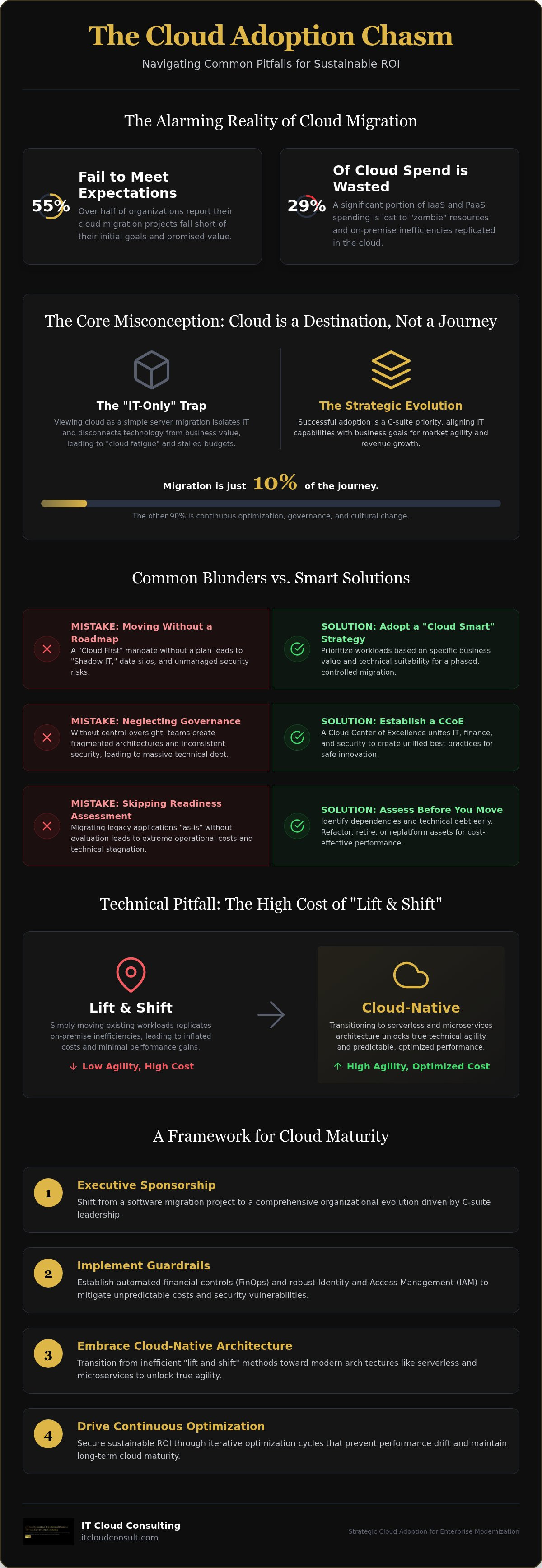
In 2026, 55% of organizations report that their cloud migration projects fail to meet expectations, while 29% of IaaS and PaaS spending is lost to waste. These figures illustrate that common cloud adoption mistakes are no longer just minor setbacks; they're fundamental barriers to organizational evolution. You likely started your journey with the promise of agility, yet you're now facing unpredictable monthly bills and a widening gap in your team's technical expertise.
It's frustrating to watch a strategic investment transform into a source of operational complexity and security risk. We understand that the transition from legacy systems to a cloud-native architecture requires more than just a change in hardware. This article identifies the strategic, financial, and technical errors that derail modern transformations and provides the path to sustainable ROI. We'll explore how to bridge the skills chasm, implement rigorous FinOps, and move beyond the "lift and shift" mentality to achieve a state of predictable, optimized performance.
Key Takeaways
- Shift your perspective from a simple software migration to a comprehensive organizational evolution driven by executive leadership.
- Avoid common cloud adoption mistakes by establishing a Cloud Center of Excellence (CCoE) and prioritizing a "Cloud Smart" strategy tailored to specific business outcomes.
- Mitigate unpredictable expenditures and security vulnerabilities by implementing automated financial guardrails and robust Identity and Access Management (IAM) protocols.
- Transition from inefficient "lift and shift" methods toward cloud-native architectures like serverless and microservices to unlock true technical agility.
- Secure sustainable ROI through continuous optimization cycles that prevent performance drift and maintain long-term cloud maturity.
Why Cloud Adoption Projects Stall: The "IT-Only" Trap
Cloud adoption is often mischaracterized as a technical upgrade. In 2026, many organizations still treat it as a server migration rather than a fundamental shift in business operations. This "IT-only" focus remains one of the most common cloud adoption mistakes, contributing to the fact that 55% of organizations report their cloud migration projects fail to meet expectations. Strategic Cloud Adoption is the alignment of IT capabilities with long-term business goals. Without this alignment, the C-suite often views cloud spending as a black hole, resulting in "cloud fatigue" and stalled budgets when promised innovation fails to materialize.
The Misconception of Cloud as a Destination
Many leaders believe that reaching the cloud is the finish line. In reality, the migration itself represents only 10% of the journey. Simply moving existing workloads often replicates on-premise inefficiencies in a virtual environment, leading to inflated costs without performance gains. Success requires a transition from a capital expenditure (CapEx) mindset to an operational expenditure (OpEx) model. This shift demands continuous management rather than a one-time purchase. Organizations that fail to evolve their financial processes find themselves managing "zombie" resources that drain capital without contributing to the bottom line. To navigate this financial evolution, you can discover SD Mayer for specialized outsourced CFO and accounting advisory services.
Bridging the Gap Between IT and Executive Leadership
To avoid stagnation, IT teams and executive leadership must establish a shared language for success. The role of strategic cloud adoption is to drive market agility, allowing the business to pivot based on real-time data. When a cloud strategy is disconnected from business reality, the warning signs are clear. IT metrics focus on uptime while business leaders focus on time-to-market. Budgets are approved for "maintenance" rather than "innovation." Most importantly, the organization lacks clear KPIs that link cloud performance to revenue growth. Cloud transformation must be a C-suite priority to ensure technical capabilities directly empower the company's broader vision.
Strategic Blunders: Moving Without a Roadmap
Executing a cloud transition without a structured roadmap is like constructing a complex architectural project without a blueprint. In 2026, the conversation has matured from a "Cloud First" mandate to a "Cloud Smart" strategy. This approach prioritizes workloads based on their specific business value and technical suitability rather than moving everything at once. One of the most common cloud adoption mistakes is the absence of a phased migration plan, which frequently triggers the rise of "Shadow IT." When individual departments feel the central strategy is too slow or non-existent, they often procure their own cloud services, creating fragmented data silos and unmanaged security risks. As organizations integrate AI and machine learning requirements into their 2026 roadmaps, a unified strategy becomes even more vital to manage the massive data and compute demands these technologies impose.
Neglecting the Cloud Center of Excellence
A Cloud Center of Excellence (CCoE) is no longer a luxury for enterprise governance; it's a fundamental requirement. This cross-functional team acts as the visionary architect for your digital environment, bringing together stakeholders from IT, finance, and security to establish unified best practices. Without a CCoE, organizations often suffer from fragmented security and inconsistent architecture, which are common cloud adoption mistakes that lead to long-term technical debt. By scaling this group from a small pilot team to a permanent governance body, you create a dependable framework that empowers every department to innovate safely and efficiently.
Failure to Assess Cloud Readiness
Before the first workload moves, a comprehensive cloud readiness assessment is essential to identify potential roadblocks. This process evaluates legacy application dependencies and technical debt that could complicate the transition. Not all assets belong in the cloud in their current state. Some require extensive refactoring to be cost-effective, while others should be retired entirely. Identifying these "un-migratable" assets early saves millions in wasted operational costs and prevents technical stagnation. To ensure your roadmap is built on a solid foundation, consider partnering with an expert in strategic cloud adoption to guide your architectural evolution.
Financial and Security Blind Spots in Cloud Operations
Strategic roadmaps provide the vision, yet operational blind spots in finance and security often derail the execution. In 2026, the "Bill Shock" phenomenon has intensified as global hardware shortages drive up cloud infrastructure costs, making automated guardrails a necessity rather than an option. Without these protections, monthly expenditures can spiral, turning a scalable asset into a significant liability. These financial leaks are among the most common cloud adoption mistakes, yet they're often secondary to the risks of mismanaged Identity and Access Management (IAM). In 2026, misconfiguration remains a leading cause of data breaches, proving that technical oversight is as dangerous as financial negligence. Engaging in cloud optimization consulting is a critical step in stabilizing spend and fortifying your architecture against these invisible threats.
The FinOps Gap: Accidental vs. Strategic Spending
The gap between accidental and strategic spending often stems from a lack of mature FinOps practices. Flexera's 2026 research indicates that 29% of IaaS and PaaS spending is wasted, primarily through over-provisioned instances and "zombie" resources that remain active without purpose. To reclaim this capital, organizations must implement real-time cost monitoring and departmental chargebacks to foster internal accountability. Strategic use of reserved instances and savings plans for predictable workloads can further stabilize budgets, protecting the enterprise from the sharp price hikes seen in various cloud regions this year due to the global memory shortage.
Identity and Data Policy Misconfigurations
Security in the cloud operates on a Shared Responsibility Model, yet many enterprises fail to grasp where the provider's duty ends. Gartner predicts that 99% of cloud security failures through late 2026 will be the customer's fault, largely due to improper configurations. Default cloud settings are designed for accessibility, not enterprise-grade compliance, leaving Identity and Data Policy gaps that attackers easily exploit. Utilizing a cloud security assessment checklist allows teams to move from reactive patching to proactive defense, ensuring that every access point is strictly governed and audited. This transition is vital to maintaining trust and meeting the rigorous data privacy standards that now define the national landscape.
Technical Pitfalls: The High Cost of "Lift and Shift"
Efficiency requires intent. The allure of a fast migration often leads enterprises into the trap of "lift and shift" architecture. While rehosting existing virtual machines might seem like the path of least resistance, it's one of the most common cloud adoption mistakes that directly results in higher operational costs. In 2026, where global memory prices have surged by as much as 300% compared to late 2025, running unoptimized legacy workloads in the cloud is often more expensive than maintaining them on-premise. This approach ignores "Data Gravity" and the associated egress fees. Organizations that don't plan for the cost of moving data between providers or regions find their applications technically functional but economically unviable.
Managing multi-cloud and hybrid environments in 2026 adds another layer of technical complexity. Without a unified management layer, these environments become fragmented silos that increase operational overhead. You can't achieve the agility you were promised if your team spends all their time managing the friction between different cloud providers. Technical success requires a move away from simple replication toward purposeful architecture.
Ignoring Cloud-Native Modernization
The distinction between rehosting and refactoring is the difference between a temporary fix and a long-term evolution. Rehosting offers low effort but negligible ROI, whereas refactoring into cloud-native architectures like serverless, containers, and microservices unlocks true potential. These modern frameworks enable automatic scaling and self-healing systems, ensuring your infrastructure responds dynamically to demand. Balancing these modernization efforts with business continuity is a complex dance, yet it's necessary to avoid the technical stagnation that follows a simple migration. Cloud-native features allow you to pay only for the compute you use, directly addressing the waste issues that plague unoptimized environments.
The Talent Transformation Oversight
Tools aren't enough. Investing in sophisticated cloud platforms without investing in human capital leads to expensive "shelfware." The transition from traditional sysadmins to Cloud Engineers and Site Reliability Engineers (SREs) is a cultural shift that many enterprises overlook. These common cloud adoption mistakes regarding workforce readiness can stall even the most well-funded projects. According to 2026 industry data, 78% of organizations cite a shortage of expertise as a primary obstacle to success. This "skills chasm" prevents companies from leveraging advanced features like automated governance. Utilizing managed cloud services allows your organization to bridge these immediate skill gaps while your internal team evolves. To navigate these complexities and ensure your technical architecture supports your business vision, partner with a guide experienced in ongoing cloud support and strategic optimization.
Ensuring Success: A Framework for Cloud Maturity
Achieving cloud maturity is a process of intentional evolution. While earlier sections highlighted the risks of technical debt and financial waste, a successful outcome depends on a structured framework that prioritizes business value over mere connectivity. Developing a phased migration and modernization plan allows your organization to realize incremental wins, funding future innovation through immediate efficiencies. Central to this strategy is the enterprise cloud transformation roadmap, which serves as a living document to guide long-term scaling. By implementing continuous optimization cycles, you ensure that performance remains high while costs are kept in check, preventing the gradual drift that often leads back to unmanaged complexity.
Implementing Continuous Governance
Transitioning from periodic audits to automated policy enforcement is a hallmark of a mature cloud organization. In 2026, the speed of digital business makes manual oversight impossible. Utilizing Infrastructure as Code (IaC) ensures that every deployment is consistent, secure, and compliant with your organizational standards from the moment of creation. This technical rigor supports a broader culture of experimentation. When guardrails are automated, teams feel empowered to fail fast and iterate quickly, knowing that the environment's integrity is protected by code rather than human intervention. This approach effectively eliminates many of the manual errors that lead to security vulnerabilities.
Selecting the Right Consulting Partner
Just as internal guardrails are automated, external compliance should be handled with equal efficiency. A performance-first platform like Conzent ensures that cookie consent management remains lightweight and compliant, preventing third-party bloat from negating the performance benefits of your cloud-native architecture.
Navigating the nuances of modern architecture requires more than just technical proficiency; it demands a partner with a visionary perspective. Many common cloud adoption mistakes occur because organizations choose vendors based solely on technical certifications rather than strategic alignment. A dependable guide looks beyond the immediate migration project to provide ongoing support that evolves alongside your business. Partnering with a cloud infrastructure consulting firm ensures you have access to the "big picture" expertise required to avoid technical stagnation. IT Cloud Consulting acts as both the architect of your digital future and the guide for your daily operations. We focus on transforming your current state into an optimized, advanced future state, ensuring that every technical action contributes to a broader organizational benefit. Avoiding common cloud adoption mistakes is not a one-time effort, but a continuous commitment to excellence that we help you maintain.
Architecting Your Future for Sustainable Cloud Innovation
The transition to a cloud-native enterprise is a continuous evolution rather than a final destination. By moving beyond the "IT-only" silo and embracing a strategic roadmap, you position your organization to harness the full potential of modernization. We've explored how avoiding common cloud adoption mistakes like unoptimized "lift and shift" models and fragmented governance can transform unpredictable overhead into a powerful engine for growth.
Realizing this vision requires a partner that provides both high-level architectural foresight and the technical proficiency to execute. IT Cloud Consulting offers professional advisory for cloud optimization and managed cloud support for ongoing innovation. We provide the strategic guidance for enterprise-scale transformations that your business needs to thrive in the complex landscape of 2026. Partner with IT Cloud Consulting for a Strategic Cloud Roadmap to secure your trajectory and unlock your organization's latent potential. Your journey toward a more optimized and advanced future state starts with a purposeful strategy.
Frequently Asked Questions
What is the most common reason cloud migrations fail?
The most common reason cloud migrations fail is treating the transition as a purely technical project rather than an organizational evolution. When initiatives are siloed within IT departments without executive sponsorship, they lack the strategic alignment necessary to drive business value. This disconnect often results in "cloud fatigue" where budgets are exhausted before innovation begins. Success requires a unified vision that connects technical milestones to clear, high-level business objectives.
How can we reduce our cloud costs immediately without hurting performance?
Organizations can reduce costs immediately by identifying and terminating "zombie" resources and right-sizing over-provisioned instances to match actual demand. Implementing automated scheduling for non-production environments and utilizing spot instances for flexible workloads provides instant relief. These actions address common cloud adoption mistakes related to financial waste. For long-term stability, transitioning to reserved instances for predictable workloads ensures you maintain performance while protecting the enterprise from market price fluctuations.
Is "Lift and Shift" ever a viable cloud adoption strategy?
"Lift and Shift" is a viable short-term tactic when speed is the primary driver, such as during a data center lease expiration. It allows for a rapid exit from physical infrastructure, but it's rarely a sustainable end-state. Simply replicating on-premise inefficiencies in the cloud often increases operational expenses. To realize true ROI, this phase must be followed by a planned modernization effort that leverages cloud-native features like serverless or containers.
What is a Cloud Center of Excellence (CCoE) and do we need one?
A Cloud Center of Excellence (CCoE) is a cross-functional team responsible for developing and managing the organization's cloud strategy, governance, and best practices. If you're a national enterprise, you absolutely need one to prevent fragmented architecture and inconsistent security. The CCoE acts as a visionary architect, ensuring that every department adheres to a unified roadmap. This centralized oversight is essential for scaling complex environments without sacrificing speed or security.
How does multi-cloud adoption complicate the governance process?
Multi-cloud adoption complicates governance by creating fragmented visibility and inconsistent security protocols across different provider platforms. Each vendor has unique identity management systems and operational tooling, which can lead to oversight gaps. Managing these environments requires a unified abstraction layer or a robust "Cloud Smart" strategy to avoid data silos. Without centralized control, the complexity of managing multiple sets of compliance requirements can significantly increase operational overhead.
What are the biggest security risks during the initial cloud adoption phase?
What are the biggest security risks during the initial cloud adoption phase?
The most significant security risks during initial adoption involve Identity and Access Management (IAM) misconfigurations and a misunderstanding of the shared responsibility model. Many common cloud adoption mistakes stem from assuming the provider secures every layer of the stack. In reality, the customer remains responsible for securing their data and access permissions. This is especially critical for tax and accounting professionals who must maintain strict compliance; services like Apex Tech 4 Tax Pros assist in this by developing robust Written Information Security Plans. Default settings often lack the rigor required for enterprise compliance, making proactive security assessments a critical first step.
Success should be measured through a combination of business agility, financial efficiency, and technical stability. Key metrics include the reduction in time-to-market for new features, the percentage of cloud spend tied to productive workloads, and a decrease in mean time to recovery (MTTR). By aligning these technical indicators with organizational KPIs, you can demonstrate the tangible impact of your transformation. Success isn't just about the migration; it's about the realization of long-term potential.


