
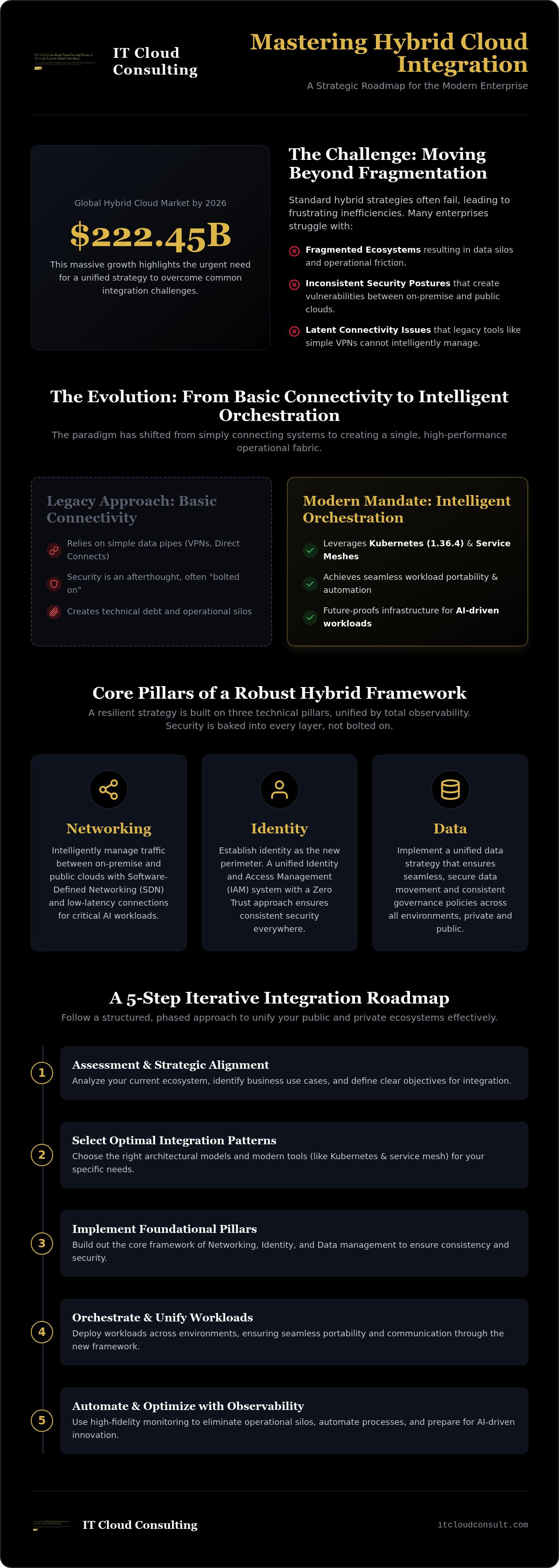
With the global hybrid cloud market projected to reach up to $222.45 billion in 2026, why do so many enterprises still struggle with fragmented ecosystems? You've likely found that a standard hybrid cloud integration strategy often falls short when confronted with latent connectivity issues and the sheer complexity of managing multiple vendors. It's frustrating to watch potential efficiency gains dissolve into data silos and inconsistent security postures that vary between your on-premise hardware and public cloud providers.
We understand that true modernization requires more than just a bridge; it demands a unified architectural framework. This article provides a research-driven roadmap to master cross-environment orchestration, focusing on how you can unify your private and public cloud assets into a single, high-performance entity. We'll examine the deployment of Kubernetes 1.36.4 and the latest service mesh protocols to ensure seamless workload portability. By the end of this guide, you'll have the strategic foundation needed to reduce operational overhead through automation and future-proof your infrastructure for the next wave of AI-driven innovation.
Key Takeaways
- Understand the critical transition from basic connectivity to intelligent orchestration to ensure seamless data movement across disparate environments.
- Identify the three technical pillars of networking, identity, and data that are essential for maintaining a consistent security posture.
- Learn how to evaluate and select the optimal integration pattern by matching modern strategic models to your specific business use cases.
- Discover a five-step, iterative roadmap for developing a comprehensive hybrid cloud integration strategy that unifies your public and private ecosystems.
- Explore how strategic advisory and ongoing cloud support can help you eliminate operational silos and prepare your infrastructure for AI-driven automation.
The Evolution of Hybrid Cloud Integration in 2026
Hybrid cloud integration is no longer defined by simple data pipes between data centers. In 2026, it represents the seamless orchestration of data and workloads across disparate environments, creating a singular operational fabric. We've moved past the era of basic connectivity into a phase of intelligent orchestration. This shift is driven by the necessity of a cohesive hybrid cloud integration strategy that treats public and private ecosystems as a unified whole rather than isolated islands of compute.
The rise of AI-driven workloads has fundamentally altered infrastructure requirements. These applications demand massive, elastic resources and real-time data access that legacy setups can't provide. When organizations rely on a reactive integration approach, they inevitably accumulate technical debt. This fragmented method creates security gaps as policies fail to translate across environments, leaving the enterprise vulnerable and inefficient. A proactive framework ensures that security is a foundational element, not an afterthought; for further exploration of this approach, visit Bio-Cognitive Solutions to review their framework for data center resilience.
Beyond Connectivity: The Orchestration Mandate
Legacy tools like VPNs and Direct Connects remain functional, yet they're no longer sufficient for the agility modern enterprises require. They lack the intelligence to manage the complex, high-velocity traffic patterns of 2026. Today, visionary architects utilize abstraction layers to decouple applications from underlying hardware. By leveraging container orchestration, specifically Kubernetes version 1.36.4, teams can achieve a cloud-native everywhere posture. This approach uses service meshes like Istio 1.30 or Linkerd 2.20 to manage secure communication, ensuring that the physical location of the workload becomes secondary to its performance and security requirements.
The Business Value of a Unified Strategy
A unified strategy isn't merely a technical preference; it's a commercial imperative. Organizations that synchronize their environments experience faster time-to-market and significantly reduced operational friction. This synergy is a cornerstone of successful strategic cloud adoption, allowing businesses to evolve without the weight of legacy constraints. By optimizing resource allocation across environments, companies don't just save on egress fees; they unlock the latent potential of their entire digital estate. This methodical transition leads to a future-proofed infrastructure capable of supporting the next decade of innovation.
Core Pillars of a Robust Hybrid Integration Framework
A resilient hybrid cloud integration strategy requires more than just functional links; it demands a structured architecture built on three technical pillars. These pillars, consisting of Networking, Identity, and Data, form the backbone of a unified ecosystem. In this framework, security isn't "bolted on" as a final step. Instead, it's baked into every layer to ensure that protection moves with the workload. Achieving this level of sophistication is a primary objective of cloud infrastructure consulting, where the goal is to transform fragmented components into a synchronized whole.
Observability acts as the glue for these pillars. In a distributed environment, you can't manage what you can't see. High-fidelity monitoring across all environments allows teams to detect latent connectivity issues before they impact the end user. This visibility ensures that the entire infrastructure operates with the steady assurance required for enterprise-scale operations.
Software-Defined Networking (SDN) and Interconnectivity
Software-Defined Networking provides the intelligence required to manage traffic between on-premise hardware and public cloud providers. By utilizing SD-WAN, organizations can dynamically route data based on application priority and network health. For data-heavy AI workloads, dedicated low-latency connections are essential to prevent bottlenecks that stall innovation. We also prioritize redundant paths, ensuring that business continuity remains intact even during unforeseen carrier outages.
Unified Identity and Access Management (IAM)
In the distributed environments of 2026, identity has replaced the physical firewall as the true perimeter. Traditional perimeter-based security fails when users and applications span multiple clouds. Implementing a unified Identity and Access Management system allows for seamless Single Sign-On across the entire stack. This architecture adopts a Zero Trust approach, where every request is verified regardless of its origin. Establishing this "identity-first" integration ensures that access remains granular and secure across every environment.
Data Fabric and Synchronization Patterns
A "data fabric" approach provides a consistent management layer for information, regardless of where it resides. Whether you utilize real-time streaming for transaction processing or batch synchronization for analytical data warehouses, the fabric ensures consistency. This is particularly vital for maintaining data sovereignty within a national framework. By standardizing how data is governed and synchronized, you eliminate the risk of non-compliance and ensure data is available exactly where it's needed.
Maintaining the health of these pillars requires constant vigilance and expertise. If you're looking to refine your current architecture, our team provides ongoing cloud support to ensure your integration remains optimized as your business evolves.
Integration Patterns: Choosing Your Strategic Model
Selecting the right architectural pattern is a defining moment for any hybrid cloud integration strategy. In 2026, the choice isn't just technical; it's a strategic decision that balances organizational governance with the need for rapid innovation. Every model carries specific trade-offs between centralized control and decentralized speed. Before committing to a specific path, it's vital to conduct a comprehensive cloud security assessment to ensure the chosen pattern doesn't introduce unforeseen vulnerabilities into your cross-environment data flows.
Hub-and-Spoke vs. Distributed Mesh
The Hub-and-Spoke model remains the preferred choice for organizations with stringent regulatory requirements. It provides a centralized point of control, which makes it easier to audit data movements and enforce consistent security policies. However, this centralization can occasionally limit scalability and introduce latency during peak loads. In contrast, a distributed Service Mesh offers superior speed and resilience for microservices-heavy architectures. While a mesh scales effortlessly across multiple public clouds, it requires a higher level of technical maturity to manage the decentralized complexity effectively.
API-Led Integration vs. Message-Oriented Middleware
API-Led Integration is a standardized method for connecting applications via reusable interfaces. This approach has become the dominant pattern for real-time application-level connectivity because it promotes reuse and significantly reduces development cycles. For asynchronous data processing, message-oriented middleware like Kafka is indispensable. It allows systems to communicate without being tightly coupled, ensuring that a failure in one environment doesn't cascade through the entire hybrid stack. Your choice depends on whether your use case requires immediate response times or high-throughput, eventual consistency.
Workload Portability and Containerization
Kubernetes serves as the primary engine for modern workload portability, allowing teams to achieve "write once, run anywhere" capabilities. By containerizing applications, you decouple the software from the underlying infrastructure. This simplifies the transition between on-premise hardware and public cloud providers. While stateless applications migrate with relative ease, stateful workloads still present challenges due to data gravity and synchronization needs. Serverless functions further refine your hybrid cloud integration strategy by providing event-driven integration points that only consume resources when active, effectively reducing operational overhead.
By matching these patterns to specific business outcomes, you transform your infrastructure from a collection of clouds into a unified, high-performance ecosystem. This methodical approach ensures that your technical choices directly support your long-term modernization goals. For those seeking to ensure these choices also drive operational excellence, Syntric Hub Advisory Services offers the digital transformation expertise needed to optimize your entire organizational ecosystem.
A successful hybrid cloud integration strategy follows a systematic, five-step path toward operational maturity. This process isn't a linear, one-time project. It's an iterative journey that evolves as your organizational needs change. Integrating financial oversight, or FinOps, into the technical planning phase is essential to ensure that cloud spend remains aligned with business value. By following a structured cloud transformation roadmap, you can navigate the complexities of multi-provider environments while maintaining a clear focus on long-term evolution.
Phase 1: Workload Assessment and Rationalization
Execution begins with a rigorous evaluation of your application portfolio using the "6 Rs" framework: Retain, Rehost, Replatform, Refactor, Retire, or Replace. We analyze each workload to distinguish between "cloud-ready" applications that can be migrated with minimal friction and "cloud-native" assets designed to exploit elastic resources. Prioritizing these workloads based on their business impact and technical complexity allows for a phased approach that delivers immediate value while minimizing risk. This rationalization ensures that you aren't simply moving technical debt from on-premise hardware to the cloud.
Phase 2: Governance and Security Baseline
Before scaling your integration, you must establish technical guardrails that empower your developers while maintaining strict compliance. This phase defines the shared responsibility model, ensuring your team understands the boundaries between internal duties and provider managed services. We implement automated policy enforcement tools to catch configuration errors in real time. These guardrails prevent the security gaps that often occur when moving data between disparate environments, ensuring that your security posture remains consistent across the entire hybrid stack.
Phase 3: Automation and Orchestration Deployment
To achieve true agility, we utilize Infrastructure as Code (IaC) to standardize environments and eliminate manual provisioning errors. This phase also introduces AIOps, leveraging artificial intelligence to manage the high-velocity telemetry generated by hybrid systems. In 2026, automation is the only viable method for managing the scale of a multi-provider hybrid ecosystem. By automating routine orchestration tasks, you reduce operational overhead and allow your IT staff to focus on high-value innovation rather than basic maintenance. This shift creates the momentum required to support advanced AI initiatives and rapid scaling.
If you're looking to build a resilient foundation for your enterprise, our team offers expert strategic cloud adoption services to guide your roadmap from initial assessment to full-scale orchestration.
Navigating Complexity with IT Cloud Consulting
The execution of a sophisticated hybrid cloud integration strategy involves a high degree of technical orchestration that can overwhelm internal teams. While the roadmap provided in previous sections offers a clear path, the reality of managing multi-cloud ecosystems often reveals unforeseen friction points. IT Cloud Consulting serves as a strategic partner for organizations navigating these complex transformations. We provide the steady assurance and technical proficiency required to turn a collection of disparate tools into a unified IT environment. By positioning ourselves as a dependable guide, we help you realize the latent potential of your infrastructure while avoiding the common pitfalls of fragmented implementation.
Advisory and Strategic Planning
Achieving this level of integration often requires resolving broader strategic bottlenecks that exist outside the IT department. To ensure your organizational strategy keeps pace with your technical evolution, you can visit Top7 for specialized guidance on overcoming growth obstacles and improving execution.
Our engagement begins with a comprehensive cloud architecture review to identify existing inefficiencies and security gaps. This assessment is critical because it prevents the accumulation of technical debt and protects against vendor lock-in. As visionary architects, we design tailored roadmaps that prioritize flexibility and long-term evolution. We don't just solve immediate enterprise challenges; we build frameworks that allow your business to pivot as new technologies emerge. This strategic foresight ensures that every technical decision you make today supports your organizational goals for 2026 and beyond.
Ongoing Management and Support
Successful integration isn't a one-time event but a continuous process of refinement. In a distributed hybrid environment, 24/7 monitoring is a necessity to maintain system health and prevent latent connectivity issues from disrupting operations. Utilizing managed cloud services allows your team to offload the burden of routine maintenance while ensuring your environment remains optimized for performance and cost. Continuous optimization is the only way to maintain the ROI of your integration efforts over time. This ongoing attention ensures that your infrastructure doesn't just function, but excels under the demands of modern workloads.
The path forward from a fragmented current state to an optimized future state requires both a high-level vision and a commitment to execution. We invite you to take the next step in your modernization journey by partnering with experts who understand the complexities of cross-environment orchestration. Together, we can build a future-proofed infrastructure that empowers innovation and drives sustainable growth across your entire digital estate.
Realizing the Potential of a Unified Hybrid Ecosystem
The transition to a unified IT environment in 2026 requires more than just linking servers; it demands a sophisticated orchestration layer that treats all environments as a single, high-performance entity. By focusing on the core pillars of networking, identity, and data, you can build a resilient framework that eliminates silos and prepares your business for AI-driven growth. This methodical approach ensures that your infrastructure remains flexible enough to adapt to future market shifts without accumulating unnecessary technical debt.
Implementing a robust hybrid cloud integration strategy is a transformative journey that requires both high-level vision and technical proficiency. We understand the complexities of cross-environment orchestration and the pressure to deliver results while maintaining a consistent security posture. You don't have to navigate this transition alone or risk the pitfalls of fragmented implementation.
If you're ready to evolve your digital estate, partner with IT Cloud Consulting for your hybrid transformation. You'll gain access to our authoritative strategic guidance and deep expertise in enterprise-scale cloud optimization. With our comprehensive managed cloud support, you can ensure the long-term health of your infrastructure while focusing on your core business objectives. The future of your enterprise is waiting; let's build it together with steady assurance.
Frequently Asked Questions
What is the difference between hybrid cloud and multi-cloud integration?
Hybrid cloud integration focuses on the synergy between private, on-premise hardware and public cloud services. While multi-cloud integration connects multiple public providers to avoid vendor lock-in, a hybrid approach bridges disparate infrastructure types. This requires a robust hybrid cloud integration strategy to manage the technical friction between legacy systems and modern, elastic public resources. It's about creating a single operational fabric across fundamentally different environments.
How does hybrid cloud integration improve enterprise security?
Integration improves security by establishing a unified Identity and Access Management (IAM) perimeter across all environments. Instead of managing separate security silos, a cohesive framework allows for the implementation of Zero Trust Architecture. This ensures that every request is verified regardless of its origin. By baking security into the orchestration layer, you eliminate the inconsistent postures that often lead to vulnerabilities when data moves between private and public ecosystems.
What are the biggest challenges in hybrid cloud integration today?
The most significant hurdles include data silos, latent connectivity issues, and the sheer complexity of managing multiple vendors. Many organizations struggle with inconsistent security policies that vary between their data centers and public cloud providers. These challenges often stem from a reactive approach to infrastructure. Overcoming them requires a visionary architectural framework that prioritizes automation and standardized orchestration to reduce the operational overhead associated with manual environment management.
Can I integrate legacy on-premise systems with modern public cloud providers?
You can successfully integrate legacy systems by utilizing abstraction layers and containerization technologies like Kubernetes. These tools decouple your applications from the underlying on-premise hardware, allowing them to communicate seamlessly with modern public cloud services. This process often involves refactoring workloads to ensure they're "cloud-ready." By leveraging a standardized hybrid cloud integration strategy, you transform static legacy assets into flexible components of a modernized, unified digital estate.
How much does it cost to implement a hybrid cloud integration strategy?
Implementation costs fluctuate significantly based on the scale of your infrastructure and the complexity of your workloads. Primary cost drivers include data egress fees, software licensing for orchestration tools, and the professional advisory required for strategic planning. Rather than focusing on a single number, enterprises should evaluate the total cost of ownership. Investing in professional optimization often leads to substantial long-term savings by reducing resource waste and preventing expensive integration failures.
What role does AI play in managing hybrid cloud environments in 2026?
In 2026, artificial intelligence is the primary engine for managing the high-velocity telemetry generated by distributed systems. AIOps platforms provide real-time visibility into resource health, allowing for automated scaling and proactive security threat detection. AI also facilitates real-time financial tracking, helping organizations maintain their FinOps goals. This intelligent orchestration is essential for managing the scale of multi-provider environments without overwhelming your internal IT teams with manual monitoring tasks.
Is a hybrid cloud strategy better for compliance-heavy industries?
Is a hybrid cloud strategy better for compliance-heavy industries?
Hybrid environments are exceptionally well-suited for compliance-heavy industries like finance and healthcare. This model allows you to maintain sensitive data on-premise to meet strict data sovereignty requirements while utilizing the public cloud for non-sensitive compute tasks. It provides the control of a private data center with the scalability of the public cloud. This balance is critical for organizations that must navigate complex regulatory frameworks without sacrificing their ability to innovate. For those in the public sector, utilizing professional government proposal writing services can help ensure that these complex technical architectures are accurately represented in competitive bids.
The timeline for realizing a return on investment varies, but most enterprises begin seeing operational improvements within the first six to twelve months. Initial gains often come from optimized resource allocation and reduced egress costs. Long-term ROI is driven by increased business agility and faster time-to-market for new AI initiatives. A well-executed roadmap ensures that technical processes are directly linked to these broader business results, creating a clear cause-and-effect path to success.


