
By the end of 2026, the global cloud migration services market is projected to reach $330.27 billion, yet a significant portion of enterprise transitions still struggle with the high risks of data loss and operational downtime. You likely recognize that moving to the cloud is no longer a simple administrative task but a critical evolution of your entire digital architecture. It is often daunting to face complex licensing models and the lack of internal expertise required to manage sophisticated modernization platforms without incurring massive budget overruns.
This guide clarifies the technical and strategic differences between leading migration tools to ensure your transition is efficient, secure, and fully optimized for ROI. Many organizations find that professional cloud migration consulting services are essential for bridging the gap between raw software capabilities and successful business outcomes. We will provide a clear decision matrix for tool selection and demonstrate how AI-driven automation can drastically reduce your migration timelines.
You'll discover a roadmap that balances the strengths of CSP-native tools with the flexibility of agnostic platforms. We focus on transforming your current infrastructure into a resilient, forward-looking environment that meets modern standards like the NIS2 Directive. By the end of this article, you will have a purposeful strategy to realize your organization's latent potential through intelligent cloud adoption.
Key Takeaways
- Identify the shift from manual scripting to autonomous, AI-driven migration paths that accelerate transition timelines while mitigating the risk of human error.
- Distinguish between CSP-native tools and agnostic enterprise platforms to determine the most resilient fit for complex or hybrid cloud environments.
- Uncover hidden costs within the total cost of ownership, including egress fees and storage snapshots, to maintain strict budget control during data synchronization.
- Learn how professional cloud migration consulting services bridge the gap between software capabilities and the strategic orchestration required for a successful enterprise transformation.
- Utilize a strategic decision matrix to evaluate data throughput, end-to-end encryption, and automated compliance auditing to ensure secure, large-scale transfers.
The Evolving Landscape of Cloud Migration Tools in 2026
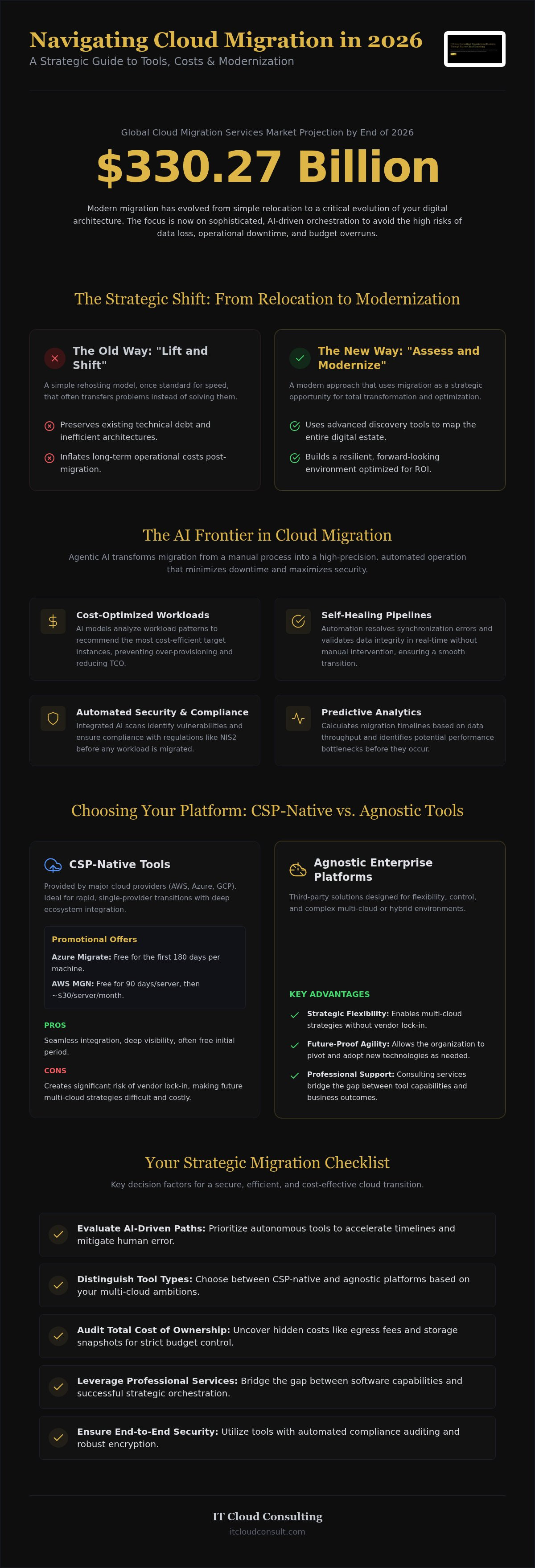
The global cloud migration services market is projected to reach $330.27 billion by the end of 2026, marking a significant departure from the era of manual data transfers. Modern migration tools have evolved into sophisticated ecosystem orchestrators that manage the entire lifecycle of a transition. This shift is driven by the realization that moving to the cloud is an opportunity for total modernization rather than a mere change in hosting environments. It's about evolution, not just relocation.
Enterprises are increasingly abandoning the "Lift and Shift" model. While rehosting was once the standard for speed, it often preserves technical debt and inefficient architectures that inflate long-term costs. In 2026, the focus has moved toward "Assess and Modernize." This approach uses advanced discovery tools to identify hidden legacy dependencies and complex integrations that could cause system failures if they aren't addressed before the move. Utilizing professional cloud migration consulting services allows organizations to leverage these discovery insights to build a roadmap that balances software capabilities with high-level business goals.
From Discovery to Execution: The Full-Lifecycle Approach
Effective migration begins with a comprehensive map of the digital estate. Automated discovery tools now scan complex environments to catalog every asset, from microservices to legacy databases. This process eliminates the "broken link syndrome" where interconnected applications fail post-migration due to unrecognized dependencies. Predictive analytics further refine this stage by calculating migration timelines based on real-time data throughput and identifying potential performance bottlenecks before they occur. It's a methodical way to build trust through clarity.
The Role of Agentic AI in 2026 Migration Automation
Agentic AI represents the newest frontier in migration automation. Unlike traditional scripts, machine learning models now analyze workload patterns to recommend the most cost-efficient target instances. This ensures that resources aren't over-provisioned or under-powered, directly impacting your post-migration ROI. Additionally, 2026 tools feature self-healing pipelines that automatically resolve synchronization errors and validate data integrity without manual intervention. By integrating AI-driven security scanning, teams can identify vulnerabilities and ensure compliance with regulations like the NIS2 Directive before a single workload reaches the target cloud environment. This level of automation transforms cloud migration consulting services into a high-precision operation that minimizes downtime and maximizes security.
Categorizing the Cloud Migration Ecosystem: CSP-Native vs. Agnostic Platforms
Selecting the right toolset is a pivotal moment in your modernization journey. The ecosystem in 2026 is broadly divided into provider-specific utilities and platform-independent solutions. Each path offers distinct advantages for cost, control, and future scalability. While software selection appears tactical, it's a strategic decision that impacts your long-term agility and organizational cost structure. Choosing the wrong category can lead to technical debt that persists long after the initial move is complete.
CSP-Native Tools: Pros and Cons of Staying In-House
Major providers offer powerful incentives to keep your workloads within their specific ecosystems. For instance, Azure Migrate provides its services for free for the first 180 days per machine, while AWS Application Migration Service (MGN) offers a 90-day free window per server. After this period, AWS MGN costs approximately $30 per server per month. These tools provide seamless integration and deep visibility into the provider's specific resource types, making them ideal for rapid, single-provider transitions. However, this convenience often comes with a trade-off. Relying solely on native tools can create a vendor lock-in trap, making it difficult to pivot to a multi-cloud strategy later. If you're planning a Strategic Cloud Adoption, evaluating these limitations early is vital to maintaining future flexibility.
Third-Party Agnostic Platforms for Multi-Cloud Flexibility
For organizations prioritizing resilience and avoiding vendor dependency, agnostic platforms offer a unified management experience. These tools support migrations across AWS, Azure, and Google Cloud simultaneously, providing a "single pane of glass" for complex digital estates. They often excel at advanced refactoring, such as containerizing legacy applications during the transition rather than simply rehosting them. While these platforms typically involve custom licensing fees, they provide the enterprise-grade reliability required for mission-critical workloads. This is where cloud migration consulting services add significant value, helping you determine if the higher upfront cost of an agnostic tool will lead to greater long-term optimization and lower operational overhead.
Beyond general platforms, specialized data migration tools are essential for maintaining business continuity. If your migration involves sensitive financial records, Switch My Books provides a dedicated service for transferring accounting data between major platforms with precision and security. These solutions focus on real-time Change Data Capture (CDC) and ETL (Extract, Transform, Load) processes to ensure databases remain synchronized throughout the move. When choosing between open-source and proprietary tools, you must balance the lower initial costs of open-source options against the robust support and security features of proprietary software. Professional cloud migration consulting services help navigate these nuances, ensuring your toolset aligns with both your technical requirements and your long-term growth strategy.
Selecting a migration tool requires more than a cursory glance at a feature list. It demands a rigorous benchmarking of performance and security to ensure alignment with enterprise-grade requirements. In 2025, large enterprises accounted for 65.3% of the cloud migration services market revenue, highlighting the necessity for tools that handle petabyte-scale transfers without disrupting production environments. High-performance tools must maintain low latency while providing end-to-end encryption to meet stringent data sovereignty standards.
Consider these critical metrics in your decision matrix:
- Data Throughput: The ability to sustain high-speed transfers across global regions.
- Identity Management: Integration with existing SAML or OIDC providers for secure access control.
- Automated Compliance: Real-time auditing to satisfy regulations like the NIS2 Directive, which mandates formalized risk management and 24-hour incident reporting.
- Operational Interface: The balance between UI-driven orchestration for visibility and CLI-heavy tools for developer speed.
Comparing Feature Sets: Native vs. Third-Party
While native tools offer deep integration, third-party platforms often provide a more robust safety net for complex environments. Automated testing and validation ensure data integrity post-transfer, which is non-negotiable for regulatory compliance. Reliable rollback capabilities are equally essential; they establish a secure "undo" button for failed attempts in legacy systems. Additionally, third-party solutions frequently support legacy operating systems and rare database engines that basic native tools might ignore. Professional cloud migration consulting services can help you audit these technical requirements to avoid costly mid-migration pivots.
Integration with Modern IT Workflows
Agility in 2026 is defined by how well your migration tooling fits into existing DevOps and CI/CD pipelines. Tools must offer robust API availability to allow for automated triggers and monitoring during the transition phase. Solutions like Apptimized support these workflows by automating software packaging and application deployment across Windows and macOS environments. Compatibility with Infrastructure as Code (IaC) frameworks, such as Terraform or Pulumi, ensures that deployments are repeatable and documented. This reduces the risk of configuration drift and speeds up the modernization process. Migration Interoperability is the key to 2026 agility. Utilizing cloud migration consulting services ensures that these technical integrations align with your broader enterprise cloud transformation, turning a complex move into a streamlined, automated workflow.
Financial clarity is the cornerstone of any successful enterprise modernization. While the sticker price of a migration tool is easy to identify, the true Total Cost of Ownership often hides beneath layers of operational complexity and technical overhead. In 2026, licensing models have diversified into per-server, per-GB, and flat enterprise tiers. Each model serves a different organizational scale, but selecting the wrong one based on a surface-level estimate can lead to significant budget overruns. It's essential to look beyond the software fee and account for the temporary compute overhead and storage snapshots required during the synchronization phase.
Post-migration optimization remains the ultimate goal. The cheapest tool on the market might facilitate a quick move, but if it lacks the intelligence to right-size instances, it can leave you with a bloated monthly cloud bill. Engaging professional cloud migration consulting services ensures that your tool selection aligns with long-term fiscal health rather than just immediate project savings. This strategic alignment prevents the "cheap tool" trap from compromising your broader digital evolution.
The Egress Fee Trap and How to Avoid It
Egress fees represent one of the most substantial hidden costs in any transition. Moving massive datasets out of legacy environments or across different providers can incur charges that rival the cost of the migration software itself. Modern tools mitigate this by offering advanced data compression and deduplication, which reduces the total volume of data transferred. By following a strategic cloud adoption roadmap, you can accurately predict these transfer expenses and schedule syncs during off-peak periods to minimize financial impact. It's a methodical way to maintain budget control while moving at speed.
Operational Overhead: The Cost of Complexity
Complexity has a direct correlation with labor costs. Specialized migration platforms often require intensive training for internal teams, which can delay timelines and increase the risk of human error. Many organizations find that the value of One-Click automation is indispensable, as it streamlines the cutover process and reduces the hours required for manual troubleshooting. Investing in cloud migration consulting services allows your team to focus on core business objectives while experts handle the sophisticated orchestration. This approach secures your long-term ROI, as cloud optimization consulting validates that every dollar spent on tooling translates into a more efficient, cost-effective future state.
If you're ready to secure your financial trajectory, explore how our team can help you achieve Cloud Optimization through precise tool selection and strategic planning.
Beyond the Tool: Orchestrating Strategy with Managed Support
While sophisticated tools automate the mechanics of data movement, they often fail to address the underlying architectural debt or the cultural inertia that can stall a transition. Software alone isn't a panacea for complex organizational challenges. Real success requires aligning these tools with a comprehensive enterprise cloud transformation. This is particularly vital in compliance-heavy sectors like finance and healthcare, where automated pipelines require rigorous professional oversight to maintain data integrity and regulatory standing. It's about ensuring the technology serves the strategy, not the other way around.
Expert cloud migration consulting services provide a neutral lens through which to evaluate the marketplace. We help you choose platforms based on your specific digital architecture rather than vendor hype or aggressive marketing. When out-of-the-box tools encounter specialized legacy environments, consultants develop custom migration scripts to bridge the gap. These "human guardrails" are essential for monitoring automated workflows and preventing configuration drift that could lead to security vulnerabilities. This methodical approach builds trust through clarity and comprehensive coverage.
The Consultant’s Role in Tool Selection
A strategic partner does more than just install software; they act as a visionary architect for your digital estate. By conducting a neutral assessment, consultants ensure that tool selection is driven by performance metrics and compatibility rather than brand loyalty. This is especially critical when dealing with complex legacy systems where standard automation often fails. Customizing the migration path allows for a seamless transition that respects the nuances of your existing infrastructure while pushing toward a more optimized future state. It's a balance of technical proficiency and high-level strategic confidence. Beyond the initial move, working with OC Cubed - Your trusted MSP can provide the proactive IT solutions needed to maintain this new environment.
The journey doesn't end when the final workload is synchronized. Transitioning from active migration to managed cloud services ensures that your new environment operates at peak efficiency from day one. Continuous monitoring allows for the fine-tuning of resource allocations, verifying that the initial tool configurations actually deliver the promised performance gains. This steady evolution turns a simple vendor relationship into a strategic partnership. IT Cloud Consulting orchestrates these diverse tools into a unified modernization roadmap, combining "big picture" vision with the technical execution needed for long-term growth. By integrating cloud migration consulting services into your broader strategy, you ensure your 2026 transition realizes its full latent potential.
Realizing Your Enterprise Potential Through Strategic Orchestration
The transition to a modernized cloud environment is a pivotal moment for any organization. It's clear that successful migration in 2026 requires more than just high-performance software; it demands a synergy of AI-driven automation and expert advisory. By prioritizing a rigorous decision matrix and accounting for the true total cost of ownership, you protect your digital estate from technical debt and ensure compliance with emerging regulations like the NIS2 Directive.
Choosing the right path involves balancing the immediate benefits of native tools with the long-term flexibility of agnostic platforms. This is where professional cloud migration consulting services act as the catalyst for a secure and cost-optimized transition. Our certified cloud strategy experts provide a proven roadmap to modernization, specializing in enterprise-scale transformations that align technical execution with your broader business vision.
Schedule a Strategic Cloud Adoption Consultation with IT Cloud Consulting today to begin your journey toward a more resilient and efficient future. We're dedicated to helping you unlock the full potential of your digital architecture with steady assurance and technical proficiency. Your digital evolution is the next step in achieving lasting operational excellence.
Frequently Asked Questions
What are the best free cloud migration tools for small businesses in 2026?
Leading CSPs offer free introductory tiers that are ideal for small businesses. These utilities allow for a risk-free entry into the cloud before monthly billing begins:
- Azure Migrate: 180 days free per machine.
- AWS Application Migration Service: 90 days free per server.
- Google Cloud Migration Tools: 90 days free.
This approach helps maintain financial control during the initial adoption phase.
How do I choose between AWS Application Migration Service and Azure Migrate?
Your choice should align with your target cloud provider's ecosystem. Azure Migrate excels at discovering and moving VMware or Hyper-V workloads into the Microsoft environment with deep integration. Conversely, AWS Application Migration Service utilizes block-level replication to move physical or virtual servers into AWS with minimal disruption. Both provide high levels of automation for standard enterprise transitions.
Can cloud migration tools help with refactoring legacy applications into containers?
Yes, modern migration utilities have evolved to support application modernization. Tools like AWS App2Container or Azure's containerization features analyze legacy web applications and automatically generate Docker images. This process allows you to skip simple rehosting and move directly into a microservices architecture, which is a key component of a successful enterprise cloud transformation.
What is the difference between an online and offline cloud migration tool?
The distinction lies in how data travels to the target environment. Online tools replicate data over the internet or a dedicated private connection while your systems remain operational. Offline tools involve shipping physical hardware to a data center for petabyte-scale transfers. You'll typically use online tools for continuous sync and offline options when bandwidth constraints make network transfers impractical.
How much do enterprise-grade cloud migration platforms typically cost?
Costs vary significantly based on the tool's sophistication and your organizational scale. While native tools like AWS MGN cost approximately $30 per server per month after the initial free period, third-party enterprise platforms often require custom licensing. It's vital to account for these fees alongside professional cloud migration consulting services to ensure your total investment remains within your strategic budget.
What security features should I look for in a third-party migration platform?
Prioritize platforms that offer end-to-end encryption and robust identity management. Your chosen tool should integrate seamlessly with your existing SAML or OIDC providers to maintain strict access control. In 2026, look for automated compliance auditing that helps satisfy the NIS2 Directive's requirements for risk management and incident reporting. This ensures your data remains secure throughout the entire transition.
Is it possible to automate a multi-cloud migration across different providers?
Automating transitions across different providers is entirely possible through agnostic migration platforms. These tools provide a single pane of glass to manage workloads moving between AWS, Azure, and Google Cloud. However, orchestrating these complex moves often requires cloud migration consulting services to handle the intricate networking and security configurations unique to each provider. This ensures a cohesive multi-cloud strategy.
How do migration tools impact the total downtime during a server cutover?
Modern tools significantly reduce downtime by using continuous asynchronous replication. Instead of a long stop-and-copy process, the tool keeps a target instance in sync with the source in real-time. This reduces the final cutover window to the time it takes to perform a delta sync and update DNS records. You can often complete the entire transition in minutes rather than hours.


