
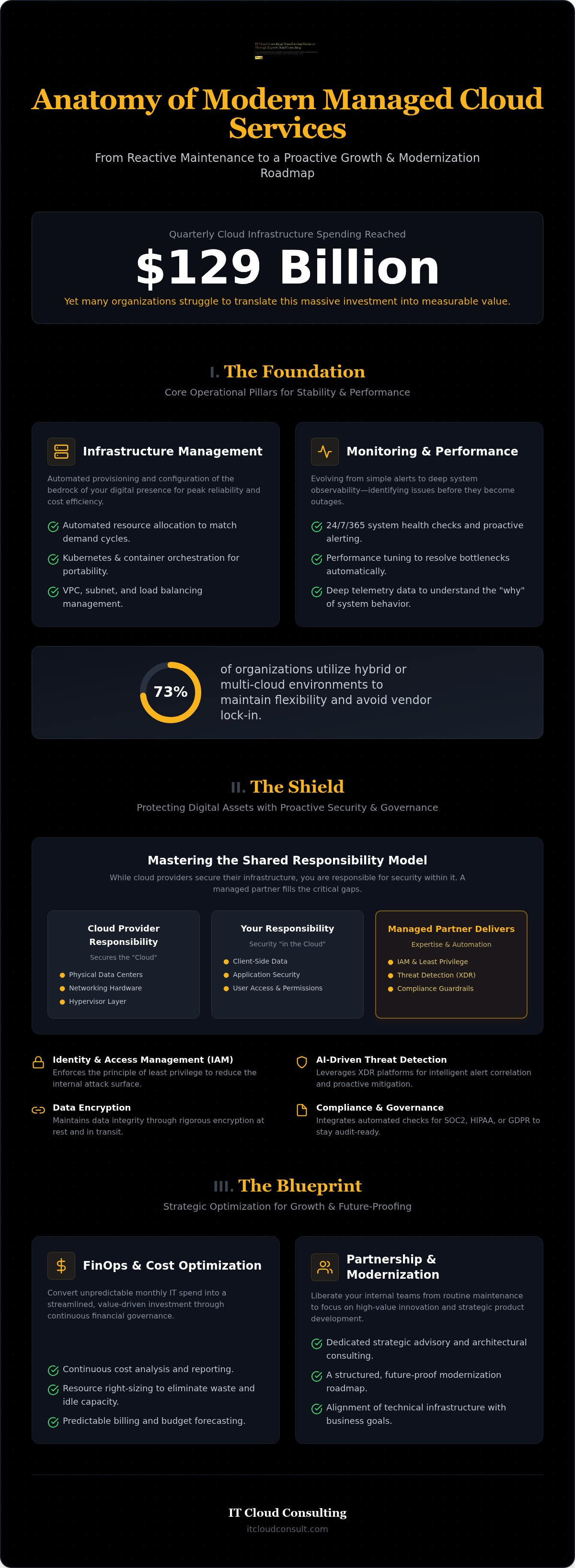
Quarterly spending on cloud infrastructure reached a staggering $129 billion in the first quarter of 2026, yet many organizations still struggle to translate this massive investment into measurable business value. You likely feel the pressure of unpredictable monthly bills and the constant anxiety of maintaining security across a complex multi-cloud environment. It's frustrating when your internal team lacks the specialized expertise to manage every technical layer, leading to the pivotal question: what is included in managed cloud services that actually moves the needle for your business?
This strategic overview clarifies the essential components that define modern managed services, moving beyond simple maintenance to focus on proactive growth and architectural evolution. We'll explore how integrating advanced FinOps for cost control, AI-driven operations for 24/7 uptime, and zero-trust security frameworks creates a predictable, high-performance environment. By understanding these technical and strategic pillars, you can transition from reactive troubleshooting to a long-term modernization roadmap that ensures your infrastructure drives organizational success.
Key Takeaways
- Identify the foundational and strategic layers of what is included in managed cloud services to align your technical infrastructure with specific organizational growth goals.
- Understand the critical role of automated threat detection and identity management in securing digital assets across complex hybrid and multi-cloud environments.
- Explore how FinOps methodologies and resource right-sizing convert unpredictable monthly IT spend into a streamlined, value-driven investment.
- Recognize the advantage of a managed partnership model that offers dedicated strategic advisory and a structured roadmap for future-proof modernization.
Defining the Scope: Core Components of Managed Cloud Services
Modern enterprise growth relies on the seamless integration of technology and strategy. Managed cloud services provide a centralized framework for technical oversight and strategic optimization, ensuring that every digital asset serves a specific business objective. Just as an AI branding agency focuses on defining a company's unique mission and identity, managed cloud services focus on aligning technical infrastructure with those overarching business goals. Unlike traditional hosting, the scope of these services extends from foundational infrastructure support to high-level architectural consulting. Understanding exactly what is included in managed cloud services is the first step in transitioning from a reactive IT posture to a proactive, growth-oriented model. This model typically encompasses public, private, and hybrid cloud environments, which 73% of organizations now utilize to maintain flexibility and avoid vendor lock-in.
The core objective of this partnership is to liberate your internal teams from the burden of routine maintenance. By delegating the complexities of cloud management to a seasoned partner, your talent can pivot toward high-value innovation and product development. This transition is rooted in the broader concept of Managed Services, where a provider assumes ongoing responsibility for monitoring, managing, and problem-solving for selected functions.
Infrastructure Management and Provisioning
Infrastructure is the bedrock of your digital presence. Effective management involves automated resource allocation designed to match real-time demand cycles, ensuring you never pay for idle capacity. This includes sophisticated virtual machine management and container orchestration using tools like Kubernetes to maintain application portability. A comprehensive service also covers intricate network configurations. Your provider should manage Virtual Private Clouds (VPCs), subnets, and load balancing to ensure traffic flows efficiently while maintaining strict isolation between sensitive environments. For organizations operating in specific jurisdictions, seeking specialized support informatique entreprise suisse can provide an additional layer of localized architectural oversight, ensuring these technical actions result in improved system reliability and cost efficiency.
Continuous Monitoring and Performance Tuning
Uptime is a prerequisite for success, and partnering with an established Managed Service Provider like Uptime Co. ensures that your network administration is backed by over 30 years of technology consulting expertise. Managed services include 24/7 system health checks that identify latency or throughput issues before they escalate into outages. Proactive alerting systems are configured to resolve bottlenecks automatically or notify engineers for immediate intervention. Observability represents the evolution of traditional monitoring in 2026, shifting the focus from simply knowing a system is down to understanding why it is behaving in a specific way through deep telemetry data. This level of insight allows for continuous refinement of the environment, ensuring that your infrastructure evolves alongside your organizational needs.
The Security and Compliance Pillar: Protecting Your Digital Assets
Security isn't an optional add-on; it's the structural core of a resilient digital architecture. When evaluating what is included in managed cloud services, organizations must prioritize providers that master the "shared responsibility model." While cloud hosts secure the physical data center, you remain responsible for the security within the cloud environment itself. A dependable partner fills this gap by deploying sophisticated Identity and Access Management (IAM) to enforce the principle of least privilege. This ensures that users access only the specific resources required for their roles, effectively reducing the internal attack surface and preventing unauthorized data exposure.
Data integrity is maintained through rigorous encryption of data at rest and in transit across all cloud tiers. This technical layer is supported by continuous threat detection and automated incident response protocols. By 2026, these systems have evolved to leverage extended detection and response (XDR) platforms, which use AI for intelligent alert correlation and proactive mitigation. Regular vulnerability scanning and automated patch management cycles further harden the environment, ensuring known exploits are neutralized before they can impact your operations. For businesses seeking to optimize these defenses, IT Works provides specialized cybersecurity strategies that protect critical digital infrastructure. This cause-and-effect relationship between technical hardening and business stability is the hallmark of a visionary architect.
Regulatory requirements are shifting rapidly, placing a greater emphasis on governance and supply chain risk. Modern managed services integrate automated compliance checks for SOC2, HIPAA, or GDPR requirements to ensure your infrastructure stays audit-ready. By establishing organizational guardrails, a provider prevents unauthorized resource creation, which often leads to security gaps and "shadow IT." You can utilize our cloud security assessment checklist to establish a baseline for your current governance posture. Adhering to established standards for Security Compliance for Cloud Services allows you to scale with confidence, knowing your growth is built on a secure foundation.
Disaster Recovery and Business Continuity
Resilience is measured by the ability to restore operations after a disruption. A comprehensive managed service includes regular, automated backups with geographically redundant storage, protecting your data against regional outages or catastrophic failures. We establish defined Recovery Time Objectives (RTO) and Recovery Point Objectives (RPO) to align technical recovery with business needs. Periodic disaster recovery testing is conducted to validate these protocols, ensuring that system restoration is both rapid and reliable. If you want to ensure your digital assets are protected by experts, our team offers ongoing cloud support tailored to your specific risk profile.
Strategic Optimization: FinOps and Resource Efficiency
Strategic optimization represents the transition from merely operating in the cloud to mastering its economic potential. A core component of what is included in managed cloud services in 2026 is Cloud Financial Management, or FinOps. This discipline ensures that every dollar spent on cloud infrastructure directly correlates to business value. Instead of facing "bill shock" at the end of the month, organizations utilize real-time data to right-size underutilized instances, eliminating the waste that often plagues unmanaged environments. By identifying and terminating "zombie" resources or unattached storage volumes, a strategic partner transforms your cloud from a cost center into a lean engine for growth.
Predictability is a primary driver for enterprise stability. Managed providers leverage strategic purchasing models, such as reserved instances and savings plans, to secure lower rates for predictable workloads. This proactive approach is supported by detailed cost attribution reporting, which allows leadership to see exactly how departments or specific projects consume resources. This level of transparency fosters accountability and enables more accurate budgeting for future initiatives. It's a methodical process that replaces guesswork with data-driven precision.
Cost Reduction and ROI Maximization
This systematic approach to financial health can be further enhanced by utilizing Count On Me for cloud-based accounting and corporate secretary services, ensuring that your business operations are as optimized as your infrastructure.
Efficiency is achieved through rigorous hygiene and automation. This involves implementing automated scheduling to power down non-production environments during off-hours, preventing unnecessary charges. Engaging in cloud optimization consulting provides the forensic analysis needed to uncover these hidden savings and drive long-term ROI. These actions move the needle by ensuring that your capital is invested in innovation rather than idle capacity. It's about realizing the latent potential within your existing budget.
Architectural Evolution and Modernization
True optimization often requires structural change. A visionary partner guides the transition from monolithic legacy systems to cloud-native microservices, which offer superior scalability and resilience. Utilizing serverless computing further reduces operational complexity by removing the need to manage underlying servers entirely. This ongoing evolution is captured in a comprehensive roadmap for strategic cloud adoption, ensuring your technology stack remains modern, efficient, and ready for future challenges. Each step in this process is a building block toward a more agile and competitive future state.
Service Delivery and The Managed Partnership Model
A managed partnership is the mechanism that translates technical capabilities into tangible business outcomes. When organizations evaluate what is included in managed cloud services, the delivery model is often as critical as the technology itself. To navigate these options effectively, reviewing a comparison from Gradius IT Solutions can provide clarity on how to choose a high-performance partner. This model is built on Service Level Agreements (SLAs) that provide contractual assurance for system availability and rapid response times, creating a foundation of trust. However, the true value lies in the human element of the service. A dedicated Technical Account Manager (TAM) serves as your visionary architect, ensuring that your infrastructure evolves in lockstep with your corporate trajectory. This relationship is maintained through Monthly Business Reviews (MBR), which provide a transparent platform to analyze performance data and refine the long-term roadmap.
The TAM doesn't just react to support tickets; they proactively identify opportunities for modernization and efficiency. During MBRs, we don't just review uptime percentages. We evaluate how the infrastructure supports your current growth and where it needs to pivot to meet next quarter's demands. This ensures that your cloud environment is never stagnant but is always moving toward a more optimized future state. This methodical communication rhythm replaces the uncertainty of unmanaged systems with a sense of steady progress and strategic alignment.
The transition to a managed model begins with a structured onboarding process designed to align technical goals with measurable business results. This phase starts with a comprehensive environment audit and meticulous documentation of the existing architecture to identify potential risks or hidden inefficiencies. We then establish monitoring baselines and security protocols that reflect your specific risk profile. Knowledge transfer sessions are integral to this stage, bridging the gap between our expertise and your internal IT teams to ensure a unified approach to system management. For organizations that want to optimize this collaborative structure, ZANGAARD provides specialized 'Managed Dual Shoring' solutions that align technical resources with business goals. This structured transition ensures that no detail is overlooked as we move toward an optimized future state.
Reliability is sustained through tiered support levels that prioritize critical issues for immediate resolution. Every major incident triggers a Root Cause Analysis (RCA) report, which provides a detailed breakdown of the event and the specific steps taken to prevent recurrence. This creates a continuous feedback loop that improves system resilience over time. By focusing on the underlying causes of friction, we help you transition from reactive troubleshooting to a state of steady operational excellence. If you're ready to stabilize your infrastructure and drive growth, our team provides ongoing cloud support that acts as a dependable guide for your digital journey.
Choosing Your Path: The Value of Specialized Managed Services
Selecting the right provider is a strategic decision that determines whether your cloud investment remains a utility or becomes a competitive advantage. When you analyze what is included in managed cloud services, you must look beyond basic ticketing systems and uptime statistics. A true partner acts as a strategic consultant, possessing the deep expertise required to manage complex, multi-cloud environments where 73% of organizations now operate. You should prioritize partners who offer a proven enterprise cloud transformation roadmap. This ensures that every technical adjustment is a calculated step toward your broader business objectives.
A visionary provider doesn't just maintain your current state; they provide the long-term modernization advice necessary to stay ahead of the competition. This means assessing their experience with cloud-native architectures and their ability to integrate emerging technologies like AIOps. The distinction between a mere vendor and a strategic partner lies in their commitment to your organizational trajectory. They should offer a balance of day-to-day operational excellence and high-level architectural foresight, ensuring your infrastructure is always prepared for the next stage of evolution.
The IT Cloud Consulting Advantage
Our approach at IT Cloud Consulting combines deep technical proficiency with a visionary architectural perspective. We don't just solve immediate problems; we focus on the continuous evolution of your infrastructure to realize its latent potential. By positioning ourselves as a dependable guide, we empower your leadership to make informed decisions that drive growth. You'll experience a partnership that prioritizes your unique business goals, ensuring that technology serves as a catalyst rather than a constraint. This focus on Strategic Cloud Adoption allows us to build systems that are as resilient as they are innovative, and for teams that need to document these complex technical advancements, an intelligent workspace like Clarami provides the perfect environment for professional research and writing.
Your journey toward an optimized future state begins with a comprehensive assessment of your current cloud maturity. This diagnostic phase allows us to identify high-impact areas for immediate cost and performance optimization, providing a clear baseline for improvement. From there, we build a customized strategy for ongoing success that aligns with your specific operational needs. To explore the full spectrum of our offerings and how they align with your needs, learn more about our managed cloud services. This guide provides the clarity required to make a confident investment in your organization's digital future.
Navigating Your Path to Architectural Excellence
Understanding exactly what is included in managed cloud services is the catalyst for transforming your digital infrastructure from a cost center into a strategic asset. By integrating authoritative cloud migration roadmaps with proactive 24/7 system monitoring, organizations can finally move past the friction of legacy maintenance. This evolution ensures that your security posture remains resilient while your technical framework stays aligned with your specific business objectives. You've seen how the right pillars of support create a foundation for both stability and scalability.
True modernization isn't just about the technology; it's about the partnership that guides its growth. Strategic FinOps and cost optimization allow you to realize the latent potential of your budget, reinvesting savings into high-impact innovation. As you look toward the future, choosing a dependable guide is the most critical step in securing your organizational trajectory and maintaining a competitive edge. Partner with IT Cloud Consulting for strategic managed services to stabilize your environment and drive sustainable growth. The possibilities for your digital evolution are limitless when you have a visionary architect by your side.
Frequently Asked Questions
What is the difference between cloud hosting and managed cloud services?
Cloud hosting provides the underlying infrastructure, such as server space and networking, but leaves the management of those resources entirely to you. In contrast, what is included in managed cloud services extends to the proactive administration, security, and optimization of that environment. A managed provider acts as a strategic partner, handling everything from patching and monitoring to architectural consulting. For many organizations, ManagePoint serves as this essential partner, offering comprehensive managed IT services and cybersecurity solutions that ensure your infrastructure evolves alongside your business goals rather than just providing a place for data to reside.
Can managed cloud services help reduce my monthly AWS or Azure bill?
Yes, managed providers utilize FinOps methodologies to align your cloud spending with actual business value. By right-sizing underutilized instances and identifying "zombie" resources, we eliminate the waste that often inflates monthly bills. We also leverage strategic purchasing models like reserved instances and savings plans for predictable workloads. These technical adjustments often result in a more efficient environment where capital is directed toward innovation rather than idle capacity or unoptimized infrastructure.
How do managed cloud service providers handle data security and privacy?
Providers manage security through a "shared responsibility model," where they secure the environment you operate within. This includes deploying robust Identity and Access Management (IAM) to enforce least privilege access and utilizing encryption for data both at rest and in transit. Continuous threat detection and automated incident response protocols are also standard. By maintaining strict compliance with frameworks like SOC2 or HIPAA, a managed partner ensures your digital assets remain protected against evolving cyber threats. For medical professionals in Latin America, MediCloud.me provides an excellent example of a platform that integrates these security standards into a simplified clinic management solution.
For organizations that require more than just platform security, healthcare managed it services offer a specialized approach to data integration and interoperability that is essential for modern clinical environments.
Absolutely, many organizations adopt a co-managed model where internal teams handle specific applications while the provider manages the underlying infrastructure and security. This approach allows your in-house talent to focus on proprietary software development or high-level innovation while we provide the dependable guide for foundational stability. Knowledge transfer sessions are typically included to ensure both teams remain aligned. This flexibility ensures you maintain control over critical business logic while delegating routine maintenance and complex optimization. For care providers seeking to apply this delegated management model to their operational support, click here to learn more about Contesto's out-of-hours services.
Response times are governed by Service Level Agreements (SLAs) tailored to the severity of the issue. For critical system outages, response times often range from 15 to 30 minutes, ensuring minimal disruption to your operations. Less urgent requests may have longer windows, such as four to eight hours. These guarantees provide the steady assurance needed for enterprise stability. Every major incident typically includes a Root Cause Analysis (RCA) report to prevent the issue from recurring in the future.
Do managed cloud services include migration from on-premise servers?
Yes, comprehensive managed services include expert advisory on cloud migration roadmaps to transition your workloads from on-premise hardware to the cloud. This process involves an initial environment audit to document existing architecture and identify potential risks. We then handle the technical execution, whether it's a "lift and shift" or a more complex refactoring to cloud-native microservices. This strategic cloud adoption ensures that your migration is not just a move, but a modernization that drives long-term growth. If you are looking for a partner to guide your business through this journey, visit Carolina IT Group to learn about their comprehensive managed IT solutions.
A managed provider offers a centralized framework for oversight across multiple platforms like AWS, Azure, and Google Cloud. This is increasingly important as 73% of organizations now utilize hybrid or multi-cloud models to avoid vendor lock-in. We establish unified security protocols and monitoring baselines that span your entire digital footprint. This cross-platform management, supported by technical insights from reisinformatica.com, ensures consistent performance and compliance while allowing you to place specific workloads in the most cost-effective and performant locations based on their unique requirements.
You maintain full ownership of your data throughout the duration of the contract. If you decide to transition away, a managed provider typically offers a structured offboarding process to ensure a secure and complete data transfer. This includes providing backups and documentation of the current environment to your new team or provider. The goal is to ensure business continuity without data loss. We prioritize a professional transition that respects your organizational trajectory and protects your digital assets during the handover.


