
By 2026, the traditional approach of merely maintaining cloud uptime will be the primary driver of organizational stagnation. While many leaders view cloud adoption as a destination, true competitive advantage lies in the continuous refinement of the ecosystem itself through sophisticated cloud infrastructure management services. You've likely experienced the frustration of unpredictable monthly billing and the persistent anxiety surrounding security vulnerabilities born from minor misconfigurations. These challenges often stem from a gap in internal expertise, especially when managing the intricate layers of multi-cloud environments.
You deserve a trajectory defined by stability and foresight rather than reactive troubleshooting. This guide provides the strategic framework necessary to master these complexities and optimize your environment for performance and cost-efficiency. We'll explore the specific actions required to achieve predictable cloud spend, zero-downtime performance, and the seamless scalability your business requires for long-term evolution. By aligning technical processes with broader organizational benefits, you can unlock the latent potential of your digital foundation and secure a path toward sustainable innovation.
Key Takeaways
- Understand the shift from reactive maintenance to proactive strategic optimization required for competitive advantage in 2026.
- Discover how sophisticated cloud infrastructure management services bridge the gap between technical complexity and seamless business scalability.
- Identify the four pillars of high-performance cloud environments, focusing on zero-trust security and continuous auditing to protect organizational assets.
- Analyze the true ROI of managed support versus in-house teams by accounting for the hidden costs of talent acquisition and innovation delays.
- Learn a structured five-step framework to eliminate unpredictable billing through automated resource tagging and comprehensive architectural reviews.
What are Cloud Infrastructure Management Services?
By 2026, the mere existence of a cloud environment doesn't guarantee competitive success; the true differentiator is how that environment is governed. At its core, cloud management involves the centralized administration of an organization's digital assets, encompassing compute power, storage systems, and networking protocols. However, the definition has evolved. Modern cloud infrastructure management services now represent a shift from reactive maintenance to proactive strategic optimization. This transition ensures that your infrastructure isn't just functional, but is actively contributing to your bottom line.
For enterprises operating on a national scale, management serves as the vital bridge between initial cloud adoption and realized business ROI. Without a structured framework, the cloud becomes a collection of expensive, disconnected tools. With it, technology becomes a synchronized engine for growth. Effective management provides the oversight needed to ensure that every dollar spent on cloud resources directly supports a strategic business outcome, transforming a complex cost center into a predictable asset.
The Scope of Modern Infrastructure Management
A comprehensive management framework goes far beyond basic uptime. It requires continuous monitoring of system health and performance metrics to identify bottlenecks before they impact the user experience. By utilizing automated provisioning and configuration management through Infrastructure as Code (IaC), organizations can eliminate the inconsistencies inherent in manual setups. This methodical approach ensures that your cloud architecture remains perfectly aligned with long-term business goals, allowing you to scale resources up or down with surgical precision as market demands fluctuate.
Why 'Setting and Forgetting' the Cloud Fails
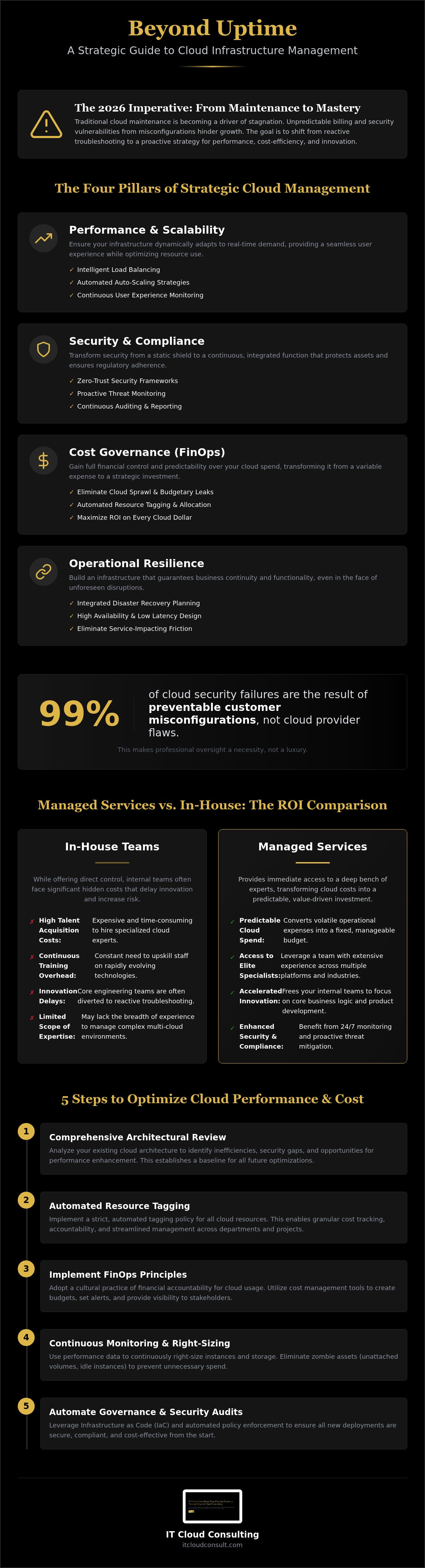
The "set and forget" mentality is a primary driver of cloud sprawl, where unmanaged resource consumption leads to massive budgetary leaks. When instances are left running without oversight, costs escalate without a corresponding increase in value. Security risks are even more critical. Industry research indicates that 99% of cloud security failures result from preventable customer misconfigurations rather than flaws in the cloud provider's systems. This reality makes professional oversight a necessity rather than a luxury. Strategic cloud management serves as the primary catalyst for organizational agility, transforming static infrastructure into a dynamic engine for growth.
The Four Pillars of Strategic Cloud Management
To move beyond basic upkeep, organizations must anchor their operations in four structural pillars. These pillars transform fragmented IT tasks into a cohesive strategy that drives long-term value. When you utilize professional cloud infrastructure management services, you aren't just paying for maintenance; you're investing in a framework designed for evolution. This framework consists of performance optimization, security and compliance, cost governance through FinOps, and operational resilience. Each pillar supports the next, creating a stable foundation for a national enterprise landscape.
Operational resilience ensures that your business remains functional regardless of unforeseen disruptions. Disaster recovery and business continuity planning are no longer "break-glass" scenarios; they're integrated components of the daily management lifecycle. By prioritizing high availability and low latency across all zones, you eliminate the friction that often plagues unmanaged environments. Achieving this level of cloud efficiency and optimization requires a commitment to maximizing resource utilization while simultaneously reducing the overhead that slows down innovation.
Performance and Scalability Management
Scalability is the pulse of a modern enterprise. Implementing intelligent load balancing and auto-scaling strategies allows your infrastructure to expand and contract based on real-time demand. It's not enough to have the capacity; you must have the agility to deploy it exactly when it's needed. Monitoring user experience metrics provides the data required to drive these infrastructure adjustments. This responsiveness is a core component of strategic cloud adoption, ensuring that your digital footprint grows in lockstep with your business objectives.
Security as a Continuous Management Function
Security is no longer a static shield but a continuous management function. Managing the Identity and Access Management (IAM) lifecycle ensures that permissions evolve alongside your personnel changes, preventing the "privilege creep" that leads to vulnerabilities. Automated threat detection provides real-time incident response, which is essential for maintaining national compliance standards across distributed networks. By implementing zero-trust architectures and continuous auditing, you protect your most valuable assets from both external threats and internal errors. If you're looking to strengthen your digital perimeter while maintaining peak efficiency, engaging with Ongoing Cloud Support can provide the steady assurance your team needs to focus on core growth.
Managed Services vs. In-House: The ROI Comparison
Deciding between building an internal team and partnering with an expert is a pivotal strategic choice that determines your organization's long-term agility. Building an internal team to manage a modern digital ecosystem often reveals hidden complexities that erode the expected ROI. While having direct control seems advantageous, the reality involves significant recruitment costs and the ongoing challenge of retaining cloud-native talent in a highly competitive market. When you opt for professional cloud infrastructure management services, you gain immediate access to a seasoned team without the overhead of internal training or the risk of talent churn. This shift allows your internal staff to focus on core innovation rather than the repetitive maintenance tasks that consume valuable resources.
The Talent Gap and Expertise Access
The talent gap is widening. Specialized cloud skills are increasingly difficult to source in-house, especially as multi-cloud environments become the standard for national enterprises. A strategic partner handles these complexities daily, bringing a depth of experience that an internal team might only encounter once or twice. Leveraging cloud infrastructure consulting for specialized audits ensures that your environment isn't just running, but is optimized against rigorous industry benchmarks. This access to advanced toolsets and proprietary management frameworks provides a level of oversight that's nearly impossible to replicate with a limited internal headcount.
Predictable vs. Unpredictable Operational Expenses
Predictability is the cornerstone of sustainable growth. Managed services replace variable internal overhead with fixed, transparent fees. This transition eliminates the "firefighting" culture where internal teams are diverted by emergency troubleshooting. By adopting a strategic framework for cloud infrastructure, organizations can achieve a lower Total Cost of Ownership (TCO). Expert oversight prevents the expensive misconfigurations discussed earlier, ensuring that your budget is allocated toward progress rather than correction. It's a move from reactive expense to proactive investment, providing the 24/7 coverage necessary for a national footprint without the logistical burden of internal shift management.
The opportunity cost of maintenance is often the most significant hidden expense. Every hour an engineer spends on patch management or resource tagging is an hour lost to developing new features or improving customer experiences. Managed providers offer a scalable solution that grows with your business, providing the resilience required for 2026 without the need for constant internal restructuring. This partnership transforms your IT department from a cost center into a strategic driver of organizational agility.
5 Steps to Optimizing Cloud Performance and Cost
Achieving peak efficiency in 2026 requires more than occasional adjustments; it demands a rigorous, five-step optimization roadmap. By utilizing professional cloud infrastructure management services, organizations can move beyond basic cost-cutting and toward a state of continuous improvement. To see how an AI-native operating system can further unify your technical and human resources, discover Trinity One. This structured approach ensures that every component of your digital ecosystem is architected for maximum impact and minimal waste.
- Step 1: Conduct a comprehensive cloud architecture review. You must establish a baseline by auditing your current resource distribution and identifying legacy configurations that no longer serve your strategic business goals.
- Step 2: Implement automated resource tagging and cost allocation. Granular visibility is essential. By tagging every asset, you can attribute costs to specific departments and eliminate the ambiguity that leads to budget overruns.
- Step 3: Rightsizing instances and utilizing spot/reserved capacity. Match your compute power to actual workload requirements. Utilizing reserved instances for stable loads and spot capacity for flexible tasks significantly reduces operational overhead.
- Step 4: Deploying AI-driven monitoring for predictive anomaly detection. Modern management uses machine learning to identify patterns that precede system failures, allowing for intervention before performance is impacted.
- Step 5: Establishing a continuous feedback loop for infrastructure evolution. Optimization is a cycle. Use the data gathered from monitoring to refine your architecture, ensuring your environment evolves alongside your organizational needs.
The FinOps Approach to Cloud Value
Strategic management involves a fundamental shift from monitoring "cloud spend" to maximizing "cloud value." This FinOps mindset focuses on identifying and eliminating orphaned resources and "zombie" instances that consume budget without providing utility. To master these advanced strategies, you can explore cloud optimization consulting for a deeper dive into enterprise-level efficiency. This proactive governance ensures that your infrastructure remains lean and purpose-driven, transforming your cloud from a utility into a competitive asset.
Automation and Infrastructure as Code (IaC)
Automation is the engine of modern scalability. By utilizing Infrastructure as Code (IaC), you can standardize your environments and ensure consistency across your entire national footprint. This approach reduces human error through automated deployment pipelines and guarantees that security protocols are baked into every new resource from the moment of creation. Automation allows for rapid scaling without increased complexity. If you're ready to transform your cost structure and performance profile, our team is ready to provide the Cloud Optimization services required to secure your competitive edge.
Elevating Your Operations with IT Cloud Consulting
IT Cloud Consulting operates as a visionary architect for your digital foundation, transcending the role of a traditional vendor to become a strategic partner in your success. Our methodology focuses on bridging the critical gap between complex technical environments and your organization's broader growth trajectory. By providing specialized managed cloud services, we empower leaders to move away from the burden of daily maintenance and toward a state of strategic confidence. We maintain a national presence, offering steady assurance to enterprises across the United States that their infrastructure is not merely a utility, but a catalyst for long-term development. This partnership ensures that technical processes are directly linked to organizational benefits, creating a clear cause-and-effect relationship between infrastructure health and business expansion.
Tailored Managed Cloud Support
Every business follows a unique trajectory, which is why our approach to cloud infrastructure management services is never one-size-fits-all. We develop customized management roadmaps that align with your specific operational requirements and scalability goals. This involves continuous monitoring and proactive performance tuning, ensuring that your systems remain operational and secure against evolving threats. Our goal is to future-proof your environment, allowing you to realize latent potential without being hindered by technical debt or architectural inefficiencies. By maintaining a supportive, client-centric orientation, we provide the technical proficiency required for execution while you focus on high-level innovation.
The Path Forward: Partnering for Modernization
The transition from a fragmented current state to an optimized future state requires a dependable guide who understands the nuances of modern systems. While internal teams often struggle with the 'big picture' perspective due to immediate operational demands, our consultants provide the strategic oversight necessary for evolution. Our advisory fees are structured to translate directly into long-term infrastructure efficiency, reducing waste and maximizing the ROI of your digital investments. We don't just keep the lights on; we architect a path forward that supports continuous modernization and the realization of new possibilities. This methodical and purposeful rhythm builds trust through clarity, leading your organization from a recognition of need to a clear understanding of the path forward.
The complexities of 2026 demand a partner who possesses both the technical proficiency and the strategic vision to execute at scale. Contact our architects today to begin your enterprise cloud transformation and secure a digital foundation built for sustainable growth.
Architecting Your Digital Future
Mastering the complexities of 2026 requires a deliberate transition from reactive maintenance to a robust framework of continuous optimization. You've explored how the four pillars of performance, security, cost, and resilience create the necessary foundation for sustainable growth. By adopting a sophisticated approach to cloud infrastructure management services, organizations can eliminate resource waste and secure their digital perimeters while empowering internal teams to focus on high-level innovation. This shift ensures that your technology remains a driver of value rather than a source of technical debt.
IT Cloud Consulting serves as your visionary architect in this journey, offering deep expertise in Strategic Cloud Adoption and a national managed support infrastructure. Our focus on enterprise modernization and ROI provides the steady assurance required to navigate a rapidly evolving landscape. We're committed to helping you realize your latent potential through a methodical, purposeful roadmap. Schedule a Strategic Cloud Consultation with IT Cloud Consulting to begin your transition to an optimized future state. Your path to excellence starts today.
Frequently Asked Questions
What is the difference between cloud management and cloud monitoring?
Cloud monitoring is the passive observation of system performance, while management is the active administration and governance of the entire environment. Monitoring provides the raw data, but management uses that data to make strategic decisions. Effective cloud infrastructure management services involve provisioning resources, optimizing costs, and enforcing security policies. While monitoring tells you a problem exists, management involves the technical processes and expertise required to resolve it and prevent its recurrence.
How can cloud infrastructure management services reduce my monthly bill?
These services reduce costs by identifying and eliminating "zombie" instances and orphaned resources that consume budget without providing value. Specialists use rightsizing techniques to match compute capacity with actual workload demands, preventing expensive over-provisioning. Additionally, management partners implement automated tagging and cost allocation. This visibility allows for the strategic use of reserved instances and spot capacity, which significantly lowers the Total Cost of Ownership compared to unmanaged environments.
Does my business need a managed service provider for a single-cloud environment?
Even single-cloud environments possess inherent complexities that require professional oversight to maintain peak performance. Misconfigurations are the leading cause of security breaches, regardless of how many providers you use. A managed partner provides the visionary perspective and technical proficiency needed to ensure your architecture remains secure and efficient. This support allows your internal team to focus on core innovation rather than being bogged down by routine patch management and troubleshooting.
What security protocols are included in managed cloud infrastructure services?
Comprehensive management includes the implementation of zero-trust architectures and continuous auditing of your digital perimeter. Identity and Access Management lifecycle oversight ensures that permissions are strictly controlled and updated as personnel change. Additionally, services include automated threat detection and real-time incident response to mitigate risks. These protocols are designed to protect sensitive data through encryption and rigorous compliance monitoring, ensuring your infrastructure meets national security standards and remains future-proof.
How do management services handle multi-cloud or hybrid-cloud environments?
Management services provide a centralized governance framework that abstracts the complexities of different cloud providers into a single operational view. This ensures consistency in security policies and performance standards across diverse platforms. By using Infrastructure as Code, partners can standardize deployments regardless of the underlying provider. This approach eliminates operational silos and allows for seamless data portability, enabling your business to scale across multiple environments without increasing the complexity of your daily operations.
Can cloud management services help with regulatory compliance like SOC2 or HIPAA?
Yes, professional management is essential for maintaining continuous compliance with rigorous standards like SOC2 or HIPAA. Partners implement automated auditing tools that track every change within the environment, providing the documentation required for official reviews. This proactive approach ensures that your security configurations always align with legal requirements. By integrating compliance into the daily management lifecycle, you reduce the risk of costly violations and secure the trust of your clients through steady assurance.
What is the typical onboarding process for a cloud management partner?
Onboarding typically begins with a deep-dive discovery phase and a comprehensive audit of your existing architecture. This baseline allows the partner to identify immediate optimization opportunities and security gaps. Following the audit, a customized management roadmap is developed to align technical processes with your organizational goals. The final stage involves the seamless integration of monitoring tools and governance protocols, establishing a steady rhythm of proactive support and continuous infrastructure evolution for long-term growth.


