
With global enterprise cloud spending reaching $143 billion in the second quarter of 2026, the real risk isn't staying on-premise; it's migrating without a map. You've likely seen the headlines about AI driving nearly a fifth of all cloud costs, and you understand that a comprehensive cloud readiness assessment is essential for maintaining a competitive edge. Most leaders recognize that legacy systems harbor hidden technical debt, and the uncertainty of security compliance or team skill gaps can turn a strategic move into a financial burden.
This guide provides a strategic framework to evaluate your technical, financial, and organizational preparedness, ensuring a high-ROI transition to cloud-native environments. By following this methodical approach, you'll gain a clear roadmap for modernization that minimizes migration risks while aligning IT performance with business objectives. We will examine how to audit existing infrastructure, manage cloud economics, and prepare your culture for a seamless evolution into the digital future.
Key Takeaways
- A comprehensive cloud readiness assessment acts as a strategic shield against unexpected costs, ensuring that your migration path is financially sustainable from day one.
- Recognize that technical infrastructure is only one component of success, as we detail the organizational and cultural pillars required for a truly modern enterprise.
- Master the "6 Rs" of migration to effectively balance the immediate need for rehosting with the long-term benefits of refactoring legacy applications.
- Implement a methodical five-step checklist to map dependencies and establish the success metrics needed to align your technical evolution with broader business goals.
- Learn how to leverage professional insights to transition from a state of technical debt to a future of continuous cloud optimization and high-ROI performance.
Cloud Readiness Assessment: Why It's Critical in 2026
A cloud readiness assessment is no longer a luxury for the risk-averse; it's a diagnostic necessity for the modern enterprise. In 2026, the transition to the cloud has moved beyond simple server migration toward the creation of agentic, AI-driven ecosystems. A true assessment isn't just a technical scan of your current hardware. It's a holistic evaluation of your technical and business maturity, determining if your organization is prepared to thrive in a cloud-native environment. While a basic inventory counts your assets, a strategic readiness audit evaluates how those assets serve your long-term vision.
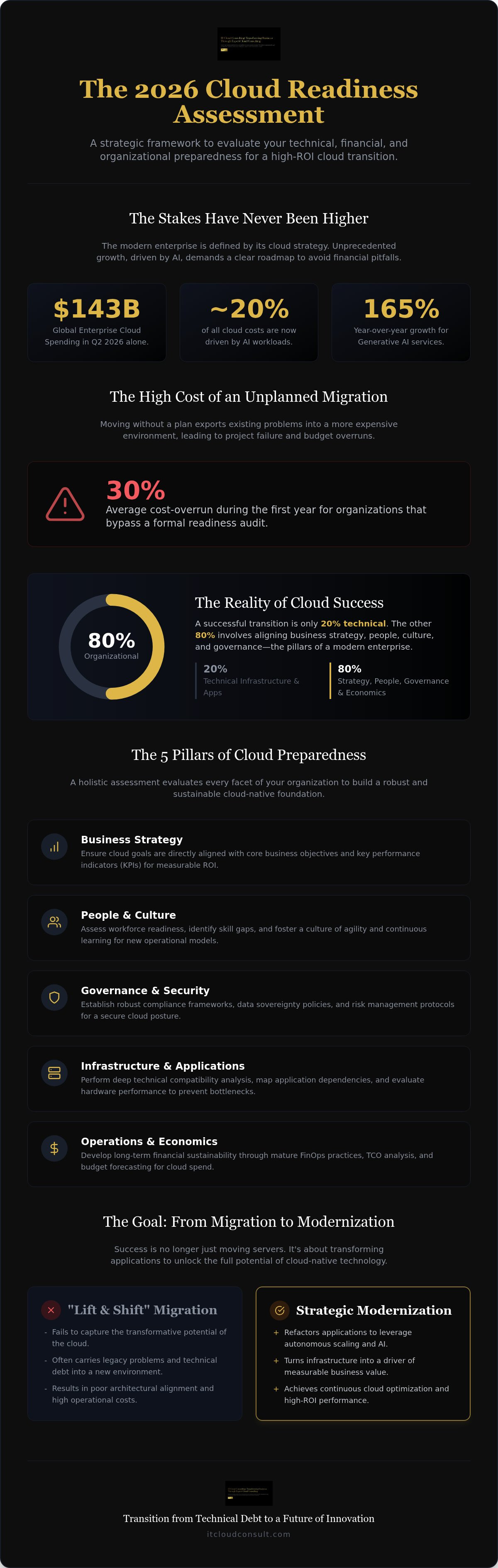
The 2026 landscape is defined by unprecedented growth in cloud infrastructure spending, which reached $143 billion in the second quarter alone. Much of this is driven by generative AI services that are growing at a rate of 165% year-over-year. Without a clear framework, businesses often fall victim to "cloud bill shock" as AI workloads consume budgets at a pace that traditional financial models can't track. A rigorous assessment acts as your primary defense, aligning your infrastructure with the economic realities of modern computing.
The High Cost of Skipping the Assessment
Moving legacy systems without a plan often exports existing problems into a more expensive environment. Unmanaged technical debt and hidden security vulnerabilities are the primary drivers of "cloud stall," a phenomenon where migration projects lose momentum and eventually stop due to unforeseen complexities. When interdependencies aren't mapped, the resulting friction creates operational bottlenecks that erode the very efficiency you're trying to gain. Organizations that bypass a formal audit frequently face a 30% cost-overrun during their first year of operation due to poor architectural alignment.
From Migration to Modernization: A 2026 Perspective
The standard for success has evolved. Competitive enterprises have moved away from "lift and shift" strategies because they fail to capture the transformative potential of the cloud. Modernization is now the goal. This involves a deep look at Software Modernization to ensure applications are refactored to leverage autonomous scaling and integrated AI capabilities. This shift from simple hosting to active modernization is a core element of our Strategic Cloud Adoption pillar, which focuses on turning infrastructure into a driver of measurable business value.
The 5 Pillars of Organizational Cloud Preparedness
A thorough cloud readiness assessment transcends simple server inventory. While technical compatibility is essential, it typically represents only 20% of the effort required for a successful transition. The remaining 80% involves aligning business strategy, governance, human capital, and operational economics with the new environment. By evaluating these five pillars, organizations can establish a robust Cloud Center of Excellence (CCoE) that bridges the gap between IT and executive leadership. Partnering with IT Cloud Consulting ensures these interdependencies are managed with a visionary perspective, transforming raw data into a strategic roadmap.
Every holistic assessment must cover these essential categories:
- Business Strategy: Alignment of cloud goals with organizational KPIs.
- People and Culture: Readiness of the workforce for new operational models.
- Governance and Security: Compliance and risk management frameworks.
- Infrastructure and Applications: Technical compatibility and dependency mapping.
- Operations and Economics: Long-term financial sustainability and FinOps maturity.
Infrastructure and Application Portfolio
Before moving, you must evaluate hardware performance, network latency, and complex application dependencies. This phase involves identifying "low-hanging fruit" like stateless web apps versus high-complexity legacy systems that require significant rework. We assess each asset's compatibility with modern containerization and serverless architectures to maximize efficiency. When assessing cloud readiness, efficiency must be a primary acceptance criterion to avoid bloating your operational footprint. By mapping these dependencies early, you prevent the performance degradation that often plagues rushed migrations.
Data Sovereignty and Security Posture
In the 2026 landscape, regulatory compliance is non-negotiable. An audit must account for data storage requirements and regional mandates like GDPR or HIPAA. Identifying security gaps before they reach the public cloud is the only way to maintain a resilient posture. For a granular breakdown of these requirements, review our Cloud Security Assessment Checklist. This proactive approach ensures your modernization efforts don't compromise your integrity. Our process identifies vulnerabilities in legacy protocols that could become critical liabilities in a cloud-native environment.
People and Cultural Readiness
The human element is often the most significant hurdle in any digital transformation. A successful cloud readiness assessment evaluates the internal skills gap, distinguishing between traditional on-premise expertise and necessary cloud-native skills. Addressing organizational resistance to change is vital for moving from rigid IT silos to a collaborative DevOps culture. Transitioning your workflows is a complex evolution, but it's one where professional guidance can turn potential friction into organizational momentum. We focus on empowering your team to embrace automation, ensuring your staff evolves alongside your technology.
Evaluating Technical Debt vs. Modernization Potential
Identifying the difference between being "ready to move" and "ready to thrive" is the core objective of a modern cloud readiness assessment. In the 2026 landscape, technical debt functions as a compounding tax on your innovation pipeline, diverting resources from growth toward the maintenance of brittle, legacy architectures. While many organizations focus on the mechanics of the move, a strategic audit evaluates the modernization potential of each asset within the 6 Rs framework: Rehost, Replatform, Refactor, Retire, Retain, and Relocate. This diagnostic process ensures that you aren't simply relocating existing inefficiencies into a more expensive environment.
Maximizing long-term ROI requires a deep understanding of how cloud-native services, such as serverless functions and managed databases, can replace legacy components. This isn't a binary choice between old and new; it's a calculated transition based on business value. Resources like the World Bank Cloud Readiness Toolkit highlight how comprehensive diagnostics are essential for planning infrastructure that supports sustainable growth. By quantifying the technical debt of your current portfolio, we help you prioritize which applications deserve the investment of a full refactor and which should be retired to make room for innovation.
The "Lift and Shift" Trap
Rehosting, or "lift and shift," is often viewed as the fastest path to the cloud, yet it frequently results in higher operational costs and stagnant performance. Moving legacy problems without optimization means you continue to pay for over-provisioned resources and manual intervention. However, rehosting remains a valid temporary step during urgent data center exits or when a specific application has a limited remaining lifespan. A rigorous cloud readiness assessment identifies these scenarios early, allowing you to build a post-migration optimization plan that captures efficiency gains immediately after the initial transition.
Architecting for Modernization
True transformation occurs when you move beyond hosting and begin architecting for scalability and resilience. Refactoring applications to utilize microservices or container orchestration allows your infrastructure to respond dynamically to market demands. This process requires a sophisticated evaluation of the effort-to-value ratio, ensuring that complex transformations align with your most critical business objectives. For organizations seeking specific guidance on these architectural shifts, our expertise in Cloud Infrastructure Consulting provides the roadmap necessary to transition from legacy constraints to a flexible, cloud-native future. We focus on creating a steady pace of evolution that respects your operational limits while pushing toward an optimized end-state.
Your Cloud Readiness Assessment Checklist: 5 Essential Steps
Transitioning to a cloud-native environment requires a disciplined, multi-phase methodology. This cloud readiness assessment checklist provides the architectural framework necessary to move from conceptual vision to operational reality. By following these structured steps, your organization can identify potential friction points before they impact your bottom line, ensuring that every phase of modernization contributes to your broader business objectives.
Step 1: Aligning Cloud with Business Strategy
Successful modernization starts with a clear articulation of the "Why." Organizations must determine if their primary driver is radical cost reduction, increased operational agility, or the rapid deployment of AI-driven innovation. Establishing Key Performance Indicators (KPIs) early ensures that every technical decision serves a measurable business outcome. This phase requires active engagement across the C-suite, ensuring that executive leadership and IT are perfectly synchronized on the definition of success. Without this alignment, even the most technically sound migration can fail to deliver organizational value.
Once the strategy is set, the focus shifts to a comprehensive inventory and dependency mapping. This technical deep-dive uncovers the hidden links between legacy applications and data silos, preventing the service interruptions that often occur during poorly planned migrations. Following this, a gap analysis evaluates the technical, financial, and skills-based requirements of your future state. This diagnostic identifies where your team needs upskilling and where your infrastructure requires refactoring to meet the high-performance standards of 2026.
Step 4: Establishing a FinOps Foundation
Financial transparency is the cornerstone of sustainable cloud growth. You must project anticipated cloud spend against your current on-premise Total Cost of Ownership (TCO) to build a realistic business case. Establishing cost-governance from day one allows your organization to scale without the fear of bill shock. For a detailed breakdown of these cost-saving frameworks, refer to our guide on Cloud Optimization Consulting. This step ensures that your financial model is as resilient as your architecture, providing a clear view of your long-term ROI.
The final step is the creation of a modernization roadmap and execution strategy. This document serves as your tactical guide, detailing the sequence of events, resource allocation, and risk mitigation plans required for a seamless transition. A well-constructed roadmap transforms the complexities of migration into a series of manageable, high-impact milestones. To begin your journey with a professional diagnostic, you can schedule a comprehensive cloud readiness assessment with our expert team today. We help you bridge the gap between where you are and where your enterprise needs to be.
Partnering for Strategic Cloud Adoption
Internal teams possess deep institutional knowledge, yet they often lack the objective distance required to identify systemic inefficiencies or cultural bottlenecks that can derail a migration. A professional cloud readiness assessment provides the unbiased scrutiny necessary to validate internal assumptions and uncover hidden risks before they manifest as costly delays. IT Cloud Consulting serves as both a visionary architect and a dependable guide, translating complex technical data into a cohesive strategy that aligns with your long-term trajectory. We don't just provide a diagnostic report; we bridge the gap between raw data and strategic action, ensuring your modernization efforts are rooted in operational reality and high-level business goals.
Our approach positions the business as a reliable partner in your long-term development rather than a mere vendor. By acting as a strategic consultant, we help you navigate the intricate interdependencies between legacy systems and modern cloud-native architectures. This partnership ensures that the findings from your initial assessment lead directly to measurable results in Cloud Optimization and Ongoing Cloud Support. We focus on the concept of evolution, helping you realize the latent potential within your infrastructure while maintaining a steady, purposeful rhythm of progress toward a more advanced future state. For mission-driven organizations, incorporating strategic growth advisory for nonprofits ensures these technical advancements are fully aligned with long-term social impact and sustainability goals.
Modernization is not a fixed destination but a continuous cycle of refinement and growth. Once the initial transition is complete, the focus shifts toward managing the entire modernization lifecycle to ensure your environment remains resilient. The value of Ongoing Cloud Support lies in its ability to provide persistent monitoring and management, allowing your team to focus on innovation rather than maintenance. We support organizations through this evolution by offering managed services that adapt to the shifting demands of the 2026 digital landscape. This steady assurance empowers your enterprise to scale with confidence, knowing that your cloud foundation is monitored by seasoned experts.
Take the Next Step in Your Cloud Journey
The transformative power of a well-executed cloud readiness assessment lies in its ability to turn organizational uncertainty into a distinct competitive advantage. By evaluating your technical, financial, and organizational preparedness today, you secure a foundation for high-ROI performance and continuous innovation. We invite you to take the first step toward a secure, optimized future by engaging in a professional consultation. Our team is dedicated to driving operational efficiency and helping you achieve the strategic alignment necessary for success. Align your infrastructure with your highest business aspirations and begin your journey toward a modernized, cloud-native enterprise today.
Architecting Your Future Through Strategic Modernization
The transition from legacy systems to cloud-native agility requires more than just technical aptitude; it demands a holistic vision that aligns culture, economics, and infrastructure. By prioritizing a cloud readiness assessment, you move beyond the risks of unmanaged technical debt and position your organization to capture the full benefits of modern scalability. This methodical approach ensures that your migration is a driver of innovation rather than a source of financial friction. Each step of the diagnostic process serves to secure your competitive standing in an increasingly automated marketplace.
We provide expert advisory for complex multi-cloud environments, crafting comprehensive modernization roadmaps focused on long-term ROI. Our commitment extends from the initial diagnostic phase to full-lifecycle support and managed operations, ensuring your evolution is steady and purposeful. We invite you to Schedule Your Strategic Cloud Readiness Assessment today to begin your journey toward a more efficient enterprise. With a dependable guide by your side, your organization can confidently navigate these complexities and realize its latent potential in the 2026 digital landscape.
Frequently Asked Questions
How long does a typical cloud readiness assessment take?
A comprehensive cloud readiness assessment generally spans four to twelve weeks, depending on the scale of your infrastructure and the complexity of your application portfolio. Smaller organizations with centralized IT may conclude the process more quickly, while global enterprises with extensive legacy systems require more time for dependency mapping. This duration ensures a thorough evaluation of technical, financial, and cultural factors, providing a reliable foundation for your modernization roadmap.
Can we perform a cloud readiness assessment ourselves?
While internal teams can conduct a preliminary review, an independent cloud readiness assessment provides the objective distance necessary for strategic success. In-house staff often possess deep institutional knowledge but may overlook systemic inefficiencies or cultural roadblocks. A professional third-party evaluation validates internal assumptions and uncovers hidden technical debt, ensuring that your transition is guided by industry best practices and a visionary perspective on long-term growth.
What are the most common gaps identified during an assessment?
Assessments frequently reveal critical gaps in cloud-native technical skills, unmanaged technical debt within legacy codebases, and misaligned security compliance frameworks. Organizations often discover that their current operational workflows are too rigid for the dynamic nature of cloud environments. Identifying these friction points early allows for targeted upskilling and architectural refactoring, preventing the operational stall that occurs when unforeseen complexities interrupt the migration process during its execution phase.
How much does a professional cloud readiness assessment cost?
The investment for a professional assessment varies based on the scope of the infrastructure and the number of applications being evaluated. Rather than a fixed fee, costs are typically scaled to the organizational complexity and the depth of the diagnostic required. It's best to consult with a strategic partner to define a scope that aligns with your modernization goals, ensuring the assessment provides a high-ROI roadmap for your specific enterprise needs.
What is the difference between a cloud assessment and a cloud audit?
A cloud assessment is a forward-looking, strategic evaluation designed to determine your organization's potential for modernization and growth. It focuses on identifying opportunities for efficiency and innovation. In contrast, a cloud audit is typically a retrospective compliance check focused on adherence to specific security, regulatory, or financial standards. While an audit ensures you meet existing benchmarks, an assessment builds the architectural framework necessary for your future digital evolution.
What happens if our organization is found not ready for the cloud?
Being identified as not ready isn't a failure; it's a vital diagnostic that prevents costly migration errors. If the cloud readiness assessment uncovers significant gaps, the resulting roadmap prioritizes the remediation of technical debt and the development of internal skills. This phase allows you to stabilize your infrastructure and align business goals before committing to a full-scale transition. It ensures your eventual move is strategically sound rather than a rushed, expensive relocation.
How do we measure the ROI of a cloud readiness assessment?
You can measure the ROI of an assessment by calculating the cost avoidance of failed migrations and the reduction in post-migration bill shock. A well-executed assessment accelerates your time-to-market by identifying the most efficient migration paths, such as refactoring versus rehosting. By mitigating risks early and aligning technical processes with business outcomes, the diagnostic ensures that every dollar spent on cloud infrastructure contributes directly to operational efficiency and long-term organizational value.


