
The most expensive cloud consulting contract isn't the one with the highest hourly rate; it's the one that fails to link its cost to your infrastructure's performance. Many enterprise leaders have come to accept unpredictable monthly bills and vague deliverables as an unavoidable tax on innovation. You've likely experienced the frustration of seeing operational costs climb while the promised efficiency gains remain disconnected from your actual business outcomes. It's a common struggle to find a partner whose fees scale in lockstep with your organization's technological evolution.
We believe that your investment should be a catalyst for modernization rather than a drain on resources. This guide empowers you to master the nuances of cloud consulting pricing models, transforming your technology spend from an opaque expense into a strategic engine for growth. By aligning financial frameworks with long term objectives, you can secure a predictable billing structure that rewards optimization and architectural excellence. We will explore how to transition from traditional hourly billing to sophisticated, value driven models that ensure a direct correlation between consulting fees and tangible infrastructure savings, providing a clear path toward sustainable cloud maturity.
Key Takeaways
- Understand the critical distinction between cloud billing and professional fees so it's easier to prevent hidden costs from inflating your budget.
- Identify the scenarios where fixed-fee structures offer more financial certainty than hourly engagements during complex security audits.
- Evaluate advanced cloud consulting pricing models that link professional compensation directly to your realized infrastructure savings.
- Align your contract framework with your cloud maturity level to ensure your support doesn't remain static as your technology evolves.
- Discover how strategic optimization acts as a self-funding mechanism that transitions high migration costs into a predictable operational spend.
Navigating the Economics of Cloud Transformation
Enterprises often conflate their monthly hyperscaler invoices with the professional investment required to manage them. While your cloud bill represents raw resource consumption, cloud consulting pricing models reflect the strategic expertise needed to ensure those resources drive business value. Without this distinction, organizations risk overspending on unoptimized environments while underinvesting in the architectural guidance that prevents financial leakage. Choosing the right cloud consulting pricing models ensures that your advisory fees are an investment in future efficiency rather than just another administrative cost.
Professional advisory fees function as a critical insurance policy against the systemic risks of migration failure. By establishing a robust FinOps culture early, consultants move beyond simple cost cutting to create a framework of financial accountability. This shift ensures that every dollar spent on cloud resources is directly tied to a performance outcome. Choosing the least expensive consulting option often results in the highest long term cloud bill because it lacks the depth of analysis required to eliminate persistent inefficiencies.
The Interdependence of Infrastructure and Advisory Costs
The relationship between technical design and financial performance is absolute. Poor architectural choices, such as selecting the wrong instance types or neglecting serverless opportunities, lead to compounding monthly costs that dwarf initial project fees. Engaging in expert cloud infrastructure consulting reduces your total cost of ownership by building efficiency into the foundation of your digital environment. Strategic roadmap development provides several critical benefits for your budget:
- Alignment of resource provisioning with actual workload demand.
- Elimination of redundant services through consolidated architectural design.
- Predictable scaling pathways that prevent "bill shock" during growth phases.
- Early identification of high cost legacy patterns that don't translate well to cloud environments.
The Hidden Costs of Traditional IT Procurement
Traditional procurement often focuses on "lift and shift" migrations that replicate on-premise inefficiencies in the cloud. This approach inevitably leads to the creation of "zombie resources", which are idle instances that continue to accrue costs without providing utility. In the 2026 cloud landscape, where workloads are viewed as fluid operating models rather than static destinations, the transition from capital expenditure (Capex) to operational expenditure (Opex) requires a more sophisticated approach to management consulting. Effective consulting models identify over-provisioned assets and re-architect workloads to ensure your infrastructure evolves alongside your strategic needs, transforming latent technical potential into measurable organizational progress.
Standard Engagement Frameworks: Time, Materials, and Fixed-Fee Structures
While the industry moves toward outcome-based incentives, traditional cloud consulting pricing models remain the foundational choice for many enterprise initiatives. These frameworks provide a clear baseline for engagement, allowing organizations to match their procurement style with the specific nature of their technical needs. Whether you require a flexible discovery phase or a tightly defined migration, understanding the mechanics of these structures is essential for maintaining budgetary control. Selecting the wrong framework often leads to friction between technical requirements and financial constraints, potentially stalling your modernization efforts.
When to Utilize Time and Materials
The Time and Materials (T&M) model is most effective during the initial stages of cloud adoption or when resolving complex, unforeseen technical debt. Because the total scope of work is often difficult to quantify during a discovery phase, T&M allows for the fluid exploration of your environment without the constraints of a rigid contract. Research indicates that general cloud consulting rates in North America typically range from $100 to $149 per hour, though specialized roles like security engineers can command over $350 per hour. Time and Materials is a flexible but high-oversight framework that requires disciplined reporting to ensure project velocity remains high. You can mitigate the inherent risks of T&M by implementing strict milestone tracking and weekly burn-rate reviews to keep the investment aligned with progress.
The Strategic Advantage of Fixed-Fee Projects
Fixed-fee models provide the highest level of cost predictability for clearly defined initiatives such as security audits or specific workload transitions. This structure effectively transfers the risk of technical overruns from your organization to the consultant, as the price is locked in against a specific set of deliverables. It's an ideal choice when executing a business cloud migration plan where the destination and requirements are well documented. Data from project reviews shows that these engagements frequently fall within the $10,000 to $49,999 range for mid-market integrations. For this model to succeed, a comprehensive Scope of Work (SOW) is mandatory to prevent scope creep from diluting the value of the engagement.
Managed Support: Predictable Monthly Operations
Transitioning from project-based fees to a retainer model ensures your infrastructure receives the continuous monitoring and proactive maintenance required for long term security. These managed cloud services stabilize your operational spend by replacing erratic troubleshooting costs with a steady monthly baseline. As your cloud footprint grows, this support scales with your maturity, providing a dependable guide for your ongoing evolution. If you're looking to bridge the gap between initial adoption and long term efficiency, partnering with a strategic firm like IT Cloud Consulting can help you architect a support model that evolves alongside your business goals.
Strategic Value-Based and Outcome-Driven Pricing Models
Performance-linked fees are becoming a hallmark of high maturity engagements. By tying consulting compensation to specific technical benchmarks, such as system uptime or transaction speed, organizations ensure their advisors are incentivized to build for excellence. This approach eliminates the conflict of interest inherent in models that reward time spent rather than results achieved. It creates a purposeful rhythm where technical processes are directly linked to organizational benefits, fostering a sense of steady assurance during complex transitions.
Implementing a Gain-Share Optimization Strategy
One of the most compelling frameworks in modern consulting is the gain-share model, where fees are calculated as a percentage of the actual cloud savings achieved. This approach allows cloud optimization consulting to become a self-funding initiative. By establishing rigorous baselines of your "before and after" cloud spend, you create a transparent environment where the consultant's success is tied to your financial efficiency. This model requires a psychological shift from both parties; it replaces the traditional vendor-client transaction with a partnership focused on maximizing every dollar of your cloud investment. It's a logical path forward for enterprises looking to realize the latent potential of their existing infrastructure without increasing their upfront capital outlays.
Outcome-Based Engagements for Modernization
Beyond simple cost reduction, outcome-based engagements prioritize broader business objectives such as accelerating time-to-market or enhancing system resilience. These models move the needle from "getting to the cloud" to "thriving in the cloud" by measuring the ROI of strategic cloud adoption through business KPIs. For instance, a successful modernization effort might be defined by a 30% reduction in deployment cycles or a significant increase in concurrent user capacity. Success in these frameworks depends on high levels of data transparency and mutual trust. Both parties must agree on the specific metrics that define success, ensuring that your technology spend isn't just an overhead, but a measurable driver of competitive advantage and long term growth.
Selecting the Optimal Model for Your Cloud Maturity Level
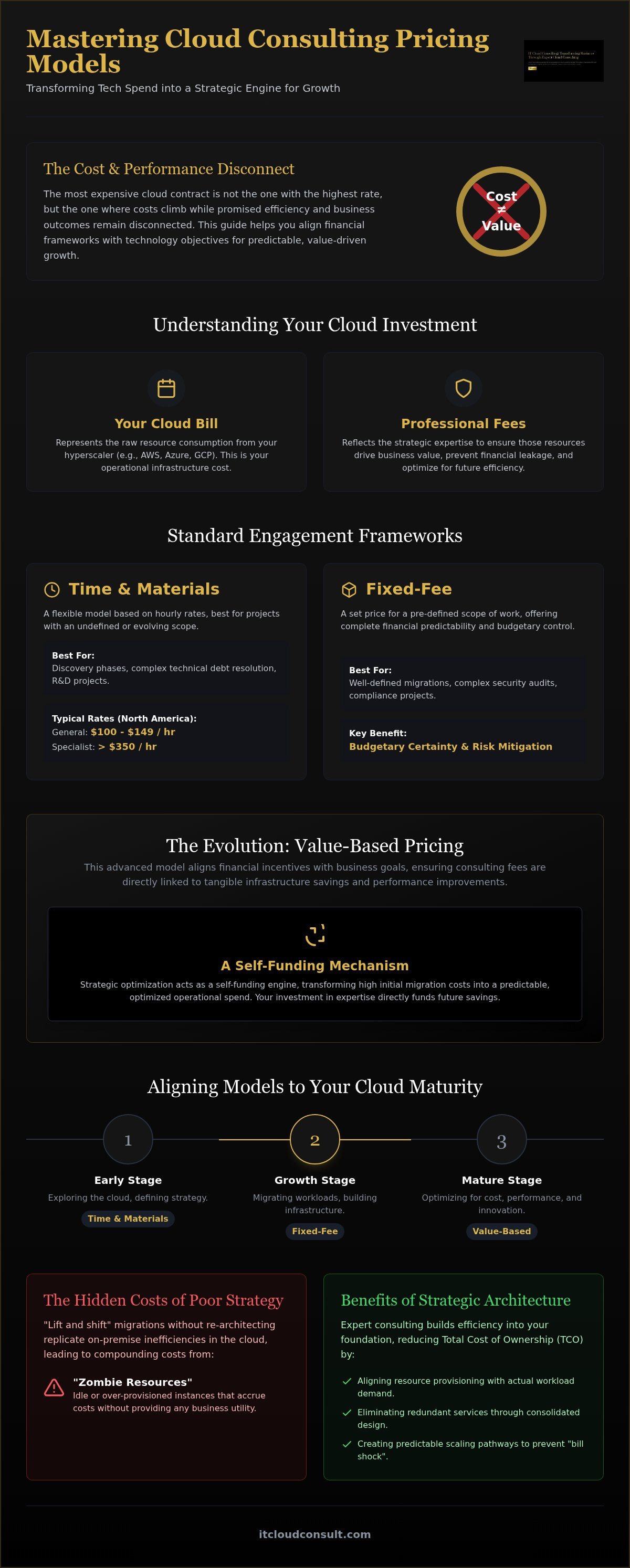
Strategic alignment requires matching your contract structure to the current stage of your cloud journey. As an organization evolves, its appetite for risk and its requirement for flexibility shift. Using the same cloud consulting pricing models for a complex migration that you utilized for an initial discovery phase often results in a misalignment between effort and expense. By selecting a framework that reflects your current phase, you ensure that every dollar invested supports a specific stage of technological evolution.
During Phase 1 (Discovery and Planning), fixed-fee assessments or Time and Materials models provide the necessary room to explore technical debt and architectural requirements without the pressure of a locked scope. Once you transition to Phase 2 (Execution and Migration), moving to milestone-based payments or fixed-price blocks ensures that costs remain tied to tangible progress. This methodical approach builds trust through clarity. As you reach Phase 3 (Optimization), gain-share or value-based models become more effective, as the focus shifts from basic functionality to maximizing ROI. Finally, Phase 4 (Steady State) involves transitioning to managed service retainers, allowing you to move from high upfront project costs to a predictable operational spend.
Maturity Assessment: Where is Your Organization?
Identifying whether your organization is a "Cloud Novice" or a "Cloud Native" is vital for selecting the right pricing model. Novices often require advisory-heavy engagements with fixed-cost roadmaps to provide a sense of steady assurance during their initial transition. These organizations need a guide to help them avoid the pitfalls of over-provisioning. In contrast, Cloud Natives focus on refined performance and benefit from managed support retainers that provide continuous monitoring and security. This evolution allows you to realize latent potential while maintaining a formal corporate register of expenses that scales alongside your footprint.
The RFP Process: Asking the Right Pricing Questions
When evaluating potential partners, move beyond the standard question of hourly rates. Instead, ask how the consultant defines value and what specific tools they use to ensure billing transparency. Red flags often include a lack of scalability in the proposed model or hidden "integration fees" that aren't clearly documented in the initial Scope of Work. You should also evaluate whether the consultant’s reporting tools provide real-time visibility into the project's burn rate. To ensure your financial framework supports long term growth, you should partner with a strategic cloud consultant who prioritizes transparent alignment and architectural excellence from the outset.
IT Cloud Consulting: Architecting Cost-Effective Cloud Evolution
At IT Cloud Consulting, we recognize that technology is merely the vehicle for organizational advancement. Our commitment to transparent, strategic alignment ensures that every engagement begins with a shared understanding of your long term objectives. We bridge the gap between technical assessment and business growth by architecting solutions that prioritize efficiency and scalability. For national enterprises seeking modernization, we provide customized frameworks that transform complex infrastructure into a streamlined competitive asset. Our cloud consulting pricing models are designed to reflect this philosophy, moving away from opaque billing toward a structure that emphasizes value and clarity.
This journey requires a partner that understands the intricacies of a national scale deployment. We ensure that your investment is protected through every phase of development, providing the expertise needed to navigate the evolving regulatory and technical landscape. Our continuous support is not a static service; it evolves with your enterprise cloud transformation roadmap, ensuring that your architectural choices remain aligned with your financial goals. By integrating these cloud consulting pricing models into your broader strategy, we help you realize the latent potential of your digital environment while maintaining strict budgetary control.
A Strategic Partnership Approach
We position ourselves as a visionary architect for your business, possessing both the high level perspective and the technical proficiency required for execution. Our advisory and managed services go beyond simple maintenance; they drive operational efficiency by identifying latent potential within your existing systems. We don't believe in one-size-fits-all solutions. Instead, we focus on driving innovation through a tailored approach that respects your unique maturity level. The next logical step for your organization is to schedule a strategic cloud readiness assessment to identify immediate opportunities for optimization and growth.
Continuous Value Delivery
Our "steady assurance" model provides the ongoing technical assistance required to maintain a secure and high performing environment. We take a proactive stance on system health, ensuring that your cloud infrastructure remains operational and cost-optimized as your organization grows. By focusing on the realization of technical potential, we help you transition from the burden of high upfront migration costs to a predictable and manageable operational spend. To secure your future growth and architectural excellence, engage with IT Cloud Consulting for a tailored pricing framework that aligns with your specific organizational objectives.
Architecting Your Financial Future in the Cloud
Modernizing your infrastructure requires more than just technical migration; it demands a sophisticated financial framework that incentivizes efficiency and long term growth. By mastering various cloud consulting pricing models, you can transition from unpredictable monthly expenses to a strategic investment that rewards architectural excellence. We've explored how choosing between fixed-fee certainty and performance-linked incentives depends entirely on your current stage of maturity and specific organizational goals.
Securing this alignment ensures that your technology spend acts as a catalyst for evolution rather than a static overhead. We provide the authoritative strategic guidance required for national enterprises to thrive in a complex digital landscape. Through expert assessment and continuous optimization services, we help you realize the latent potential of your environment while providing comprehensive managed support for long term operational efficiency.
If you're ready to align your infrastructure costs with your broader business vision, Partner with IT Cloud Consulting for a Strategic Pricing Assessment. Together, we can build a scalable and predictable path forward for your organization.
Frequently Asked Questions
How much does cloud consulting typically cost for an enterprise migration?
Industry data from Clutch (August 2026) indicates that most cloud consulting projects fall between $10,000 and $49,999. However, large scale enterprise migrations involving complex data gravity and multi-cloud architectures often exceed these baseline figures. Your specific investment depends on the scope of the architectural redesign and the level of specialized expertise required, such as Kubernetes architects or FinOps specialists who command higher market rates for their specific technical proficiency.
What is the difference between a cloud retainer and a fixed-price project?
A fixed-price project is a one-time engagement defined by a specific Scope of Work, such as a security audit or a discrete workload migration. In contrast, a cloud retainer provides ongoing access to advisory and managed support services over a set period. Retainers ensure continuous system health and long term security, whereas fixed-price projects focus on delivering a singular outcome within a locked budgetary framework. Both are essential components of cloud consulting pricing models.
Is value-based pricing better than hourly billing for cloud optimization?
Value-based pricing is often superior for optimization because it aligns the consultant's incentives with your organizational efficiency. Hourly billing rewards time spent, which can inadvertently discourage rapid resolution or innovative cost-cutting. Value-based models focus on the tangible impact created, such as improved time-to-market or increased system resilience. This approach transforms the engagement from a mere vendor transaction into a strategic partnership that prioritizes the realization of your infrastructure's latent potential.
Can I switch pricing models mid-way through a cloud transformation?
Yes, transitioning between models is a common strategy as your cloud maturity evolves. You might begin with a Time and Materials framework during a high-uncertainty discovery phase and then shift to fixed-price blocks once the migration roadmap is clearly defined. As you move into steady-state operations, transitioning to a managed service retainer provides the predictable operational spend required for long term stability. This flexibility ensures your financial framework remains aligned with your technical requirements.
What are the hidden costs to look for in a cloud consulting contract?
Hidden costs often emerge in the form of integration fees for legacy systems, data egress charges during migration, or additional licensing requirements for third-party optimization tools. You should also scrutinize the contract for vague clauses regarding scope creep or emergency support. A professional engagement should provide a transparent breakdown of all potential expenses, ensuring that your cloud consulting pricing models don't contain unforeseen liabilities that could disrupt your long-term budgetary roadmap.
How do managed cloud support fees differ from basic IT maintenance?
Strategic consulting directly impacts your hyperscaler invoices by identifying zombie resources and right-sizing over-provisioned instances. By re-architecting workloads for efficiency, consultants can significantly lower your monthly resource consumption. For example, moving from monolithic structures to serverless or containerized environments often leads to substantial savings. These technical refinements ensure that your cloud spend is a purposeful investment in performance rather than a drain on your operational resources.
What is a gain-share model in the context of cloud FinOps?
A gain-share model is a performance-driven arrangement where consulting fees are calculated as a percentage of the actual savings realized through optimization. This self-funding framework incentivizes the consultant to find the most aggressive and effective ways to reduce your infrastructure spend. It requires high data transparency and a clear baseline of your current costs. This model is particularly effective for enterprises looking to maximize ROI without increasing their upfront capital expenditure.


