
What if the most significant threat to your enterprise reliability isn't a sophisticated cyberattack, but the subtle erosion of your own infrastructure through neglect? In 2026, with AI-driven cloud spending reaching 19% of total budgets, the complexity of modern environments has outpaced traditional manual oversight. You likely recognize the sting of unpredictable downtime affecting customer trust, or the frustration of discovering security vulnerabilities only when an audit is already underway. Adopting a framework for proactive cloud maintenance is no longer optional; it's the only way to stop escalating costs from orphaned resources while your best talent remains trapped in a cycle of reactive firefighting.
This guide demonstrates how to transition to a strategy that ensures peak performance and operational stability. By shifting your focus from recovery to prevention, you can secure predictable expenses and empower your team to act as visionary architects. We will outline a strategic framework for modernization, covering everything from FinOps optimization to the mandatory implementation of Zero Trust security models. This approach transforms your cloud environment into a reliable foundation for long-term development and continuous evolution.
Key Takeaways
- Shift from reactive "break-fix" cycles to a continuous "observe-prevent" model that integrates performance, security, and cost into a unified strategic view.
- Understand the critical differences between preventive and predictive frameworks to apply the most effective maintenance approach based on service criticality.
- Deploy a comprehensive roadmap for proactive cloud maintenance that aligns technical infrastructure modernization with essential organizational change management.
- Leverage strategic managed cloud support to transition your technical team from reactive fixers to visionary architects of enterprise growth.
- Transform unpredictable operational expenses into stable investments by identifying and optimizing orphaned resources before they impact your bottom line.
The Evolution of Cloud Reliability: Moving Beyond Reactive Management
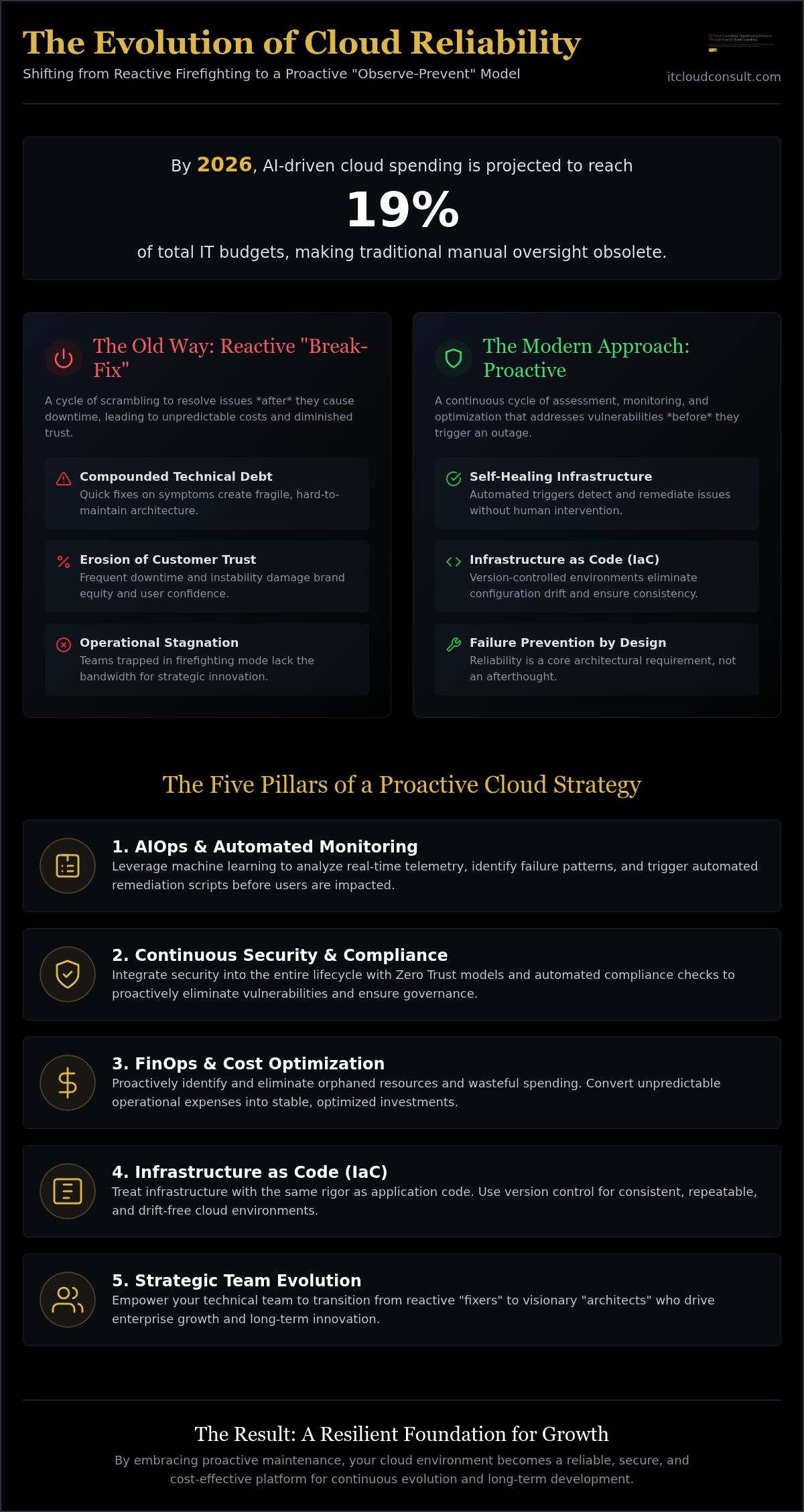
The traditional "break-fix" model, where IT teams scramble to resolve issues after they manifest, has become a relic of a simpler era. In 2026, the sheer volume of microservices and interconnected API calls makes reactive management mathematically impossible to sustain for any enterprise seeking high availability. True modernization requires a shift toward an "observe-prevent" paradigm. We define proactive cloud maintenance as a continuous, automated cycle of assessment, monitoring, and optimization that addresses vulnerabilities before they trigger an outage. This evolution is rooted in the principles of Reliability engineering, focusing on failure prevention as a core architectural requirement rather than an afterthought.
To achieve this state, enterprises are increasingly relying on Infrastructure as Code (IaC). By treating infrastructure with the same rigor as application code, teams can version-control their environments and ensure consistency across deployments. This programmatic approach eliminates the configuration drift that often leads to "ghost" failures in complex cloud ecosystems. It's the foundational layer that allows for a predictable, repeatable, and maintainable environment.
The Hidden Costs of Reactive IT Models
Reactive models carry financial burdens that extend far beyond the immediate repair invoice. When a system fails, the resulting downtime creates a ripple effect of lost revenue and diminished customer trust. It's often impossible to regain a user's confidence once an outage disrupts their critical workflows. The risks of staying in a reactive state include:
- Compounded Technical Debt: Solving for symptoms rather than root causes leads to fragile architecture that's harder to update.
- Erosion of Trust: Modern customers expect 99.999% availability; frequent disruptions quickly damage brand equity.
- Operational Stagnation: Teams stuck in firefighting mode don't have the bandwidth to focus on innovation or strategic growth.
Defining Proactive Maintenance in the 2026 Cloud Landscape
Modern maintenance has moved away from manual server checks and toward sophisticated, API-driven health assessments. This transition is a key component of strategic cloud adoption, which prioritizes the creation of resilient, maintainable systems from the outset. In 2026, proactive cloud maintenance relies on "self-healing" infrastructure. These systems use automated triggers to detect performance degradation or security anomalies and execute remediation scripts without human intervention. By offloading these routine checks to intelligent systems, your team can pivot from being "fixers" to becoming the architects of your organization's digital future.
The Five Pillars of a Proactive Cloud Maintenance Strategy
A resilient cloud environment isn't merely the absence of errors; it's a state of continuous alignment between technical performance, financial health, and security posture. Moving beyond "gut feeling" operations requires a framework that prioritizes data-driven visibility over anecdotal evidence. For many enterprises, achieving this level of equilibrium requires professional cloud optimization consulting to identify hidden inefficiencies that drain resources. This strategic oversight ensures that proactive cloud maintenance becomes a core business driver rather than a background task.
AIOps and Automated Performance Monitoring
In 2026, the volume of telemetry data generated by distributed systems is staggering. AIOps leverages machine learning to analyze millions of data points in real time, identifying patterns that precede system failures. By deploying automated remediation scripts, organizations can resolve common issues, such as memory leaks or container orchestration errors, without manual intervention. Real-time visibility is the non-negotiable prerequisite here. Without a clear view of your infrastructure's pulse, prevention remains an elusive goal.
Continuous Security and Compliance Guardrails
Security is no longer a seasonal audit; it's a continuous operational requirement. A "Shift-Left" approach ensures that security maintenance begins directly in the development pipeline, catching misconfigurations before they reach production. Utilizing a comprehensive cloud security assessment checklist allows teams to maintain a consistent posture against evolving threats. This real-time compliance monitoring assumes that trust must be verified at every access request, aligning with mandatory Zero Trust mandates that govern modern enterprise environments.
FinOps-Driven Resource Optimization
Resource waste is fundamentally a maintenance failure. A proactive strategy identifies "zombie" resources, such as unattached storage volumes or orphaned load balancers, that inflate costs without adding value. Rightsizing instances ensures that you aren't paying for excess capacity that remains idle during off-peak hours. Continuous monitoring provides the budget predictability necessary for long-term planning, transforming cloud spending from an unpredictable variable into a controlled investment. If your team is struggling to balance these competing priorities, exploring ongoing cloud support can provide the external expertise needed to stabilize and scale your environment effectively.
Predictive vs. Preventive Maintenance: Choosing the Right Framework
Choosing the right framework for proactive cloud maintenance requires understanding the distinction between scheduled interventions and dynamic, data-driven responses. Preventive maintenance follows a fixed schedule, similar to routine patch management or monthly resource audits, to mitigate known wear-and-tear risks. In contrast, predictive maintenance relies on real-time telemetry to identify when a specific component is likely to fail, allowing for a surgical strike rather than a broad sweep. For non-critical internal tools, a scheduled preventive approach might suffice. However, for revenue-generating microservices, a predictive or Condition-Based Maintenance (CBM) model is essential to prevent latency spikes or cold starts from impacting the user experience. Reliability-Centered Maintenance is the process of ensuring cloud assets continue to operate as their users require.
CBM is particularly relevant for cloud-native applications where health isn't binary. Instead of waiting for a "down" signal, CBM monitors specific conditions like API response times or container memory pressure. When these metrics drift from established baselines, the system triggers maintenance actions automatically. This ensures that resources are only consumed when a genuine need arises, directly supporting your organization's efficiency goals.
Predictive Analytics: Leveraging Historical Data
Predictive analytics transforms how enterprises manage capacity. By analyzing historical performance trends, these systems can forecast future bottlenecks weeks before they manifest. Machine learning models now detect "silent failures," which are subtle performance degradations that don't trigger traditional threshold-based alerts but eventually lead to systemic instability. Moving from static, threshold-based alerts to dynamic, anomaly-based detection allows your team to ignore the noise and focus on genuine threats to reliability.
Reliability-Centered Maintenance (RCM) for Cloud Assets
Reliability-Centered Maintenance (RCM) prioritizes tasks based on the business impact of specific cloud components. Not all assets are created equal. An RCM strategy uses Failure Mode and Effects Analysis (FMEA) to map out how a component might fail and what the consequences would be for the broader enterprise. This rigorous evaluation ensures that proactive cloud maintenance efforts are concentrated where they provide the highest ROI. Engaging in cloud infrastructure consulting can help your organization architect systems that are inherently compatible with RCM principles, ensuring that your most critical workloads are shielded by the most robust preventive measures.
Implementing a Proactive Maintenance Roadmap for Your Enterprise
Transitioning from a reactive "firefighting" culture to a state of steady assurance requires more than just a software update. It demands a fundamental realignment of how your organization perceives risk, value, and operational excellence. This evolution is most effectively managed through a structured enterprise cloud transformation roadmap. Such a framework serves as a strategic blueprint, ensuring that technical updates are synchronized with organizational change management and long-term business objectives. Without this high-level coordination, even the most advanced automation tools will fail to deliver their full latent potential.
A successful transition also hinges on continuous skill development. As your environment moves toward AI-driven orchestration, your team's role must shift from manual intervention to strategic oversight. This requires a commitment to modernization that empowers your staff to act as visionary architects rather than mere fixers of broken systems.
Phase 1: Assessing Infrastructure Maturity and Gaps
The journey toward proactive cloud maintenance begins with a rigorous audit of your current operational state. You must establish a clear baseline by analyzing response times, failure rates, and the frequency of manual interventions required to maintain stability. During this phase, identify "High-Value" targets—the critical components where automated prevention will yield the most immediate impact on reliability. Understanding these gaps allows you to prioritize efforts and allocate resources where they will most effectively enhance your cloud performance and cost metrics.
Phase 2: Establishing KPIs for Proactive Success
To measure the progress of your modernization effort, your metrics must evolve. Traditional uptime percentages are no longer sufficient in the complex landscape of 2026. Instead, focus on Mean Time Between Failures (MTBF) and Mean Time to Recovery (MTTR) to gain a deeper understanding of system resilience. You should also track the percentage of maintenance tasks that have been successfully automated versus those that still require manual effort. By generating cost-avoidance reports that highlight the ROI of proactive interventions, you can provide stakeholders with tangible evidence of increased efficiency and predictable operational expenses. If you are ready to begin this transition and secure your enterprise's digital future, our experts at IT Cloud Consulting can help you design and execute a customized roadmap for success.
Managed Cloud Services: Partnering for Strategic Evolution
Enterprises often find that maintaining a complex, multi-cloud environment consumes the very resources intended for innovation. Partnering with a visionary architect allows organizations to offload the repetitive, high-stakes operational burden that typically stifles progress. This shift is a fundamental step in realizing the full potential of managed cloud services, which provide the scale and specialized toolsets that a single internal team might lack. By delegating these tasks to a strategic partner, your internal talent can pivot toward high-value projects that drive market differentiation and long-term development.
Effective proactive cloud maintenance isn't just about keeping the lights on; it's about building a foundation for continuous evolution. When you move beyond the "break-fix" mentality, you create space for transformative growth. This transition ensures that your infrastructure remains a robust asset rather than a source of persistent technical debt. It's the difference between merely surviving in the cloud and truly mastering it to achieve organizational excellence.
Why Expert Advisory Catalyzes Transformation
A consulting partner brings a cross-industry perspective that internal teams rarely possess, offering insights into emerging threats and optimization opportunities that haven't yet impacted your specific environment. This external view allows for the implementation of proven, best-practice templates, significantly reducing the time-to-value for new maintenance strategies. Managed Cloud Support is a strategic partnership that ensures systems remain operational and secure while driving growth. This approach moves beyond the traditional vendor-client dynamic, establishing a collaborative environment where technical proficiency and business vision are perfectly aligned.
The Path Forward: Transitioning to Managed Cloud Support
Transitioning to an expert-led model begins with a deep-dive discovery phase to align your current infrastructure with future business goals. This collaborative model of shared responsibility ensures that your internal teams maintain control over core business logic while consultants manage the underlying complexity of the cloud stack. The peace of mind that comes from continuous, 24/7 system health monitoring allows leadership to focus on the "big picture" of modernization without the fear of a sudden outage. By integrating proactive cloud maintenance into your long-term strategy, you ensure that your enterprise remains resilient, cost-efficient, and prepared for the rapid pace of innovation in 2026.
Orchestrating the Future of Enterprise Reliability
The transition from reactive firefighting to a stable, architect-led environment is the defining challenge for enterprises in 2026. By integrating the five pillars of reliability and leveraging predictive analytics, you can transform your infrastructure from a source of technical debt into a powerful engine for innovation. Adopting a framework for proactive cloud maintenance ensures that your security posture, operational costs, and system performance remain in perfect alignment, even as cloud complexity grows. This shift isn't just a technical update; it's a strategic evolution that empowers your team to focus on high-level development rather than constant recovery.
Realizing this latent potential requires a partner that possesses both a "big picture" perspective and the technical proficiency to execute. IT Cloud Consulting provides the strategic guidance and expert advisory necessary to navigate this modernization journey while ensuring significant cost reduction through comprehensive managed services. It's time to move beyond the "break-fix" cycle and embrace a future of steady assurance. Optimize your infrastructure with IT Cloud Consulting’s Managed Cloud Support to secure your organization's trajectory. Your journey toward a more optimized and advanced future starts with a single, purposeful step forward.
Frequently Asked Questions
What is the primary difference between proactive and reactive cloud maintenance?
The primary difference lies in the timing and intent of the intervention. Reactive maintenance triggers only after a failure occurs, often resulting in expensive downtime and emergency repairs. Proactive cloud maintenance utilizes continuous monitoring and automated health checks to resolve vulnerabilities before they impact users. This shift ensures a stable environment where technical teams focus on architecture rather than firefighting, ultimately protecting your brand's reputation and operational continuity.
How does proactive maintenance help in reducing cloud costs (FinOps)?
Proactive strategies reduce costs by eliminating resource waste before it accumulates. By identifying "zombie" resources like unattached storage volumes or over-provisioned instances, organizations can align their spending with actual usage patterns. This continuous optimization prevents the "bill shock" often associated with unmanaged cloud environments. It transforms cloud expenses into a predictable investment, ensuring that every dollar spent contributes directly to performance and scalability rather than administrative overhead.
Can proactive maintenance be fully automated with AI?
While AI is a powerful catalyst for analyzing millions of telemetry points, it cannot fully replace human strategic oversight. AI-driven tools excel at identifying anomalies and executing automated remediation scripts for known issues. However, the "Visionary Architect" is still required to align these technical actions with broader business goals. A hybrid approach ensures that while the system self-heals routine errors, your experts remain focused on high-level modernization and long-term infrastructure evolution.
Is proactive maintenance necessary for small cloud environments?
Proactive oversight is essential for small environments because they often lack the redundancy of larger systems. A single misconfiguration or orphaned resource can have a disproportionate impact on a smaller budget and a leaner team. Implementing foundational proactive cloud maintenance practices early prevents technical debt from compounding. It allows smaller organizations to scale with confidence, knowing their infrastructure is built on a reliable, maintainable, and cost-efficient framework from the start.
How do we measure the ROI of a proactive cloud maintenance program?
ROI is measured through a combination of operational efficiency and cost-avoidance metrics. Enterprises should track improvements in Mean Time Between Failures (MTBF) and the reduction in Mean Time to Recovery (MTTR). Additionally, comparing the costs of prevented outages against the investment in maintenance tools provides a clear financial picture. Highlighting the percentage of automated versus manual tasks also demonstrates the realization of latent potential within your technical staff.
What role does Infrastructure as Code (IaC) play in proactive maintenance?
Infrastructure as Code (IaC) acts as the foundational blueprint for a maintainable cloud environment. By defining resources through code, you eliminate the manual configuration errors and "ghost" failures that often lead to outages. IaC allows for version-controlled deployments, ensuring that every environment is consistent and repeatable. This programmatic approach makes it easier to implement automated health checks and security guardrails, which are central to a proactive operational strategy.
How often should a cloud architecture review be performed as part of maintenance?
Cloud architecture reviews should be performed at least quarterly to ensure ongoing alignment with evolving business needs. These reviews are also critical following any major deployment or significant change in traffic patterns. Regular assessments help identify performance bottlenecks and security gaps that might have emerged as the system scaled. This cadence ensures that your infrastructure remains modernized and that your proactive strategies are still targeting the most relevant risks.
Does proactive maintenance replace the need for a disaster recovery plan?
Proactive maintenance does not replace a disaster recovery plan; instead, it serves as the first line of defense. While maintenance focuses on preventing failures through optimization and monitoring, disaster recovery provides the framework for total system restoration following a catastrophic event. Both are necessary components of a comprehensive reliability strategy. A well-maintained system is less likely to trigger a disaster recovery event, but having a proven plan ensures resilience in any scenario.


