
With over $44.5 billion in cloud spending wasted annually, the promise of digital agility often feels overshadowed by the reality of unpredictable monthly invoices. You likely recognize the frustration of seeing costs climb without a corresponding surge in business performance. It's a common challenge where technical debt and a lack of departmental accountability turn a powerful growth engine into a source of persistent financial friction. Professional cloud financial management services provide the necessary bridge between technical execution and fiscal discipline, moving your organization beyond reactive cost-cutting toward a model of strategic investment.
We understand that your goal isn't just to spend less, but to spend with purpose. This article outlines a comprehensive framework designed to master the complexities of cloud economics and transform variable spend into measurable enterprise value. By the end of this guide, you'll understand how to achieve predictable forecasting and clear alignment between your infrastructure and specific business units. We'll examine the transition from legacy inefficiencies to an optimized environment that empowers your teams to scale with confidence and precision.
Key Takeaways
- Shift from traditional IT procurement to a dynamic consumption model that treats cloud spend as a strategic investment rather than a fixed cost.
- Leverage cloud financial management services to gain total visibility into infrastructure usage and establish departmental accountability.
- Optimize your environment by rightsizing resources and purging inefficient "zombie" infrastructure to ensure every dollar supports business scaling.
- Deploy a standardized tagging and taxonomy framework to bridge the communication gap between engineering teams and financial leadership.
- Transform cloud economics from a reactive cost-cutting exercise into a continuous cycle of strategic cloud adoption and value realization.
What are Cloud Financial Management Services?
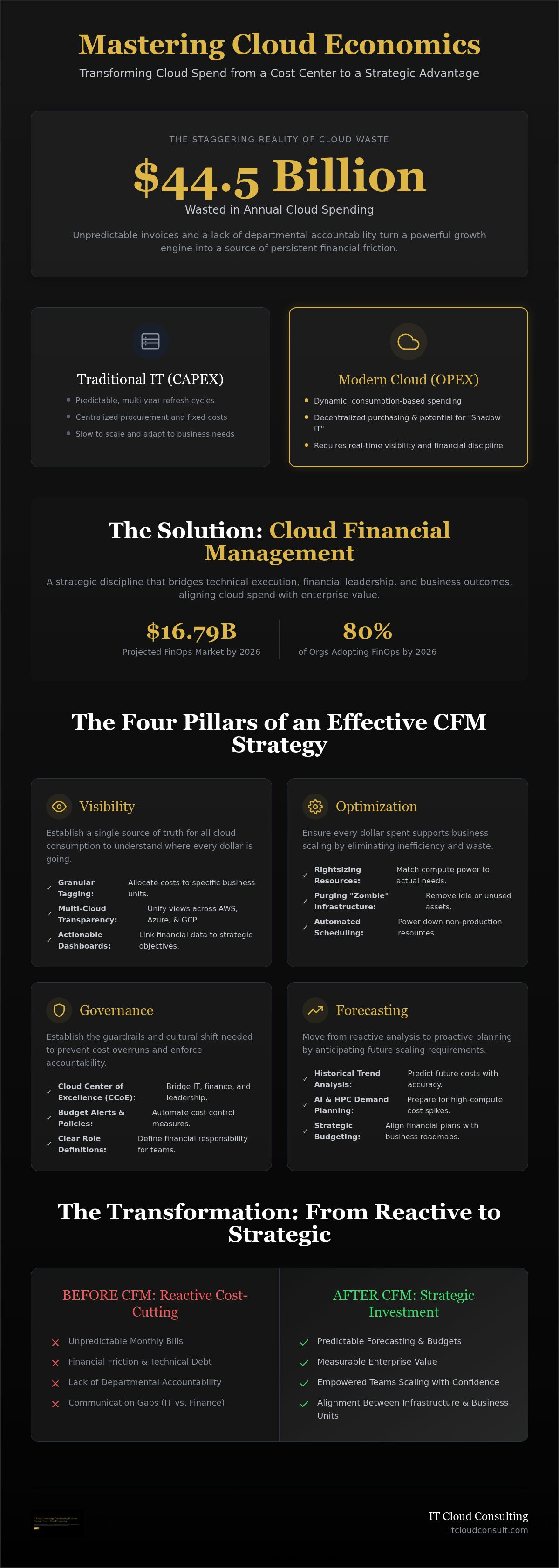
Cloud financial management services represent a fundamental shift in how modern organizations perceive and manage their digital resources. Historically, IT procurement followed a predictable CAPEX model where hardware was purchased, depreciated, and refreshed on multi-year cycles. The transition to an OPEX-driven consumption model has introduced a level of volatility that traditional accounting frameworks cannot handle. By 2026, the global cloud financial operations market is projected to reach $16.79 billion, reflecting a widespread recognition that cloud spend is no longer just a technical line item. It's a core strategic lever.
The Evolution of Cloud Economics
The move to variable spending models disrupted traditional budgeting by replacing fixed costs with near-infinite scalability. This evolution has accelerated throughout 2026 as high-performance computing and AI-driven initiatives place unprecedented pressure on infrastructure budgets. These advanced technologies require massive compute power, often leading to rapid cost spikes that automated tools alone fail to contextualize. Cloud Financial Management serves as the critical intersection of finance, engineering, and business strategy, ensuring that every dollar of cloud consumption translates directly into organizational growth. This discipline aligns with the broader FinOps movement, which 80% of organizations are expected to adopt by the end of 2026 to foster a culture of financial accountability.
CFM vs. Traditional IT Accounting
Traditional IT accounting relies on annual cycles and historical reporting, but cloud environments demand real-time visibility. Decentralized purchasing and "shadow IT" allow departments to provision resources without centralized oversight, leading to the massive $44.5 billion in annual cloud waste currently seen across the industry. Professional cloud financial management services address this by providing the expert advisory that internal teams frequently lack. By integrating these services into a broader roadmap for Strategic Cloud Adoption, organizations can maintain continuous Cloud Optimization. While software tools can flag a high bill, professional consultants bridge the gap by identifying why costs are rising and how they align with specific business outcomes. This oversight ensures that scaling doesn't lead to inefficiency, but rather to a more resilient and profitable enterprise architecture.
The Core Pillars of an Effective CFM Strategy
Success in the cloud requires more than technical proficiency; it demands a structured approach to fiscal responsibility. It's a strategic necessity. An effective CFM strategy rests on four distinct pillars that turn raw data into actionable intelligence. Visibility provides the "single source of truth" necessary for understanding consumption across disparate platforms. Optimization focuses on rightsizing resources and purging "zombie" infrastructure that drains budgets without adding value. Governance establishes the guardrails that prevent cost overruns, while Forecasting utilizes historical trends to anticipate future scaling requirements and AI-driven demand spikes.
Establishing Comprehensive Cost Transparency
Achieving transparency involves more than glancing at a monthly bill. It requires a granular tagging strategy that spans across multi-cloud environments, including AWS, Azure, and Google Cloud. By assigning specific tags to every resource, organizations can allocate costs directly to individual business units or product lines. This level of detail ensures that financial data is linked directly to your strategic cloud adoption objectives. When every stakeholder sees the financial impact of their technical decisions, the organization moves from vague estimates to precise accountability. This visibility is the foundation of any mature cloud financial management services framework.
Cross-Functional Governance and Accountability
Tools alone cannot fix inefficient spending habits. True transformation requires a cultural shift, often led by a Cloud Center of Excellence (CCoE). This cross-functional team bridges the gap between IT, finance, and executive leadership, ensuring that everyone speaks the same language regarding cloud economics. Clear roles must be defined so that engineers understand the cost implications of their architecture and finance teams understand the necessity of technical scaling. Our managed cloud services facilitate this by providing continuous monitoring and enforcing governance policies in real time. This proactive stance ensures that compliance isn't a periodic check, but a constant operational state.
Integrating these pillars into your daily operations allows your business to evolve without the fear of uncontrolled costs. If you're ready to refine your current framework, exploring professional cloud optimization support can help secure your financial trajectory and drive long-term value.
Beyond Cost Cutting: CFM vs. Reactive Cloud Optimization
Many organizations mistake reactive "bill-scrubbing" for a sustainable financial strategy. While a one-time audit might yield immediate savings, this approach fails to deliver long-term enterprise value because it ignores the underlying architectural causes of waste. Reactive cutting often creates a "rebound effect" where costs surge back to previous levels within months as unmanaged workloads continue to scale without oversight. In contrast, comprehensive cloud financial management services shift the focus from merely saving money to maximizing Return on Investment (ROI). This transition allows leadership to practice "value engineering," where reclaimed capital is reallocated into innovation and high-growth projects rather than simply disappearing from the budget. By treating cloud spend as an investment vehicle, businesses can unlock latent potential in their existing infrastructure.
The Trap of Short-Term Cost Reduction
Aggressive, superficial cost-cutting can inadvertently introduce performance bottlenecks or even system outages. If a team terminates resources without a deep understanding of their role in the application lifecycle, the resulting technical debt can be far more expensive than the original cloud bill. Strategic cloud optimization consulting avoids this trap by prioritizing architectural health over quick wins. We focus on rightsizing that respects the requirements of your specific workloads, ensuring that your infrastructure remains resilient as it becomes more efficient. True optimization isn't about doing less; it's about doing more with exactly what is required to maintain peak performance during periods of rapid growth.
Measuring Business Value and Unit Economics
Sophisticated CFM practices move beyond total spend to look at unit economics. By defining metrics like "cost per transaction" or "cost per active user," you can align cloud performance directly with organizational KPIs. If your cloud expenditure increases by 10% while your transaction volume grows by 40%, your efficiency has actually improved despite the higher bill. This data-driven perspective provides executive leadership with the clarity needed to make informed scaling decisions. Cloud financial management services transform cloud spend from a liability into a strategic asset by ensuring every cent of expenditure directly fuels competitive advantage. This alignment ensures that your technical infrastructure is a catalyst for business growth rather than a drain on resources, allowing for a more predictable and profitable future.
A Roadmap to Implementing Cloud Financial Management
Implementing a framework for cloud financial management services requires a methodical approach that balances immediate savings with long-term architectural integrity. It's not a one-time audit but an evolutionary process that matures alongside your technical infrastructure. This journey typically unfolds across five distinct phases, moving from initial discovery to a state of automated, self-governing efficiency. By following a structured roadmap, organizations can replace the chaos of unpredictable billing with a culture of fiscal precision and strategic growth.
Phase 1: The Cloud Readiness and Cost Assessment
The first step involves gaining a comprehensive understanding of your existing digital footprint. Identifying low-hanging fruit, such as unattached storage volumes or over-provisioned instances, provides the initial momentum for the project. We evaluate how your current cloud infrastructure consulting efforts align with core business goals. By benchmarking against 2026 industry standards, organizations can pinpoint exactly where their efficiency lags compared to peers. This assessment sets the baseline for all future optimization efforts, ensuring that every subsequent action is rooted in verified data.
Once the assessment is complete, Phase 2 focuses on tagging and taxonomy standardization. Establishing a "single source of truth" across all providers ensures that every resource is attributed to the correct department. This transparency leads naturally into Phase 3, where we focus on rightsizing high-cost services. Instead of broad cuts, we match resource allocation to actual performance requirements, ensuring that you only pay for the compute power you truly consume.
Phase 4: Leveraging Automation for Continuous Control
Modern cloud environments move too fast for manual oversight to remain effective. Implementing auto-scaling and automated scheduling significantly reduces spend on idle resources by powering down non-critical systems during off-peak hours. As AI-driven compute spikes become more frequent throughout 2026, using anomaly detection to catch runaway costs in real-time is vital for budget protection. This phase is a critical component of an enterprise cloud transformation plan that embeds automated guardrails directly into the deployment pipeline. Automation ensures that your financial policies are enforced 24/7 without requiring constant human intervention.
The final stage, Phase 5, centers on cultural integration. This is where financial discipline becomes part of the engineering DNA, and teams take proactive ownership of their cloud consumption. If you're ready to build a resilient roadmap, our team at IT Cloud Consulting can guide your transition from reactive spend to strategic investment.
Strategic Advisory: How IT Cloud Consulting Transforms Cloud Economics
Modern enterprises often find that automated tools alone are insufficient for managing the nuances of a multi-cloud environment. While these platforms flag spikes, they don't provide the architectural context needed to understand why those costs exist or how they align with your long-term vision. Our approach to cloud financial management services is built on vendor-neutral advisory, ensuring that your strategy remains focused on business outcomes rather than provider-specific features. We act as the vital link between your engineering teams and executive leadership; we translate technical consumption into a clear financial narrative that supports strategic growth.
This partnership ensures that your Cloud Optimization efforts aren't isolated events. Instead, they become a continuous operational discipline that evolves with your business. By integrating fiscal responsibility into the heart of your technical operations, we help you maintain a state of permanent readiness for market shifts. This steady assurance allows your leadership to focus on innovation, knowing that the underlying infrastructure is both lean and highly performant.
Expert Guidance for Complex Cloud Journeys
Internal teams frequently approach cost management as a "best-effort" task, squeezed between urgent development sprints and maintenance cycles. A dedicated consultant provides the focused oversight required to navigate complex compliance landscapes, such as the Digital Operational Resilience Act (DORA) or PCI DSS 4.0.1 requirements. We develop customized roadmaps that respect these regulatory boundaries while aggressively pursuing resource efficiency. This expert advisory doesn't just save money; it drives innovation by reclaiming the capital and time previously lost to technical debt. We help you realize the full potential of your Strategic Cloud Adoption by ensuring that your infrastructure is an enabler of progress, not a financial bottleneck.
Next Steps: Realizing Your Latent Cloud Potential
The transition from reactive spending to strategic investment begins with a single, focused conversation about your current cloud health. By partnering with IT Cloud Consulting, you gain access to a seasoned team that possesses both the "big picture" perspective and the technical proficiency required for execution. Our ongoing support provides the steady hand needed to maintain fiscal discipline as your organization scales across the United States. We're committed to your long-term trajectory; we ensure that your cloud environment remains a powerful engine for enterprise value.
If you're ready to transform your variable spend into a measurable growth vehicle, we're here to guide the way. Inquire about our cloud optimization services today to begin your journey toward a more efficient and visionary future.
Securing Your Enterprise Trajectory through Fiscal Precision
Transitioning from unpredictable cloud invoices to a model of measurable business growth requires a fundamental shift in perspective. By integrating cloud financial management services into your core operations, you move beyond superficial "bill-scrubbing" to a state of value engineering where reclaimed capital fuels continuous innovation. This strategic framework ensures that your infrastructure remains an asset that scales with your ambitions rather than a liability that drains your resources.
IT Cloud Consulting provides the authoritative advisory needed to navigate complex multi-cloud and hybrid environments across the United States. We specialize in strategic cloud adoption that aligns your technical infrastructure with executive financial goals, ensuring every dollar spent translates into enterprise value. Our team is dedicated to your long-term evolution; we provide the steady assurance required to master the complexities of modern cloud economics. It's a partnership designed to empower your leadership and optimize your digital roadmap.
The path toward modernization is built on steady progress and expert oversight. Partner with IT Cloud Consulting for Strategic Cloud Optimization and realize the latent potential of your digital ecosystem today. It's time to build a more efficient and visionary future for your organization.
Frequently Asked Questions
What is the difference between FinOps and Cloud Financial Management?
FinOps is an operational framework focusing on cultural accountability, while Cloud Financial Management (CFM) is the broader strategic discipline that includes these services. CFM aligns technical execution with high-level business strategy. It ensures that financial governance isn't just a set of rules but a core component of your organization's digital evolution. Professional cloud financial management services bridge the gap between collaboration and long-term value realization.
How much can a business typically save through cloud financial management services?
While savings vary by organization, the primary goal of cloud financial management services is to eliminate the estimated $44.5 billion in annual cloud waste reported across the industry. Professional advisory identifies latent potential within your budget by rightsizing resources and purging inefficient infrastructure. Instead of simply cutting costs, we focus on value engineering. This allows your team to reallocate reclaimed funds into high-impact innovation and strategic growth initiatives.
Do I need CFM services if I only use one cloud provider like AWS or Azure?
Single-cloud environments present significant complexities that often lead to overspending. Native tools like AWS Cost Explorer provide raw data but lack the strategic context required for long-term optimization. Professional advisory services offer a vendor-neutral perspective that internal teams frequently miss. They help you navigate the intricate pricing models and service tiers of a single provider to ensure your infrastructure remains lean and perfectly aligned with your business roadmap.
How does CFM handle the unpredictable costs of AI and machine learning workloads?
CFM handles the volatility of AI and machine learning workloads through predictive forecasting and real-time anomaly detection. These high-performance computing tasks often cause sudden budget spikes that traditional accounting can't anticipate. By implementing automated guardrails and rightsizing compute instances, we ensure that your AI initiatives remain fiscally sustainable. This proactive approach prevents experimental projects from becoming financial liabilities while supporting the rapid scaling required for modern innovation.
Can cloud financial management help with security and compliance?
Cloud financial management directly supports security by reducing your organization's attack surface. Optimization processes identify and remove "zombie" infrastructure and unattached storage volumes that often harbor overlooked vulnerabilities. By enforcing strict tagging and governance policies, CFM ensures that every active resource is accounted for and compliant with regulations like DORA or PCI DSS. This alignment between finance and security creates a more resilient and transparent digital environment.
How often should a cloud financial assessment be performed?
Continuous monitoring is essential for day-to-day efficiency, but a comprehensive strategic assessment should occur at least quarterly. These deeper reviews ensure that your infrastructure continues to support your evolving business goals and adapts to new market conditions. Significant architectural shifts or the introduction of major new workloads also necessitate an immediate evaluation. Regular assessments prevent the "rebound effect" where costs climb back up after a one-time optimization effort.
What are the most common causes of cloud waste in 2026?
The most common causes of waste in 2026 include unmanaged AI-driven compute spikes and the persistence of "zombie" resources that remain active without purpose. Over-provisioning instances to handle hypothetical peak loads also contributes significantly to unnecessary spend. Additionally, a lack of standardized tagging and taxonomy prevents organizations from accurately allocating costs. These inefficiencies often stem from technical debt that hasn't been addressed through a structured modernization framework.
How do CFM services integrate with our existing IT and Finance teams?
These services integrate with your teams by establishing a Cloud Center of Excellence (CCoE) that bridges the communication gap between IT and Finance. We provide the data-driven insights needed to align technical requirements with executive financial strategy. This collaboration ensures that engineers understand the cost of their architecture while finance teams gain visibility into the necessity of technical scaling. It's a supportive partnership that empowers every department to take ownership of cloud economics.


