
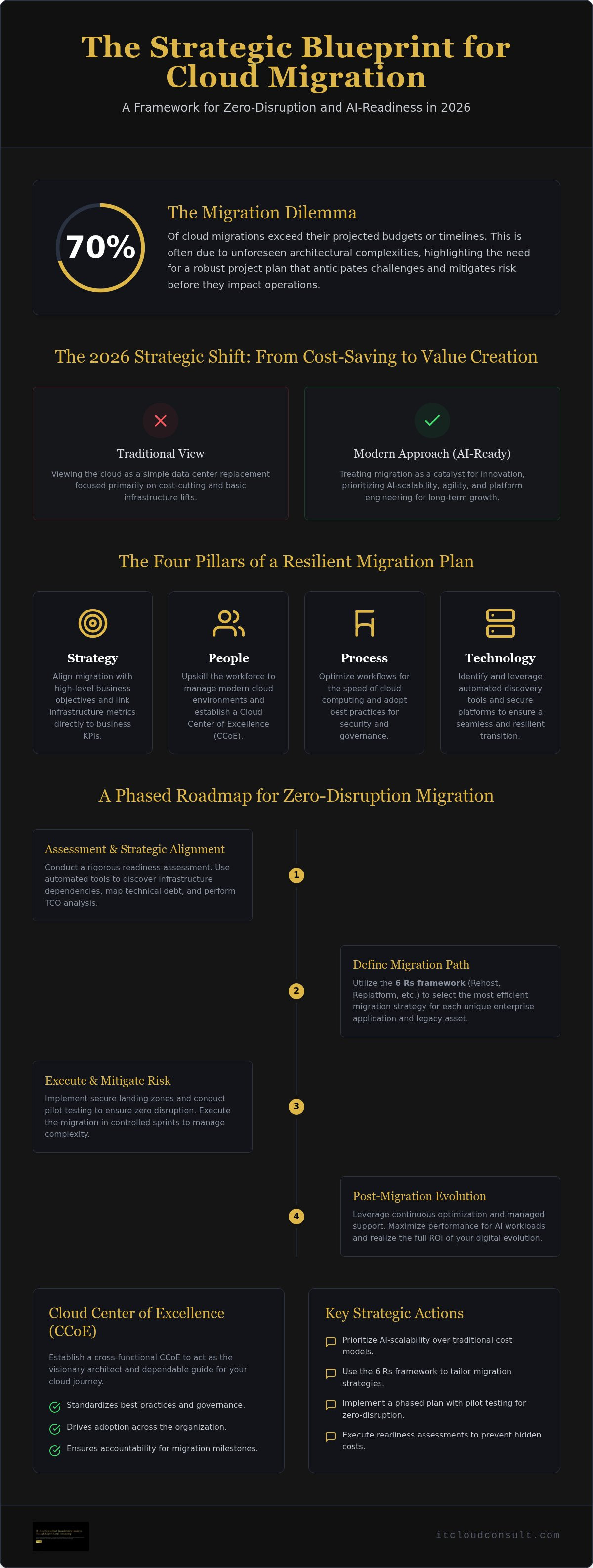
Recent industry data reveals that 70 percent of cloud migrations currently exceed their projected budgets or timelines due to unforeseen architectural complexities. This reality creates a justifiable anxiety for enterprise leaders who must balance the urgent need for modernization with the risk of operational paralysis. You understand that a simple technical transition is no longer sufficient. Your organization requires a robust cloud migration project plan that secures long-term value without compromising current stability.
We recognize the persistent pressure of managing hidden migration costs and the technical debt inherent in complex hybrid environments. This guide provides a strategic framework designed to deliver zero-disruption and measurable ROI. By adopting this methodology, you can move beyond the fear of downtime and establish a predictable roadmap for organizational evolution. We will explore the essential milestones of enterprise migration, ranging from the implementation of updated ISO/IEC 27017:2026 security controls to the engineering of a resilient platform capable of sustaining advanced AI and automation workloads. This structured approach ensures your infrastructure is not merely moved, but fundamentally optimized for the next decade of digital growth.
Key Takeaways
- Understand why the 2026 strategic shift prioritizes AI-scalability and platform engineering over traditional cost-saving models to ensure long-term competitive advantage.
- Navigate the complexities of the 6 Rs framework to select the most efficient migration strategy for each unique enterprise application and legacy asset.
- Implement a phased cloud migration project plan that utilizes secure landing zones and pilot testing to ensure zero-disruption to your critical business functions.
- Execute a rigorous readiness assessment to identify technical debt and map out dependencies before they lead to hidden migration costs or timeline delays.
- Leverage continuous optimization and managed support during the post-migration window to maximize performance and realize the full ROI of your digital evolution.
The Architecture of a Modern Cloud Migration Project Plan
A successful cloud migration project plan isn't just a technical checklist; it's the fundamental blueprint for enterprise evolution. In 2026, the global cloud market is estimated to reach $917.9 billion, driven by a strategic pivot from simple cost-cutting toward agility and AI-readiness. Leaders who view the cloud as a mere data center replacement often fail to realize its full potential. Instead, you must treat this transition as a catalyst for innovation, where infrastructure becomes a dynamic asset rather than a static expense.
Building a resilient plan requires a balanced focus on four critical pillars: Strategy, People, Process, and Technology. Strategy ensures your migration aligns with high-level business objectives. People focuses on upskilling your workforce to manage modern environments. Process optimizes workflows for the speed of cloud computing, while Technology identifies the specific tools required for a seamless transition. By connecting these pillars, you create a framework that supports long-term growth and operational excellence.
Precision is vital for success. You must establish SMART goals that link infrastructure metrics directly to business KPIs. Rather than focusing solely on server uptime, define success through outcomes like reduced time-to-market for new features or enhanced AI workload performance. This approach ensures every technical milestone contributes to a measurable return on investment.
Why Enterprise Cloud Transformation Requires a Roadmap
Visualizing the transition from legacy constraints to cloud-native potential is impossible without a structured path. Accidental cloud adoption, characterized by fragmented deployments and lack of oversight, creates significant security risks and spiraling costs. A formal cloud migration project plan mitigates these dangers by providing a clear sequence of actions. Utilizing a comprehensive enterprise cloud transformation roadmap prevents the accumulation of technical debt and ensures that your modernization efforts remain purposeful and predictable.
Identifying Key Stakeholders and the Cloud Center of Excellence (CCoE)
Transformation is a cross-functional endeavor that necessitates collaboration across IT, Finance, and Business Operations. To manage this complexity, leading enterprises establish a Cloud Center of Excellence (CCoE). This specialized team acts as both a visionary architect and a dependable guide, standardizing best practices and driving adoption across the organization. By defining clear ownership for specific migration milestones, the CCoE ensures accountability and maintains the momentum required to navigate complex hybrid environments successfully.
Phase 1 & 2: Assessment and Strategic Alignment
The assessment phase is the bedrock of any successful cloud migration project plan. It's the moment where you move beyond high-level vision into the granular reality of your current environment. You need a comprehensive inventory of all on-premise and virtual assets. This isn't just a list; it's a map of technical maturity and organizational readiness. Without this clarity, enterprises often face migration paralysis when legacy system dependencies emerge unexpectedly during the execution phase.
Technical Readiness and Infrastructure Discovery
Analyzing workload patterns is essential for meeting 2026 performance standards. You can't rely on manual spreadsheets. Automated discovery tools are necessary to visualize application interdependencies. These tools reveal the hidden connections that often cause downtime. To ensure your foundation is secure, integrate a cloud security assessment checklist early. This proactive step aligns your technical discovery with the latest compliance requirements. Referencing a detailed cloud migration checklist can help your team verify that no critical dependency is overlooked during this high-stakes inventory.
Financial Modeling and TCO Analysis
Many organizations ignore FinOps until after they've migrated. This is a mistake. Establishing cost baselines before the first move is non-negotiable. You must calculate the Total Cost of Ownership (TCO) by comparing on-premise maintenance with cloud operational expenses. Don't forget hidden costs like data egress fees, licensing complexities, and staff training. These variables can quickly erode your projected savings if they aren't accounted for in the initial budget.
Forecasting the ROI of strategic cloud adoption allows you to present a data-driven business case to stakeholders. It transforms the conversation from cost to value creation. If you're looking to refine your financial projections, our experts can help you design a custom roadmap that prioritizes both performance and profitability. By mapping these financial variables early, your cloud migration project plan remains predictable and fully aligned with your enterprise's long-term evolution.
Defining Your Migration Path: The 6 Rs Framework
The 6 Rs framework serves as the tactical engine of your cloud migration project plan. It dictates how each unique application in your portfolio will evolve to meet modern standards. Rehosting, often called "lift and shift", offers the quickest path to the cloud with minimal code changes. This strategy is ideal for legacy systems where an immediate data center exit is the priority. However, while it delivers rapid infrastructure relief, it often fails to unlock the deeper efficiencies found in cloud-native environments.
Replatforming, or "lift and reshape", provides a sophisticated middle ground. It allows you to optimize specific components, such as migrating to a managed database service, without a total application rebuild. For organizations seeking maximum scalability and resilience, Refactoring involves re-architecting applications to utilize serverless or microservices architectures. This path requires more effort but yields the highest long-term ROI by fully leveraging the elastic nature of modern infrastructure.
Managing the tail-end of your portfolio is equally critical for financial health. Repurchasing moves legacy software to modern SaaS models, while Retiring identifies redundant assets to slash operational overhead immediately. Retaining is a strategic choice for applications that must remain on-premise due to extreme latency requirements or specific regulatory constraints. Each choice must be documented within your cloud migration project plan to maintain clarity across the team.
Choosing the Right Strategy for Each Workload
Selecting the appropriate path requires a rigorous decision matrix that weighs technical debt against business value. You've got to balance the immediate need for migration speed against long-term cloud optimization consulting objectives. For instance, legacy databases often benefit from replatforming to managed services, which reduces administrative burden without requiring a code overhaul. Expert-led cloud migration planning ensures that your strategy isn't a one-size-fits-all approach but a tailored roadmap for every digital asset.
The 2026 R: Re-architecting for AI and Data Science
In 2026, infrastructure readiness for Large Language Models (LLMs) and high-performance computing (HPC) is a non-negotiable requirement. Modernizing your stack involves decoupling data from legacy silos to fuel AI-driven insights. This transition requires a multi-cloud perspective to ensure data sovereignty and compliance with evolving global regulations like the updated ISO/IEC 27017:2026. By re-architecting specifically for data science, you transform your infrastructure into a future-proof engine for enterprise innovation.
Execution and Risk Mitigation: The Migration Sprint
Execution is the critical juncture where strategic vision transitions into operational reality. Within a modern cloud migration project plan, the migration sprint represents a period of focused activity designed to move workloads with precision and speed. This phase isn't merely about data transfer; it's about the orchestration of complex systems to ensure that your new environment is secure, performant, and ready for immediate use. Success here relies on a "test and learn" approach that begins with a pilot migration of non-critical workloads to validate the underlying assumptions of your roadmap.
Data migration requires a tailored strategy based on volume and velocity. Online transfers are preferred for continuous synchronization, keeping the cloud environment in lock-step with on-premise systems until the final cutover. For massive datasets that exceed network capacity, offline transfer protocols remain a viable alternative to prevent bandwidth exhaustion. Once the data resides in the cloud, post-migration validation becomes the priority. Your team must verify performance parity and ensure that security integrity meets the rigorous standards established during the assessment phase.
Establishing a Secure Landing Zone
The landing zone serves as the foundational architecture for your cloud presence. It's essential to implement Identity and Access Management (IAM) from day one to enforce the principle of least privilege. Configuring virtual private clouds (VPCs) and secure connectivity through VPNs or dedicated connections ensures that your data remains isolated and protected. To maintain consistency at scale, you should automate governance using Infrastructure as Code (IaC). This approach allows you to treat your environment as a versioned asset, reducing the risk of manual configuration errors and ensuring that every resource aligns with your organizational standards.
Managing Downtime and Business Continuity
Zero-downtime cutovers are no longer a luxury; they're a business requirement. Adopting a "Blue-Green" deployment strategy allows you to run parallel environments, switching traffic to the new "Green" environment only after it's been fully validated. If unexpected issues arise, a robust rollback plan provides the safety net needed to restore services to the original "Blue" environment instantly. Clear communication with end-users and business units is vital throughout this transition. Keeping stakeholders informed of progress helps manage expectations and minimizes the perceived impact of the migration. If you need a partner to oversee these high-stakes transitions, you can explore our strategic implementation support to ensure a seamless evolution.
Post-Migration Evolution: Optimization and Managed Support
The successful execution of a cutover is not the conclusion of your enterprise's journey; rather, it marks the commencement of a continuous cycle of optimization. A comprehensive cloud migration project plan must extend beyond the initial launch to encompass the long-term operational reality of a cloud-native environment. Transitioning from a discrete migration project to ongoing managed cloud services ensures that your infrastructure remains aligned with evolving business requirements. This shift allows your organization to move from a reactive posture to a proactive state of innovation, where technology serves as a constant driver of value.
The first 90 days following a migration are critical for establishing a performance baseline. During this 30-60-90 day window, you should focus on tuning resources to eliminate the inefficiencies often introduced during a rapid transition. By analyzing actual usage data against your initial projections, you can identify opportunities to refine your architecture. Leveraging cloud-native automation reduces the burden of manual IT operations, allowing your team to focus on high-level strategic initiatives rather than routine maintenance. Continuous monitoring and proactive health management become the standard, ensuring that your systems are not just running, but thriving.
Realizing Potential Through Continuous Optimization
True efficiency is achieved through the meticulous right-sizing of instances based on empirical usage patterns. Implementing automated scaling policies ensures your environment can handle demand spikes without incurring the costs of permanent over-provisioning. Ongoing cloud infrastructure consulting provides the external perspective needed to maintain architectural health over time. This iterative approach to optimization ensures that your cloud migration project plan delivers on its promise of maximum ROI by preventing cost sprawl and performance degradation as your workloads evolve.
Managed Support: The Key to Long-Term Transformation
Managed services provide the necessary foundation for sustained business growth. By partnering with expert advisors, you reduce the operational burden on your internal IT teams, empowering them to pursue transformative projects that drive competitive advantage. Ongoing support is also vital for maintaining a rigorous security and compliance posture in an increasingly complex regulatory environment. As a dependable guide, a managed service provider ensures that your infrastructure remains resilient, secure, and fully capable of supporting the next generation of AI-driven enterprise applications. This partnership transforms cloud adoption from a one-time event into a permanent state of strategic excellence.
Securing the Path to Enterprise Evolution
The transition to a cloud-native environment is a defining moment for any modern enterprise. You've seen that a successful cloud migration project plan requires more than technical execution; it demands a synergy of strategic assessment, disciplined migration paths, and rigorous risk mitigation. By moving beyond simple "lift and shift" tactics to embrace platform engineering and FinOps governance, your organization secures a future-proof foundation for AI and automation. These steps ensure that your infrastructure isn't just moved, but fundamentally transformed to support your long-term vision.
The journey doesn't end at cutover. Realizing the full potential of your investment requires continuous optimization and a commitment to architectural health. We provide the national expertise in AWS, Azure, and Google Cloud needed to navigate these complexities with confidence. Our proactive managed cloud support serves as a safety net for your continuous evolution, ensuring long-term security and compliance. Ready to transform your legacy constraints into a competitive advantage? Partner with IT Cloud Consulting for Your Strategic Roadmap and ensure your digital evolution is both predictable and profitable. We're here to help you lead with confidence.
Frequently Asked Questions
What are the common phases of a cloud migration project plan?
The standard cloud migration project plan typically unfolds through five distinct phases. It begins with comprehensive discovery and assessment to inventory digital assets, followed by strategic planning to define the migration path. The third phase involves designing the target architecture and landing zone. Execution follows via a structured migration sprint, concluding with a post-migration optimization phase. This methodical approach ensures alignment between technical milestones and overarching business evolution goals.
How long does a typical enterprise cloud migration take in 2026?
Timeline duration varies significantly based on portfolio complexity and the chosen migration strategy. A single-application migration may conclude within three to six months, while a full-scale enterprise portfolio modernization often spans 12 to 24 months. Organizations utilizing automated discovery tools and platform engineering approaches in 2026 typically experience faster cutovers. The key to maintaining momentum is a phased roadmap that prioritizes high-value workloads to deliver incremental ROI throughout the transition.
How do I calculate the budget for a cloud migration project?
Budgeting requires a comprehensive Total Cost of Ownership (TCO) analysis that accounts for one-time project expenses and ongoing operational costs. You must factor in professional service fees, data transfer costs, and temporary parallel environment expenses during the cutover. Additionally, include the cost of upskilling internal teams or securing managed support. Industry data suggests that 70 percent of migrations exceed budgets due to poor planning, making a detailed strategy essential for financial predictability.
What is the difference between rehosting and refactoring in a migration plan?
Rehosting, or "lift and shift," involves moving applications to the cloud with minimal changes to the underlying code. It's the fastest route for legacy systems but offers limited scalability. Conversely, refactoring involves re-architecting applications to leverage cloud-native features like microservices and serverless computing. While refactoring requires a higher initial investment in time and expertise, it delivers superior long-term performance and the agility necessary for modern AI-driven enterprise workloads.
How can we minimize downtime during a cloud migration?
Minimizing disruption relies on a phased cutover strategy and the use of parallel environments. Implementing a Blue-Green deployment model allows you to validate the new environment before redirecting user traffic, providing an instant rollback path if issues arise. Pilot migrations of non-critical workloads help identify potential bottlenecks early. By integrating these risk-mitigation tactics into your cloud migration project plan, your organization can achieve zero-downtime transitions for complex legacy applications.
What are the biggest risks in a cloud migration project plan and how do we avoid them?
The primary risks include unforeseen application dependencies, spiraling egress costs, and security vulnerabilities during transit. You can avoid these pitfalls by conducting a rigorous technical readiness assessment and implementing automated discovery tools. Integrating the updated ISO/IEC 27017:2026 security controls from the start ensures compliance. Finally, addressing the internal expertise gap through strategic partnerships or managed support prevents project stalls and ensures the long-term architectural health of your new environment.
Should we use a multi-cloud or single-cloud strategy for our migration?
The choice depends on your specific requirements for redundancy and data sovereignty. Over 85 percent of enterprises now operate in hybrid and multi-cloud environments to avoid vendor lock-in and optimize for specific platform strengths. A single-cloud strategy offers operational simplicity and deeper integration but may limit flexibility. Your roadmap should evaluate whether the added complexity of managing multiple providers aligns with your goals for resilience and the specialized needs of your AI workloads.
How does FinOps fit into the cloud migration planning process?
FinOps is the practice of bringing financial accountability to the variable spend model of the cloud. It should be integrated into the planning phase to establish cost baselines and performance KPIs before the first workload moves. This ensures that every architectural decision is weighed against its financial impact. By embedding FinOps governance into your migration framework, you transform cloud spending from an unpredictable expense into a transparent, optimized investment that fuels continuous innovation.


