
A cloud migration is not a technical shift; it's a fundamental business evolution that often fails before the first server moves. You likely recognize the transformative power of the cloud, yet the prospect of unpredictable post-migration costs and legacy system incompatibility remains a valid concern. Without a rigorous cloud migration assessment checklist, these technical hurdles can quickly erode your projected ROI. Our framework transforms this uncertainty into a structured roadmap for strategic cloud adoption. We've designed this guide to help you identify security gaps and internal expertise shortages before they become project-ending liabilities.
We'll provide the professional framework you need to navigate these complexities with confidence. You'll learn how to conduct a strategic audit of your organizational readiness while aligning your IT infrastructure with 2026’s performance standards. By following this methodical approach, you can secure a risk-mitigated migration plan that delivers a modernized, scalable environment. From financial optimization to operational health, we're outlining the essential building blocks for your next phase of digital maturity.
Key Takeaways
- Recognize why a formal audit is essential to prevent "cloud sprawl" and align your IT assets with high-level organizational objectives.
- Explore the four pillars of readiness-technical, financial, security, and operational-to ensure your transition addresses the full spectrum of enterprise health.
- Master the 6 Rs framework to choose the optimal migration strategy for each application, balancing immediate costs against future-state potential.
- Implement a professional cloud migration assessment checklist to map asset dependencies and establish performance baselines that guarantee a risk-mitigated transition.
- Understand how strategic consulting provides the unbiased perspective required to realize the latent potential of a modernized, scalable IT environment.
Why a Cloud Migration Assessment is Your Most Critical Pre-Migration Step
A cloud migration assessment is far more than a technical inventory; it's a strategic audit that evaluates how your current IT assets align with long-term business goals. This process bridges the gap between your existing technical debt and the future state of your organization. By utilizing a comprehensive cloud migration assessment checklist, leaders can identify hidden dependencies and security gaps before they disrupt operations. This phase serves as the essential foundation for Strategic Cloud Adoption, moving the conversation from mere server relocation to true organizational evolution.
One of the most significant shifts during this transition is the move from a Capital Expenditure (CapEx) model to an Operational Expenditure (OpEx) framework. While buying and maintaining hardware requires massive upfront investment, the cloud allows you to pay for what you use. However, this financial agility requires precise planning. A formal audit prevents "cloud sprawl," where unmonitored resources lead to uncontrolled spending. It ensures that your infrastructure is not just moved, but optimized for a modern, scalable environment; to ensure your digital presence is equally optimized, you can visit Kyin Web Group for expert SEO and marketing support as you scale.
The Cost of Skipping the Assessment Phase
Inadequate planning often leads to immediate performance bottlenecks that can paralyze a business. When legacy applications are moved without optimization, they frequently struggle in cloud-native environments, resulting in service interruptions and a poor user experience. Perhaps the most visible consequence is "cloud bill shock." Without a clear inventory, companies often over-provision resources, leading to monthly invoices that far exceed original projections. A structured assessment identifies these risks early, allowing you to right-size your environment from day one.
Defining Your Migration Business Objectives
A successful transition starts with clear drivers that go beyond technical requirements. You must identify whether your primary goal is rapid scalability, enhanced disaster recovery, or overall cost reduction. Aligning these IT modernization efforts with your broader corporate growth strategy ensures that the cloud remains a catalyst for innovation rather than a technical burden. To maintain this momentum, we recommend establishing clear performance baselines before the move. Key metrics to document include:
- Current CPU and RAM utilization across all workloads.
- Application latency and response times for end-users.
- Data transfer volumes and storage I/O requirements.
- Existing security compliance levels and regulatory gaps.
By integrating these metrics into your cloud migration assessment checklist, you create the benchmarks necessary to measure post-migration success and prove ROI to stakeholders. This methodical approach transforms the migration from a risky leap into a calculated, strategic advancement.
The Four Pillars of a Comprehensive Cloud Readiness Audit
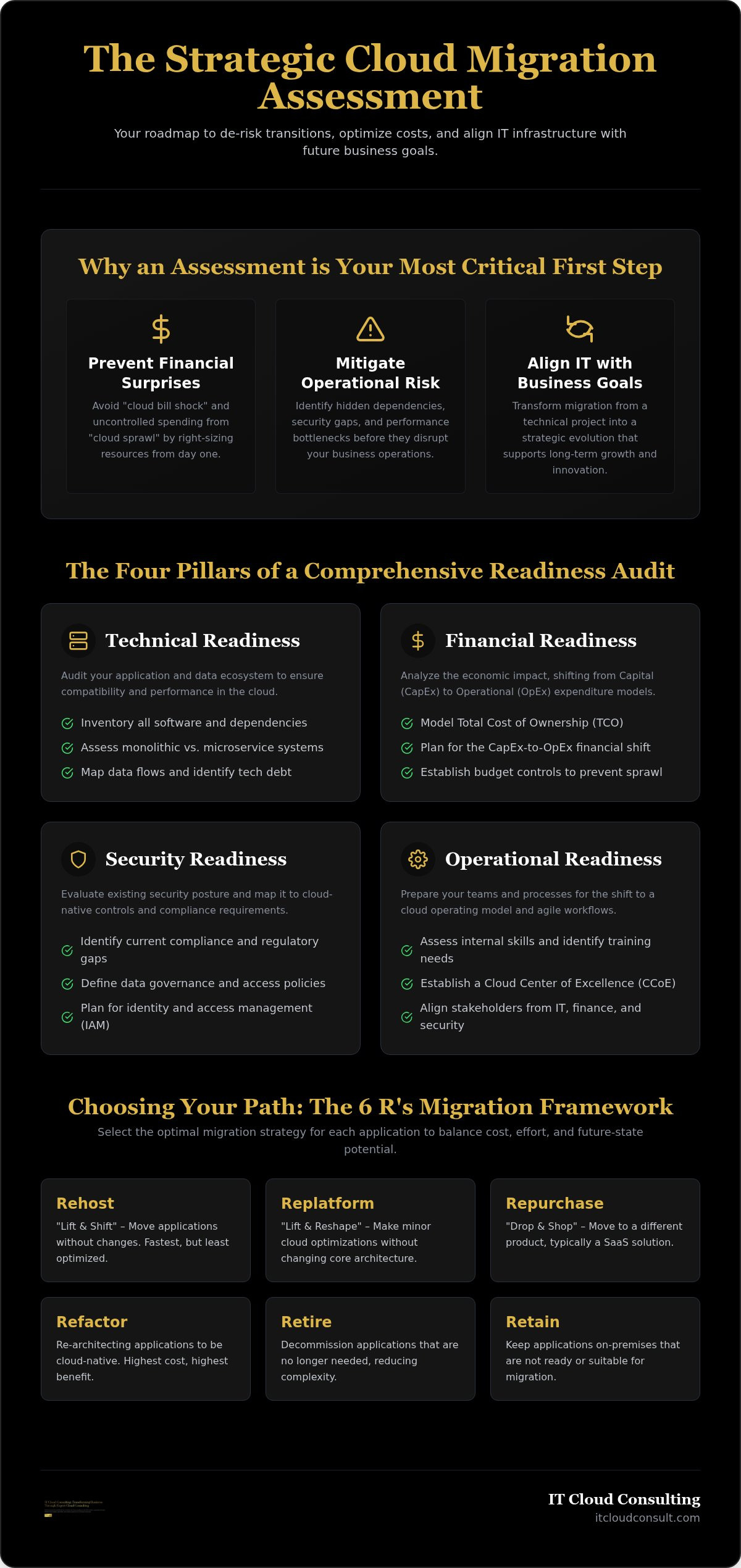
Many organizations mistakenly view migration as a purely technical exercise, yet technical readiness accounts for only 25% of a successful transition. A truly comprehensive cloud migration assessment checklist must encompass four distinct pillars: Technical, Financial, Security, and Operational readiness. Neglecting any of these areas creates systemic friction that can stall modernization efforts. Engaging in Cloud Infrastructure Consulting at this stage ensures that your audit isn't just a list of servers, but a strategic evaluation of organizational agility. To manage this evolution, we recommend establishing a cross-functional Cloud Center of Excellence (CCoE) to unify stakeholders from IT, finance, and security under a single vision.
Technical Readiness: Application and Data Audits
Success begins with a deep dive into your existing software ecosystem. You must conduct a comprehensive inventory of all software, databases, and dependencies to identify which applications are "cloud-friendly." While microservices transition easily, monolithic legacy systems often require significant modification before they can thrive in a distributed environment. Technical debt is the primary obstacle to cloud performance, representing the accumulated cost of choosing easy workarounds over sustainable, scalable architecture.
Financial Readiness: TCO and ROI Modeling
Modernization requires a shift in how you quantify value. Start by calculating the Total Cost of Ownership (TCO) of your current on-premise hardware, including power, cooling, and physical maintenance. You can then estimate monthly cloud consumption by analyzing current workload patterns and peak usage times. By integrating cloud optimization consulting principles early, you can forecast long-term ROI and avoid the common trap of over-provisioning resources. If you're unsure how to balance these complex variables, our team at IT Cloud Consulting can help refine your financial projections.
Security and Compliance Readiness
Your transition must align with the specific regulatory requirements of your industry, whether that involves GDPR, HIPAA, or SOC2 standards. Evaluating your current protocols against a specialized cloud security assessment checklist reveals where your internal controls might fall short in a public or hybrid cloud setting. It's vital to map out the "Shared Responsibility Model" immediately. This framework clarifies that while the Cloud Service Provider (CSP) secures the infrastructure, your business remains responsible for securing the data and configurations within that environment. Addressing these gaps early ensures that security becomes an accelerator for innovation rather than a roadblock.
Evaluating Migration Strategies: Choosing Between the 6 Rs
Once you've completed the initial audit using your cloud migration assessment checklist, the next step is categorizing every workload into a specific execution path. This decision framework, often called the "6 Rs," determines how you'll move each application to ensure it delivers maximum value. The assessment phase is critical here because it reveals the technical and financial constraints that dictate which strategy is viable. Without this data, organizations often default to the easiest path, potentially missing out on the transformative benefits of modernization.
The 6 Rs include Rehost, Replatform, Refactor, Retire, Retain, and Repurchase. While Rehosting offers the fastest route to the cloud, Refactoring provides the highest long-term efficiency and cost savings. Interestingly, "Retire" is often the most overlooked yet cost-effective strategy. By identifying redundant systems during the audit through your cloud migration assessment checklist, you can eliminate maintenance costs entirely rather than paying to migrate obsolete software.
When to Lift and Shift (Rehost)
Rehosting is ideal for organizations facing urgent deadlines, such as an expiring data center lease or a hardware refresh cycle. It involves moving applications to the cloud with minimal changes to the underlying code. While this approach ensures business continuity, it often fails to take full advantage of cloud-native scalability. Many enterprises use a "Move and Improve" middle ground; they rehost quickly to exit the physical data center, then optimize the environment once it's operational in the cloud. This allows for immediate savings while deferring more complex modernization tasks.
Modernization Through Refactoring
Refactoring represents the pinnacle of cloud evolution. This strategy involves re-architecting applications to utilize cloud-native features like serverless functions and containerized microservices. While it requires significant developer resources and time, the benefits are substantial: near-infinite scalability, improved resilience, and a drastic reduction in operational overhead. This approach is a core component of a comprehensive enterprise cloud transformation roadmap. By investing in Refactoring today, you're building an IT environment that can adapt to the shifting demands of 2026 and beyond.
The Definitive Cloud Migration Assessment Checklist for 2026
Transitioning from high-level strategy to tactical execution requires a granular breakdown of your current environment. This cloud migration assessment checklist serves as your operational manual, ensuring no asset remains hidden and no risk goes unmitigated. By following these five phases, you transform a chaotic migration into a predictable, value-driven process that aligns with the performance standards of 2026. This structure allows you to build a defensible business case while providing your technical teams with a clear path forward.
Phase 1 & 2: Mapping the Digital Landscape
Step 1 involves uncovering shadow IT and undocumented dependencies that often lurk within disconnected departments. These hidden connections are frequently the source of post-migration failures and unexpected latency issues that can derail an otherwise sound strategy. Step 2 focuses on profiling workload performance over a 30-day period to capture peak usage cycles, RAM spikes, and storage IOPS requirements. You must use automated discovery tools to ensure every virtual and physical asset is accurately mapped within your infrastructure. This data allows you to right-size your cloud instances, preventing the common mistake of over-provisioning based on static on-premise hardware specs.
Phase 3 & 4: Operational Readiness
Risk assessment requires you to classify data based on sensitivity, downtime tolerance, and data gravity. This classification ensures that high-priority workloads receive the necessary redundancy while maintaining strict compliance with industry standards. Simultaneously, you must evaluate your internal team's cloud proficiency to identify potential bottlenecks in management. Developing a training roadmap for IT staff is essential for long-term health, though many organizations utilize managed cloud services to bridge immediate skills gaps and accelerate the transition. This hybrid approach allows your team to learn from experts while maintaining project momentum.
Finally, Phase 5 focuses on governance and selecting the specific tooling required for day-two operations. Choosing robust monitoring and FinOps tools during the assessment phase allows you to maintain total visibility into your cloud spend and performance from the moment you go live. This proactive stance prevents the "cloud sprawl" mentioned in earlier sections and sets the stage for continuous optimization. If you're ready to begin your audit, contact IT Cloud Consulting to schedule a professional assessment today.
Partnering for Success: How Strategic Consulting Accelerates Your Transition
While a cloud migration assessment checklist provides the necessary structure, executing a large-scale transition requires more than just a list of tasks. It demands a partner who can interpret complex data and turn it into a strategic advantage. IT Cloud Consulting acts as a visionary architect for your enterprise cloud transformation, ensuring that every technical decision supports your broader business objectives. A third-party assessment offers an unbiased view of your IT health, identifying inefficiencies that internal teams might overlook due to operational familiarity. This external perspective is vital for uncovering the latent potential within your existing systems.
The IT Cloud Consulting Assessment Framework
We don't believe in one-size-fits-all solutions. Our framework delivers customized roadmaps that align technical execution with your specific growth targets. We conduct deep-dive optimization audits that go beyond surface-level metrics to ensure you realize immediate cloud ROI. This methodical approach includes continuous monitoring and management, supporting long-term innovation rather than just a one-time migration. Each step is designed to build trust through clarity, providing a comprehensive view of your path forward.
Next Steps: From Checklist to Execution
The transition from a cloud migration assessment checklist to a live environment begins with a focused migration pilot. This initial phase allows us to test assumptions and refine the overarching plan based on real-world findings from the assessment. By starting with a subset of non-critical workloads, we can validate performance baselines and security protocols before scaling across the entire enterprise. This iterative process mitigates risk and ensures that your modernized IT environment is fully prepared for production-level demands.
Are you ready to transform your infrastructure from a cost center into a driver of innovation? Schedule your professional cloud migration assessment with IT Cloud Consulting today. Our team is dedicated to your long-term trajectory, providing the expertise you need to ensure a seamless, optimized, and future-proof transition.
Realizing Your Organization's Latent Potential through Strategic Migration
A successful cloud transition is the result of methodical preparation and visionary planning. By utilizing a professional cloud migration assessment checklist, you've established the foundation required to navigate the financial and technical complexities of 2026's digital landscape. We've explored how a rigorous audit of the four readiness pillars prevents cloud sprawl and ensures that every workload is aligned with its optimal migration strategy. This structured approach transforms potential risks into a clear roadmap for long-term operational efficiency and scalable growth.
Your journey toward a modernized IT environment doesn't have to be a solitary endeavor. Our Strategic Cloud Adoption Framework provides the precision needed for execution; meanwhile, our expert Cloud Optimization Advisory ensures your ROI remains a priority. With ongoing Managed Cloud Support, we maintain the health of your systems long after the initial move is complete. It's time to evolve your infrastructure and unlock the possibilities of true innovation. Secure your digital future with a professional Cloud Migration Assessment from IT Cloud Consulting. We're ready to serve as your dependable guide in this transformative process.
Frequently Asked Questions
What is a cloud migration assessment and why is it necessary?
A cloud migration assessment is a comprehensive audit of your organization's IT assets, operational processes, and business objectives to determine their readiness for the cloud. It's necessary because it identifies hidden technical debt and security gaps that could otherwise lead to project failure. By using a structured cloud migration assessment checklist, leaders can align their technical shift with long-term corporate strategy, ensuring a risk-mitigated transition that avoids the common pitfalls of unoptimized adoption.
How long does a typical enterprise cloud migration assessment take?
A typical enterprise assessment generally spans four to twelve weeks, depending on the complexity of your infrastructure and the number of applications involved. This timeline allows for deep discovery, performance baselining over a full business cycle, and cross-functional stakeholder interviews. While smaller environments might conclude faster, national enterprises require this methodical window to ensure every dependency is mapped and every financial projection is verified against actual usage patterns.
What are the most common risks identified during a migration audit?
Migration audits frequently uncover incompatible legacy architectures, undocumented "shadow IT" dependencies, and significant security compliance gaps. Another major risk is the potential for "cloud bill shock," where unoptimized resource allocation leads to costs exceeding original projections. Identifying these issues early allows your team to address technical hurdles before they disrupt business continuity. This proactive identification ensures that the eventual move is a calculated advancement rather than a reactive technical shift.
Can we perform a cloud migration assessment internally?
While internal IT teams can perform an initial inventory, they often lack the specialized cloud expertise and unbiased perspective required for a strategic audit. Internal assessments may overlook deep-seated technical debt or fail to account for the nuances of cloud-native financial models. Partnering with a consultant provides an objective view of your IT health, ensuring that your cloud migration assessment checklist is executed with the "big picture" proficiency needed for long-term success.
What tools are used for automated cloud discovery and assessment?
Professional assessments utilize automated discovery tools such as AWS Application Discovery Service, Azure Migrate, or specialized third-party platforms. These tools capture real-time data on server configurations, network dependencies, and performance metrics like CPU and RAM utilization. Using automated solutions eliminates the errors associated with manual spreadsheets, providing a precise digital map of your environment that serves as the foundation for your modernization roadmap and ensures no asset remains undocumented.
How does an assessment help in calculating cloud ROI?
An assessment calculates ROI by comparing your current Total Cost of Ownership (TCO), including hardware maintenance and power, with projected cloud operational expenditures. It identifies opportunities for rightsizing and resource optimization, ensuring you don't overspend on unnecessary capacity. By establishing these financial baselines early, you can provide stakeholders with clear, data-driven projections of how the transition will improve your bottom line and drive operational efficiency over the next several years.
What is the difference between a readiness assessment and a migration plan?
A readiness assessment focuses on the "if" and "why," evaluating your current state to determine organizational and technical maturity. In contrast, a migration plan is the tactical "how" and "when," outlining the specific schedule, tools, and execution steps for moving workloads. The assessment provides the data needed to build the plan; without the insights gained from an audit, a migration plan is merely a set of assumptions prone to costly errors.
What happens if an application is found to be incompatible with the cloud?
When an application is deemed incompatible, it's typically categorized under the "Retain," "Retire," or "Refactor" strategies. You might choose to keep it on-premise temporarily, decommission it if it's redundant, or re-architect it into a cloud-native microservices model. This determination is a key outcome of the assessment phase, preventing you from attempting a "lift and shift" that would result in poor performance or system failure in a distributed, modern environment.


