
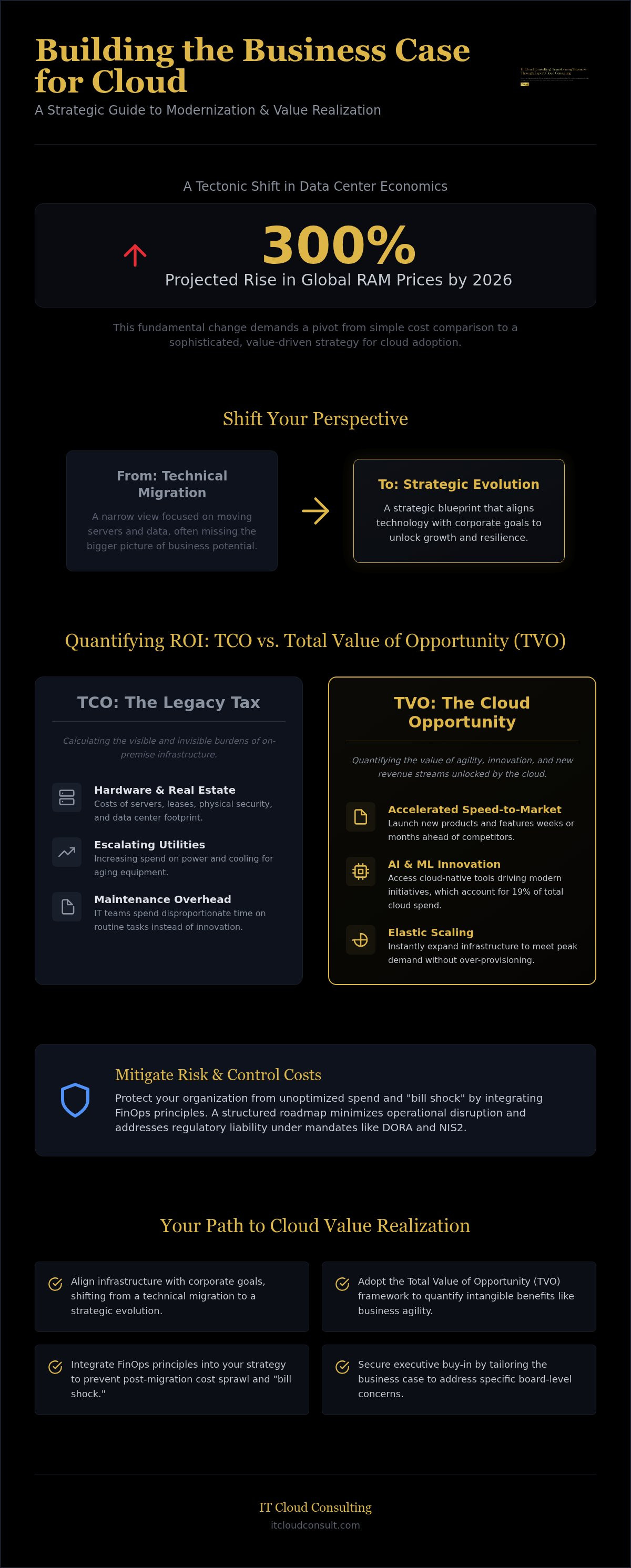
By the end of 2026, global RAM prices are projected to rise by up to 300 percent compared to late 2025, fundamentally altering the economics of the traditional data center. Building a business case for cloud adoption is no longer a simple exercise in comparing server costs; it's a high-stakes strategic pivot that demands a sophisticated understanding of both technical and financial variables.
You're likely facing internal resistance from stakeholders who are comfortable with legacy systems or terrified of the "bill shock" that often follows unoptimized migrations. We understand that quantifying the value of agility or the cost of non-compliance under new mandates like DORA and NIS2 feels like a moving target. It's difficult to justify modernization when the financial landscape shifts so rapidly and regulatory liability now reaches the board level.
This guide provides a definitive framework to master ROI calculations, mitigate financial risks, and align your IT and Finance teams around a shared vision. We'll explore how to transform technical migration into a value-realization engine that secures executive buy-in and ensures long-term operational resilience through a structured, risk-aware roadmap.
Key Takeaways
- Shift your perspective from technical migration to strategic evolution by building a business case for cloud adoption that aligns infrastructure with overarching corporate goals.
- Move beyond standard TCO calculations by adopting the Total Value of Opportunity (TVO) framework to quantify intangible benefits like agility and competitive speed.
- Protect your organization from unoptimized spend and "bill shock" by integrating FinOps principles into your long-term cloud optimization strategy.
- Secure executive alignment by tailoring your narrative to address the specific financial, operational, and strategic concerns of individual board members.
- Establish a clear path forward using a structured roadmap that minimizes operational disruption while maximizing the realization of latent business potential.
Defining the Cloud Business Case: Beyond the Technical Migration
A cloud business case is often mistaken for a simple cost-benefit analysis of server racks versus virtual instances. This narrow view ignores the transformative potential of modernization. In reality, building a business case for cloud adoption serves as a strategic blueprint that bridges the gap between technical execution and corporate objectives. It's a living document that must evolve alongside your organization. Rather than focusing solely on moving data, this framework emphasizes enabling business outcomes like rapid speed to market and enhanced operational resilience.
The scope of a robust case extends far beyond the initial migration phase. It must account for long-term managed support and ongoing cloud optimization to prevent the common pitfall of post-migration cost sprawl. By identifying primary drivers such as risk mitigation and innovation, leadership can visualize the cloud as a catalyst for growth rather than a mere utility expense. This approach ensures that every technical decision contributes directly to the realization of latent organizational potential.
The Core Components of a Modern Business Case
A successful pitch begins with a concise executive summary that frames technical needs in the language of business value. This section should explain how modernization solves specific organizational pain points for non-technical stakeholders. Following this, a detailed situation analysis documents the escalating maintenance costs and security vulnerabilities inherent in legacy hardware. Finally, the financial projections must reflect the 2026 shift from capital expenditure (CapEx) to operational expenditure (OpEx) models. This provides the board with a predictable, consumption-based spending forecast that aligns with modern fiscal standards.
Why 'Cheaper' is Not Always the Goal
Many organizations fall into the trap of prioritizing immediate infrastructure savings above all else. While reducing data center footprints is beneficial, the true value lies in qualitative gains that traditional spreadsheets often miss. Quantifying developer productivity and the elimination of unplanned downtime provides a more accurate picture of long-term success. Through strategic cloud adoption, businesses gain the ability to scale instantly. This allows them to capture market opportunities that legacy systems simply cannot support. The ultimate objective isn't just to spend less; it's to spend more effectively to drive continuous evolution and maintain a competitive edge in an increasingly digital economy.
Quantifying ROI: TCO vs. Total Value of Opportunity (TVO)
Traditional ROI models often fail because they focus on static costs rather than dynamic growth. When building a business case for cloud adoption, you must distinguish between immediate savings and long-term value creation. Measuring success requires a dual approach that accounts for both the elimination of legacy burdens and the activation of new revenue streams. In 2026, the financial argument for modernization is driven as much by the cost of missed opportunities as it is by operational efficiency.
Calculating the TCO of Legacy Infrastructure
Legacy infrastructure carries heavy invisible burdens that rarely appear on a single line item. Beyond the obvious hardware lease, you must factor in the escalating costs of power, cooling, physical security, and the real estate required for on-premise data centers. There is also the human element; 2026 benchmarks indicate that enterprise IT teams spend a disproportionate amount of time on routine maintenance rather than innovation. The legacy tax is defined as the specific percentage of your annual IT budget consumed by maintaining existing systems instead of funding new business initiatives. By migrating, you transform these sunk costs into flexible resources that support evolution.
Measuring the Value of Agility and Innovation
Modern digital leadership requires looking at the Total Value of Opportunity (TVO). This metric quantifies the financial benefit of launching new products weeks or months earlier than competitors. Cloud-native tools are now essential for accelerating AI and machine learning initiatives, which account for 19 percent of total cloud spending in 2026. Elastic scaling provides another critical advantage, allowing your infrastructure to expand instantly during peak demand periods without the need for over-provisioning. This shift is central to a successful enterprise cloud transformation, where infrastructure becomes a driver of revenue growth rather than a cost center.
Choosing to do nothing is a decision with its own significant price tag. Global hardware shortages have pushed DDR5 RAM prices up by 307 percent since late 2025, making the replacement of physical servers increasingly expensive. Sticking with aging hardware compounds your technical debt and leaves your organization vulnerable to supply chain shocks and regulatory non-compliance. Partnering with experts for strategic cloud adoption ensures you have the data needed to prove that the path of least resistance is actually the path of highest risk. Building a business case for cloud adoption is ultimately about securing the financial flexibility required to thrive in a volatile market.
Mitigating Risk and Managing Post-Migration Cost Sprawl
The primary deterrent for many financial executives isn't the technology itself, but the specter of unpredictable monthly expenditures. Building a business case for cloud adoption must directly confront the reality of "bill shock" by outlining a rigorous governance model. Without a clear strategy for post-migration management, the flexibility of the cloud can inadvertently lead to resource sprawl, where idle instances and unoptimized storage erode the projected ROI. A successful proposal treats cost control as a technical requirement rather than a secondary administrative task.
Strategic risk mitigation involves identifying potential points of failure before the first workload moves. This includes accounting for the costs of data egress, the complexities of hybrid connectivity, and the potential for operational disruption during the transition. By addressing these variables early, you transform the cloud from a perceived financial risk into a controlled, high-performance environment that scales with your organizational needs. This level of foresight is what separates a mere technical shift from a successful business evolution.
The Role of FinOps in Cost Governance
FinOps represents the cultural and operational shift necessary to maintain fiscal discipline in a consumption-based world. It moves beyond traditional budgeting by establishing cloud guardrails that prevent unapproved resource spinning and ensuring that every dollar spent is tied to a specific business outcome. Engaging in cloud optimization consulting within the first 90 days of migration is a critical step for identifying early inefficiencies. Automated rightsizing tools further enhance this process, identifying over-provisioned assets and turning wasted spend into investment capital for future innovation. This proactive stance ensures that the migration process leads to a plateau of optimized, predictable spending.
Security and Compliance as a Value Add
Modern cloud environments offer a level of security and resilience that most on-premise data centers cannot replicate. Hyperscale providers invest billions into infrastructure that meets the most stringent global standards, including HIPAA and SOC2. With the 2026 enforcement cycle of the Digital Operational Resilience Act (DORA), boards now face personal liability for cyber risk, making the built-in protections of the cloud a strategic necessity. Utilizing a cloud security assessment checklist helps bridge the gap between current vulnerabilities and a hardened, compliant future state. By automating security protocols, organizations significantly reduce the likelihood and financial impact of data breaches, effectively turning compliance into a competitive advantage.
Securing Executive Buy-In: Presenting the Case to the Board
Securing board approval requires more than a technical validation. It demands a narrative that resonates with the unique priorities of each executive stakeholder. Building a business case for cloud adoption is a collaborative effort to prove that modernization is the only viable path for sustained growth in 2026. Success hinges on your ability to translate complex technical metrics into strategic outcomes that the board can easily digest and champion.
Boards often fear the "migration hump," a period where costs temporarily spike as legacy and cloud systems run in parallel. Use data visualization to clearly illustrate this peak followed by the long-term descent into optimized spending. Presenting a phased roadmap further reduces perceived transition risk by demonstrating value in manageable stages. This approach allows the organization to realize quick wins while maintaining operational stability during the broader evolution.
You must also address the human element of this transformation. Organizational change management and upskilling are essential components of any successful case. If the workforce isn't prepared to operate in a cloud-native environment, the technology's potential will remain latent. Detailing a plan for talent development proves to the board that you've considered the cultural shifts required for long-term success.
The CFO’s Perspective: Financial Predictability
The CFO prioritizes financial predictability and the efficient allocation of capital. You must explain the fundamental shift from rigid depreciation schedules to flexible, consumption-based billing. This model ensures that cloud spend correlates directly with business activity, providing a more accurate reflection of operational health. Highlighting managed cloud services serves as a powerful argument for stabilizing IT OpEx. It provides the finance department with the steady, predictable cost structure they need to plan for future fiscal cycles without the fear of unmanaged spending spikes.
The CEO’s Perspective: Strategic Advantage
For the CEO, the cloud is the engine for digital transformation and competitive differentiation. Position the migration as a strategic necessity by showing how competitors use cloud-native features to capture market share and innovate at a faster pace. Create a vision of the organization as a data-driven enterprise where decision-making is fueled by real-time insights rather than historical reports. This isn't just an infrastructure upgrade; it's a fundamental evolution of the business model that enables the realization of new market opportunities. To ensure your presentation hits these strategic marks, consider a strategic partnership with IT Cloud Consulting to refine your argument and align your leadership team around a unified vision.
Executing the Vision: The IT Cloud Consulting Approach
The transition from a theoretical framework to a functional cloud environment requires more than just technical expertise; it demands a partner that understands the intricate relationship between infrastructure and business value. Building a business case for cloud adoption is the first step in a much larger journey of organizational evolution. IT Cloud Consulting serves as the bridge between these high-level objectives and the complex reality of enterprise-wide migration. By acting as a strategic consultant rather than a mere vendor, we ensure that the promise of modernization is fully realized through methodical execution and steady assurance.
Success in a national market requires a consistent approach that accounts for diverse operational needs across different regions. As a partner with national coverage across the United States, we provide the stability and comprehensive perspective necessary for large-scale transformation. Our methodology is rooted in the belief that infrastructure should be a catalyst for progress, not a bottleneck. By refining the initial work done during the phase of building a business case for cloud adoption, we create a clear path forward that minimizes disruption and maximizes the realization of your organization's latent potential.
As you manage these diverse operational needs and regional expansions, having the right legal counsel is essential; for assistance with immigration or other specialized legal services, check out Kanu & Associates, P.C..
Assessment and Strategic Planning
Our engagement begins with a deep-dive assessment designed to align your technical requirements with specific industry demands. We don't believe in one-size-fits-all solutions. Instead, we identify "low-hanging fruit"-those specific workloads where migration offers the most immediate and visible ROI. This early success builds momentum and validates the strategic vision for stakeholders. This assessment phase culminates in a multi-year roadmap that provides a logical, purposeful progression toward full-scale modernization, ensuring that every move is a building block for future scaling.
Ongoing Management and Optimization
Modernization is not a destination, but a continuous state of refinement. The value of cloud infrastructure consulting lies in its ability to adapt to shifting market conditions and evolving business needs. Our managed cloud support includes continuous monitoring to ensure your environment remains optimized and that your original business case stays valid over time. We proactively identify opportunities for cost savings and performance enhancements, preventing the sprawl that often follows unmanaged migrations. This steady, supportive orientation allows your internal teams to focus on innovation while we manage the complexities of the underlying systems. We invite leadership teams to schedule a consultation with our experts to validate their cloud assumptions and refine their strategic trajectory.
Architecting Your Path to Modernization
A successful transition to the cloud is defined by its alignment with your long-term corporate vision. By moving beyond traditional cost-comparison spreadsheets and adopting a value-realization framework, your organization can unlock the agility required to lead in a competitive market. Building a business case for cloud adoption is the essential foundation for this evolution; it ensures that every technical decision is backed by financial logic and strategic purpose.
True modernization requires a balance of expert advisory and continuous optimization to maintain high-level ROI. As your strategic partner, IT Cloud Consulting provides the steady assurance and technical proficiency required to navigate complex migrations. We offer national coverage across the United States to support consistent enterprise-wide transformation, focusing on maximizing your operational efficiency while mitigating the risks of cost sprawl through dedicated cloud optimization. Partner with IT Cloud Consulting to build your strategic cloud roadmap today.
The journey toward a more optimized future starts with a single, well-structured plan. We're here to help you realize your organization's full potential through purposeful innovation and resilient infrastructure.
Frequently Asked Questions
What are the biggest hidden costs when building a business case for cloud adoption?
Data egress fees, internal staff training, and the "migration hump" of running parallel systems are the most common hidden expenses. When building a business case for cloud adoption, organizations often underestimate the cost of refactoring legacy applications for cloud-native environments. Failing to account for these variables can lead to "bill shock" after the initial migration, making it essential to include a buffer for operational transition and upskilling.
How do I calculate the ROI of cloud migration for legacy applications?
Calculate ROI by comparing the Total Cost of Ownership (TCO) of existing hardware against the Total Value of Opportunity (TVO) enabled by the cloud. Factor in the reduction of unplanned downtime, the elimination of specialized maintenance for obsolete systems, and the revenue gains from faster product launches. This comprehensive view proves that the cloud is a driver of revenue growth rather than just a technical replacement for servers.
Is cloud adoption always cheaper than maintaining on-premise servers?
Cloud adoption isn't always cheaper in terms of raw monthly billing, but it's fundamentally more efficient. The primary value lies in shifting from rigid capital expenses to flexible operational expenses that scale with your actual business demand. This elasticity prevents the waste of over-provisioning legacy hardware and allows you to reinvest those savings into innovation. It's about spending more effectively to drive growth rather than just cutting a utility bill.
How can I convince my board to move to the cloud if our current systems aren't 'broken'?
Frame the argument around strategic risk and opportunity rather than technical failure. Even if systems aren't "broken," they're likely becoming liabilities due to rising hardware costs and the inability to meet 2026 regulatory standards. Focus on building a business case for cloud adoption by illustrating how legacy systems limit speed to market and prevent the organization from leveraging the AI capabilities that competitors are already using to gain market share.
What role does FinOps play in a cloud business case?
FinOps acts as the financial governance framework that ensures your infrastructure spend remains aligned with business value. It moves beyond traditional budgeting by establishing real-time accountability for resource consumption across the organization. By integrating FinOps principles into your initial plan, you can proactively manage costs and prevent the unmanaged resource sprawl that often erodes the savings predicted in your business case.
How long does it typically take to see a positive ROI after cloud migration?
Most enterprises achieve a positive ROI within 18 to 36 months, though this timeline varies based on migration complexity. You can accelerate this realization by focusing on "low-hanging fruit" that offers immediate operational benefits. Consistent cloud optimization and early adoption of FinOps principles are also critical for shortening the time to value and ensuring that the financial benefits of the transition are visible to stakeholders early on.
What are the risks of staying on-premise in 2026?
Staying on-premise in 2026 carries significant financial and regulatory risks. With the global cloud infrastructure market growing by 43 percent year-over-year as of Q2 2026, organizations remaining on legacy hardware risk isolation from the modern digital ecosystem. These systems lack the automated resilience required to meet new supervisory standards, making them a liability for board members who are now personally accountable for operational cyber risk.
Should I include managed services fees in my initial business case?
You should absolutely include managed services fees to ensure your financial projections are transparent and realistic. These fees provide the steady, predictable cost structure that CFOs prioritize while securing the expertise needed for continuous cloud optimization. Including these costs upfront demonstrates that you've considered the full lifecycle of the migration, including the ongoing support required to maintain infrastructure health and achieve the projected ROI.


