
What if the legacy systems currently draining your budget were actually your greatest untapped competitive advantage? Many organizations find themselves trapped in a cycle of mounting maintenance costs and stagnant release schedules, where every attempt to scale feels like fighting against the weight of their own infrastructure. Developing a comprehensive cloud application modernization strategy isn't just about moving code to a new environment; it's about fundamentally evolving how your business delivers value. You likely feel the pressure of falling behind as more agile competitors deploy features in hours while your teams struggle with weeks of manual testing and deployment bottlenecks.
This article provides the roadmap you need to bridge that gap. You'll master the strategic frameworks and technical pathways required to transform aging, monolithic applications into high-performance, cloud-native assets. We'll explore a structured decision-making model that reduces operational overhead and secures a faster time-to-market for your next generation of features. By the end of this guide, you'll have a clear, future-proofed architecture designed to thrive in the 2026 digital economy. We'll move beyond simple migration to focus on the purposeful evolution of your technical landscape.
Key Takeaways
- Understand why moving beyond basic migration is essential for maintaining a competitive edge in the 2026 digital landscape.
- Learn to apply the 6 Rs framework to build a custom cloud application modernization strategy that balances immediate speed with long-term architectural health.
- Discover how microservices and containerization provide the portability and scalability needed to future-proof your application architecture.
- Identify the specific KPIs, such as deployment frequency and latency, that validate the success and ROI of your modernization efforts.
- Recognize how professional advisory minimizes the inherent risks of internal modernization projects while ensuring operational continuity.
The 2026 Imperative for Cloud Application Modernization Strategy
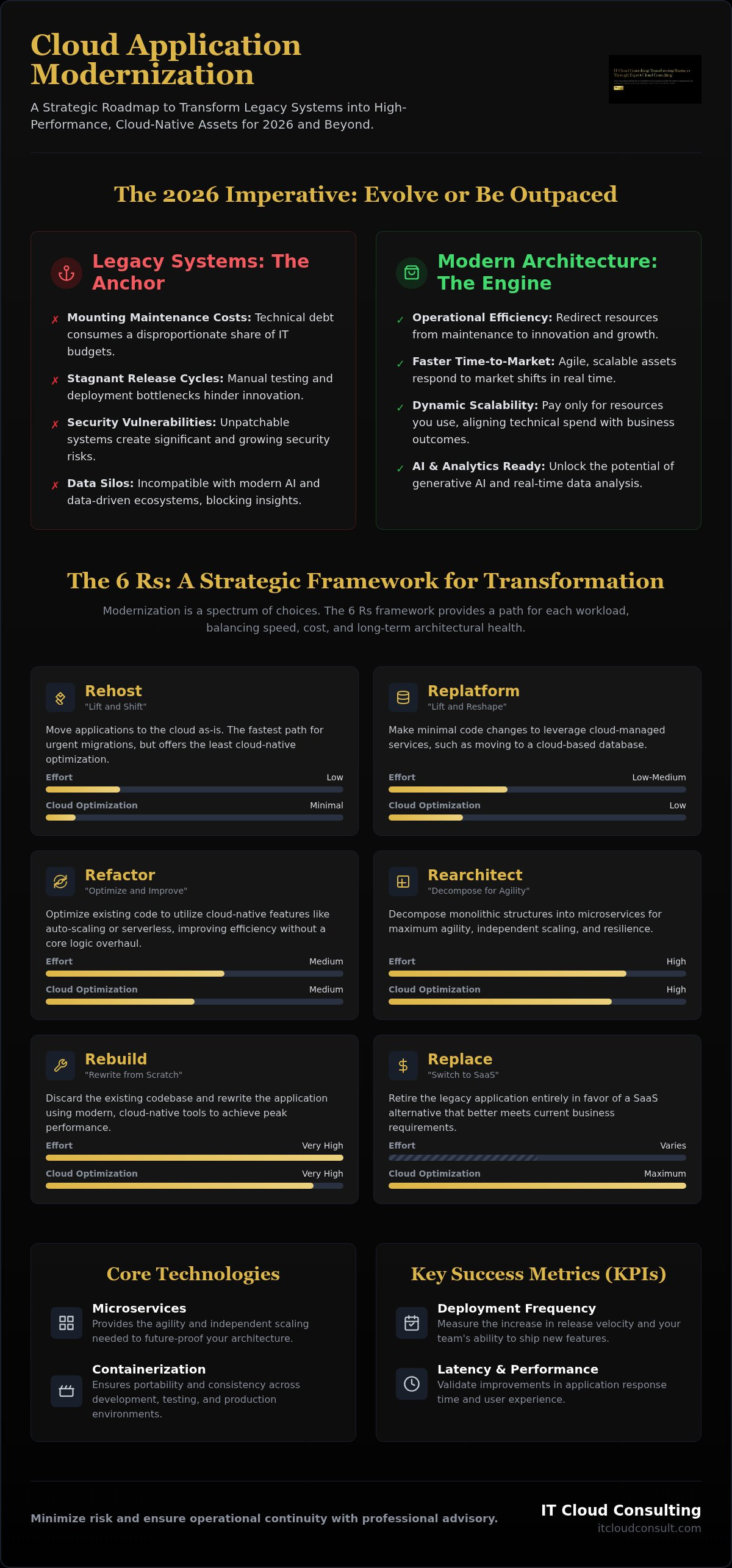
As we approach 2026, the definition of success in the cloud has shifted. It's no longer enough to simply exist in a virtual environment. True cloud application modernization strategy involves the deliberate transformation of monolithic legacy code into high-performance, cloud-native architectures. While the previous decade focused on migration speed, the next era demands architectural agility. Organizations that rely on "Lift and Shift" tactics find themselves burdened by the same inefficiencies they sought to escape, merely moving their problems from a private data center to a public provider. This approach fails to unlock the true benefits of elasticity and resilience that modern platforms offer.
A deep understanding legacy systems reveals that these structures often become anchors rather than foundations. Technical debt acts as a silent tax on innovation, often consuming a disproportionate share of IT budgets just to maintain the status quo. Modernization clears this debt, redirecting resources toward growth and operational efficiency. When you transform an application, you aren't just updating code; you're creating a scalable asset that can respond to market shifts in real time. This evolution is the catalyst for faster release cycles and a more responsive business model.
From Cloud First to Cloud Smart
The "Cloud First" mantra of the early 2020s has evolved into a "Cloud Smart" approach. This shift marks a transition from simple migration to strategic optimization. By refactoring applications to utilize serverless functions or microservices, companies don't just change where their code lives; they change how it performs. This precision directly impacts the total cost of ownership (TCO). Instead of paying for idle resources in a mirrored environment, a modernized stack scales dynamically. This ensures that every dollar of technical spend aligns perfectly with specific business outcomes and actual user demand.
The Risks of Maintaining Legacy Systems
Holding onto outdated frameworks carries significant liabilities that grow more dangerous each year. Beyond the obvious security vulnerabilities inherent in unpatchable systems, there's a growing human capital crisis. The cost of hiring specialized talent to maintain antiquated languages is rising as the global workforce pivots toward modern stacks. Perhaps most critically, legacy systems create data silos that are incompatible with modern AI and data-driven ecosystems. Without a robust cloud application modernization strategy, the transformative potential of generative AI and real-time analytics remains out of reach, leaving legacy-bound firms unable to compete in an increasingly automated market. To prepare for these future computational demands, research firms like Navmedha AI LLP are engineering quantum-ready operating systems that provide the high-performance foundation necessary for next-generation enterprise applications.
Evaluating the 6 Rs: A Strategic Framework for Transformation
Modernization isn't a monolith. It's a spectrum of technical choices. A robust cloud application modernization strategy relies on selecting the right path for each individual workload rather than applying a blanket solution. The 6 Rs framework provides the necessary granularity to make these decisions with confidence. Each pathway offers a distinct balance of speed, cost, and long-term capability.
- Rehost (Lift and Shift): This approach prioritizes speed, moving applications to the cloud as-is. It's often the first step for organizations facing urgent data center exits, though it offers the least cloud-native optimization.
- Replatform (Lift and Reshape): You introduce minimal code changes to leverage managed services, such as moving to a cloud-based database, without a full architecture overhaul.
- Refactor: Developers optimize existing code to utilize cloud-native features like auto-scaling or serverless triggers, improving efficiency without changing the application's core logic.
- Rearchitect: This involves a deeper shift, decomposing monolithic structures into microservices for maximum agility and independent scaling.
- Rebuild: You discard the existing code and rewrite the application from scratch using modern, cloud-native tools to achieve peak performance.
- Replace: You retire the legacy application in favor of a SaaS alternative that meets current business requirements more effectively.
Choosing Your Path: Effort vs. ROI
Selecting the appropriate "R" requires balancing immediate operational needs with long-term ROI. While rehosting might solve an immediate infrastructure problem, it rarely delivers the efficiency gains found in refactoring. Success often requires a hybrid approach where different applications follow different paths. This nuanced view aligns with broader initiatives like the federal cloud computing strategy, which emphasizes modernization as a pillar of security and performance. Establishing a firm foundation through strategic cloud adoption ensures that your cloud application modernization strategy serves the overarching business mission.
Identifying Candidates for Modernization
Not every application requires a full rearchitecting. Identifying candidates starts with assessing business criticality and performance bottlenecks. If a system has a short shelf life or limited user impact, a simple rehost might suffice. Conversely, high-traffic applications that stifle growth should be prioritized for deeper modernization during the first phase. Assessing these variables early prevents the misallocation of technical resources and ensures a smoother transition. If you're unsure which path maximizes your value, a session focused on cloud optimization can clarify your technical priorities.
Core Technologies Powering Modern Application Architectures
Technical execution is where a cloud application modernization strategy transforms from a conceptual framework into a tangible business asset. Success in 2026 relies on a tech stack that prioritizes portability, automation, and granular control. By selecting the right combination of tools, organizations can move away from the limitations of hardware-bound software and toward a fluid, responsive digital environment. This shift enables a level of operational resilience that was previously impossible with traditional infrastructure.
Containerization serves as the foundational layer for this transition. By packaging applications with all necessary dependencies, tools like Kubernetes ensure consistent performance across diverse cloud environments. This eliminates the common "it works on my machine" conflict and allows for seamless scaling that responds to traffic spikes automatically. Kubernetes manages the orchestration of these containers, ensuring they remain healthy and are distributed efficiently across the available resources to maintain peak performance.
Automation through DevOps practices and robust CI/CD pipelines ensures that the modernization lifecycle remains continuous. Integrated security protocols and automated testing reduce the risk of regressions as applications evolve. This systematic approach allows teams to deploy updates with confidence, knowing that the underlying infrastructure will support rapid changes without compromising stability or user experience.
The Shift to Microservices
Moving away from monolithic structures allows development teams to update specific features without risking the integrity of the entire system. Decoupled services enable independent scaling, where high-demand components receive more resources while others remain lean. To manage the resulting network complexity, organizations utilize service meshes and API gateways to secure and observe inter-service communication. Microservices represent a modular architecture pattern for 2026 that decomposes complex applications into discrete, independently deployable units to maximize organizational agility. This structure ensures that technical updates can keep pace with shifting market demands.
Leveraging Serverless and Cloud-Native Services
Serverless computing allows developers to focus entirely on code by abstracting away the underlying server management. This event-driven model is highly cost-effective, as you only pay for the exact execution time used. Managed databases also play a vital role, removing the burden of manual patching and backups while providing built-in high availability. This technical selection should align with official guidance for cloud and IT modernization to ensure compliance and industry best practices. Ultimately, ensuring that expert cloud infrastructure consulting informs the tech stack prevents costly misconfigurations and ensures long-term scalability for your cloud application modernization strategy.
Designing Your Modernization Roadmap: From Assessment to Execution
A successful cloud application modernization strategy requires more than a technical checklist. It demands a structured roadmap that bridges the gap between architectural vision and operational reality. Without a clear sequence of actions, even the most advanced tech stacks can lead to fragmented systems and ballooning costs. Your roadmap should begin with a comprehensive cloud readiness assessment to determine which assets are ready for transformation and which require foundational remediation. Big bangs often lead to failure. Iterative steps ensure long-term success.
Defining success through measurable KPIs is essential for maintaining stakeholder alignment. You should track specific metrics such as application latency, total operational cost, and deployment frequency to validate the impact of your efforts. Integrating FinOps practices early in the process ensures that cost-efficiency remains a priority, preventing the common pitfall of over-provisioning in the new environment. A phased rollout allows for these adjustments in real time, minimizing disruption to core business functions while building momentum through early wins.
The Assessment Phase
Effective planning starts with a detailed inventory of dependencies and architectural constraints. You must evaluate the "Modernization Score" for each application, which weighs business value against technical complexity. This phase also serves to identify talent gaps within your organization. If your internal teams don't have specific cloud-native expertise, recognizing this early allows for targeted training or the inclusion of external advisory to maintain the project's pace. It's the only way to ensure your technical debt doesn't simply migrate to a new platform.
Iterative Delivery and Continuous Improvement
Adopting a "Minimum Viable Modernization" (MVM) approach prevents the risks associated with large-scale transitions. By focusing on high-impact, low-risk components first, you establish a proof of concept that informs later stages of the rollout. Continuous feedback loops between development and operations teams ensure that lessons learned in early phases are applied across the entire enterprise. For organizations seeking to refine their performance after the initial transition, engaging in cloud optimization consulting provides the necessary post-launch tuning to maximize ROI. To begin building your custom roadmap today, explore our professional services for strategic cloud adoption.
Navigating Complexity: Why a Strategic Consulting Partner is Essential
Executing a comprehensive cloud application modernization strategy requires a specialized skill set that often exceeds the capacity of internal IT teams. While your staff focuses on maintaining the continuity of current operations, the sheer complexity of a large-scale transformation can lead to project fatigue or critical delays. A strategic consulting partner acts as a force multiplier, providing the high-level perspective needed to avoid common pitfalls. Professional advisory significantly reduces the risk of project failure and budget overruns by identifying technical roadblocks before they manifest as costly setbacks. This steady assurance allows your leadership to focus on market growth while experts handle the architectural heavy lifting.
A vendor-neutral perspective is particularly valuable in modern multi-cloud environments. Instead of being restricted by a single provider's proprietary ecosystem, you gain the flexibility to choose tools that best serve your specific business logic. This objectivity bridges the gap between high-level architectural strategy and the granular technical execution required to achieve measurable results. It ensures that your technology serves your business goals, rather than your business goals being limited by your technology.
The IT Cloud Consulting Advantage
We specialize in strategic planning that aligns your technical evolution with long-term business growth. By utilizing proven enterprise cloud transformation frameworks, we ensure that every code change contributes to your competitive advantage. Our engagement model provides comprehensive support, moving from the initial roadmap development through to technical execution and ongoing management. We don't just deliver a plan; we provide the visionary architecture and dependable guidance required to realize your organization's latent potential.
Ensuring Long-Term Operational Health
Modernization doesn't end at deployment. The "Day 2" reality of managing cloud-native assets requires a different operational mindset focused on continuous evolution. Integrating managed cloud services into your modernized ecosystem ensures that your applications remain optimized as demand fluctuates. This holistic approach includes:
- Continuous monitoring to detect performance anomalies in real time.
- Proactive resource tuning to maintain cost-efficiency and performance.
- Persistent cloud security and compliance management to protect your dynamic environment.
Maintaining this level of vigilance ensures that your cloud application modernization strategy delivers sustained value long after the initial transformation is complete. It transforms your IT department from a cost center into a resilient engine of innovation.
Securing Your Competitive Edge in the 2026 Digital Economy
The transition from legacy systems to cloud-native assets is a journey of evolution that requires more than technical migration. By embracing a structured cloud application modernization strategy, you've seen how organizations can move beyond the limitations of monolithic code to achieve true architectural agility. We've explored the importance of selecting the right modernization pathway among the 6 Rs and leveraging core technologies like microservices to drive efficiency. Success depends on a methodical roadmap that aligns these technical shifts with your broader business objectives.
Navigating this complexity is simpler with a partner that provides both visionary architecture and tactical proficiency. IT Cloud Consulting offers strategic advisory for enterprise-scale evolution and high-performance cloud optimization for US-based organizations. Our national coverage ensures you have the support needed to transform technical debt into a scalable engine for growth. We're committed to helping you realize the full potential of your infrastructure.
Contact IT Cloud Consulting for a Strategic Modernization Assessment to begin your transformation today. The potential of your digital assets is waiting to be realized, and the path forward is clearer than ever.
Frequently Asked Questions
What is the difference between cloud migration and application modernization?
Cloud migration involves moving workloads to the cloud with minimal changes, often referred to as "lift and shift." In contrast, application modernization focuses on transforming the code and architecture to be cloud-native. While migration provides a quick exit from data centers, modernization unlocks the true benefits of elasticity and scalability. This deeper evolution is a core component of a successful cloud application modernization strategy, ensuring your software thrives in modern environments.
How long does a typical application modernization project take?
Timelines depend heavily on the application's complexity and the chosen transformation pathway. A single application refactor might take three to six months, while a comprehensive enterprise-wide initiative often spans twelve to twenty-four months. Establishing a phased roadmap allows you to realize incremental value throughout the process. By prioritizing high-impact workloads first, you can demonstrate success and secure internal support while the broader modernization of your portfolio continues.
What are the most common risks associated with modernization?
The most common risks include unforeseen technical debt, data integrity issues during transition, and a lack of in-house cloud-native expertise. Organizations also face the challenge of maintaining current operations while simultaneously rearchitecting core systems. Project failure often stems from poor assessment phases or unclear business objectives. Partnering with a strategic advisor helps mitigate these liabilities by identifying bottlenecks early and ensuring that technical changes align with your long-term organizational goals.
Can we modernize applications without moving to a new cloud provider?
Yes, you can modernize your applications within your current cloud environment. Modernization is about architectural evolution, such as adopting microservices or serverless functions, rather than changing your infrastructure provider. Most major cloud platforms offer the necessary managed services to support a robust cloud application modernization strategy. This approach allows you to leverage your existing provider agreements while still achieving significant improvements in performance, scalability, and operational efficiency.
How does modernization impact our current cloud bill?
Initially, you might see a temporary increase in costs as you run legacy and modernized systems in parallel. However, the long-term goal is a significant reduction in your total cloud bill through improved resource utilization. Modernized applications scale dynamically, ensuring you only pay for the capacity you actually use. By eliminating over-provisioned idle resources and adopting managed services, you transition from a fixed-cost model to a more efficient, consumption-based financial structure.
What is the "Refactor" strategy and when should we use it?
The "Refactor" strategy involves optimizing an application's code to leverage cloud-native features without changing its external behavior. You should use this approach when an application is fundamentally sound but requires better scalability or performance to meet modern demands. It's a middle-ground option that offers higher ROI than a simple rehost but requires less effort than a full rearchitecture. This makes it an ideal choice for critical applications that need immediate efficiency gains.
How do we measure the ROI of an application modernization strategy?
Measuring success requires tracking both technical and business metrics. Key indicators include increased deployment frequency, reduced application latency, and a lower total cost of ownership. You should also evaluate improvements in developer productivity and faster time-to-market for new features. When these technical gains translate into better user experiences and reduced operational overhead, the return on investment becomes clear. These data points provide the evidence needed to justify continued architectural evolution.
Is serverless always better than containerization for modernized apps?
Serverless is not always superior; the choice depends on your specific workload requirements. Serverless is ideal for event-driven tasks and applications with unpredictable traffic patterns because it abstracts all infrastructure management. Containerization, managed via Kubernetes, offers more control over the environment and is better suited for complex, long-running processes or applications with steady demand. A balanced strategy often utilizes both technologies, matching the tool to the specific performance and cost requirements of each service.


