
Did you know that wasted cloud spend climbed to 29% in 2026, marking the first increase in five years? This surge is frequently driven by the rapid adoption of AI workloads that outpace existing governance, making a rigorous application portfolio assessment more critical than ever. You're likely feeling the weight of this inefficiency through escalating maintenance costs for redundant applications and the persistent shadow of legacy technical debt that stalls your progress.
It's common to feel overwhelmed by a lack of visibility into which systems are truly cloud-ready and which are simply draining resources. This guide provides a definitive framework for evaluating your software landscape, empowering you to convert these liabilities into a high-performance modernization roadmap. You'll learn how to identify immediate cost savings through rationalization while maximizing your long-term cloud ROI.
We'll explore the methodical process of analyzing your assets through the lens of strategic alignment and technical quality. This path ensures your IT infrastructure finally matches your broader business vision, evolving from a source of friction into a catalyst for innovation and growth.
Key Takeaways
- Understand why a rigorous application portfolio assessment is the essential foundation for resolving the 2026 modernization crisis and eliminating fragmented legacy stacks.
- Learn how to conduct a comprehensive discovery phase that unearths shadow IT and establishes clear visibility into your true Total Cost of Ownership.
- Master the integration of the TIME and 6Rs frameworks to categorize your software assets for either immediate elimination or strategic investment.
- Discover how to build a weighted scoring rubric that prioritizes "Quick Wins" and aligns your technical roadmap with core business objectives.
- Bridge the gap between strategic assessment and technical execution by aligning your portfolio with high-impact cloud optimization and adoption strategies.
The Strategic Importance of Application Portfolio Assessment in 2026
An application portfolio assessment is a systematic evaluation of your software assets to determine their business value, technical health, and cloud readiness. In the broader discipline of Application Portfolio Management, this assessment serves as the critical diagnostic phase that precedes any meaningful transformation. By 2026, enterprises find themselves in the midst of a modernization crisis. They're caught between fragmented SaaS sprawl and aging hybrid stacks that can't support the speed of AI-driven business requirements. Without a clear view of this landscape, leadership is essentially flying blind.
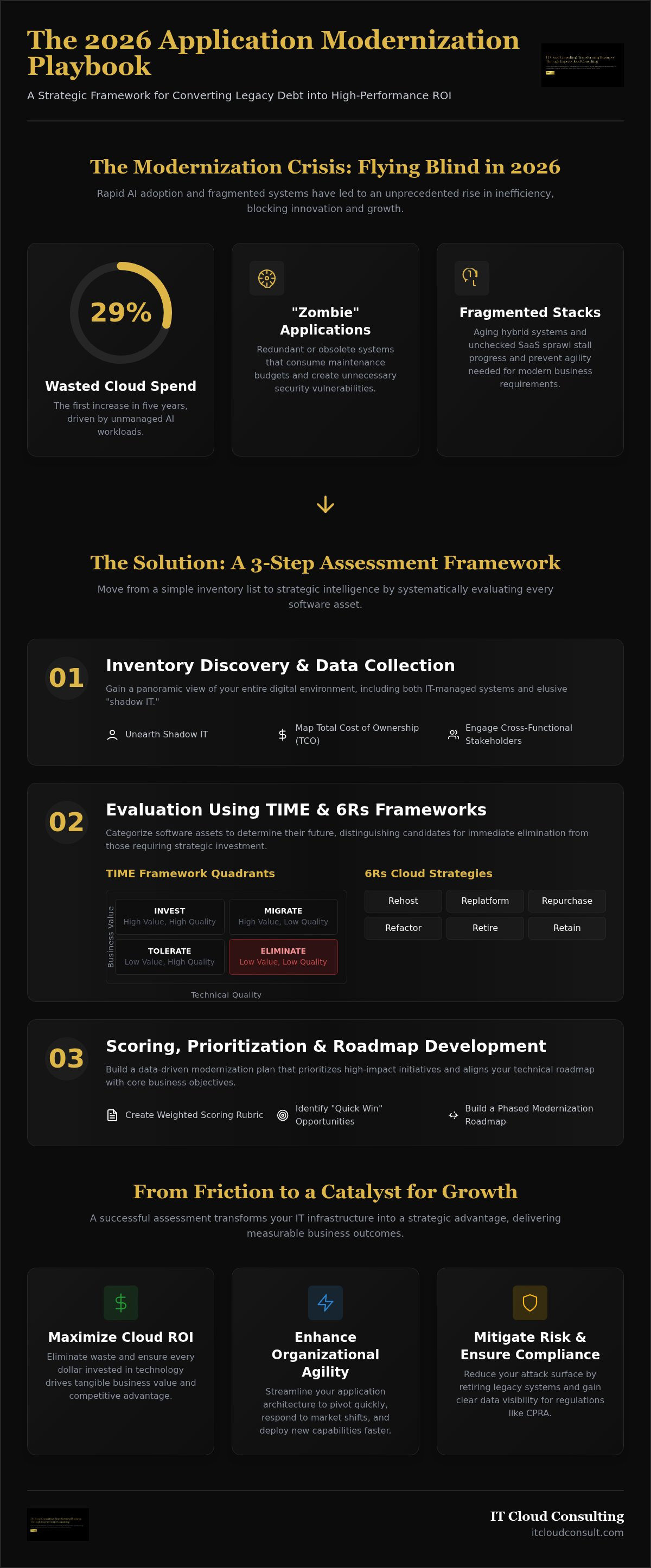
This lack of visibility creates "zombie applications." These are redundant or obsolete systems that continue to consume maintenance budgets and create unnecessary security vulnerabilities. These hidden costs are a primary reason why wasted cloud spend reached 29% in 2026. Performing a rigorous application portfolio assessment allows you to identify these fiscal drains and clear the path for strategic cloud adoption. It ensures your infrastructure is built for the future rather than anchored to the past. It's about evolving your IT assets into a lean, responsive engine for growth.
Moving Beyond Simple Inventory to Strategic Intelligence
Enterprise leaders often mistake a flat inventory list for a strategy. Knowing you have 400 applications doesn't tell you which ones drive revenue or which ones are a liability. Strategic intelligence involves connecting technical metadata, such as code quality and API connectivity, with business-critical outcomes. This process reveals the latent potential within your organization. It shows you exactly where modernization will yield the highest returns. We don't just look at what you have; we look at what those tools allow you to become. This transition from a simple list to a visionary roadmap is what separates market leaders from those struggling with technical debt.
Key Drivers: ROI, Agility, and Risk Mitigation
A thorough assessment directly informs cloud optimization consulting by highlighting where resources are misallocated. Beyond simple cost-cutting, it's about risk management. Every legacy application you retire or refactor reduces your attack surface. As data privacy laws like the California Privacy Rights Act (CPRA) become more stringent in 2026, knowing exactly where your data resides is a legal necessity. Streamlining your architecture increases organizational agility. It allows your team to pivot quickly as market demands shift, turning your application portfolio into a strategic advantage rather than a maintenance burden.
Step 1: Inventory Discovery and Stakeholder Data Collection
The initial phase of an application portfolio assessment requires a panoramic view of your digital environment. Successful discovery spans both IT-managed systems and the "shadow IT" applications that often hide within departmental budgets. By 2026, the proliferation of specialized SaaS tools has made this visibility harder to achieve, yet more vital for fiscal health. You must identify every piece of software currently in use to understand where your resources are actually going.
Effective data collection relies on a cross-functional team that includes IT, finance, and business unit leaders. This collaborative approach ensures that you capture essential data points like Total Cost of Ownership (TCO), active user counts, and business criticality. While automated discovery tools provide a necessary technical foundation, they can't capture the full story. You'll need to supplement these findings with qualitative stakeholder interviews to understand how each tool impacts daily operations.
We recommend utilizing a mix of network logs, financial invoices, and direct surveys to build a single source of truth. This multi-source validation prevents gaps in your inventory and sets the stage for meaningful evolution. If you're unsure where to begin with this complex mapping, our team at IT Cloud Consulting can act as the visionary architect to guide your discovery process.
Mapping the Business Value vs. Technical Health
Once your inventory is complete, you must weigh each application's technical stability against its strategic worth. This involves asking whether a tool is mission-critical or simply a matter of convenience for a small group. Business value is the intersection of user impact and revenue generation. By applying frameworks like Gartner's TIME model, you can begin to see which applications deserve further investment and which are candidates for retirement.
Overcoming Data Silos and Resistance
Resistance often arises from department heads who fear losing specific tools they've grown accustomed to using. To overcome this, you must establish a transparent "why" that focuses on empowerment rather than just cost-cutting. Show stakeholders how streamlining the portfolio reduces friction and frees up budget for more innovative projects. Validating your data through multiple channels ensures accuracy and builds trust across the organization. This transparency is the key to securing the buy-in needed for a successful long-term modernization strategy.
Step 2: Evaluating Applications Using the TIME and 6Rs Frameworks
After finalizing your inventory, the next phase of a rigorous application portfolio assessment involves applying strategic and technical lenses to every asset. This stage moves beyond simple data collection and enters the realm of strategic intelligence. We utilize two primary frameworks to categorize applications: the TIME model for business rationalization and the 6Rs for technical execution. By overlaying these models, you can pinpoint exactly which systems are ready for the cloud and which are holding your organization back.
Evaluating cloud readiness requires a deep dive into application architecture and its underlying dependencies. We look for "12-factor" app principles and service-oriented architectures that can thrive in distributed environments. Identifying these traits early allows us to select the most impactful candidates for enterprise cloud transformation. This methodical approach ensures that your modernization efforts are focused on the areas that will yield the highest ROI and business agility.
The TIME Model: A High-Level Strategic Lens
The TIME model helps you determine the strategic fate of your software based on business value and technical quality. It's a vital tool for rationalization that prevents you from wasting resources on low-impact systems. We categorize applications into four quadrants:
- Tolerate: These are applications with low business value but high technical quality. They're necessary for operations, so we maintain them with minimal investment.
- Invest: These high-value systems are the core of your competitive advantage. They deserve modernization and feature expansion to drive growth.
- Migrate: These applications provide high value but suffer from poor technical health. They're prime candidates for moving to more efficient cloud environments.
- Eliminate: These are the "zombie applications" that provide little value and carry high technical debt. We retire these to reclaim your budget.
The 6Rs: Technical Migration Pathways
Once the strategic direction is set, the 6Rs provide the technical roadmap for execution. This framework distinguishes between simple migrations and complex architectural shifts. For example, replatforming involves making minor optimizations to take advantage of cloud features without changing the core code, while refactoring is a deeper commitment. Repurchasing transitions your workflow to a standardized SaaS provider, whereas refactoring involves a comprehensive re-engineering of the application's code to fully utilize cloud-native scalability.
Deciding when to "Retire" an application rather than "Retaining" it on-premise is a critical choice. Retaining is often a temporary measure for applications with high compliance requirements or complex hardware dependencies. However, retiring redundant systems is the fastest way to reduce your attack surface and simplify your technical landscape. This clarity allows your team to stop managing legacy friction and start building future-ready capabilities; you can learn more about Ashiq S to see how expert full-stack development supports this transition.
Step 3: Scoring, Prioritization, and Roadmap Development
The culmination of a successful application portfolio assessment is the transition from raw data to a structured, executable roadmap. While previous steps focused on discovery and categorization, this phase requires you to develop a weighted scoring rubric that balances technical effort against business impact. This is where your strategic vision takes a concrete form. By assigning numerical values to specific criteria, you remove subjectivity and ensure that your modernization efforts align with the organization's most pressing goals.
During this prioritization phase, it's essential to review security gaps using a cloud security assessment checklist. This step ensures that your migration order doesn't inadvertently leave legacy vulnerabilities exposed. Finally, establish clear KPIs to measure the success of your implementation. Whether it's a reduction in technical debt or an increase in cloud-native deployment frequency, these metrics validate the entire assessment process. If you're ready to translate your inventory into a high-performance strategy, start building your execution roadmap with IT Cloud Consulting today.
The Scoring Rubric: Balancing Effort and Impact
A robust rubric evaluates the feasibility and value of every modernization candidate. We recommend using a 1-5 scale for each of the following factors to create a clear prioritization matrix. This mathematical approach allows leadership to see exactly why certain projects take precedence, transforming IT from a cost center into a driver of strategic value.
- Factors for Effort: You must analyze application complexity, the density of third-party dependencies, total data volume, and specific regulatory compliance needs.
- Factors for Impact: Focus on projected annual cost savings, potential performance gains, and the degree of competitive advantage the modernization provides.
Building the Execution Roadmap
Once scored, applications fall into three logical categories that define your timeline. Quick Wins are low-effort migrations that deliver immediate value and build organizational momentum. Strategic Projects represent high-impact transformations that may require more significant resources, while Long-term Evolution targets systems that need gradual modernization over several years. This categorization ensures you aren't overwhelmed by trying to modernize everything at once.
To maintain progress, structure your roadmap in six-month waves. This rhythm accounts for resource availability and allows for regular reassessment as business needs evolve. By allocating budget and talent resources specifically to high-priority "Invest" and "Migrate" targets, you ensure that your most valuable assets receive the attention they require. This structured flow allows your organization to evolve steadily, realizing the latent potential within your software landscape while maintaining operational stability.
Executing Your Modernization Strategy with IT Cloud Consulting
The transition from a documented roadmap to a functional cloud-native environment is where many enterprise transformations lose momentum. A comprehensive application portfolio assessment provides the blueprint, but execution requires a partner that possesses both high-level strategic confidence and the technical proficiency to deliver results. IT Cloud Consulting serves as that visionary architect, guiding your organization through the complexities of modernization while ensuring every action aligns with your broader business objectives. We don't just identify the path; we walk it with you.
Our cloud infrastructure consulting bridges the critical gap between assessment and action. We move beyond the traditional vendor relationship to act as a strategic consultant deeply invested in your long-term trajectory. By integrating our expertise into your modernization workflow, we facilitate the heavy lifting of migration and optimization. This collaborative approach empowers your leadership to realize the latent potential within your existing software landscape while accelerating your return on investment.
From Visionary Architecture to Technical Execution
We help you refine the scoring and validation processes established in your initial assessment to ensure no technical debt remains unaddressed. Our team provides the deep technical expertise required for complex "Refactor" and "Replatform" projects that often stall internal teams due to their inherent complexity. This specialized support reduces the risks associated with transitioning from legacy states to cloud-native architectures, maintaining operational stability throughout the evolution. We focus on creating a resilient foundation that supports both immediate performance and future innovation.
Continuous Evolution: The Post-Assessment Journey
Modernization isn't a one-time event but a continuous cycle of improvement. To maintain a lean and responsive IT environment, a formal application portfolio assessment should become an iterative, annual process. As market conditions shift and new technologies emerge, your portfolio must evolve to stay competitive and secure. A static inventory quickly becomes obsolete, but a dynamic assessment strategy ensures your assets remain strategic drivers rather than maintenance burdens.
Maintaining this long-term health is made possible through our Ongoing Cloud Support services, which provide continuous monitoring to ensure your environment remains optimized. This lifecycle management approach ensures that the cost savings and agility gains identified during your assessment are preserved and enhanced over time. We invite you to partner with IT Cloud Consulting for your application assessment and take the first step toward a more advanced, strategic future.
Advancing Your Enterprise Modernization Roadmap
The transition from a fragmented legacy landscape to a streamlined, cloud-native environment requires more than just a list of tools. It demands a rigorous application portfolio assessment that converts technical metadata into actionable business intelligence. By integrating the TIME and 6Rs frameworks, you've learned how to prioritize high-impact investments while systematically eliminating the "zombie applications" that drain your budget. This strategic clarity ensures your IT assets finally serve as a catalyst for growth rather than a source of friction.
As you move into the execution phase, remember that modernization is an iterative journey. Maintaining a lean, secure architecture in the 2026 landscape requires ongoing lifecycle management and expert guidance. IT Cloud Consulting specializes in enterprise-scale cloud transformation and multi-cloud infrastructure optimization. We provide the forward-looking strategic advisory necessary to navigate these complex transitions with confidence.
Schedule a Strategic Consultation for Your Application Portfolio Assessment
We're ready to help you build a more advanced, resilient future.
Frequently Asked Questions
What is an application portfolio assessment?
An application portfolio assessment is a systematic evaluation of an organization's entire software landscape to determine the business value, technical health, and cloud readiness of each asset. This diagnostic process serves as the essential foundation for strategic modernization. It allows leadership to identify redundant systems, technical debt, and opportunities for optimization. By analyzing metadata and business impact, organizations can evolve their IT infrastructure from a maintenance burden into a strategic engine for growth.
How often should an organization perform an application portfolio assessment?
Organizations should ideally perform an application portfolio assessment on an annual basis to maintain alignment with shifting business goals. The rapid pace of technology in 2026, especially regarding AI integration, makes static inventories obsolete very quickly. You should also trigger a reassessment during major organizational changes like mergers, acquisitions, or significant shifts in cloud strategy. Regular reviews ensure your portfolio remains lean, secure, and optimized for maximum ROI.
What are the common challenges in application portfolio assessment?
The most persistent challenges include the proliferation of shadow IT and the presence of fragmented data silos across different departments. Many organizations struggle with inaccurate data regarding Total Cost of Ownership or user impact. Additionally, stakeholder resistance can arise when department heads fear losing specific legacy tools. Overcoming these hurdles requires a cross-functional approach that combines automated discovery tools with qualitative interviews to build a transparent, validated source of truth.
How does the TIME model differ from the 6Rs migration strategy?
The TIME model is a strategic rationalization framework used to categorize applications based on business value and technical quality. In contrast, the 6Rs focus on the technical execution of cloud migration. While TIME tells you what the strategic fate of an application should be, the 6Rs define the specific technical pathway required to achieve that future state. Both frameworks work together to bridge the gap between high-level vision and technical proficiency.
Can an application portfolio assessment help reduce cloud costs?
Yes, a thorough application portfolio assessment is one of the most effective ways to reduce escalating cloud costs. It identifies zombie applications and redundant SaaS subscriptions that can be eliminated to reclaim budget immediately. By categorizing assets, you can move workloads to more cost-effective environments or refactor inefficient code to reduce resource consumption. This process ensures you only pay for the infrastructure that delivers genuine business value and supports your trajectory.
What data is required for a successful application portfolio assessment?
A successful assessment requires a mix of technical metadata and business context. Key data points include Total Cost of Ownership, active user counts, technical health scores, and business criticality ratings. You must also document application dependencies, compliance requirements, and current performance metrics. Combining this quantitative data with qualitative feedback from stakeholders ensures a comprehensive view of how each application supports the organization's broader vision and long-term development goals.
How long does a typical enterprise application portfolio assessment take?
A typical enterprise-scale assessment generally spans four to twelve weeks depending on the size and complexity of the portfolio. The discovery phase usually takes the longest as it involves unearthing shadow IT and validating data across multiple silos. Subsequent phases, such as scoring and roadmap development, move faster once a clean inventory is established. Engaging a strategic partner can often accelerate this timeline by providing specialized discovery tools and a proven methodology for prioritization.
Is an application portfolio assessment necessary for small businesses?
Yes, even small businesses benefit from a simplified version of this process to prevent resource drain. While the scale is smaller, the risk of SaaS sprawl and redundant subscriptions is just as real for growing companies. Performing a regular check of your software assets ensures that your limited IT budget is focused on tools that actually drive revenue. It's about maintaining agility and ensuring your technical foundation can support future scaling without accumulating excessive technical debt. If you're exploring expansion through a franchise model, check out Franchise Marketing Systems (FMS) for specialized development consulting.


