
The most expensive cloud bill isn't the one that exceeds your budget; it's the one that pays for a stagnant infrastructure while your competitors evolve. You've likely experienced the frustration of unpredictable monthly billing and the "bill shock" that follows a period of rapid scaling. These financial fluctuations often indicate that your current managed cloud services pricing models aren't aligned with your actual operational needs. This disconnect frequently stems from a gap in internal FinOps skills or the sheer overhead of managing multi-cloud complexities.
This guide will help you master the financial frameworks necessary to transition from unpredictable infrastructure costs to value-driven architectural evolution. We'll provide a 2026 strategic evaluation of how to align your cloud spend with specific business growth milestones. You will gain a clear framework for evaluating MSP value beyond simple uptime, ensuring your partnership drives modernization rather than just maintenance. By the end of this evaluation, you'll have the tools to transform your IT operations into a predictable, growth-oriented engine.
Key Takeaways
- Distinguish between restrictive legacy maintenance contracts and modern, outcome-based orchestration that supports long-term business agility.
- Evaluate the nuances of various managed cloud services pricing models, including tiered and per-resource structures, to identify the optimal fit for your specific infrastructure complexity.
- Understand the critical trade-offs between native hyperscaler support and the specialized, high-level strategic advisory required for complex multi-cloud environments.
- Implement a structured evaluation framework that prioritizes FinOps maturity and reporting transparency to ensure cloud spend directly fuels organizational growth.
- Discover how prioritizing professional advisory fees can mitigate long-term "cloud debt" and accelerate your transition toward a more optimized future state.
The Evolution of Managed Cloud Pricing: From Maintenance to Modernization
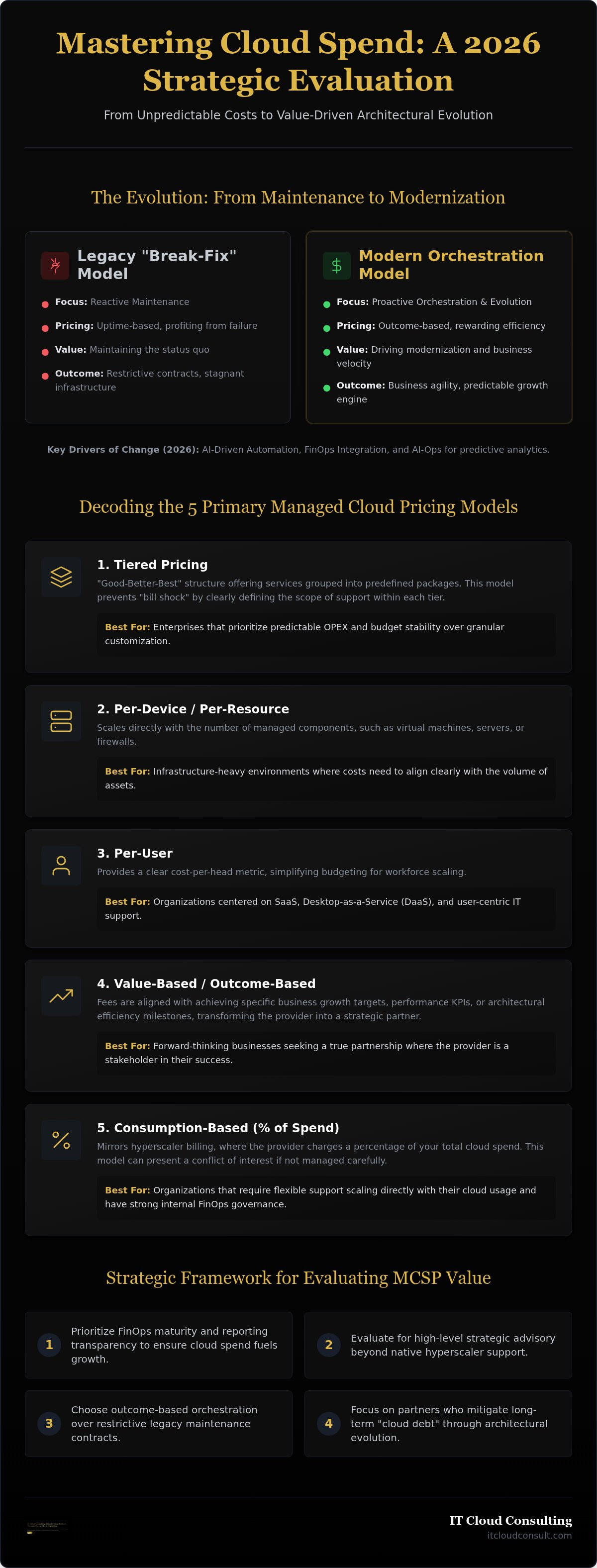
The enterprise landscape of 2026 has fundamentally redefined how organizations evaluate managed cloud services pricing models. Pricing is no longer a simple calculation of labor hours or server counts; it represents a strategic investment in architectural maturity. Modern Managed Cloud Service Providers (MCSPs) have shifted away from the legacy "break-fix" mentality, where vendors profited from failure, toward outcome-based orchestration models that reward efficiency and growth. This evolution ensures that IT spend directly correlates with business velocity rather than just maintaining the status quo.
AI-driven automation is the primary catalyst behind this structural shift. By automating routine maintenance and monitoring, providers have significantly lowered traditional operational costs, allowing them to pivot resources toward high-value advisory services. US enterprises now seek partners who don't just manage infrastructure but actively optimize it. This transition from a utility vendor to a strategic architect allows businesses to realize the latent potential of their cloud environments while maintaining a predictable financial trajectory.
From Reactive Support to Proactive Orchestration
Traditional uptime-based pricing is becoming obsolete. In a world where high availability is the baseline expectation, enterprises now demand performance-based KPIs that measure the actual impact on user experience and system agility. A commitment to strategic cloud adoption serves as the foundation for this shift, allowing organizations to reduce long-term management fees by building inherently resilient systems. Automated incident response further alters the cost-to-value ratio. By resolving issues before they impact the business, providers can focus their expertise on architectural evolution rather than repetitive manual troubleshooting.
The 2026 Drivers: FinOps and AI-Ops
Predictable spend requires more than just a monthly invoice. It demands the integration of FinOps directly into managed service contracts to ensure every dollar spent on infrastructure is optimized for value. Top-tier providers now leverage AI-Ops to predict and prevent costly system outages, shifting the financial risk away from the enterprise. Additionally, national US enterprises are increasingly prioritizing sovereign cloud compliance within their service agreements. This ensures that data residency and security protocols meet stringent federal standards while maintaining the flexibility of a modern cloud environment. By choosing specialized advisory partners, organizations can bridge the gap between raw infrastructure and sustainable business evolution. To further explore how tailored consulting can optimize your broader business processes, check out ITmore.
Selecting the right framework among various managed cloud services pricing models requires a deep understanding of your organization's operational rhythm. It's not merely a procurement decision; it's a strategic choice that dictates the quality of your partnership. In the 2026 landscape, most enterprises utilize one of five foundational structures to manage their cloud investments.
- Tiered Pricing: This "Good-Better-Best" structure offers predictable OPEX by grouping services into predefined packages. It's excellent for enterprises that prioritize budget stability over granular customization.
- Per-Device/Per-Resource: Often utilized in infrastructure-heavy environments, this model scales directly with the number of virtual machines, servers, or firewalls managed.
- Per-User: This approach simplifies costs for organizations centered on SaaS and Desktop-as-a-Service (DaaS), providing a clear cost-per-head metric for workforce scaling.
- Value-Based/Outcome-Based: Fees align with specific business growth targets or architectural efficiency milestones, moving the provider from a vendor to a stakeholder.
- Consumption-Based: This model mirrors hyperscaler billing, where the provider charges a percentage of your total cloud spend.
Tiered vs. Consumption-Based Models
Tiered models provide the steady assurance necessary for large-scale enterprise budgeting. These fixed-fee arrangements prevent "bill shock" by defining the scope of support clearly within each tier. Conversely, percentage-of-spend models can present a conflict of interest. If a provider's revenue increases as your cloud bill grows, they have less incentive to optimize your environment. This structure can inadvertently hinder cloud infrastructure consulting initiatives aimed at lean modernization. For those seeking to bridge the gap between raw infrastructure and growth, a professional cloud optimization strategy is essential to ensure the billing model supports efficiency.
The Rise of Outcome-Based Pricing
The industry is witnessing a significant shift toward outcome-based pricing. This model ties fees to architectural efficiency gains, incentivizing providers to actively reduce your total cloud bill through superior engineering. Unlike per-unit pricing, this framework accounts for the sophisticated "human element" of professional advisory services. Providers are no longer just keeping the lights on; they act as architects of your evolution. These models are particularly effective because they reward the provider for preventing issues rather than just reacting to them. By aligning financial incentives with system performance, you ensure that your partner is deeply invested in your long-term trajectory.
Comparative Analysis: Hyperscalers vs. Specialized Partners
Selecting the right entity to manage your infrastructure is just as critical as choosing between specific managed cloud services pricing models. National US enterprises often face a choice between native support from hyperscalers like AWS, Azure, and GCP or partnering with specialized independent firms. While hyperscalers provide the raw global scale and immediate access to new feature releases, their pricing structures often function as a "cloud tax" on your total spend. This native support typically scales as a fixed percentage of your monthly bill, which can lead to escalating costs that don't necessarily correlate with increased advisory value.
Specialized partners offer a distinct alternative by bridging the expertise gap that native tools cannot fill. These partners act as strategic architects, providing the customized oversight necessary to navigate multi-cloud complexities without the overhead of siloed native management. Relying solely on platform-native tools often results in hidden costs; managing disparate dashboards requires multiple internal skill sets and creates fragmented visibility. A specialized partner eliminates this friction by providing a unified management layer and unbiased strategic direction.
The Platform Provider (Hyperscaler) Model
Hyperscaler support is fundamentally designed for broad, "one-size-fits-all" technical assistance. It's a reliable choice for organizations that possess deep internal engineering talent and only require a safety net for platform-specific outages. However, these models lack the customized strategic guidance needed for complex business evolution. Because their revenue is tied to your consumption, hyperscalers have little financial incentive to help you aggressively reduce your resource footprint. This conflict can lead to "cloud debt" where you pay for high-level support that fails to optimize your actual architecture.
The Specialized Managed Partner Advantage
Independent partners prioritize objectivity and efficiency over platform loyalty. This perspective is vital for organizations pursuing hybrid-cloud or multi-cloud strategies where unbiased advice is the primary driver of ROI. By engaging in targeted cloud optimization consulting, specialized partners focus on lean modernization. They tailor their pricing and support to your specific organizational workflows, ensuring that every dollar spent on management fees translates into a more resilient and cost-effective environment. This approach converts managed services from a line-item expense into a catalyst for long-term architectural maturity.
Strategic Framework for Evaluating MCSP Pricing and Value
Mastering the complexities of managed cloud services pricing models requires a shift from simple cost comparison to a holistic value assessment. It demands a structured evaluation of how a provider's financial framework supports your long-term architectural goals. To move beyond the limitations of legacy billing, organizations must adopt a rigorous framework that prioritizes transparency and strategic alignment.
- Step 1: Internal Audit. Conduct a comprehensive review of your current cloud readiness and identify management gaps that lead to billing unpredictability or performance bottlenecks.
- Step 2: FinOps Maturity. Evaluate the provider's ability to deliver granular reporting and their commitment to continuous cost optimization.
- Step 3: Roadmap Execution. Assess whether the provider can translate high-level business goals into a technical execution plan.
- Step 4: SLA Alignment. Audit Service Level Agreements to ensure they focus on business-aligned outcomes rather than just basic server uptime.
- Step 5: Transformation Review. Utilize a proven enterprise cloud transformation roadmap to benchmark the provider's strategic vision against industry standards.
Auditing for Financial and Operational Transparency
A provider's reporting frequency and dashboard depth serve as immediate indicators of their operational maturity. You should look for integrated financial management that provides real-time visibility into resource consumption across multi-cloud environments. It's vital to differentiate between traditional uptime SLAs and "Strategic Success" SLOs. While uptime is a baseline requirement; your Service Level Objectives should track architectural efficiency and the reduction of technical debt. Verify the provider's internal process for continuous resource right-sizing. This proactive approach ensures your environment stays lean and avoids the common pitfall of over-provisioning. To benchmark your current infrastructure and security readiness, click here to utilize Nubivio's professional self-scan tool.
The interview phase is where you distinguish a utility vendor from a visionary architect. Ask lead architects how they handle complex legacy system integrations and what their specific strategy is for your migration path. A dependable partner will prioritize your organizational growth over their own billable hours. They should demonstrate a clear cause and effect between their technical actions and your business results. If you're ready to transition from unpredictable costs to a value-driven future, you can schedule a strategic cloud evaluation to identify your most impactful optimization opportunities.
Maximizing ROI with IT Cloud Consulting’s Managed Services
IT Cloud Consulting operates on the fundamental principle that your managed service provider should be a strategic architect rather than a mere utility vendor. We bridge the critical gap between raw infrastructure and sustainable business growth by prioritizing technical maintenance, security, and cost-efficiency for national US enterprises. Our advisory-first model ensures that your investment in cloud management translates directly into architectural evolution. By aligning our frameworks with the most effective managed cloud services pricing models, we empower organizations to realize their latent potential without the burden of unpredictable operational expenses.
Professional advisory fees are a strategic investment designed to prevent long-term "cloud debt." Our approach integrates high-level strategic planning with proactive technical maintenance, ensuring your environment remains lean and high-performing. This synergy allows us to identify and eliminate waste that automated tools alone often overlook. We don't just maintain the status quo; we modernize the infrastructure to support your specific growth milestones. This cause-and-effect structure ensures that every technical action we take is directly linked to an organizational benefit, providing you with steady assurance and a clear path toward optimization.
A Partnership Engineered for Continuous Evolution
Effective management requires moving beyond simple maintenance toward active managed cloud services that incentivize progress and agility. We specialize in helping US enterprises transition from fragmented, high-cost environments to unified, optimized cloud strategies that drive efficiency. Our customized support models are designed to scale with your organization, providing the steady assurance of a dedicated partner invested in your trajectory. This transformation results in a more resilient architecture where technical processes are simplified and aligned with your broader business vision. By focusing on the realization of potential, we help you evolve from a state of reactive troubleshooting to one of proactive innovation.
Next Steps Toward Cloud Maturity
Achieving cloud maturity is a methodical process that begins with a recognition of your current operational needs. An initial strategic consultation provides the clarity required to uncover immediate efficiency gains and identify hidden architectural vulnerabilities. Our team conducts a comprehensive review of your infrastructure and current billing structures to ensure they align with your long-term objectives. This steady, purposeful evaluation builds trust and provides a clear building block for your modernization journey. We focus on the big-picture perspective while maintaining the technical proficiency required for flawless execution.
Schedule a strategic cloud consultation with IT Cloud Consulting.
Aligning Financial Strategy with Architectural Maturity
The evolution of your digital infrastructure shouldn't be hampered by the limitations of legacy billing structures. The transition from reactive maintenance to proactive orchestration requires a deliberate evaluation of managed cloud services pricing models. By prioritizing outcome-based frameworks and FinOps maturity, national US enterprises can effectively convert traditional IT overhead into a catalyst for sustainable growth. You've discovered that the most effective partnerships move beyond simple uptime to drive continuous optimization and long-term architectural efficiency.
IT Cloud Consulting provides the steady assurance needed for this transition through authoritative strategic roadmap development and specialized cloud optimization expertise. Our advisory-first model ensures that your technical maintenance and security protocols are scaled for national enterprise requirements. We bridge the expertise gap that often leads to "cloud debt," ensuring your infrastructure remains lean and high-performing as you scale. This purposeful approach allows your organization to focus on its core trajectory while we manage the complexities of your cloud environment.
Begin your strategic cloud evolution with a professional advisory session.
Your organization possesses significant latent potential; it's time to unlock it through purposeful modernization and steady strategic guidance.
Frequently Asked Questions
What is the most common pricing model for managed cloud services?
Per-user and per-resource structures remain the most prevalent frameworks in the current market. These models provide predictable OPEX by linking costs directly to workforce size or your specific infrastructure footprint. Many organizations also utilize tiered pricing, which groups services into predefined "Good-Better-Best" levels to simplify budgeting. Understanding these managed cloud services pricing models is essential for aligning IT spend with specific business growth milestones.
How do managed cloud service providers help reduce AWS or Azure costs?
Providers utilize sophisticated FinOps methodologies and AI-driven optimization tools to identify underutilized resources and eliminate waste. They implement automated right-sizing and reserved instance management to lower monthly infrastructure bills. By focusing on architectural efficiency rather than just maintenance, a partner ensures your environment remains lean. This proactive oversight converts raw infrastructure costs into a value-driven investment that supports your long-term organizational goals.
Is it more cost-effective to use a hyperscaler’s native support or a third-party partner?
Native support from hyperscalers often functions as a fixed percentage of your total cloud spend, which can lead to escalating costs without added strategic value. Third-party partners provide customized, objective advisory services that native tools cannot replicate. A specialized partner prioritizes your specific business outcomes and multi-cloud complexities. This independent perspective often yields a higher ROI by preventing "cloud debt" and promoting continuous architectural maturity.
What are the hidden costs associated with managed cloud service agreements?
Common hidden costs include one-time onboarding fees, which often range from one to three times the monthly recurring charge. Organizations should also evaluate out-of-scope charges for specialized projects or emergency support outside standard SLAs. Unexpected data egress fees or licensing gaps can also impact the final bill. Analyzing various managed cloud services pricing models helps you identify these variables during the evaluation phase to maintain financial predictability.
How does a managed cloud partner handle security and compliance in their pricing?
Security and compliance are typically integrated into tiered service levels or offered as specialized add-on modules. Managed security services often include 24/7 threat detection, vulnerability scanning, and compliance management for industry-specific standards. Pricing reflects the complexity of the regulatory environment and the depth of monitoring required. This integrated approach ensures that data residency and security protocols meet federal standards while maintaining the flexibility of a modern cloud environment.
Can a managed cloud service provider assist with multi-cloud management costs?
Specialized partners provide a unified management layer that simplifies oversight across disparate platforms like AWS, Azure, and GCP. They use cross-cloud optimization tools to track spend and identify efficiency gains across your entire portfolio. This holistic view eliminates the friction of siloed management and reduces the need for multiple internal skill sets. By centralizing visibility, providers help organizations balance latency, data residency, and costs across their national operations.
What key metrics should I use to measure the success of a managed cloud partnership?
Success should be measured through business-aligned Service Level Objectives (SLOs) rather than just basic server uptime. Key metrics include the reduction of technical debt, architectural efficiency gains, and the alignment of cloud spend with growth milestones. You should also evaluate the provider's response times and the frequency of proactive optimization recommendations. These indicators demonstrate whether your partner is acting as a strategic architect or a mere utility vendor.
How does the "Strategic Architect" model differ from traditional IT support pricing?
Traditional IT support pricing often focuses on "break-fix" reactive maintenance and labor hours. The Strategic Architect model utilizes an advisory-first approach that prioritizes long-term modernization and technical proficiency. It links management fees to architectural evolution and business velocity. This model incentivizes the provider to prevent issues and optimize resources, whereas legacy structures may profit from recurring system failures or manual troubleshooting that hinders progress.


