
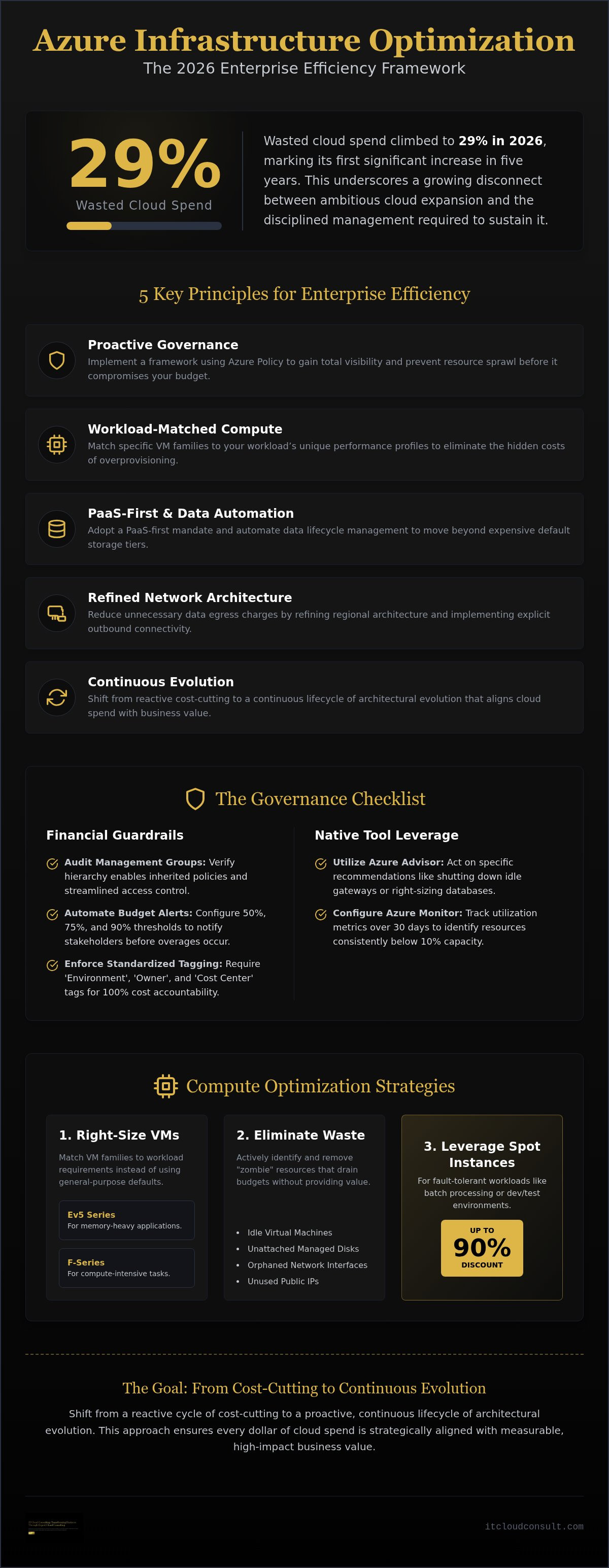
Wasted cloud spend climbed to 29% in 2026, marking its first significant increase in five years. This data underscores a growing disconnect between ambitious cloud expansion and the disciplined management required to sustain it. For many enterprise leaders, the promise of agility is often overshadowed by unpredictable monthly invoices and the persistent presence of zombie resources that drain budgets without delivering measurable value.
It's frustrating to watch your cloud TCO spiral while performance remains stagnant or misaligned with your strategic goals. You deserve a clear path toward stability and modernization. This article provides a comprehensive framework for azure infrastructure optimization, offering a professional-grade checklist designed to transform your environment into a model of enterprise efficiency. We'll move beyond basic cost-cutting to build a foundation of architectural excellence.
By following this systematic guide, you'll master the complexities of the 2026 Azure landscape, from navigating new Reserved Instance policies to implementing automated governance. We'll preview the essential steps to achieve predictable costs, performance-tuned workloads, and a cloud strategy that finally mirrors your organizational vision.
Key Takeaways
- Implement a proactive governance framework using Azure Policy to gain total visibility and prevent resource sprawl before it compromises your budget.
- Match specific VM families to your workload’s unique performance profiles to eliminate the hidden costs of overprovisioned or idle compute resources.
- Enhance your azure infrastructure optimization strategy by adopting a PaaS-first mandate and automating data lifecycle management to move beyond expensive default storage tiers.
- Reduce unnecessary data egress charges by refining your regional architecture and implementing explicit outbound connectivity methods for modern virtual networks.
- Shift from reactive cost-cutting to a continuous lifecycle of architectural evolution that aligns every dollar of cloud spend with measurable business value.
The Governance Checklist: Establishing Azure Visibility
Azure infrastructure optimization isn't merely a financial exercise; it's the precise alignment of cloud computing resources with actual business demand at the most efficient price point. Without a rigorous governance framework, the agility of the cloud quickly turns into a liability. Resource sprawl occurs when deployments lack oversight, leading to "zombie" VMs and orphaned storage disks that inflate your monthly bill without contributing to productivity. Azure Policy serves as your primary defense here, allowing you to codify guardrails that prevent non-compliant or over-provisioned resources from being created in the first place.
Establishing visibility is your first essential step. You can't optimize what you can't see. Microsoft Cost Management dashboards provide the granular data necessary to track spending patterns across different departments and projects. By implementing a standardized tagging taxonomy, you transform a generic invoice into a strategic map of cost-center attribution. This transparency ensures that every dollar spent is tied to a specific business outcome, allowing leadership to make informed decisions about future investments.
Financial Governance and Guardrails
Effective governance requires hard boundaries rather than vague suggestions. You must audit your existing subscription limits and management group structures to ensure they reflect your current organizational hierarchy. This structural integrity prevents accidental over-provisioning at the root level and simplifies the application of security policies. Consider these critical checklist items for your 2026 roadmap:
- Audit Management Groups: Verify that your hierarchy enables inherited policies and streamlined access control across all subscriptions.
- Automated Budget Alerts: Configure thresholds at 50%, 75%, and 90% of your monthly budget to trigger immediate notifications to stakeholders before overages occur.
- Standardized Tagging: Enforce a policy requiring tags for Environment, Owner, and Cost Center for every new resource to ensure 100% cost accountability.
Leveraging Native Optimization Tools
Azure provides powerful native tools that act as a visionary architect for your environment, but their value depends on your ability to interpret their output. Azure Advisor offers specific recommendations that highlight immediate azure infrastructure optimization opportunities, such as shutting down idle virtual network gateways or right-sizing underutilized databases. These insights are often the quickest way to realize latent potential in your existing spend.
To achieve a deeper level of efficiency, configure Azure Monitor to track utilization metrics across your entire tenant. By analyzing CPU, memory, and disk I/O trends over a 30-day period, you can identify resources that are consistently running below 10% capacity. This data-driven approach moves your team from reactive firefighting to proactive architectural refinement. Establishing strategic cloud adoption through automated governance provides the stable foundation necessary for long-term enterprise growth.
Compute Optimization: Right-Sizing and Reservation Strategies
Compute remains the primary driver of cloud expenditure, yet it's frequently the most mismanaged component of the modern stack. True azure infrastructure optimization requires a shift from a "provision and forget" mentality to a model of continuous right-sizing. This principle involves matching specific VM families to your workload’s unique CPU and RAM requirements rather than relying on general-purpose defaults. For instance, memory-heavy applications should utilize the Ev5 series, while compute-intensive tasks benefit from the F-series. Failing to align these profiles leads to chronic over-provisioning and wasted capital.
Idle virtual machines and unattached managed disks are silent drains on enterprise budgets. When a VM is deleted but its disk remains, or when a development server runs 24/7 despite being used only eight hours a day, your efficiency drops. For fault-tolerant workloads like batch processing or dev/test environments, Azure Spot Instances offer a powerful alternative, providing discounts of up to 90% on spare capacity. Implementing these strategic shifts allows organizations to reclaim lost budget and reinvest in higher-value innovation.
Virtual Machine Audit Checklist
A methodical audit is the precursor to meaningful cost reduction. By examining utilization data, you can identify resources that are no longer serving a clear business purpose. Use this checklist to refine your compute footprint:
- Identify Underutilized VMs: Flag any instances with an average CPU utilization of less than 5% over a 30-day window for immediate downsizing or consolidation.
- Modernize Legacy Families: Transition away from older A-series or D-series VMs to latest-generation families. As of July 1, 2026, Microsoft has discontinued new Reserved Instance purchases for several older series, making modernization a financial necessity to avoid reverting to expensive pay-as-you-go rates.
- Enforce Auto-Shutdown: Implement automated schedules for non-production environments to ensure they don't incur costs during off-hours or weekends.
Advanced Commitment Models
Selecting the right financial vehicle is as critical as the technical configuration. Azure Reservations provide up to 72% savings for predictable, steady-state workloads when you commit to a specific SKU and region for one or three years. Conversely, the Azure Savings Plan for Compute offers up to 65% savings with greater flexibility, applying automatically across different VM sizes and regions as your infrastructure evolves. Many of the same optimizing AWS spend principles apply here, especially when managing hybrid environments that require a unified financial strategy. For organizations seeking to master these complexities, professional cloud optimization services provide the roadmap needed to secure long-term ROI.
Storage and Data Lifecycle Management Checklist
Storage efficiency is the silent architect of a lean cloud environment. Many organizations fall into the trap of selecting "Premium SSD" as a default, regardless of the actual input/output operations per second (IOPS) required by the workload. This lack of precision results in over-provisioned performance that adds no tangible value to the business. Strategic azure infrastructure optimization involves a granular assessment of data access patterns to ensure every byte resides on the most cost-effective tier. By leveraging Azure Blob Storage lifecycle management policies, you can automate the transition of data from Hot to Cool or Archive tiers based on age or access frequency, ensuring your spend aligns with the data's utility.
Hidden costs often lurk within snapshots and backup retention policies. While data protection is non-negotiable, keeping daily snapshots for years without a business mandate is a common source of waste. Modernizing your storage strategy means utilizing features like disk bursting, which allows for temporary performance spikes without the permanent cost of a higher tier. This approach ensures you pay for peak performance only when it's actually utilized. These technical refinements, when applied systematically, transform storage from a growing liability into an optimized asset.
Azure Storage Tiering Audit
A thorough audit of your storage footprint often reveals immediate opportunities for cost reclamation. As of July 1, 2026, new storage accounts face a 128 KiB minimum billable object size for Cool and Archive tiers, making it essential to evaluate how small-file workloads are stored. Use this checklist to streamline your environment:
- Analyze Access Patterns: Transition data that hasn't been accessed in 30 days to the Cool tier, and move compliance data to the Archive tier to realize significant savings compared to Hot storage.
- Eliminate Orphaned Disks: Identify managed disks that are no longer attached to active VMs. These resources continue to incur charges until they are manually deleted, often representing a major portion of wasted spend.
- Refine Backup Retention: Review your Azure Backup policies to ensure retention periods match regulatory requirements rather than arbitrary historical defaults.
Disk Performance Optimization
Performance tiering should be a deliberate architectural choice. Paying for Premium SSD in development or testing environments that only require the latency profile of a Standard HDD is an avoidable drain on resources. For large-scale block storage needs, consider Azure Elastic SAN to consolidate storage and simplify management across multiple workloads. Understanding these nuances is critical, much like the strategies outlined in our guide on GCP cost optimization best practices, which highlights how multi-cloud storage comparisons can drive better procurement decisions. Mastering storage lifecycle management ensures your azure infrastructure optimization efforts deliver a sustainable, performance-tuned foundation for your enterprise.
Networking Efficiency and Modernization Checklist
Networking architecture serves as the circulatory system of your cloud environment, yet it's often the most overlooked component in a standard azure infrastructure optimization strategy. Data egress charges, specifically those incurred when traffic crosses regional boundaries, can quietly inflate an enterprise budget. By refining your regional architecture and ensuring that services communicate within the same availability zones where possible, you eliminate unnecessary transfer fees. Additionally, utilizing Azure Front Door or the Azure Content Delivery Network (CDN) allows you to offload bandwidth from your origin servers, reducing both latency for the end-user and compute load on your backend.
A significant regulatory shift is approaching on March 31, 2026, after which new virtual networks will no longer have default outbound access. This change necessitates a proactive transition to explicit connectivity methods like Azure NAT Gateway. Organizations that fail to modernize their networking stack before this deadline risk connectivity disruptions. Beyond mere connectivity, enterprise leaders should adopt a "PaaS-First" mandate. Transitioning from Virtual Machines to platform services like Azure App Service or Azure SQL often results in a lower TCO because these services abstract the underlying infrastructure, removing the management overhead and resource waste associated with traditional IaaS hosting.
Network Cost and Resiliency Audit
Visibility into traffic patterns is essential for identifying where your networking spend is leaking. High egress charges often signal a fragmented architecture that lacks regional alignment. Use this audit checklist to secure your perimeter and your budget:
- Audit Data Transfer Patterns: Use Traffic Analytics to identify high-volume egress between regions and consolidate workloads to minimize cross-region talk.
- Implement Private Links: Utilize Azure Private Link to keep traffic on the Microsoft backbone, which often reduces exposure and provides more predictable traffic costs than public internet routing.
- Streamline Firewall Rules: Review Azure Firewall and WAF configurations to remove redundant or conflicting rule sets that increase processing latency and costs.
The Shift to Cloud-Native Services
Modernization is the ultimate form of optimization. Moving away from the "lift and shift" mentality allows you to leverage the inherent efficiency of cloud-native architectures. This transition requires a methodical approach to service selection:
- Database Modernization: Identify SQL Server VMs that can be migrated to Azure SQL Managed Instance to eliminate OS licensing costs and patching efforts.
- Containerization Strategy: Assess opportunities to move monolithic applications into Azure Kubernetes Service (AKS) for better resource density. For deeper insights into managing these environments, refer to our Kubernetes cost optimization guide.
If your organization is struggling to reconcile complex global networking with rising cloud costs, our experts can provide the Strategic Cloud Adoption roadmap required to modernize your environment effectively.
Continuous Evolution: Scaling Your Optimization Lifecycle
True azure infrastructure optimization is a marathon, not a sprint. It requires a fundamental shift from episodic cost-cutting to a continuous lifecycle of architectural evolution. Establishing monthly review cadences ensures that your environment remains aligned with shifting business priorities and technological advancements. In 2026, this evolution is increasingly driven by AI, with spending on AI-optimized IaaS projected to grow by 96%. Organizations that treat optimization as a static task will quickly find themselves burdened by technical debt and inefficient resource allocation.
Building a culture of cost-awareness is the catalyst for long-term success. Engineering teams must understand how their architectural decisions impact the bottom line. When developers have access to real-time data, they transition from being mere builders to becoming stewards of enterprise value. This cultural shift is supported by the fact that 98% of FinOps practitioners are now managing AI-related expenses, proving that financial discipline is inseparable from modern innovation. Engaging cloud optimization consulting experts can help bridge the gap between technical execution and strategic financial goals.
Implementing a Continuous FinOps Cycle
The FinOps framework provides a methodical approach to scaling your efficiency through three distinct stages. It begins with the "Inform" phase, where teams receive real-time visibility into their specific cloud spend. This transparency removes the ambiguity that often leads to over-provisioning. Next, the "Optimize" phase involves executing the technical right-sizing and architectural transitions identified during your audits. Finally, the "Operate" phase focuses on monitoring the impact of these changes and adjusting governance guardrails to prevent future drift, ensuring your azure infrastructure optimization efforts remain effective over time.
The Value of Managed Cloud Support
For enterprises managing complex, multi-subscription environments, the burden of manual tuning can become overwhelming. Professional managed services provide 24/7 monitoring and proactive tuning, transitioning your strategy from manual audits to automated, policy-driven remediation. This level of steady assurance allows your internal teams to focus on core product development while seasoned architects handle the intricacies of performance tuning and security compliance.
Beyond technical tuning, optimizing the contractual side of your cloud ecosystem is equally vital. For enterprises navigating complex vendor renewals or new service acquisitions, RightCostIQ provides the RFP management and negotiation expertise needed to secure the most favorable procurement outcomes.
Ready to evolve? Learn how our managed cloud services can handle the heavy lifting of optimization for you, ensuring your infrastructure remains lean, secure, and fully aligned with your long-term roadmap.
Securing Your Cloud Trajectory for 2026 and Beyond
Mastering the complexities of the modern cloud requires moving beyond reactive cost-cutting. True azure infrastructure optimization is a continuous journey of architectural evolution that aligns your technical footprint with your high-level business vision. By implementing a robust governance framework, right-sizing your compute resources, and transitioning to PaaS-first networking models, you transform your cloud environment from a volatile cost center into a resilient strategic asset. These disciplined steps ensure that every dollar of your cloud spend actively contributes to measurable organizational value and long-term efficiency.
At IT Cloud Consulting, we combine deep Microsoft Azure expertise with comprehensive strategic roadmaps to ensure your modernization journey is both logical and profitable. Our ongoing managed support provides the steady assurance required for sustained enterprise growth in an increasingly competitive landscape. We're dedicated to helping you realize the full potential of your cloud investments through precision and foresight. Maximize your ROI with IT Cloud Consulting’s optimization experts and begin your transition toward a more efficient, future-ready infrastructure today.
Frequently Asked Questions
What is the most effective way to reduce Azure costs quickly?
The most immediate way to reduce spend is through the elimination of orphaned resources and the right-sizing of over-provisioned compute. By analyzing 30 days of utilization data, you can identify instances running at less than 5% capacity. Shutting down these idle VMs and deleting unattached managed disks provides instant financial relief without impacting your operational performance.
How does Azure Advisor differ from professional cloud infrastructure consulting?
Azure Advisor serves as a helpful baseline for automated suggestions, but professional consulting provides the visionary architecture required for enterprise-scale efficiency. While Advisor points out idle resources, a consultant builds a comprehensive strategic roadmap. This approach ensures your cloud spend aligns with long-term business value rather than just following generic technical prompts, helping you realize latent potential in your infrastructure.
Is it always cheaper to move from IaaS to PaaS on Azure?
Transitioning to PaaS is generally more cost-effective because it removes the hidden costs of managing infrastructure. When you move from a SQL VM to Azure SQL Managed Instance, you eliminate the need for OS patching and manual backups. This shift reduces your total cost of ownership by allowing your engineering teams to focus on innovation instead of routine server maintenance.
How often should our organization perform an Azure infrastructure audit?
Your organization should establish a monthly review cadence to maintain peak efficiency. High-level azure infrastructure optimization isn't a one-time project but a continuous lifecycle of refinement. Regular audits help you catch resource sprawl early and adjust your commitment models as your workload requirements evolve, ensuring your cloud budget remains predictable and fully optimized.
What are Azure egress charges and how can I minimize them?
Egress charges occur when data is transferred out of an Azure region or to the public internet. To minimize these costs, you should design your architecture to keep traffic within the same region whenever possible. Implementing Azure Private Link and Content Delivery Networks (CDN) also helps reduce the volume of data leaving your primary environment, resulting in lower monthly networking fees.
Can I optimize my Azure environment without risking downtime?
You can certainly optimize your environment without risking service interruptions. Many strategies, such as storage tiering or purchasing Savings Plans, are purely financial or background changes. For technical adjustments like right-sizing, using deployment slots and blue-green deployment strategies ensures that you can move to more efficient hardware profiles while maintaining 100% uptime for your users.
What is the difference between an Azure Reservation and a Savings Plan in 2026?
Azure Reservations offer the highest savings for stable, predictable workloads in a specific region. In contrast, Savings Plans provide a more flexible model that applies across various compute services and regions as your needs change. With the 2026 phase-out of Reservations for older VM series, Savings Plans have become a critical tool for maintaining discounts during infrastructure modernization.
How do I handle "zombie resources" in a large Azure tenant?
The most effective way to manage zombie resources is through automated governance and strict tagging. By using Azure Policy to enforce Owner and Cost Center tags, you can easily identify who is responsible for every resource. Azure Resource Graph queries can then automate the detection of orphaned disks, allowing you to reclaim budget across a large-scale tenant systematically through azure infrastructure optimization.


