
Multi-cloud is no longer just a migration milestone. It is an operating reality that needs to be managed as a connected system. Without a clear plan, AWS, Azure, and Google Cloud can mean fragmented security, hard-to-compare costs, and extra demands on teams already managing skills gaps. Effective multi-cloud strategy consulting shifts the focus from adopting more platforms to coordinating them with purpose.
If cloud spending is difficult to predict, workloads are hard to move, or each provider seems to require a separate approach to compliance, those concerns are well founded. More clouds do not automatically create more resilience or flexibility. A shared governance model, adapted to each provider, can help make complexity more manageable.
This article outlines a consulting roadmap for enterprise evolution in 2026, from assessing your current environment and setting cloud-neutral principles to strengthening FinOps, security, workload portability, and disaster recovery. You’ll find practical ways to establish consistent controls across platforms, identify where provider lock-in matters, and connect cloud investment to business priorities through strategic planning, optimization, and ongoing support.
Key Takeaways
- Replace accidental multi-cloud sprawl with intentional orchestration by linking each platform to defined business outcomes.
- Use multi-cloud strategy consulting to identify visibility and skills gaps before they create operational or security problems.
- Assess providers against workload requirements and interoperability needs, rather than defaulting to a single-provider mindset.
- Start with cloud discovery, then establish practical guardrails for security, ownership, and spending.
- Plan for regular optimization and support so your cloud environment can adapt as business needs and provider capabilities change.
What is Multi-Cloud Strategy Consulting in 2026?
Multi-cloud strategy consulting is professional advisory that aligns services from multiple cloud providers with defined business outcomes. It goes beyond choosing platforms: a consultant reviews workloads, dependencies, risks, and operating capabilities, then helps shape a coordinated approach to placement, governance, and optimization. A foundational understanding of cloud computing helps clarify what these services provide. Strategy determines how they should support the organization.
In 2026, the challenge is often not deciding whether to use multiple clouds. Organizations may arrive there through acquisitions, separate business-unit decisions, or the needs of new applications. The strategic shift is from accidental adoption to intentional orchestration: managing environments as a connected system rather than as isolated accounts. This can reduce reliance on a single provider, but it does not remove risk by itself. Identity models, interfaces, and operating practices still need deliberate coordination.
A cloud-neutral consultant can help compare AWS, Azure, and Google Cloud against business requirements instead of defaulting to provider loyalty. The assessment should also reflect emerging workloads. AI services may raise questions about data access, governance, and operating costs, while edge applications can make latency and proximity to data more important. Choose placement based on the workload and its constraints, not a blanket preference for one platform.
The Core Pillars of a Modern Multi-Cloud Strategy
Three disciplines help turn platform diversity into a manageable design:
- Interoperability: Map dependencies and decide which workloads need portability. Shared patterns can help, but moving an application between providers may still require changes and testing.
- Unified governance: Define consistent security and compliance policies across environments, then map each policy to the controls and services available from each provider.
- Cost transparency: Use FinOps practices to compare spending across provider consoles, assign usage to accountable teams, and guide optimization decisions.
Why Strategy Must Precede Implementation
Implementation without a target architecture can create technical debt, including duplicated services, inconsistent controls, and dependencies that make later changes harder. Begin by defining business priorities, existing constraints, and the intended transition from legacy systems to cloud operations. A structured enterprise cloud transformation roadmap can connect those priorities to infrastructure decisions.
Next, assess workloads one at a time. Consider performance requirements, data location, service dependencies, team readiness, and total cost before assigning a provider. This makes trade-offs visible before implementation begins and gives future cloud adoption a consistent framework.
Overcoming the 3 Critical Multi-Cloud Complexity Gaps
Running AWS, Azure, and Google Cloud side by side can expand choice, but it also increases the work of seeing, securing, and managing each environment. Three gaps often create daily friction: limited visibility, uneven skills, and costs that are difficult to compare. These problems reinforce one another. When teams cannot see resource usage consistently, they may miss waste. When expertise is divided among provider-specific teams, cross-platform issues can be harder to resolve.
Closing the Visibility Gap with Unified Management
Separate monitoring consoles can leave teams with an incomplete view of application health, access, and configuration. A shared dashboard can bring key signals together, while consistent logging and telemetry make events easier to compare and investigate across providers. These steps will not eliminate every blind spot, but they can give teams a common operational view and a clearer way to find unauthorized or untracked resources. When setting up shared reporting, choose a core set of signals and ownership fields that teams can interpret consistently.
Cloud sprawl is the uncontrolled growth of cloud services, accounts, and resources that obscures ownership and weakens operational efficiency.
Bridging the Skill Gap and Operational Silos
It can be difficult for an internal team to maintain deep expertise in every provider’s changing services while keeping pace with business priorities. This can lead to operational silos: one team understands a provider’s tools, while shared policies and cross-platform incidents fall between teams. Strategic advisory can provide specialized guidance and help internal staff build skills in cross-platform governance, architecture, and decision-making, not just provider-specific procedures.
Ongoing cloud support can help maintain system health through continuous monitoring and technical maintenance. For practical considerations when defining an operating model, see this guide to ongoing cloud support.
Addressing the Cost Gap with FinOps
Multi-cloud spending can become difficult to control when providers report usage differently and teams lack consistent resource ownership. Review actual billing and utilization data rather than assuming costs will rise by a fixed amount. Look for idle or oversized resources, duplicated services, and usage that cannot be assigned to an accountable team. FinOps turns those findings into a regular cycle of measurement, prioritization, and optimization. Cloud optimization consulting can help establish that discipline across providers and connect usage decisions to business value.
Effective multi-cloud strategy consulting addresses these gaps together. Shared visibility supports governance, cross-platform expertise improves coordination, and cost transparency gives leaders a sounder basis for deciding what to change.
Evaluating Providers: A Strategic Interoperability Framework
Provider selection should begin with workload requirements, not brand preference. AWS is often evaluated for breadth and scale, Azure for alignment with Microsoft-centered enterprise environments, and Google Cloud for data and AI capabilities. These are starting points, not universal rankings. The right fit depends on an application’s performance needs, existing dependencies, data location, compliance obligations, and the organization’s ability to operate the service.
A best-of-breed approach selects a service because it fits a defined requirement, while accounting for the cost and complexity of connecting it to the rest of the environment. Compare more than compute rates. Storage, data transfer and egress charges, support needs, and operational effort all affect total cost. Before committing, model expected data movement and test representative workloads. A low compute price may not mean better value if transfer charges or integration work add friction.
Compare Providers Against Enterprise Requirements
Use a consistent evaluation scorecard instead of broad claims about which provider “leads.” For compliance, map the organization’s specific obligations to the certifications and service coverage each provider documents for the relevant services and regions. Check the scope against current provider materials. Do not assume a platform-level certification covers every service or workload.
Network design matters, too. Inter-cloud latency can affect applications that exchange data frequently, so measure performance between the actual services and locations under consideration. Private connectivity options, such as AWS Direct Connect and Azure ExpressRoute, may be worth assessing for particular network requirements. Compare their design, availability, and costs with the application’s needs rather than treating private interconnects as an automatic default.
Design for Portability Without Overengineering
Cloud-native architecture does not have to mean provider lock-in. Containers orchestrated with Kubernetes can create consistency for some workloads, while open-source standards and infrastructure definitions can make environments easier to understand and reproduce. Portability is not automatic, however. Provider-specific databases, identity services, and managed features may require adaptation. Serverless services can reduce infrastructure management, yet their event models and integrations may increase dependence on a provider. Document these trade-offs before adopting them.
Resilience also requires more than distributing data across clouds. Define recovery objectives, identify authoritative data sources, and decide which datasets need replication or independent backups. Replication can support continuity, but it also introduces synchronization, access-control, and cost considerations. Test recovery procedures to confirm whether an alternative environment can meet business needs.
For organizations planning these decisions, cloud infrastructure consulting can help align architecture choices with modernization priorities. A cloud-neutral review of AWS, Azure, and Google Cloud optimization can clarify where portability is valuable and where a provider-specific capability is a stronger fit. Organizations assessing their next steps can also explore cloud optimization support as part of a broader multi-cloud strategy consulting roadmap.
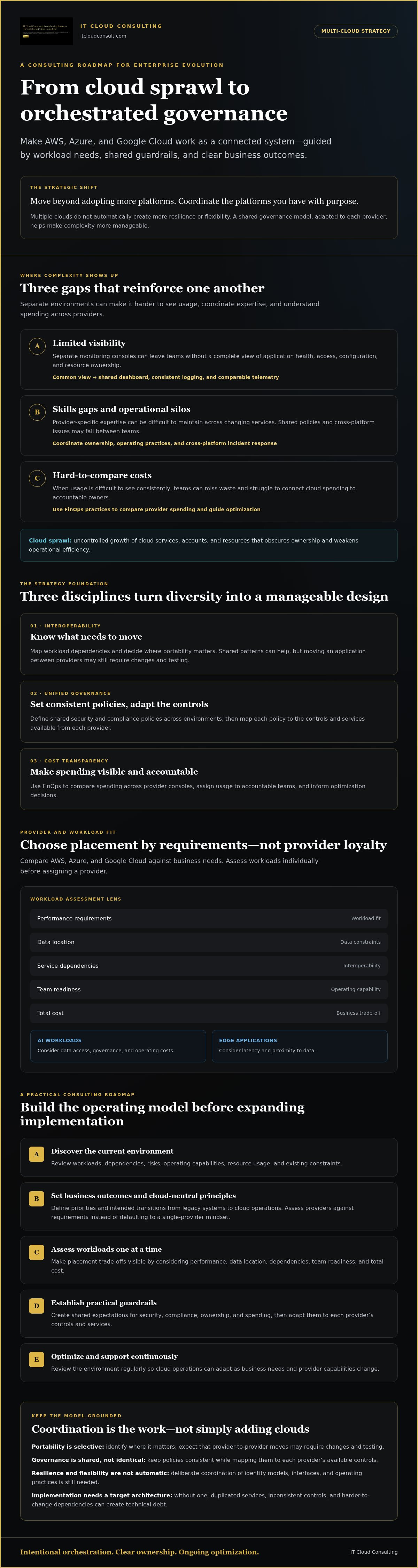
The Roadmap: From Cloud Sprawl to Orchestrated Governance
A durable multi-cloud program needs more than a migration sequence. It needs clear ownership, practical controls, and a feedback loop to keep architecture aligned with business priorities as workloads and provider services change. A five-phase roadmap gives teams a structured way to move from scattered adoption toward coordinated operations.
- Phase 1, Discovery and assessment: Inventory applications, accounts, data flows, existing commitments, and ownership. Review current strategic cloud adoption efforts to find duplicate services, undocumented dependencies, and workloads that may need different treatment.
- Phase 2, Governance design: Set decision rights and guardrails for identity, security, compliance, data handling, and spending before expanding or moving workloads.
- Phase 3, Architecture and migration: Sequence workload changes by business priority, dependencies, and risk. Validate the target design and recovery approach before making changes.
- Phase 4, Continuous optimization: Use FinOps reviews and performance data to find underused resources, unexpected costs, and opportunities to improve workload fit.
- Phase 5, Managed evolution: Maintain technical oversight and review provider updates so operating practices and architecture remain aligned with changing requirements.
Establishing Multi-Cloud Governance Guardrails
Governance works best when it establishes a consistent baseline without pretending every provider works identically. Define common identity and access principles, such as least privilege and clear role ownership, then map them to each cloud’s controls. Standardize resource tags for application, owner, environment, and cost center so finance and engineering teams can interpret usage consistently. Automated checks can flag policy drift and support a repeatable cloud security assessment. Confirm that checks reflect your actual control requirements.
Executing the Migration Strategy
Choose a migration method based on the workload. Re-hosting moves an application with limited changes, re-platforming makes targeted adjustments, and re-architecting reshapes it more substantially for the intended environment. Data transfer plans should account for dependencies, transfer windows, validation, and rollback options to reduce disruption. A Cloud Readiness Assessment is the essential starting point for any migration, establishing whether workloads, teams, and dependencies are prepared for the proposed change.
Multi-cloud strategy consulting can connect these phases in one accountable roadmap, with review points to adjust as business needs evolve. For a structured approach to cloud adoption and optimization, explore a cloud roadmap with IT Cloud Consulting.
Partnering for Evolution: Managed Multi-Cloud Support
A multi-cloud environment keeps changing after its initial design. Providers introduce services, business priorities shift, and workloads evolve. The operating model needs regular attention, not just a one-time implementation. Ongoing technical support can help teams maintain system health, review emerging risks, and keep cloud operations aligned with business goals.
This support can also give internal teams more room to focus on innovation. Instead of spending all their time on routine maintenance and platform-specific issues, they can prioritize work closer to their organization’s core objectives. Define responsibilities clearly, including monitoring scope, escalation paths, and response expectations. Confirm these details before engaging a provider, particularly if you require round-the-clock coverage.
The ROI of Managed Cloud Support
Managed support can create value by bringing maintenance, cost discipline, and operational coordination into a consistent practice. Proactive maintenance and patching help teams address known issues before they disrupt workloads, while continuous monitoring provides useful visibility across cloud environments. Clear service expectations and support fees also help leaders assess support as an investment in operational continuity and security, rather than simply an added line item.
Cost optimization needs to continue after the initial cleanup. Usage patterns change as applications scale, teams deploy resources, and provider services evolve. Regular reviews can identify idle capacity, unexpected consumption, or resources that no longer fit their workloads. In a multi-provider incident, agreed escalation procedures and shared operational context can help teams coordinate investigation and response. Outcomes depend on the support scope and the organization’s environment, so responsibilities and service levels should be explicit.
Future-Proofing Your Infrastructure
Architecture reviews help organizations evaluate new provider capabilities, including relevant AI services, without adopting them simply because they are available. Each review should consider business value, security, data handling, integration, operating effort, and cost. As demand grows, teams can scale infrastructure to workload needs while checking that added capacity does not introduce unnecessary complexity.
IT Cloud Consulting provides strategic cloud adoption, cloud optimization, and ongoing cloud support. Its consulting and managed services can help organizations assess cloud environments, plan adoption, and maintain systems through ongoing technical assistance. That is the enduring role of multi-cloud strategy consulting: not just helping establish an architecture, but supporting its evolution over time.
If your organization is assessing its next stage of cloud adoption or optimization, contact IT Cloud Consulting to discuss how its cloud consulting and managed services may align with your multi-cloud priorities.
Build a Multi-Cloud Foundation That Keeps Evolving
Strong multi-cloud outcomes depend on more than choosing providers. They come from matching workloads to business needs, establishing governance across environments, and reviewing cost, security, and performance as the organization changes. A deliberate roadmap also helps teams address visibility and skills gaps before they undermine day-to-day operations.
Effective multi-cloud strategy consulting connects these priorities with ongoing optimization and support. IT Cloud Consulting offers strategic cloud adoption, cloud optimization, and ongoing cloud support to help organizations evaluate their environments and shape adoption around long-term goals. Continuous monitoring and technical maintenance can help organizations sustain operational stability as cloud needs evolve.
The next step is to assess where your current environment stands, where complexity is accumulating, and which improvements matter most to the business. Contact IT Cloud Consulting to discuss your multi-cloud priorities and explore a practical path forward.
Frequently Asked Questions
What is the primary benefit of a multi-cloud strategy for large enterprises?
The primary benefit is the ability to match workloads with cloud services that fit business requirements, rather than relying on one provider for every need. A thoughtful strategy can also diversify some provider-specific risks and support resilience. These advantages depend on coordinated governance, capable operations, and careful architecture. Without those foundations, multiple platforms may add management effort without improving performance, flexibility, or continuity.
How does multi-cloud strategy consulting help reduce vendor lock-in?
Multi-cloud strategy consulting helps reduce vendor lock-in by identifying dependencies before they limit future choices. Advisors can assess which workloads benefit from portable patterns, such as containers, and where provider-specific services offer enough value to justify tighter coupling. They can also clarify data transfer requirements, exit considerations, and migration effort. Portability is not automatic, so prioritize it for workloads where flexibility matters and account for the trade-offs.
Is multi-cloud more expensive than using a single cloud provider?
It can be, but the number of providers alone does not determine total cost. Separate tools, duplicated services, data transfer charges, and specialist operating effort can increase spending. Placing workloads according to performance and business needs may improve value. Compare costs across environments, including usage, data movement, support, and operations. Regular reviews help identify idle resources, unexpected charges, and services that no longer fit their workloads.
How do you manage security across multiple different cloud platforms?
Manage security by setting common policies and translating them into controls that work within each provider. Establish consistent identity and access principles, clarify ownership, and standardize how teams log and review security events. Centralized visibility can help reveal gaps across environments, while automated checks can flag configuration drift for follow-up. Because provider tools and controls differ, validate implementation in each environment instead of assuming one policy is applied identically everywhere.
What role does FinOps play in a multi-cloud environment?
FinOps helps organizations understand and manage cloud spending across providers by connecting usage data with business ownership and decisions. Teams can standardize cost allocation, review consumption regularly, and investigate differences in pricing or data transfer charges. Those insights support actions such as rightsizing resources or removing unused capacity. FinOps is an ongoing practice, not a one-time cost-cutting exercise, and should balance financial efficiency with workload performance and reliability.
How long does it take to develop and implement a multi-cloud strategy?
There is no single timeline. The work depends on the number and complexity of workloads, existing documentation, dependencies, governance needs, and migration scope. Developing a roadmap is distinct from implementing it; planning decisions may be made before phased workload changes begin. Start with an inventory and readiness assessment, then sequence work by business priority and risk. Set milestones after discovery rather than relying on a generic estimate that may not fit your environment.
Can a multi-cloud strategy help with regulatory compliance and data sovereignty?
It can help organizations plan where data and workloads run and apply governance across providers, but using multiple clouds does not itself ensure compliance. Map applicable requirements to the specific services, configurations, and locations under consideration, then verify provider documentation and organizational responsibilities. Include data access, transfer, retention, and recovery in the review. Qualified compliance and legal stakeholders should validate how obligations apply to each workload.
What is the difference between hybrid cloud and multi-cloud?
Multi-cloud means using services from more than one cloud provider. Hybrid cloud combines different infrastructure environments, commonly public cloud with private cloud or on-premises systems, with some level of integration or coordination. An organization can use both approaches at once, such as operating workloads across two public cloud providers while connecting them to a private environment. The distinction matters because each model introduces different architecture, governance, and operational considerations.


