
What if your cloud security priorities are already visible, but buried beneath a long list of alerts, control gaps, and unclear responsibilities? Cloud security consulting can help turn those findings into a practical sequence of improvements, while clarifying which safeguards belong to your organization and which are managed by your cloud provider.
That division can be difficult to interpret. Risks may span identities, configurations, data, and day-to-day operations, while internal teams have limited time to plan and maintain improvements. The goal isn’t to add controls indiscriminately. It’s to focus effort on risks that matter to the business and choose changes your team can implement and sustain.
This guide explains what a well-scoped engagement should cover, how to prioritize findings, and what to assess when comparing consulting partners. It also shows how to connect security improvements with cloud adoption, infrastructure optimization, and ongoing operations, so recommendations can become part of a workable cloud operating model.
Key Takeaways
- Use cloud security consulting to turn assessment findings into prioritized controls that reflect business impact, exposure, and implementation effort.
- Clarify the engagement scope, deliverables, implementation support, communication approach, and ongoing responsibilities before choosing a consulting partner.
- Convert accepted recommendations into an action plan with clear owners, dependencies, target dates, and ways to measure completion.
- Consider consulting when cloud migration, changing obligations, unclear control ownership, or limited internal capacity makes security planning harder.
- Set expectations early for discovery, stakeholder involvement, findings, and follow-up so recommendations can connect with cloud operations.
Why Cloud Security Consulting Matters When Your Business Moves to the Cloud
Moving a workload to the cloud changes more than where data and applications reside. Teams must decide who can access them, how information is protected, which configurations are appropriate, and who maintains each safeguard as services evolve. Cloud providers secure parts of the underlying environment, but customers still make important decisions about how they use and manage cloud services.
Cloud security consulting translates cloud risks into prioritized, business-relevant controls, then helps an organization determine how to put those controls into practice. That means looking beyond a list of technical findings. Recommendations should account for the value of the systems involved, operational dependencies, and the capacity to implement and maintain changes. For foundational context on the topic, see Cloud computing security.
What does cloud security consulting include?
An engagement may review cloud architecture, access practices, data handling, configurations, existing controls, and the processes used to operate the environment. The advisor can then identify gaps, explain their business relevance, and develop a sequence of improvement priorities. The precise scope depends on the organization’s environment, needs, and the provider capabilities confirmed for the engagement.
Assessment and strategy are distinct from implementation and ongoing support. A review may produce findings and a roadmap, while carrying out changes requires agreed responsibilities, technical capacity, and follow-through. Strategic cloud planning, implementation support, optimization, and ongoing cloud management can help connect improvements to the wider operating model. Confirm whether dedicated security assessment or incident response is included rather than assuming it is part of a general cloud engagement.
Who is responsible for cloud security?
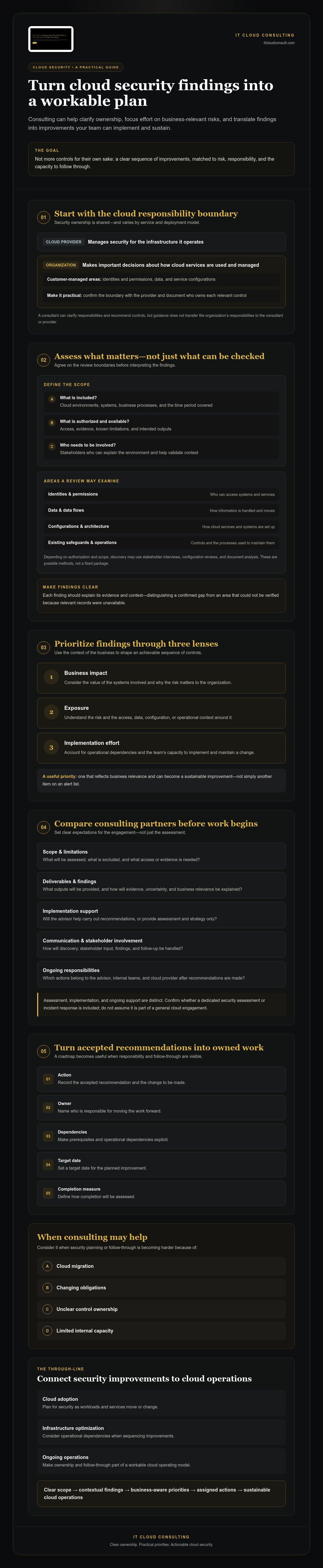
Responsibility depends on the cloud service and deployment model. Providers generally manage security for the infrastructure they operate, while customers remain accountable for decisions about their use of those services. The exact boundary varies, so organizations should confirm it with the provider and document who owns each relevant control.
Customer-managed areas often include decisions about identities and permissions, data, and service configurations. For example, a provider may protect the platform, but an organization still needs to determine who should access a business application and how its data should be handled. A consultant can clarify these boundaries and recommend controls, but that guidance doesn’t transfer the organization’s responsibilities to the consultant or provider.
A useful engagement makes ownership explicit. Before work begins, confirm what will be assessed, which recommendations the advisor will help implement, and which actions remain with internal teams or the cloud provider. This turns shared responsibility from an abstract concept into a practical operating plan.
How Cloud Security Consultants Assess Risks and Prioritize Controls
A useful assessment doesn’t start with a generic checklist. It starts by defining what’s in scope: which cloud environments, systems, business processes, and time period the review covers. The consultant and organization should also agree on access, intended outputs, and known limitations. This gives stakeholders a clear basis for interpreting findings and prevents assumptions from being mistaken for verified gaps.
What happens during a cloud security assessment?
Within the agreed scope, discovery may map cloud assets and account structure, identities and permissions, data flows, and existing safeguards. Depending on authorization and the engagement, consultants may combine stakeholder interviews, configuration reviews, and document analysis. These are possible assessment methods, not a fixed package. The depth of review depends on the environment, available evidence, and access granted.
Each finding should identify its evidence and context. For instance, a review might confirm that a sensitive system has broader access than intended, or flag that access couldn’t be verified because relevant records weren’t available. Documenting the difference helps decision-makers understand what is established, what remains uncertain, and where further investigation may be needed. Reference material such as the CISA SCuBA Project can also help teams explore guidance for securing cloud environments.
How are cloud security gaps ranked?
Findings become actionable when the assessment explains why they matter to the organization, not just which control appears incomplete. Prioritization should consider:
- Business impact: What important service, information, or operation could be affected?
- Exposure and likelihood: How accessible is the risk, and how plausible is misuse or disruption?
- Dependencies: What systems, teams, or provider-managed services must be considered before making a change?
- Implementation effort: What skills, approvals, and operational changes are needed to address it safely?
A confirmed weakness that exposes a critical system may call for prompt risk reduction. A broader architecture or governance improvement may require planning, coordination, and staged delivery. Rank findings by both urgency and the practical path to remediation, rather than treating every gap as equally important.
A prioritized finding combines verified risk context with a clear, actionable next step. To make that step executable, document an owner, proposed action, dependencies, target timing, and an observable measure of completion. Recommendations can then flow into an improvement roadmap instead of remaining a static report. Organizations developing their wider cloud plans can explore strategic cloud planning and support as part of connecting improvements to ongoing operations.
How to Compare Cloud Security Consulting Partners
A strong partner should make the work understandable before it begins and useful after findings are delivered. Compare cloud security consulting candidates on more than technical vocabulary. Look for a clear scope, evidence-based recommendations, realistic implementation support, and agreement about who owns follow-through. Ask how their advice will account for your business priorities, cloud architecture, and internal capacity.
Use a consistent set of criteria to compare proposals:
| Area | What to clarify |
|---|---|
| Scope | Which environments, services, and systems are included or excluded? What access and stakeholder time are required? |
| Deliverables | Will you receive documented findings, assumptions, priorities, and a practical improvement roadmap? |
| Implementation support | Will the partner help put agreed changes into practice, or is the engagement limited to assessment and recommendations? |
| Communication | How will findings, uncertainty, trade-offs, and progress be explained to technical teams and business stakeholders? |
| Ongoing responsibilities | Which follow-up tasks remain with your team, the provider, or the consultant after the engagement? |
Which questions should you ask a cloud security consultant?
Ask candidates to describe their process in terms you can verify. What environments and services are in scope? What is excluded, and what access is needed? What deliverables will you receive? Who decides whether to implement a recommendation? How are findings validated, ranked, and communicated? Request examples of deliverable formats with sensitive client information removed, so you can judge whether the output will support decisions and action.
Also ask how assumptions and limitations will be documented. A recommendation should explain its rationale, dependencies, and trade-offs, not present a control as universally appropriate. You can use the cloud security assessment checklist to prepare evaluation questions, and review the SANS Cloud Security Essentials course outline as one reference for relevant areas of expertise.
How can you distinguish strategy from a product pitch?
Look for advice that starts with your requirements, existing processes, skills, and operating constraints, then explains why a control or tool may fit. Be cautious of recommendations that default to a specific product without discussing alternatives or dependencies. Ask how success will be measured, such as confirming an agreed configuration change or assigning an accountable owner and review process. Treat claims about certifications, guarantees, or outcomes as items to verify with evidence before relying on them.
How to Turn Cloud Security Recommendations into an Action Plan
A recommendation only reduces risk when someone can carry it through and confirm the result. Translate each accepted finding into a defined task with an accountable owner, required dependencies, a target date, and an observable completion measure. For example, if access permissions need adjustment, specify which team approves the change, which workloads may be affected, and what evidence will show that access now matches the intended policy.
Sequence the work by weighing risk against operational impact, available skills, and technical dependencies. A high-impact exposure may need prompt attention, but remediation still needs to account for application owners, change processes, and services that rely on the affected configuration. Group related work when it reduces rework, and distinguish immediate risk reduction from longer-term architecture or governance improvements.
How should an organization prioritize remediation?
Start with material exposure and weaknesses that could affect critical systems or business operations. Coordinate changes with application owners and operational teams so a control improvement doesn’t create avoidable disruption. Then document decisions to defer work or accept a risk, including the accountable owner, rationale, and a date or trigger for review. This keeps lower-priority items visible without treating every recommendation as equally urgent.
- Owner: The person or team responsible for moving the task forward.
- Dependency: Required approvals, technical prerequisites, or coordination with other teams.
- Target date: A realistic timeframe agreed by the teams doing the work.
- Completion measure: Evidence that the change was made and works as intended.
How can cloud security improvements stay effective?
Controls need ongoing ownership because workloads, users, and business requirements change. Assign responsibility for maintaining each safeguard, and define review triggers for events such as a major architecture change, a shift in access needs, or a revised operating process. After a change, validate the control in the real environment. Confirm that it functions as intended and hasn’t disrupted dependent services.
Connect this follow-through with cloud operations where the agreed service scope supports it. Strategic planning, implementation support, optimization, and ongoing cloud management can provide continuity for cloud improvements, but responsibilities and deliverables should be explicit. A cloud security consulting roadmap is most useful when it becomes maintained operational work, not a report that sits apart from everyday management.
If your organization is turning cloud recommendations into owned, sequenced improvements, explore cloud consulting support as part of your broader cloud planning and operations.
When to Hire Cloud Security Consultants & What to Expect
External expertise can be useful when a cloud migration is approaching, new compliance obligations raise questions, control ownership is unclear, or internal teams lack capacity to assess and address security gaps. These situations don’t automatically call for the same engagement. The right scope depends on the organization’s environment, priorities, and the skills already available.
Is external cloud security expertise the right fit?
Consider whether your team needs an independent perspective, a clearer assessment process, help prioritizing concerns, or support connecting cloud improvements to operational plans. If internal specialists have the right expertise and capacity, they may be able to lead the work themselves. If they need added structure or implementation support, an external advisor may help fill that gap. Cloud security consulting should complement internal ownership, not replace it or promise a guaranteed outcome.
Before proceeding, agree on what the engagement will and won’t cover. Confirm how discovery will work, what information or access is needed, which stakeholders should participate, and what findings and follow-up are expected. Verify security-specific capabilities rather than assuming them: ask candidates to confirm their methods, platform experience, and the implementation support included in the agreed scope.
What should you prepare before an initial discussion?
A concise briefing helps make an initial conversation more useful. Summarize your business goals, cloud services in use, known concerns, and relevant deadlines. Identify technical and business stakeholders who can explain the environment, decision-making process, and operational constraints. You don’t need a complete inventory to start, but noting what’s known and what remains uncertain can help define realistic next steps.
- Goals and context: What business change or concern prompted the discussion?
- Current environment: Which cloud services and important workloads are involved?
- Known questions: Where are ownership, access, configuration, or data practices unclear?
- People and timing: Who can provide input, and what deadlines or dependencies matter?
Use the cloud security assessment checklist to organize initial questions and identify useful information to gather. Clear preparation helps shape an engagement around real priorities instead of assumptions.
For organizations seeking guidance that connects cloud planning, implementation support, optimization, and ongoing operations, IT Cloud Consulting can be part of the conversation. Discuss your cloud advisory needs and clarify which support fits your goals and agreed scope.
Build a More Secure Cloud Operating Model
Effective cloud security starts with clear ownership and continues through practical, prioritized improvements. The right cloud security consulting engagement should help your organization understand which risks matter most, compare potential partners by scope and delivery, and turn accepted recommendations into work that teams can own and validate.
Security also needs to keep pace with cloud operations. Strategic planning and roadmap development can help align improvements with business goals, while implementation support and ongoing cloud management can provide continuity as your environment evolves. The appropriate guidance depends on your organization’s cloud adoption stage, internal capacity, and agreed service scope.
IT Cloud Consulting provides customized guidance for organizations at different stages of cloud adoption, with support for cloud planning, implementation, and ongoing operations. To discuss how these capabilities may fit your cloud priorities, discuss your cloud consulting needs. A thoughtful next step can help your team move forward with greater clarity and confidence.
Frequently Asked Questions
What is cloud security consulting?
Cloud security consulting is professional guidance that helps an organization understand risks in its cloud environment and decide how to address them. Depending on the agreed scope, the work may review architecture, access, data handling, controls, or operating practices. A useful engagement connects evidence-based findings to prioritized actions. It doesn’t transfer responsibility for managing the cloud environment from the organization to the consultant or provider.
Why should a business hire a cloud security consultant?
A business may hire a cloud security consultant for an independent view of risk, specialist guidance, or a structured improvement plan. External input can help clarify priorities and responsibilities during cloud adoption or significant change. The right fit depends on the organization’s needs, internal skills and capacity, and the consultant’s verified experience. Before agreeing to work, define the scope, expected deliverables, and who will own follow-through.
What does a cloud security consultant do?
A cloud security consultant may help define an engagement’s scope, review relevant controls, explain potential gaps, and recommend improvements. Depending on the statement of work, the engagement may also include implementation planning or follow-up. Confirm which environments, assessment methods, deliverables, and responsibilities are included rather than assuming a particular service is provided. The organization remains responsible for its decisions and for managing its cloud environment.
How do I choose a cloud security consulting firm?
Compare firms on relevant experience, clearly defined scope, practical deliverables, communication, and the ability to explain trade-offs. Ask how they gather and validate evidence, prioritize findings, and support implementation. Confirm claims about certifications, platform expertise, or compliance capabilities directly. A suitable partner should tailor recommendations to your business requirements, architecture, and internal capacity, rather than defaulting to a standard solution without explaining its fit.
How much does cloud security consulting cost?
The cost of cloud security consulting depends on the environment’s size and complexity, the agreed scope, access requirements, expected deliverables, and whether implementation or follow-up support is included. Request a written proposal that explains assumptions, exclusions, responsibilities, and what work the engagement covers. When comparing proposals, consider whether each one addresses your priorities and describes useful outcomes, not just the headline figure.
Does cloud security consulting guarantee compliance?
No. An assessment or set of recommendations alone can’t guarantee that an organization meets its obligations. Requirements depend on the organization’s circumstances, services, processes, and supporting evidence, while implementation and ongoing governance remain important. Ask what requirements a consultant can assess, what evidence is needed, and what the engagement excludes. For interpretations of specific legal or regulatory obligations, consult qualified counsel where appropriate.
What is the difference between cloud security consulting and managed cloud support?
Cloud security consulting generally focuses on advice, assessment, planning, or defined improvement work. Managed cloud support typically involves ongoing operational assistance, though responsibilities vary by provider and agreement. Organizations may use both, but should confirm whether activities such as security monitoring, incident response, configuration changes, or continuing reviews are included. Don’t assume a general cloud support engagement covers dedicated security services unless the scope says so.
When should a company engage a cloud security consultant?
Consider external guidance when planning a cloud migration, control ownership is unclear, the architecture is changing, or your team needs a prioritized improvement plan. It may also help when internal capacity or expertise is limited. Start by defining the business question and the decisions you need to make, then select a scope that addresses them. Not every organization needs the same assessment or level of support.


