
What if your cloud data platform is adding complexity faster than it’s creating business value? A cloud data strategy framework helps prevent that by connecting each platform decision to a clear business outcome, an accountable owner, and a way to measure progress.
Data initiatives can feel disconnected from business priorities when teams disagree about who owns data, how governance works, or which architecture choices are worth making. Moving to the cloud alone won’t resolve those gaps. Without a deliberate plan, it can make them harder to manage.
This guide shows you how to build a practical framework: rank initiatives by business value, establish clear governance and ownership, make architecture decisions that fit your needs, and create a phased roadmap with meaningful measures of progress. You’ll also learn how strategic cloud planning and ongoing support can help keep the framework aligned as your data requirements and cloud environment evolve.
Key Takeaways
- Use a cloud data strategy framework to connect business outcomes with the data capabilities and responsibilities needed to achieve them.
- Build trust in data by addressing quality, access, lineage, and lifecycle management as connected priorities.
- Compare centralized, federated, and hybrid operating models by how they balance consistent decisions with team autonomy.
- Evaluate architecture options against interoperability, security, scalability, existing skills, and workload requirements before selecting tools.
- Turn strategy into sequenced initiatives with dependencies, accountable owners, and review checkpoints so progress can be assessed and adjusted.
What a Cloud Data Strategy Framework Defines, and Why It Matters
A cloud data strategy framework is a set of connected decisions, responsibilities, and measures that guides how an organization manages and uses data in cloud environments to achieve business outcomes. It connects the reason for using data to the choices that make it useful, trusted, and appropriately protected.
This is broader than a platform migration plan, a technology inventory, or a single analytics project. A migration plan focuses on moving workloads; an inventory records what exists; an isolated project addresses a particular use case. A strategy framework connects these activities to shared priorities. It helps teams decide what data to collect, who can access it, what quality is needed, how to protect it, and how to evaluate its use.
What belongs in a cloud data strategy framework?
The framework brings business outcomes, data assets, architecture, governance, people, and measurement into one decision-making structure. For example, if an organization wants to improve demand planning, it can identify the sales and inventory data needed, assign stewardship, set quality expectations, define access, and choose measures that show whether the information supports better planning.
Set the scope according to organizational priorities, applicable regulatory duties, and existing capabilities. Information management principles offer a useful foundation for considering data across its lifecycle, from acquisition and use through retention and disposal. The framework guides these choices; it doesn’t prescribe a single cloud platform.
How does it differ from a cloud adoption strategy?
Cloud adoption addresses the broader organizational transition to cloud, including platform use, operating practices, and how cloud supports business objectives. Data strategy focuses on how information is managed and used across that environment: its ownership, quality, access, movement, protection, and contribution to decisions.
The two strategies should reinforce each other. Cloud adoption establishes the environment and operating direction; the data framework clarifies how information creates value within it. For a wider view of planning that transition, see the strategic cloud adoption guide.
Keeping these boundaries clear helps prevent technology decisions from becoming the strategy itself. A framework gives teams a shared basis for evaluating initiatives, assigning accountability, and checking whether cloud data capabilities are advancing the outcomes the organization set out to achieve.
The Core Components That Turn Cloud Data Goals into Capabilities
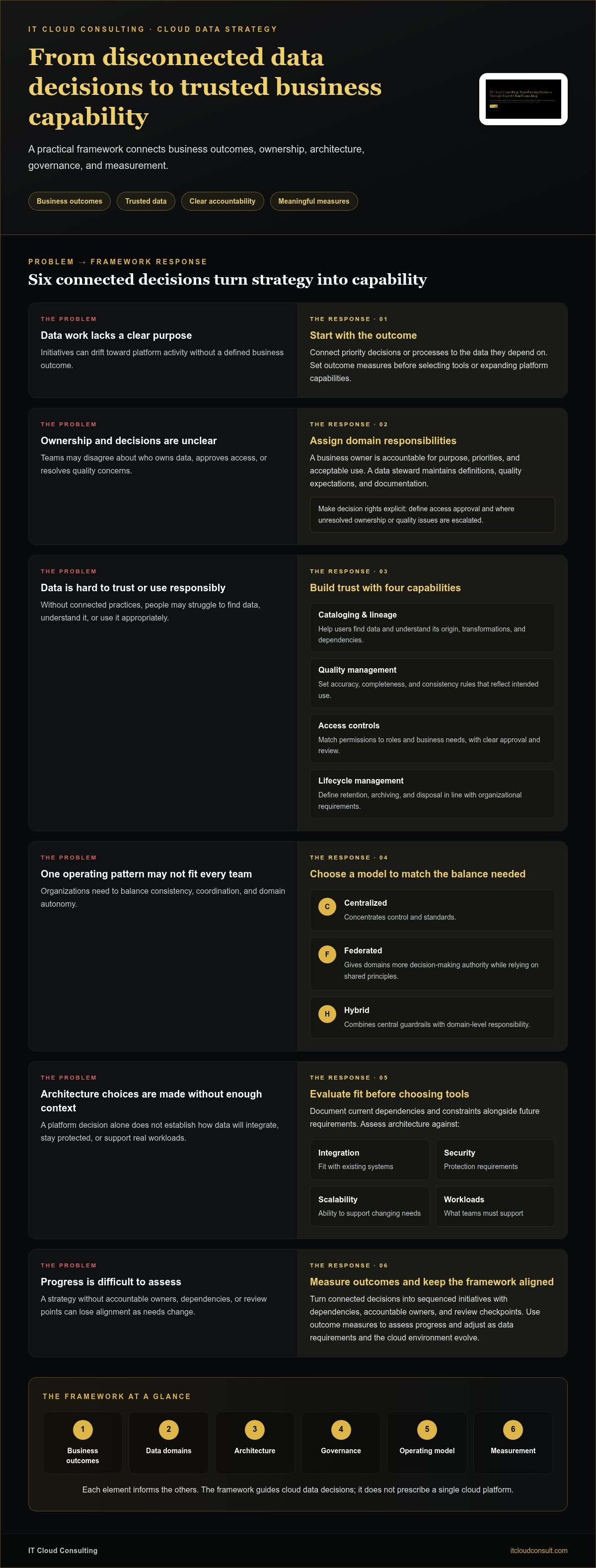
A useful cloud data strategy framework connects six elements: business outcomes, data domains, architecture, governance, the operating model, and measurement. Each element informs the others. A goal such as improving service forecasting, for example, shapes which operational data matters, who maintains it, how teams access it, and what measure will show whether it supports better decisions.
Set outcome measures before selecting tools or expanding platform capabilities. Gartner's guide to data strategy also emphasizes connecting data initiatives to business goals. This alignment helps teams direct investment toward capabilities with a defined purpose rather than technology for its own sake.
Business outcomes, data domains, and ownership
Map priority decisions or processes to the data they depend on, then assign responsibility at the domain level. A business owner is accountable for the domain’s purpose, priorities, and acceptable use. A data steward maintains definitions, quality expectations, and documentation. These are responsibilities, not necessarily separate job titles. Make decision rights explicit: identify who approves access and where unresolved quality or ownership issues are escalated.
Cloud architecture, integration, and governance
Choose an operating pattern based on the consistency, autonomy, and coordination the organization needs. A centralized model concentrates control and standards. A federated model gives domains more decision-making authority while relying on shared principles. A hybrid model combines central guardrails with domain-level responsibility. The right fit depends on how teams share data, maintain consistency, and make decisions across the environment.
Then define the capabilities that make information trustworthy and usable:
- Cataloging and lineage: Help users find data and understand its origin, transformations, and dependencies.
- Quality management: Set rules for accuracy, completeness, and consistency that reflect the intended use.
- Access controls: Match permissions to roles and business needs, with a clear approval and review process.
- Lifecycle management: Establish how data is retained, archived, or disposed of in line with organizational requirements.
Governance doesn’t exist to block access; it enables the right people to use trusted data responsibly, with clear accountability. Make that work practical with defined decision rights, named stewards, and escalation paths that resolve issues without leaving ownership ambiguous.
Architecture decisions should also account for integration with existing systems, security needs, scalability, and the workloads teams must support. When assessing infrastructure, document current dependencies and constraints alongside future requirements. Strategic cloud planning can translate these connected choices into an actionable roadmap, while ongoing support helps maintain alignment as data needs evolve. Explore cloud planning and support.
How to Compare Cloud Data Strategy Approaches Without Choosing Tools Too Early
Start with how decisions should be made, not which platform to buy. A cloud data strategy framework should identify the consistency, autonomy, and coordination teams need, then use those requirements to guide architecture and platform evaluation. This separates durable capabilities, such as reliable integration and clear access controls, from provider-specific features that may change.
Centralized, federated, or hybrid: which model fits?
Each operating model distributes decision rights differently. The best fit depends on whether the organization needs tighter control, more domain-level flexibility, or a deliberate balance of both.
| Approach | Strengths | Trade-offs | Organizational conditions |
|---|---|---|---|
| Centralized | Consistent standards, controls, and prioritization across teams. | Central teams can become bottlenecks for access, delivery, and changes. | Fits organizations that need uniform policies and can support a central team with clear service responsibilities. |
| Federated | Domains make decisions close to their data and business needs. | Teams need coordination to maintain shared definitions, quality, and interoperability. | Fits organizations with capable domain teams and a commitment to common principles. |
| Hybrid | Combines shared guardrails with domain-level autonomy. | Requires explicit decision rights so local flexibility doesn’t undermine shared standards. | Fits organizations that need central oversight while allowing domains to manage appropriate decisions. |
Before settling on a model, clarify which decisions are shared and which belong to individual domains. In a hybrid approach, for example, central governance might set access principles and metadata standards, while domain owners manage definitions and quality expectations for their own data. Write down the boundary so teams know where to make decisions and when to escalate.
How should cloud platforms be evaluated?
Compare AWS, Microsoft Azure, and Google Cloud against the same requirements rather than brand preference. Begin with the workloads and data flows the organization must support, then assess each option’s fit across:
- Interoperability and portability: How well can data and processes integrate with existing systems, and what dependencies could make future changes difficult?
- Security and identity controls: Can access policies align with roles, governance decisions, and operational responsibilities?
- Data services and scalability: Do available capabilities support current workloads and anticipated growth without adding unnecessary complexity?
- Team operating capability: Do existing skills and support practices match the platform’s operational demands?
Separate durable requirements from features tied to a particular provider. A useful feature shouldn’t substitute for core needs such as data quality, lineage, governance, and recovery planning. Document trade-offs, dependencies, and assumptions behind each option. That record makes future reassessment more deliberate as workloads, skills, and priorities evolve.
A Practical Sequence for Building and Measuring the Framework
Build the framework in stages, with each phase producing decisions that inform the next. Assign an accountable role, record a tangible output, and set a review checkpoint so the work can adapt as evidence emerges.
- Align on business outcomes. Interview business stakeholders to identify priority decisions, process pain points, and desired outcomes. The executive sponsor or business owner approves the priorities. The output is a ranked set of use cases with named owners and proposed measures. Before proceeding, confirm that each use case addresses a real business need.
- Assess the current state. Data and technology leads map critical domains, data flows, quality concerns, access requirements, and existing cloud capabilities. Document the baseline and gaps, then review findings with relevant domain owners to confirm what is accurate and where more assessment is needed.
- Set governance and architecture direction. The accountable business and technical leads define decision rights, stewardship responsibilities, security inputs, and the operating approach. Record agreed principles and open decisions. Include security considerations in the assessment by identifying access requirements, responsibilities, and relevant controls.
- Run focused pilots. Select a small number of use cases with clear owners, accessible data, and achievable measures. The use-case owner and delivery lead track progress against the baseline. At the checkpoint, decide whether to refine, expand, pause, or stop the pilot.
- Iterate and scale deliberately. Governance and business stakeholders review pilot evidence, resolve ownership or quality issues, and prioritize the next initiatives. Update the framework and roadmap as requirements change rather than treating the initial plan as fixed.
How can teams measure progress and adapt?
Establish a baseline before setting targets, and assign an owner to each measure. Choose indicators that reflect outcomes, trust, adoption, risk, and operations. For example, assess whether a priority process uses the data, quality issues are resolved, authorized users can access needed information, and controls operate as intended. Define the measurement method and review checkpoint in advance so teams can interpret changes consistently.
AI readiness should follow the same disciplined sequence. Assess each potential use case for business value, relevant data quality, provenance, access controls, and governance needs. Prioritize use cases whose data can be trusted and whose risks can be managed. Address capability gaps before expanding to more complex applications.
A cloud data strategy framework becomes actionable when measurement leads to decisions, not just reporting. Strategic planning and cloud advisory can translate assessment findings into a tailored roadmap, while ongoing support helps maintain progress as needs evolve. Develop your cloud data roadmap.
Turn the Cloud Data Strategy Framework into an Executable Roadmap
A strategy creates value when teams can act on it. Translate the framework into a roadmap that sequences initiatives, makes dependencies visible, assigns accountable owners, and sets review gates. Each initiative should connect a business outcome to the data and cloud capabilities required to support it, keeping architecture choices grounded in organizational needs.
What should an implementation roadmap contain?
Prioritize initiatives by expected business value, risk, readiness, dependencies, and available organizational capacity. A high-value initiative may still need to wait if a critical data source is unreliable or ownership is unresolved. Record the reason for the sequence so stakeholders can understand what must happen first and what conditions will allow the next phase to proceed.
For each initiative, document:
- Intended outcome and measure: State what business need it addresses and how progress will be assessed.
- Accountable owner: Name the person or role responsible for decisions, coordination, and results.
- Dependencies and capacity: Identify prerequisite data, integrations, skills, and available team effort.
- Governance and review gates: Define required controls, approvals, and checkpoints for continuing, adjusting, or pausing work.
Keep a clear line from each platform or architecture decision back to the business and data requirements it supports. This traceability makes the roadmap easier to reassess when priorities or cloud needs change, without losing sight of why a decision was made.
When can cloud consulting support the strategy?
The next step depends on the gap between the current state and the roadmap. An assessment can clarify existing infrastructure, data capabilities, and constraints. Strategic planning and roadmap development can turn priorities into sequenced work. Implementation support helps put agreed decisions into practice, while cloud optimization and ongoing management support operational continuity as environments and data needs evolve.
IT Cloud Consulting provides strategic planning and support tailored to organizational goals and cloud context, connecting framework decisions with practical execution. The cloud data strategy framework should remain a working guide, reviewed as initiatives deliver evidence and business priorities develop. Learn about cloud consulting and roadmap support.
Turn Your Data Strategy into Sustained Progress
A strong cloud data strategy framework connects business priorities to trusted information, clear ownership, and measurable outcomes. The right operating model and platform choices follow those requirements, not the other way around. A phased roadmap then turns decisions into accountable initiatives with checkpoints for learning and adjustment.
Progress doesn’t end when the roadmap is written. As data needs and cloud environments evolve, teams need to revisit priorities, assess infrastructure, and keep governance and operations aligned. Strategic planning and roadmap development can clarify next steps, while cloud infrastructure assessment and optimization can inform practical decisions. Ongoing technical support, monitoring, and management help sustain the work over time.
IT Cloud Consulting helps organizations connect cloud decisions to their goals and move from planning toward execution. A clear roadmap, accountable ownership, and regular reviews give teams a practical path from strategy to action.
With clear priorities, accountable owners, and regular reviews, your data strategy can evolve into a durable capability that supports better decisions and continued progress. Discuss a cloud data strategy roadmap.
Frequently Asked Questions
What is a cloud data strategy framework?
A cloud data strategy framework connects business goals with how an organization manages, protects, shares, and uses data in cloud environments. It brings priorities, data ownership, architecture, governance, people, and measurement into a structure for making decisions over time. It’s not simply a platform selection or migration checklist. For example, the framework can clarify who owns a data domain, who may access it, and how teams will assess whether it supports a business priority.
What are the main components of a data strategy framework?
The main components include business outcomes, priority data domains, ownership, architecture, integration, governance, security, skills, and measures of success. Their emphasis depends on organizational goals and current capabilities. These components work together: access policies need clear ownership, while architecture should support prioritized data uses. A practical framework also defines how teams will maintain data quality and evaluate progress, so technology choices contribute to trusted, usable information rather than becoming objectives on their own.
How do you build a cloud data strategy?
Start by identifying business priorities and the decisions or processes that depend on data. Assess critical data assets, flows, quality, governance, and current cloud capabilities. Then define ownership, operating principles, architecture needs, and measures of success. Prioritize initiatives in a roadmap, test assumptions through focused work, and review results against agreed outcomes. This sequence helps teams address foundational gaps early and adjust the strategy as they learn more about requirements and organizational readiness.
What is the difference between a data strategy and a cloud strategy?
A cloud strategy sets broader direction for adopting and operating cloud capabilities across the organization. A data strategy focuses on how information is managed and used to support business goals, including its ownership, quality, governance, access, and architecture. The two should align. Cloud decisions shape the capabilities available for data, while requirements for data use can influence cloud design, integration, security, and operating choices.
Should a cloud data strategy include AI?
A cloud data strategy should address AI when prioritized business use cases depend on it, but AI doesn’t need to define the entire strategy. Assess each use case for its business purpose, data quality, access requirements, governance, and suitability. For example, a team considering an AI-supported process should first establish whether the necessary information is reliable and appropriately controlled. Build durable data capabilities for current needs, then expand responsibly as priorities and technologies evolve.
How do you choose between centralized and federated data governance?
Choose by balancing the consistency and control the organization needs with the autonomy business domains require. Centralized governance can make shared standards easier to maintain, but approvals may become bottlenecks. Federated governance supports domain-level ownership, while requiring coordination around common definitions and controls. A hybrid model can combine enterprise-wide guardrails with domain responsibilities. Whichever approach you use, document decision rights, stewardship responsibilities, and how teams escalate unresolved issues.
How do you measure whether a cloud data strategy is working?
Measure progress against intended business outcomes and the data capabilities that support them. Depending on priorities, track data quality, trusted access, adoption, governance coverage, operational performance, risk, or progress on defined use cases. Establish a baseline, assign an owner to each measure, and review results at planned intervals. Platform activity alone doesn’t demonstrate business value. Measures are useful when they help decision-makers determine what to continue, adjust, or prioritize next.
When should a business engage cloud data strategy consultants?
Consider advisory support when leadership needs to align priorities, assess current capabilities, develop a roadmap, or connect cloud decisions with implementation. Support can also help organizations optimize infrastructure and manage cloud environments as requirements change. IT Cloud Consulting provides strategic planning and roadmap development, cloud infrastructure assessment and optimization, and ongoing technical assistance, monitoring, and management. Effective advisory work should result in practical decisions, accountable ownership, and measures that connect planning to execution.


