
Could a more focused cloud partnership deliver more value than a larger, more complex engagement? If your organization needs cloud guidance that connects technical decisions to business priorities, a boutique cloud consulting firm may offer the fit and continuity you’re looking for. The right model should match the scale of your needs, not add complexity for its own sake.
Choosing a partner can still feel uncertain. You may be weighing whether advice will lead to practical implementation, how cloud costs and performance will be managed, and what support will look like after initial changes. These stages work best as part of a connected plan that reflects your priorities, existing systems, and internal capacity.
This article explains what boutique cloud consulting means in practice and how to assess an engagement against your business and technical needs. You’ll see how strategic cloud adoption, implementation support, optimization, and ongoing assistance can form a clear path forward. IT Cloud Consulting supports this work by aligning cloud decisions with operational efficiency, innovation, and growth.
Key Takeaways
- A boutique cloud consulting firm describes a focused engagement approach, not a guaranteed firm size or outcome.
- Connect cloud priorities to a practical roadmap, execution support, and ongoing evaluation without assuming a full migration is needed.
- Assess boutique firms, larger consultancies, and in-house teams by scope, flexibility, and ownership to understand the trade-offs.
- Match strategic planning, cloud optimization, or continued support to the specific challenges your organization needs to address.
- IT Cloud Consulting connects strategic cloud adoption, implementation support, optimization, and ongoing assistance with business goals.
What Does a Boutique Cloud Consulting Firm Actually Do?
A boutique cloud consulting firm provides focused advice and practical support to help an organization make decisions about its cloud environment. Rather than treating a tool or hardware purchase as the solution, consulting connects business priorities to infrastructure choices, implementation support, and ongoing improvement. For a neutral introduction to the underlying technology, see Cloud computing.
“Boutique” describes an approach to the engagement, not a guaranteed company size, level of personal access, speed, or outcome. The scope should reflect business goals, existing systems, and the capabilities of the internal team. One organization may need strategic planning and a cloud roadmap; another may need targeted guidance on an established environment. Neither automatically requires a broad transformation project.
How boutique cloud consulting differs from a general IT vendor
A product reseller focuses on supplying technology. A consulting engagement focuses on what fits the organization’s priorities and how to put that direction into practice. The work starts with operating needs, such as improving infrastructure performance or supporting planned growth, then connects technical recommendations to those needs. This helps decision-makers understand what may change and why it matters to the business.
Which cloud challenges can a consulting engagement address?
The work depends on the organization’s starting point. Strategic cloud adoption can clarify a new direction or plan a transition. Optimization can address an existing cloud environment, including infrastructure performance and cost-efficiency. Ongoing cloud support provides continuing technical assistance, maintenance, monitoring, and management.
- Planning a new direction: Define business objectives, review current systems, and develop a cloud roadmap that reflects both.
- Improving an existing environment: Assess infrastructure performance and identify where optimization could better support operational needs.
- Maintaining progress: Use ongoing assistance to manage cloud operations and respond as requirements evolve.
These needs can overlap, but they don’t have to become one large engagement. A useful scope identifies the desired outcomes, the systems involved, and the work the internal team can own. It should also clarify who makes decisions and how progress will be reviewed. This directs advisory and implementation support toward the areas that matter, while leaving room to adjust priorities as the environment develops.
How Boutique Cloud Consulting Connects Strategy to Execution
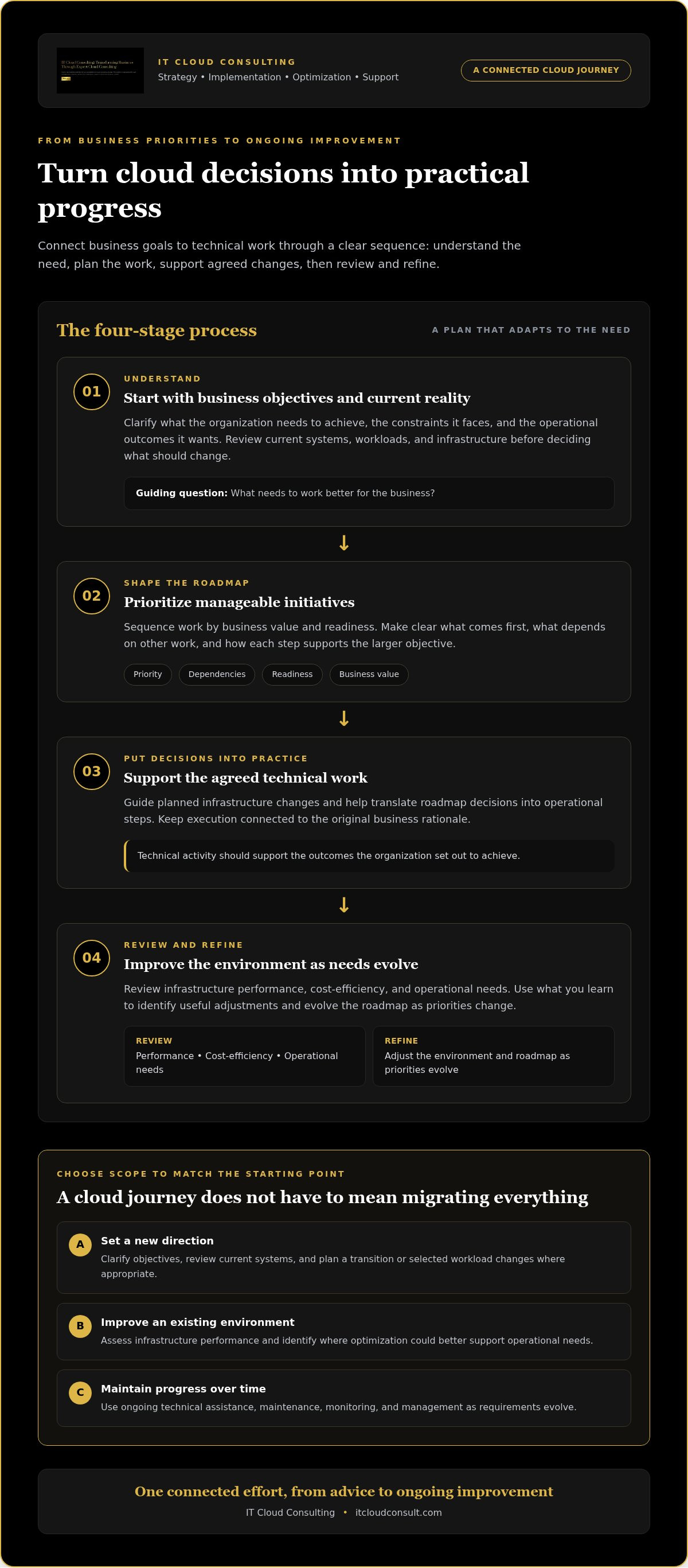
A cloud plan creates value when it guides real decisions, not when it remains a document on a shelf. A boutique cloud consulting firm can connect business priorities to technical work through a practical sequence: understand the goals, shape a roadmap, support agreed changes, then review and refine the environment. The steps can be scaled to the need. A cloud journey may involve moving selected workloads, improving existing infrastructure, or setting a new direction, rather than migrating everything.
From business objectives to a cloud roadmap
Planning starts with what the organization needs to achieve, the constraints it faces, and the operational outcomes it wants. For example, a team seeking greater efficiency should first understand how its current workloads and infrastructure support day-to-day operations. An advisory process can help prioritize decisions by business value and readiness without assuming a particular platform or prescribing a wholesale migration.
A useful roadmap sequences work into manageable initiatives and explains what should happen first, what depends on other work, and how each step supports the larger objective. This helps internal teams understand dependencies and allocate attention. For more planning detail, explore this strategic cloud adoption guide. The CSIS analysis of cloud adoption for modernization discusses the planning challenges in a federal context.
From implementation support to continued improvement
Once priorities are agreed, implementation support helps carry them into technical work. This may involve guiding a planned infrastructure change or helping teams translate roadmap decisions into operational steps. Keep execution tied to the original business rationale, so technical activity supports the outcomes the organization set out to achieve.
Work continues after a change is made. Reviewing infrastructure performance, cost-efficiency, and operational needs helps determine whether the change is working as intended and where further adjustments may help. As priorities evolve, the roadmap can evolve too. Connecting advisory, implementation, optimization, and ongoing support makes it easier to manage the cloud environment as a continuing effort rather than a series of disconnected projects.
IT Cloud Consulting’s cloud consulting services bring strategic guidance, implementation support, optimization, and ongoing management into the same cloud journey.
Boutique Cloud Consulting vs. Larger Firms and In-House Teams
The right engagement model depends on the work, the expertise already available internally, and who will own decisions after recommendations are made. A boutique cloud consulting firm may suit a clearly defined priority, while a larger consultancy or internal team may fit other needs. These models can also complement one another: internal staff can retain operational ownership while consultants contribute strategic guidance or targeted technical support.
| Model | Scope | Flexibility | Ownership |
|---|---|---|---|
| Boutique consulting firm | Often organized around a focused objective or defined set of cloud needs. | Engagement scope can be tailored to the project and organizational priorities. | Can advise or support execution; the organization should clarify who owns ongoing decisions and operations. |
| Large consultancy | May be considered for broad programs that involve coordination across multiple workstreams. | Approach and structure depend on the engagement’s scope and requirements. | Responsibilities are established through the engagement; internal teams still hold important business context and decisions. |
| In-house team | Works within the organization’s ongoing technology and operational needs. | Can adjust work based on internal priorities and available capacity. | Retains direct operational context and responsibility for decisions the organization keeps internally. |
When a focused consulting engagement may fit
A focused engagement can help when an organization has a defined cloud priority, a capability gap, or a decision that calls for tailored guidance. For example, a team may need help reviewing a specific part of its cloud environment, not launching a broad transformation. Define the outcome and boundaries of the work first, including what the internal team will own. Boutique status alone doesn’t guarantee lower cost, faster delivery, or better results; fit depends on the work and how responsibilities are agreed.
When a larger team or internal ownership matters
A broad transformation may involve many workstreams and specialties, making a larger engagement worth considering. Internal teams also bring valuable knowledge of existing systems, operating processes, and business priorities. External support can complement that expertise by helping plan or address targeted cloud work without replacing internal ownership. Make decision rights, implementation responsibilities, and ongoing operational duties clear from the outset.
When the main priority is improving the performance or cost-efficiency of an existing cloud environment, cloud optimization consulting is a focused area of support.
How to Match Boutique Cloud Consulting to Your Needs
The most useful engagement starts with your organization’s situation, not a standard package. A boutique cloud consulting firm can shape its scope around your priorities, internal skills, and current cloud environment. A team preparing for adoption may need strategic planning, while an organization with established infrastructure may need optimization or ongoing technical assistance. To define the right scope, identify the business outcome, the systems affected, the decisions that need to be made, and the work your team can support. Needs can change, so the engagement should be able to evolve with business goals and infrastructure requirements.
If your organization is planning cloud adoption
Strategic planning can clarify what the organization wants cloud adoption to achieve, which initiatives should come first, and how to sequence work into a practical roadmap. Internal capabilities, operating constraints, and existing systems all inform the plan. Legacy systems may be one factor in assessing readiness, but they shouldn’t define the entire strategy. Architecture-specific considerations are covered in this cloud infrastructure consulting guide.
If your cloud environment needs optimization
An established environment may call for a focused assessment of infrastructure performance and cost-efficiency. Start by describing the issue in operational terms, such as a workload that does not meet its needs or cloud resources that are not being used effectively. Optimization can then focus on technical changes that better support those needs, without treating the review as a new adoption project. The appropriate scope depends on what the organization wants to improve and the internal capacity available to carry changes forward.
If your team needs continuing support
A defined optimization initiative addresses specific improvement priorities; continuing support helps an organization manage cloud operations over time. The distinction matters if internal staff can lead planned changes but need ongoing technical assistance, maintenance, monitoring, or management to sustain day-to-day operations. Be clear about which tasks require continuing attention and which decisions remain with the internal team.
Ongoing cloud support is useful when your team needs continuing help to maintain and manage its cloud environment as operational needs evolve.
In each situation, the scope should reflect who will make decisions, which work internal teams can own, and what outcomes matter most. This keeps support aligned with actual capabilities and leaves room to adjust as requirements develop. IT Cloud Consulting provides tailored cloud consulting support for organizational priorities.
How IT Cloud Consulting Supports Your Cloud Journey
Cloud work delivers more lasting value when planning, technical execution, optimization, and operational support reinforce one another. IT Cloud Consulting provides strategic cloud adoption, cloud optimization, and ongoing cloud support. As a boutique cloud consulting firm, it tailors guidance and implementation support to organizational priorities, connecting cloud decisions with goals for operational efficiency, innovation, and growth.
A tailored path from cloud planning to optimization
Strategic planning and cloud roadmap development translate business objectives into a sequence of practical decisions. Consider existing systems, operational needs, and internal capabilities to prioritize work and direct implementation support toward agreed goals. The roadmap can guide a larger transformation or a more focused change, depending on what the business needs.
After implementation, cloud optimization can address infrastructure performance and cost-efficiency. Reviewing how the environment supports day-to-day operations can identify areas where adjustments may better align technical resources with business requirements. Planning and optimization are connected: a roadmap establishes direction, while ongoing evaluation helps ensure the environment continues to serve that direction as needs develop.
Ongoing support for evolving cloud operations
Initial planning and optimization are not the end of a cloud journey. Ongoing support can include technical assistance, maintenance, monitoring, and management, helping organizations respond as operational requirements change. This continuity gives teams support beyond a single planning or improvement effort. For a closer look at continuing cloud operations, read about managed cloud services.
Together, strategic adoption, implementation support, optimization, and continued management provide a connected path rather than isolated technical tasks. The scope can reflect current priorities and adapt as objectives or infrastructure change, while keeping business outcomes central to cloud decisions.
Review IT Cloud Consulting’s cloud services to see how they align with your organization’s goals.
Move Your Cloud Priorities Forward
The right cloud partnership fits your organization’s priorities, existing systems, and internal capabilities. A boutique cloud consulting firm can connect those needs to a practical scope, whether you’re planning a cloud direction, refining an established environment, or seeking continued support.
IT Cloud Consulting links strategic planning and roadmap development with implementation support, so cloud decisions can translate into purposeful technical work. Cloud optimization focuses on infrastructure performance and cost-efficiency, while ongoing support includes technical assistance, maintenance, monitoring, and management. Together, these capabilities support a cloud journey that can evolve alongside operational needs and business goals.
Your next step doesn’t need to be a sweeping transformation. Start with the priority that matters most, then build from there. Discuss your cloud consulting needs with IT Cloud Consulting and identify a path aligned with your organization’s goals.
Frequently Asked Questions
What is a boutique cloud consulting firm?
A boutique cloud consulting firm provides focused advisory and technical support shaped around an organization’s priorities. “Boutique” describes the engagement approach, not a guaranteed team size or service level. Work may include cloud planning, implementation guidance, optimization, or ongoing support. The practical measure is fit: whether the scope and expertise align with your business goals, existing systems, and operating needs.
How is a boutique cloud consulting firm different from a large consultancy?
The difference usually lies in engagement model and organizational focus, not a universal difference in quality. A boutique firm may structure work around a tailored scope, while a large consultancy may be engaged for a broad program with multiple workstreams. Capabilities vary across firms. Consider the work required, your internal resources, decision structure, and need for continued support to determine which model fits your priorities.
When should a business hire a cloud consulting firm?
A business may benefit from cloud consulting when it needs a roadmap, adoption guidance, help improving existing infrastructure, or continuing technical support. Start with the business objective and the capabilities already available internally. A defined assessment can clarify priorities and shape an appropriate scope. Consulting is most useful when it addresses a practical operational need, rather than introducing cloud changes without a clear purpose.
Can a boutique cloud consulting firm support cloud migration?
Yes. Cloud consulting can include strategic planning and implementation support for cloud adoption, including migration-related work when it aligns with the organization’s needs. Planning should account for existing systems, dependencies, operating requirements, and internal skills. Migration isn’t automatically the first or only answer; optimization or staged modernization may better support some goals. A roadmap helps sequence decisions and connect technical work to business priorities.
How much does boutique cloud consulting cost?
Fees depend on the engagement’s scope, complexity, duration, and type of advisory or technical support. A strategic assessment differs from implementation support or ongoing management, so a single general figure could be misleading. First define the business outcomes and work required. Then compare proposed scopes and deliverables, rather than comparing fees without considering what each engagement covers.
What services does a boutique cloud consulting firm provide?
Services may include cloud strategy, roadmap development, infrastructure assessment, optimization, implementation support, and ongoing technical management. The mix depends on the organization’s priorities and the firm’s offerings. IT Cloud Consulting provides strategic cloud adoption, cloud optimization, and ongoing cloud support. These services align cloud planning with operational objectives, address infrastructure performance and cost-efficiency, and support continuing management needs.
Is a boutique cloud consulting firm right for a small or mid-sized business?
It can be a fit when an organization needs focused cloud guidance, a tailored engagement scope, or continuing technical support without treating every challenge as a large transformation program. Business size alone doesn’t determine suitability. Consider your cloud objectives, internal capabilities, operational complexity, and support needs. The engagement should connect its work to clear business priorities and match the level of assistance your team requires.


