
A cloud project alone isn’t a reason to bring in outside help. A stronger signal is that the project’s complexity, risk, or demands on your team have outgrown your current capacity. Knowing when to hire a cloud consultant means looking beyond the project itself: Are costs becoming harder to explain? Are security and governance decisions uncertain? Is a major business change exposing gaps in your cloud strategy? These concerns can make it difficult to decide whether your team needs advice, implementation help, or ongoing support.
It’s reasonable to want your internal team to lead cloud decisions whenever it has the time and expertise. But targeted external guidance can help your team assess options before a decision creates avoidable risk or takes time away from other priorities. This article covers seven signs your business may be ready for a consultant, explains what strategic guidance can involve, and distinguishes planning from optimization and ongoing cloud support. You’ll also find a practical way to define a focused next step, so you can address a genuine capability gap without treating every cloud challenge as a reason to outsource.
Key Takeaways
- Learn when to hire a cloud consultant by recognizing when cloud decisions exceed your team’s available capacity or confidence.
- Consider outside expertise at key business moments, from cloud planning to modernization or operational change.
- Compare consulting, internal ownership, and managed support to identify the right fit for your needs.
- Prepare for a focused engagement by defining the business problem, scope, and measures of success before work begins.
- Clarify recommendations, implementation support, deliverables, and responsibilities before agreeing on an engagement.
When to hire a cloud consultant: signals your business has outgrown its current approach
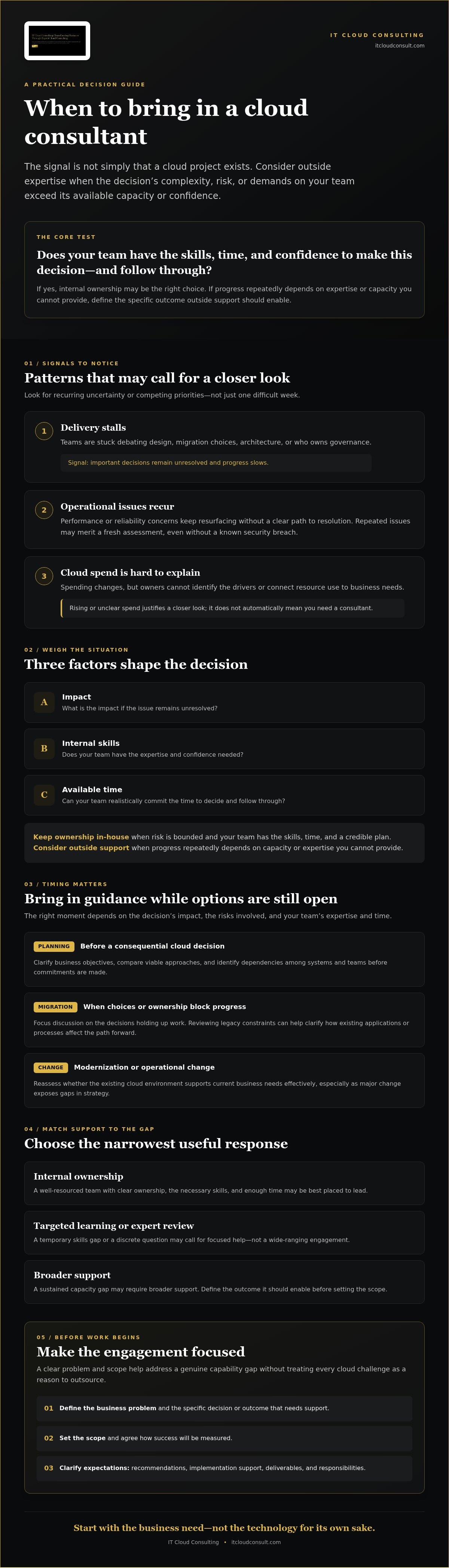
Consider outside expertise when a cloud decision matters to the business, but your team lacks the capacity or confidence to make it and follow through. The signal isn’t simply that a project is underway. It’s that uncertainty or competing priorities are slowing progress, increasing operational exposure, or making accountability unclear.
Outside cloud expertise can help when a decision’s complexity or consequences exceed your team’s available skills, time, or confidence. You might see stalled initiatives, unclear ownership, recurring operational concerns, or technology choices that aren’t connected to measurable business outcomes. For example, a migration can stall if teams haven’t settled architecture choices or agreed who owns governance. Repeated performance or reliability issues may also warrant a fresh assessment, even when there’s no known security breach.
Cloud challenges can span different service and deployment models, as this overview of cloud computing explains. With so many options, it’s more useful to start with the business need than to adopt technology for its own sake.
Which cloud challenges are warning signs?
Look for patterns rather than judging by a single difficult week. Repeated delays may point to unresolved migration or architecture decisions. Recurring reliability, performance, or security concerns may indicate gaps in how the environment is managed. Rising or poorly understood cloud spend can also justify a closer look, but it doesn’t automatically mean you need a consultant. First check whether your team can identify the cost drivers and decide what to do about them.
- Delivery: Work stalls while teams debate design, migration choices, or governance responsibilities.
- Operations: Similar performance or reliability issues keep resurfacing without a clear path to resolution.
- Financial visibility: Spending changes, but owners can’t explain the drivers or connect resource use to business needs.
When is the internal team still the right choice?
A well-resourced team with clear ownership may be best placed to lead, particularly when it has the necessary skills and time. A temporary skills gap may call for targeted learning or a limited expert review. A sustained capacity gap may need broader support. A discrete question, such as whether a proposed architecture fits the business need, doesn’t necessarily require a wide-ranging engagement.
Weigh three factors together: the impact if the issue remains unresolved, the skills available internally, and the time your team can realistically commit. If the risk is bounded and the team has a credible plan, keep ownership in-house. If progress repeatedly depends on expertise or capacity you can’t provide, define the specific decision or outcome that outside support should enable before setting the scope.
Which business moments make hiring a cloud consultant timely?
The right time to involve a cloud consultant is often before a consequential decision becomes difficult to reverse, or when an existing cloud environment no longer supports business needs effectively. That may be during planning, migration, modernization, or a major operational change. There’s no universal milestone. Timing depends on the decision’s impact, the risks involved, and whether your team has the expertise and time to assess its options.
For a broader view of how cloud decisions fit into enterprise change, explore this strategic cloud adoption guide. It can help leaders frame a roadmap before narrowing in on a particular project or technical choice.
Before a major cloud decision or migration
Advisory input can be useful while objectives and options are still open. A consultant can help clarify what the business needs to achieve, identify dependencies among systems and teams, and compare viable approaches before commitments are made. Reviewing legacy constraints at this stage can also reveal how existing applications or processes may affect the path forward. It doesn’t mean a particular migration outcome is right for every organization.
If the migration challenge is already defined, focus the discussion on the decisions blocking progress. A bounded strategy engagement can help assess those questions without automatically expanding into a larger transformation. Teams building a roadmap can also use strategic cloud adoption guidance for additional context.
After launch, when performance or costs are unclear
A launch isn’t the only time to seek expertise. If infrastructure performance is uncertain, recurring inefficiencies remain unexplained, or cloud spending is difficult to connect to actual needs, an assessment can help identify what deserves attention. Set a specific goal, such as understanding a performance concern, examining resource use, or clarifying an optimization decision. Don’t assume the organization needs a complete cloud transformation.
Cloud optimization consulting may suit a targeted review of an existing environment, while broader modernization involves more business and technology decisions. The right scope depends on what an assessment finds and what your organization wants to change. For a deeper look at optimization considerations, see this cloud optimization consulting guide.
Major operational changes can also make it timely to revisit earlier assumptions. A new business priority, a changing workload, or a shift in how teams rely on cloud infrastructure may affect what the environment needs to support. If you can name the decision that needs attention, consider a focused discussion about strategic cloud adoption or optimization needs before defining an engagement.
Cloud consultant, internal team, or managed support: which fits the need?
The right option depends on whether you need specialist guidance for a defined challenge, your team can lead the work, or cloud operations require ongoing assistance. A consultant may advise or support implementation, but agree on the scope, responsibilities, and expected outcomes in advance. Internal teams bring organizational knowledge and can lead delivery when they have the skills and capacity. Managed support addresses recurring operational needs and doesn’t necessarily include strategic planning.
| Option | Purpose | Typical duration | Ownership | Best-fit need |
|---|---|---|---|---|
| Cloud consultant | Provide specialist advice or agreed implementation support | Usually defined by the engagement scope | Shared or assigned as agreed; the organization retains decision-making responsibility | A specific decision, expertise gap, or project need |
| Internal team | Plan, operate, and improve cloud systems using in-house knowledge | Ongoing or tied to internal project priorities | Organization-led | Work that fits available skills, ownership, and capacity |
| Managed cloud support | Provide ongoing technical assistance, monitoring, or management | Ongoing, according to the agreed arrangement | Responsibilities are shared or assigned in the service scope | Recurring operational needs that exceed internal capacity |
When to add specialist expertise to an internal team
Targeted consulting can complement an internal team when a project involves unfamiliar architecture, complex dependencies, or a temporary capacity constraint. For example, your team may understand its business applications well but need another perspective to evaluate a cloud design. Set expectations for collaboration and knowledge transfer, and clarify who makes decisions and owns delivery. Outside consultants should fill a defined gap, not automatically replace existing staff.
When ongoing cloud support may be more appropriate
If the need recurs beyond a single project, such as continued monitoring, technical assistance, or cloud management, ongoing support may fit better than time-limited advisory work. Consulting typically centers on a defined question or scope. Managed support focuses on continuing operational responsibilities set out in an agreement. For more detail on evaluating service models, read this managed cloud services buying guide.
To decide when to hire a cloud consultant, identify whether the gap is specialized and bounded or operational and recurring. Strategic cloud adoption, cloud optimization, and ongoing cloud support address different needs. Match the engagement to the work instead of choosing a service label first.
Is Your Organization Ready for a Cloud Consultant?
Readiness isn’t about having every technical detail resolved. It’s about knowing which business decision or outcome needs support and being able to provide enough context to make the work useful. Before discussing tools or providers, follow a short sequence: define the problem, assess internal capacity, set a bounded scope, and agree on how to evaluate the work.
- Define the business problem. Turn a broad concern into a question the engagement can address, such as identifying what is causing delays in a cloud initiative.
- Assess internal capacity. Identify available skills, who can contribute time, and where the team needs additional expertise.
- Set a bounded scope. Specify the decisions to examine, expected deliverables, boundaries, and responsibilities.
- Agree on success measures. Choose indicators tied to the business problem without assuming or promising a particular result.
A clear scope connects the consultant’s work to a defined business need and helps everyone understand what is and isn’t included.
Define the problem and the decision you need to make
Start with the business question, not a preferred tool or provider. Instead of asking for a general cloud review, for example, ask what is contributing to project delays and which decisions need to be resolved. Name a business owner and the technical stakeholders who can explain current priorities and constraints. Document relevant cloud context, system dependencies, and known limitations. Separate confirmed facts from assumptions the assessment should test.
Set scope, collaboration, and success measures
Before work begins, agree on deliverables, what falls outside the engagement, any access required, and what your internal team will provide. Decide how recommendations will be reviewed, prioritized, and translated into action. Measures might track whether a decision is clarified, key dependencies are documented, or recommendations are prioritized. These are ways to evaluate the work, not guarantees of a technical or financial result.
As you consider when to hire a cloud consultant, use this preparation to determine whether the need is focused enough for a defined advisory engagement or calls for another form of support. If your organization has identified a capability gap, discuss your cloud consulting needs with a clear problem and scope in mind.
Hiring a Cloud Consultant: Expectations and Next Steps
A well-defined engagement gives your organization and the consultant a shared basis for action. Work may begin with discovery to understand business priorities, existing cloud context, and constraints. An assessment can then examine the agreed challenge, followed by recommendations to inform decisions or next steps. If implementation support is needed, include it in the scope rather than assuming it comes with advisory work.
Deliverables and responsibilities vary by engagement. Before work begins, confirm what the consultant will provide, what your team must contribute, how decisions will be made, and how progress and outcomes will be reviewed. Clear expectations help prevent a focused assessment from expanding into work neither party planned.
Questions to ask before selecting a consultant
Use the conversation to understand how the proposed work will fit your organization, not just which tools the consultant prefers. Ask:
- How will you learn about our existing architecture, business priorities, and constraints?
- Which deliverables and decisions will this scope support, and what collaboration will you need from our team?
- How will we review progress, assess recommendations, and determine whether the agreed objectives have been addressed?
Clear answers help you compare proposed scopes and responsibilities. You can also ask how the consultant will distinguish confirmed information from assumptions that need further assessment, and how recommendations will be presented so internal stakeholders can evaluate them.
Choose a focused next step
If the business problem is clear but the right approach isn’t, begin with a scoped discussion rather than committing to a broad transformation. A strategic cloud adoption engagement may help clarify a roadmap or decision before implementation. An assessment and optimization engagement may fit concerns about an existing environment. Ongoing cloud support may be more appropriate when the need is continuous technical assistance, monitoring, or management.
These options address different needs. Identify the decision you need to make or the operational challenge you need to address, then confirm which scope can support it and what remains your team’s responsibility. That gives both sides a practical starting point without presuming the solution in advance.
If you’ve identified a cloud challenge and want to explore an appropriate scope, you can discuss your cloud consulting needs with IT Cloud Consulting.
Turn Cloud Complexity Into a Clear Next Step
Knowing when to hire a cloud consultant comes down to whether your organization can make important cloud decisions with its available capacity, expertise, and confidence. A consultant may help when a defined capability gap is slowing progress or increasing uncertainty, but the engagement should match the need. Agree on scope, responsibilities, and measures of success before work begins.
Keep the options distinct. Strategic cloud planning and roadmap development can support future decisions, while infrastructure assessment and optimization focus on an existing environment. Ongoing technical assistance, monitoring, and management may suit recurring operational needs.
If you’ve identified a cloud challenge and need help determining the right scope, discuss your cloud consulting needs with IT Cloud Consulting. A focused conversation can help clarify a practical path forward and connect your next cloud decision to your organization’s direction.
Frequently Asked Questions
When should a business hire a cloud consultant?
Hire a cloud consultant when a consequential cloud decision or recurring challenge exceeds your team’s available expertise, time, or confidence. Signs may include a stalled initiative, unclear technical ownership, ongoing performance concerns, or cloud spending that’s difficult to explain. The right time depends on the business impact and your internal capacity, not a fixed project milestone. A focused engagement can help clarify a decision without requiring a broad transformation.
Is a cloud consultant necessary for cloud migration?
No. A business doesn’t automatically need a consultant for every migration. An internal team with the right skills, time, and clear ownership may be able to lead the work. Outside guidance can help when objectives, system dependencies, legacy constraints, or migration choices are difficult to assess internally. Before engaging a consultant, identify the decisions or risks that need support and agree whether the scope is advisory, implementation support, or both.
Can a cloud consultant help after migration?
Yes. After migration, a consultant can assess an existing cloud environment and help investigate concerns such as unclear performance or inefficient resource use. Scope the work around specific findings or decisions rather than treating it as a complete transformation. If your organization needs recurring technical assistance, monitoring, or management, ongoing cloud support may fit better than a time-limited consulting engagement. Define the need first to choose an appropriate scope.
How do I know if my internal team can manage cloud projects?
Assess whether your team has the skills, time, and decision-making ownership required for the project, along with enough context about the systems and business priorities involved. Internal leadership may be appropriate when the team can manage dependencies and make progress against clear objectives. If delivery repeatedly stalls or essential expertise is unavailable, consider targeted outside help. A discrete question may need a limited expert review rather than a broad engagement.
What does a cloud consultant do during an assessment?
An assessment typically starts by understanding the organization’s goals, current cloud context, and constraints, then examines the agreed area of concern. Depending on the scope, the consultant may identify relevant dependencies, assess infrastructure, and present recommendations to inform decisions. Before work starts, confirm what information and access are needed, which deliverables are included, and how recommendations will be reviewed. An assessment provides findings and guidance, not a guarantee of a particular result.
Should I hire a cloud consultant or use managed cloud support?
Choose consulting when you need specialist advice or implementation support for a defined decision or project. Consider managed cloud support when the need is ongoing, such as continued technical assistance, monitoring, or management. The two address different responsibilities, so clarify who will own decisions and operations under either arrangement. If you need both help with a specific strategic question and recurring operational work, discuss and define each scope separately before proceeding.
How should I prepare before contacting a cloud consultant?
Prepare a concise description of the business problem, the decision you need to make, and the outcome that would help your organization. Note relevant systems, known constraints, dependencies, stakeholders, and existing cloud context. Separate confirmed facts from assumptions that may need assessment, and identify the internal time and expertise available. You don’t need to choose a tool or provider first. A clear starting question helps shape a focused scope and useful discussion.


