

What if cloud governance could strengthen security and cost control without slowing delivery? The challenge is not simply writing policies. It is turning priorities into practical decisions when technology, security, finance, and business teams do not share clear ownership. Effective cloud governance implementation closes that gap through an operating cycle, not a one-time policy rollout.
It is reasonable to worry that new controls will add friction, especially when teams are balancing speed, risk, and changing business needs. Governance works best when policies reflect business priorities and give teams clear guardrails, rather than creating approval bottlenecks for routine work.
This guide explains how to build a phased implementation plan, assign decision rights, translate policies into controls teams can use, and measure adoption. You will also learn how to review results and refine the approach as your cloud environment and priorities evolve. The goal is an operating model that supports accountable decisions and continuous improvement while helping teams keep delivering.
Key Takeaways
- Start with business outcomes and clear ownership so governance decisions have purpose and accountability.
- Use a phased cloud governance implementation plan to move from a baseline assessment to pilots, measurement, and refinement.
- Balance consistent safeguards with team autonomy by applying controls according to risk and impact.
- Turn policy into assigned responsibilities, practical procedures, and controls teams can apply in daily work.
- Track adoption, exceptions, risk, cost visibility, and delivery impact to identify what works and what needs adjustment.
Cloud Governance Implementation Starts with Outcomes and Ownership
Cloud governance is an operating model for making and reviewing cloud decisions. Named owners set policies, teams apply controls, and decision-makers assess whether those measures work. Because cloud computing involves shared responsibilities and changing services, governance should clarify how an organization manages its use of cloud resources. A tool can enforce a decision, but it cannot decide who is accountable or which risks matter most.
Set governance outcomes before writing policies
Translate organizational priorities into a short list of outcomes that can guide implementation. A business seeking more predictable cloud operations, for example, might prioritize clear resource ownership, better cost visibility, and consistent safeguards for sensitive data. Choose objectives that fit your current cloud environment, then define what evidence would show progress. Avoid goals so broad that teams cannot connect them to daily decisions.
- Manage risk: Identify workloads or data that need stronger oversight and name who reviews exceptions.
- Improve cost visibility: Set expectations for assigning ownership to cloud resources and reviewing usage.
- Support reliable operations: Define who maintains workloads and how teams handle operational responsibilities.
For each objective, state what governance should enable as well as what it must control. Teams might need to provision approved resources efficiently while meeting defined security and cost requirements. This makes the objective useful: governance protects the organization without sending every routine choice through an escalation.
Assign decision rights across the organization
Give governance a clear mandate. An executive sponsor can connect the work to business priorities and help resolve conflicts. A cross-functional governance team can coordinate standards, decisions, and reviews. Map responsibilities across technology, security, finance, compliance, and application teams. A RACI-style model can record who is responsible for the work, accountable for the decision, consulted for expertise, and informed of the outcome.
- Technology: Maintains shared cloud practices and operational standards.
- Security and compliance: Define risk expectations and review safeguards or exceptions.
- Finance: Establishes cost visibility needs and supports spending reviews.
- Application teams: Apply requirements to workloads and identify delivery impacts.
Clear decision rights make cloud use more consistent and accountable by showing each team who can decide, who must act, and who reviews the result. Document the model where teams can find and use it. Revisit assignments when responsibilities or business priorities change.
Build the Cloud Governance Implementation Plan in Phases
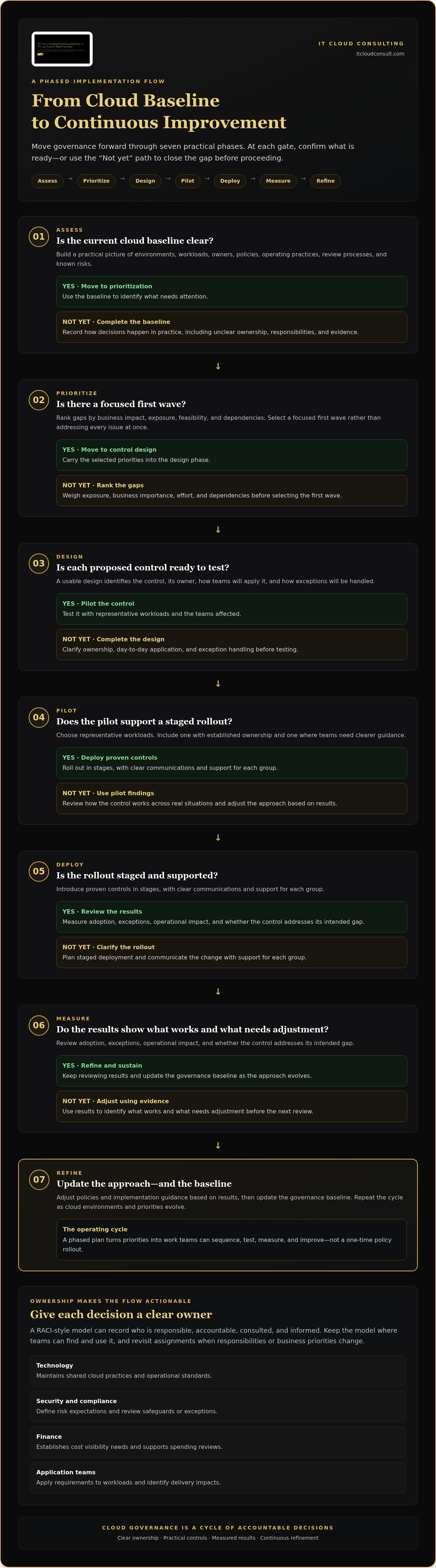
A phased plan turns governance priorities into work teams can sequence, test, and improve. Start with a baseline of cloud accounts and environments, workloads, owners, existing policies, review practices, and known risks. This gives you a practical picture of current operations before deciding what to change. The ISACA article Cloud Governance: Emerging Trends and a Proposed Framework also emphasizes aligning governance with business requirements, a useful principle for setting priorities.
- Assess: Document current environments, workload ownership, policies, operating practices, review processes, and known risks.
- Prioritize: Rank gaps by business impact, exposure, feasibility, and dependencies. Select a focused first wave rather than trying to address every issue at once.
- Design: Define the proposed control, its owner, how teams will apply it, and how exceptions will be handled.
- Pilot: Test the control with representative workloads and the teams affected by it.
- Deploy: Roll out proven controls in stages, with clear communications and support for each group.
- Measure: Review adoption, exceptions, operational impact, and whether the control addresses its intended gap.
- Refine: Adjust policies and implementation guidance based on results, then update the governance baseline.
Assess current practices and select a first wave
Make the baseline useful by recording how decisions happen in practice, not just what documents exist. Note which teams own workloads, where policies apply, how reviews are carried out, and where responsibilities or evidence are unclear. Rank gaps by exposure, business importance, and effort. A control that addresses a high-impact risk may take priority, but dependencies matter. For example, teams may need consistent ownership records before they can run a reliable review process.
Choose pilot workloads that represent different operating conditions without making the first effort too broad. Include a workload with established ownership and one where teams need clearer guidance. This helps show whether a policy works across real situations, rather than only under ideal conditions.
Pilot, deploy, and expand controls
Pilots expose friction before a broad rollout. Affected teams can point out where a requirement conflicts with routine work, lacks a clear owner, or needs a defined exception path. Record these issues and adjust the policy, process, or enablement materials before expanding. Set rollout criteria in advance, including who approves the next stage, which teams receive communications, and how exceptions are reviewed.
Scale controls in manageable stages, using feedback and review results to guide each expansion. Update the baseline after changes so teams can see which requirements are active and where implementation stands. If you need help translating governance priorities into a practical roadmap, cloud advisory and implementation support can structure the work around your organization’s needs.
Choose Governance Controls That Manage Risk Without Blocking Delivery
Governance does not have to route every technical decision through a central committee. Effective cloud governance implementation standardizes controls where inconsistency creates material risk, while preserving bounded choices for teams close to the work. The right balance depends on workload sensitivity, business impact, and the consequences of a control failure.
Three common models distribute authority differently. A centralized model gives a core team ownership of standards and decisions, supporting consistency but potentially limiting responsiveness to team-specific needs. A federated model delegates more decisions to business or application teams, improving local responsiveness but requiring shared standards to prevent fragmented practices. A blended model sets enterprise-wide requirements centrally and lets teams implement them within defined boundaries. For broader context on how controls fit into an overall approach, see this cloud governance framework guide.
Match policy enforcement to risk and workload needs
Apply stronger enforcement where a workload handles sensitive data, supports a critical business function, or carries greater exposure. Lower-risk workloads can have more flexibility if they still meet baseline requirements. A simple tiering model makes the distinction visible:
| Workload profile | Business impact and risk | Control approach |
|---|---|---|
| High sensitivity | Exposure or disruption could have serious consequences | Require mandatory access, provisioning, review, and compliance controls; document and approve exceptions. |
| Moderate sensitivity | Impact is meaningful but contained | Apply the enterprise baseline and allow approved variations with a named owner and review. |
| Lower sensitivity | Limited impact and lower exposure | Use baseline safeguards with recommended patterns that teams can adapt within clear boundaries. |
Keep control areas distinct so teams know what each requirement is meant to achieve. Access controls define who can use or change resources. Provisioning controls establish which resources teams can create and how ownership is recorded. Cost controls make responsibility for usage visible. Compliance controls translate applicable organizational requirements into operational checks. Avoid applying identical controls to every workload when the risk profiles differ.
Speed is not an automatic casualty of governance. Unclear rules and repeated approvals can create friction; standard baselines and pre-defined decision boundaries can make routine work more predictable. Teams might provision resources independently when they follow an approved pattern, while unusual access or higher-risk configurations go through a documented review.
Separate mandatory controls from recommended practices, and define an exception route before teams need one. Each exception should have a business rationale, an accountable owner, and a review point. This keeps flexibility from becoming a permanent loophole while giving teams a way to address legitimate needs. A risk-tiered model combines centralized consistency with federated execution: the organization sets the guardrails, and teams choose compliant ways to work within them.
Deploy Cloud Governance Through Policies, Roles, and Feedback
A policy only guides cloud operations when teams understand what it requires, who owns it, and how to apply it. Effective cloud governance implementation connects each policy to an accountable owner, a practical procedure, and evidence that shows whether the control works. This makes governance part of routine decisions instead of a document teams consult only during audits or incidents.
For example, a policy requiring clear ownership of cloud resources should identify who assigns that ownership, how teams record it, and who reviews gaps. A related procedure should explain how to correct resources with missing or outdated ownership information. The control owner can review an agreed evidence source on a defined cadence. For related assessment steps, use this cloud security assessment checklist to identify areas that need attention.
Turn policy into operational practice
Write policies in clear, testable language. Broad statements can leave teams guessing about what to do or how compliance will be assessed. For each requirement, document the accountable owner, operating procedure, evidence source, and review cadence. This creates a direct line from policy to daily work and makes gaps easier to identify.
- Requirement: State what teams must do and where it applies.
- Owner: Name who maintains the control and addresses failures.
- Procedure and evidence: Explain how teams comply and what shows the control is active.
- Exception process: Set out how teams request a deviation, who assesses it, and how the rationale and decision are recorded.
Assess exception requests against the business need and the risk created by the deviation. Record the decision, accountable owner, any compensating steps, and when the exception should be reviewed. This keeps exceptions visible and prevents temporary workarounds from becoming undocumented norms.
Enable adoption and manage change
Explain the purpose of each policy alongside the expected workflow. Teams are more likely to apply a requirement consistently when they understand the risk it addresses and know how to meet it during normal delivery. Provide practical guidance, examples, and reusable patterns so teams can follow the standard without reinventing the process for each workload.
Reach the people affected by a change, including technical teams and business stakeholders who own or depend on workloads. Make clear where guidance lives, who can answer questions, and how teams can raise concerns. Enablement is ongoing: changes to responsibilities, workloads, or operating practices may call for updated instructions.
Close the loop by reviewing exceptions, incidents, control failures, and recurring questions. Repeated requests may indicate a policy is too restrictive, unclear, or difficult to apply. Compare feedback with the original objective, revise the guidance when needed, and communicate what changed and why. Strategic cloud support can help translate priorities into an implementable roadmap, while ongoing monitoring and management can support continued governance improvement. Explore cloud implementation support to put those priorities into practice.
Measure Cloud Governance Maturity and Sustain Improvement
Cloud governance implementation is effective only if it changes how cloud decisions are made and managed, not simply how many policies are published. A balanced scorecard helps assess whether controls are adopted, risks are addressed, costs are visible, and teams can still deliver effectively. Establish a baseline before rollout, then compare trends over time. A compliance snapshot shows one point in time, but not whether governance is becoming more practical or improving outcomes.
Select useful governance metrics
Choose measures that connect control activity to business results. For each metric, name an owner, identify its data source, set a review interval, and define when an issue should be escalated. Keep the scorecard focused enough that decision-makers can act on its findings.
- Adoption: Track whether affected teams follow the required policies and procedures.
- Exceptions: Review their volume, rationale, age, and resolution to identify unclear or impractical requirements.
- Risk: Monitor relevant control gaps, incidents, and recurring findings against the organization’s priorities.
- Cost visibility: Assess whether cloud usage has clear ownership and whether teams can use cost information in decisions.
- Delivery impact: Consider workflow delays, repeated approvals, and team feedback alongside measures of operational efficiency.
Interpret indicators together. A high adoption rate may look positive, but it offers limited assurance if exceptions are rising or teams say routine work is becoming harder. A policy exception may also be reasonable when it has a documented business rationale and appropriate oversight. Trend reviews show whether a measure is improving, deteriorating, or pointing to a process issue.
Make governance a continuous operating cycle
Use each review to turn evidence into a small set of specific actions. Record the finding, its impact, the next step, the accountable owner, and a follow-up date. For example, repeated exceptions involving the same control could prompt clearer guidance, a revised procedure, or a targeted review of the requirement. At follow-up, assess whether the change addressed the underlying issue.
Reassess governance when business priorities, cloud environments, or risk conditions materially change. Retire controls that no longer serve their purpose, and prioritize improvements according to evidence and business impact. This keeps the operating model relevant instead of letting the framework become a static checklist. For broader roadmap alignment, connect governance priorities to your strategic cloud adoption guide.
Some organizations benefit from structured support as they build and sustain this cycle. IT Cloud Consulting provides strategic guidance and implementation support to translate priorities into a practical roadmap, along with ongoing cloud management that includes monitoring and continuous improvement. This support helps teams maintain visibility, act on review findings, and keep governance aligned with changing operational needs.
Make Governance the Foundation for What Comes Next
Cloud priorities will continue to evolve, so treat cloud governance implementation as a capability your organization can strengthen over time, not a finish line. Choose one meaningful next step: clarify an unresolved decision, address a recurring friction point, or align a governance improvement with an upcoming business priority. Deliberate changes help governance keep pace with innovation and operational needs.
IT Cloud Consulting provides strategic cloud planning, implementation support, and customized guidance focused on operational efficiency. Ongoing monitoring and management support continued refinement as your environment changes.
Explore how IT Cloud Consulting can support your cloud governance implementation and take the next step toward a governance model that enables confident, sustainable progress.
Frequently Asked Questions
What is cloud governance implementation?
Cloud governance implementation is the process of putting agreed rules and decision-making practices into everyday cloud work. For example, a team launching an application should know which data-handling requirements apply, who approves access, and where to record decisions. Governance is operational when people can follow these expectations during real projects, not just find them in a policy document. Its scope should reflect the organization’s business needs and cloud environment.
How do you implement cloud governance step by step?
Begin by documenting how cloud decisions are currently made, then identify the most important business outcomes and gaps. Assign decision owners and select a manageable first set of controls. Test them with the teams and workloads they affect, capturing questions and process obstacles. Before expanding, decide what evidence will show the controls are working. Keep a decision log and action register so open issues have clear owners and remain visible between reviews.
Who should be involved in cloud governance?
Include an executive sponsor and representatives who understand cloud operations, architecture, security, finance, compliance, application delivery, and business requirements. In a smaller organization, one person may cover several areas, but each decision still needs an accountable owner. Application teams can explain how a proposed access rule affects deployment, while security defines the risk it should address. A responsibility matrix helps prevent delays caused by teams assuming someone else owns a decision.
Does cloud governance slow down cloud teams?
It can, particularly if teams need approval for routine, low-risk work or cannot tell which requirements apply. Separate routine decisions from higher-risk ones. A team following an established deployment pattern might proceed within its defined authority, while a request for unusual data access follows a review path. Compare team feedback and workflow bottlenecks before and after a policy change to see whether the guardrail addresses the risk without creating avoidable delays.
What should a cloud governance policy include?
A policy should make its expectations clear enough for a team to apply them to a real decision. Include its purpose, scope, accountable owner, required actions, and how adherence is assessed. An access policy, for example, could identify which roles are covered, who reviews access decisions, and how teams document an approved exception. Link the policy to practical instructions, and use plain, testable wording so teams can distinguish mandatory requirements from guidance.
How do you measure whether cloud governance is working?
Measure whether governance changes behavior and outcomes, not just whether a document exists. Compare trends in control adoption, recurring exceptions, unresolved gaps, cost ownership, and delivery-team feedback against a baseline. Pair a control measure, such as completion of an access review, with an operational indicator, such as repeat findings or process rework. Assign someone to interpret each measure and recommend an action, since a dashboard without follow-through will not improve the operating model.


