
A cloud migration plan can move applications without moving the business forward. A practical cloud transformation roadmap does more: it connects business priorities to architecture, delivery decisions, governance, and measurable outcomes, then adapts as evidence and priorities change.
It’s reasonable to be cautious. When applications, platforms, and teams depend on one another, unclear sequencing can increase operational risk. Cloud investment can also be difficult to justify without measures tied to business value. The answer isn’t a fixed checklist or a rush to migrate. It’s a phased plan that makes dependencies, decision criteria, ownership, and success measures visible from the start.
This guide explains how to build that plan around defined business outcomes. You’ll learn how to assess workloads, prioritize phases, make architectural and security decisions, establish governance, and track progress while maintaining day-to-day operations. It also covers how review and optimization keep the roadmap useful as business needs evolve. With a clear strategy connecting each decision to its intended result, cloud transformation becomes a managed path to lasting improvement, not a one-time migration exercise.
Key Takeaways
- A cloud transformation roadmap should connect business outcomes to technology choices and evolve as priorities and evidence change.
- Use decision gates to clarify ownership, assess dependencies, and determine what must be in place before each phase advances.
- Compare workloads by business value, cloud fit, risk, compliance needs, and operational readiness before choosing whether to migrate, modernize, retain, or retire them.
- Build Zero-Trust Architecture, enterprise-grade protection, and relevant HIPAA, PII, GDPR, and SOC2 considerations into governance from the start.
- Connect architecture, security, optimization, and ongoing support to regular roadmap reviews so delivery can adapt and progress stays measurable.
What a Cloud Transformation Roadmap Must Achieve Beyond Migration
A cloud program creates lasting value when it changes more than where applications run. A cloud transformation roadmap is a sequenced, revisable plan that connects business goals to technology decisions, delivery work, accountable owners, and measures of progress. It helps leaders decide not only what to move, but why, in what order, and what evidence should inform the next decision.
That structure matters because cloud initiatives often involve interdependent applications, data, teams, and operating processes. Without clear outcomes and dependencies, projects may compete for resources or create avoidable disruption. A roadmap gives teams a shared basis for prioritization while allowing leaders to adjust when business needs or delivery evidence changes.
How a transformation roadmap differs from a migration plan
Migration is one workstream within a broader transformation program. It moves workloads to cloud environments; transformation may also reshape architecture, operating models, processes, and organizational capabilities. For organizations seeking structured guidance to evaluate operational readiness and align core processes, business transformation specialists such as Udyog Guru provide diagnostic frameworks that help leaders clarify strategic priorities. Some applications may move with limited change, while others need modernization, continued investment in their current environment, or retirement. The right scope depends on business goals and each workload’s context.
A cloud transformation roadmap is a business-led sequence of cloud decisions and outcomes, not simply a schedule for moving workloads. Understanding foundational concepts, including service models such as IaaS, PaaS, and SaaS, can help teams frame those choices; see What is Cloud Computing? Architecture decisions should then reflect how the organization’s systems, data, and people need to work together.
Which business outcomes should guide the roadmap?
Begin with organizational priorities, such as accelerating innovation, improving operational efficiency, supporting growth, or strengthening resilience. Translate each priority into an outcome that can be reviewed during delivery. For example, if faster product launches are a priority, define how teams will assess whether a cloud workstream is reducing barriers to release. Don’t treat migration completion as the outcome itself.
- Innovation: Identify the capability or delivery constraint the work is intended to address.
- Efficiency: Establish a relevant baseline and a measure for reviewing operational improvement.
- Growth: Define how the target architecture should support changing business demand.
Assign an accountable owner to each outcome, record dependencies, and agree on review points before delivery begins. Measures should match the work: application availability, delivery speed, or resource use may be relevant depending on the goal. Targets depend on project context, so avoid assuming every workload or team will produce the same result.
Finally, weigh modernization against operational continuity, security, and organizational complexity. A phased roadmap makes these trade-offs explicit, so teams can sequence change around dependencies and assess readiness before advancing. The central leadership decision is not simply whether to move to cloud, but how to progress toward business goals while managing risk and maintaining essential operations.
Build the Cloud Transformation Roadmap Around Assessments and Decision Gates
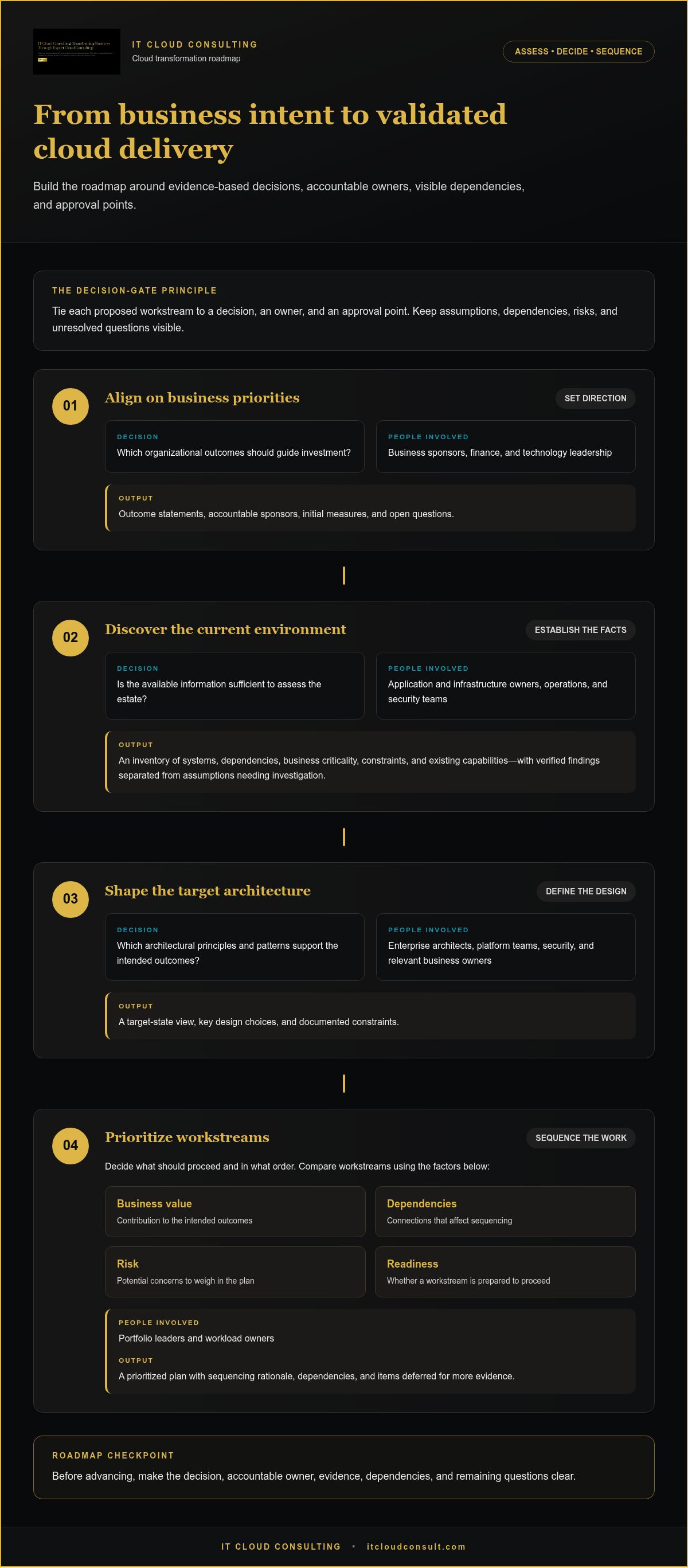
A cloud transformation roadmap becomes executable when each proposed workstream is tied to an evidence-based decision, an accountable owner, and an approval point. Move from business intent to validated delivery, recording assumptions, dependencies, risks, and unresolved questions where decision-makers can see them.
For broader context on connecting modernization to enterprise priorities, the strategic cloud adoption guide explores the strategic foundations that inform this planning.
- Align on business priorities. Decide which organizational outcomes should guide investment. Business sponsors, finance, and technology leadership agree on priorities and define initial measures. The output is a set of outcome statements, accountable sponsors, and open questions.
- Discover the current environment. Decide whether the available information is sufficient to assess the estate. Application and infrastructure owners, operations, and security teams document systems, dependencies, business criticality, constraints, and existing capabilities. The output is an inventory that separates verified findings from assumptions needing investigation.
- Shape the target architecture. Decide which architectural principles and patterns support the intended outcomes. Enterprise architects, platform teams, security, and relevant business owners document the target-state view, key design choices, and constraints. For broader adoption strategy, connect this work to strategic cloud adoption planning.
- Prioritize workstreams. Decide what should proceed and in what sequence, based on value, dependencies, risk, and readiness. Portfolio leaders and workload owners create a prioritized plan with sequencing rationale, dependencies, and items deferred for more evidence.
- Set governance and delivery controls. Decide who can approve scope, architecture, risk treatment, and material changes. Delivery leads, security, compliance, and business owners establish decision rights, review criteria, escalation paths, and measures for tracking outcomes.
- Review and adapt. Decide whether evidence supports continuing, adjusting, or pausing a workstream. The accountable sponsor and delivery team review progress against agreed measures and document the decision, owner, and resulting roadmap update.
What should an enterprise assessment establish?
An assessment should show how applications connect to infrastructure, data, business processes, and operational responsibilities. It should also identify business criticality, operating constraints, security and compliance considerations, and capability gaps that could affect delivery. Don’t present an assumption as a confirmed dependency. Label it, name who will investigate it, and record which decision depends on the answer.
Which roadmap artifacts make decisions actionable?
Keep a concise set of linked artifacts: target-state view, prioritized workstreams, dependency map, risk register, accountable owners, outcome measures, and a decision log. At each gate, record the question being answered, evidence reviewed, approver, decision, and any conditions for proceeding. Gates can validate scope, architecture, readiness, or delivery progress, with criteria tailored to the organization and workstream.
When an approved change alters scope or assumptions, update the relevant artifact and note who approved it, why, and which dependencies or measures are affected. This preserves accountability without treating the roadmap as fixed. Strategic cloud adoption planning can help connect governance decisions to the broader modernization direction.
Prioritize Workloads by Business Value, Dependencies, and Cloud Fit
Workload sequencing is a set of business and technical trade-offs, not a race to move everything at once. For each application or service, compare its contribution to business priorities with its dependencies, risk, compliance needs, and operational readiness. This gives leaders a reasoned basis for choosing a path and makes clear why a high-value workload may still need preparation before delivery begins.
How to rank workloads without defaulting to lift-and-shift
Assess each workload in context. A stable application with manageable dependencies may be a candidate for migration with limited change. A workload constrained by its current architecture may warrant modernization. Others may need to remain where they are for now or be retired if they no longer support a relevant business need. None of these paths is universally best.
Use a comparison like the one below to structure discussion, not to generate an automatic score. Record evidence and unresolved questions alongside each assessment. For example, a critical application with undocumented integrations may need discovery before its sequence can be set, even if its business value is high.
What outcome does the workload support, and how important is it to current priorities?
Which applications, data flows, teams, or processes must be ready first?
What operational or technical impact could a change create, and how manageable is that exposure?
Which relevant requirements or data-handling considerations shape its placement and controls?
Are ownership, skills, support processes, and delivery conditions in place for the proposed path?
Use the findings to form work packages around real dependencies. Sequence prerequisite components before dependent workloads, and separate items ready to proceed from those needing more evidence or risk reduction. This keeps the cloud transformation roadmap responsive to workload-level realities rather than imposing one migration pattern across the estate.
How cloud architecture choices affect sequencing
Public, hybrid, and multi-cloud approaches have different implications for integration, governance, and day-to-day operations. Public cloud may fit workloads whose requirements align with the selected environment. A hybrid design can accommodate workloads or data that need to operate across cloud and other environments. Multi-cloud can address specific organizational requirements, but it also calls for the capability to manage architecture and governance across environments.
Choose based on workload needs, data location and movement considerations, security and compliance requirements, existing integrations, and the organization’s ability to operate the design. Don’t treat a particular model as the default before those factors are understood. Provider examples can illustrate architectural options, but they should not substitute for requirements-led decisions or imply a preferred partnership.
For a deeper look at how infrastructure decisions connect to modernization priorities, the cloud infrastructure consulting guide provides additional architecture context. Use that perspective to test whether each workload’s proposed path supports its outcome and whether the organization can govern and operate the resulting environment.
Govern Cloud Transformation with Security, Risk, and Outcome Measures
Governance makes a roadmap accountable once plans become delivery work. Each workstream needs clear security and risk controls, an owner who can act on findings, and measures that show whether delivery is advancing its intended business outcome. This discipline helps leaders identify issues early and make informed choices about whether to continue, adjust, or reprioritize work.
How should security and compliance shape each phase?
Map security and compliance considerations to workload placement, architecture, and delivery controls from the start. A workload handling sensitive information may require different design decisions and review evidence from a less critical service. Identify which requirements apply to the organization and its data, including HIPAA, PII, GDPR, and SOC2, then assign responsibility for addressing them within each relevant workstream.
Zero-Trust Architecture makes trust and access decisions part of architectural planning and supports enterprise-grade protection. It doesn’t eliminate risk or replace ongoing governance. Teams should document control ownership, risks, exceptions, and the evidence needed at delivery gates. A focused cloud security assessment checklist can help structure this review.
Which measures keep transformation tied to business value?
Pair delivery indicators with outcome measures for each approved workstream. A completion milestone can show that a technical task finished; it cannot, on its own, establish that the business benefit followed. Select measures that fit the intended result, define a baseline where available, and give an accountable owner responsibility for interpreting progress.
- Delivery: Track agreed milestones, unresolved dependencies, and readiness criteria.
- Operations: Monitor a relevant indicator, such as service availability or downtime, alongside change progress.
- Business outcomes: Assess the specific goal, such as faster transaction processing, improved access to information, or more efficient resource use.
Case studies can illustrate how measures connect to outcomes, but they aren’t universal targets. A healthcare provider case study reports migration of 200+ applications, 40% cost reduction, HIPAA compliance, and 65% improvement in patient data access. A financial services case study reports a 75% reduction in transaction processing time while maintaining regulatory compliance. A manufacturing case study reports a cloud platform connecting 5,000+ devices, 30% downtime reduction, and $2.5M in annual savings.
Use review findings to decide whether a workstream remains aligned with its objectives. If operational evidence reveals a bottleneck, teams might optimize the current environment before advancing dependent work. If priorities shift, leadership can revise sequencing while recording the rationale and owner. This keeps the cloud transformation roadmap connected to controlled execution and measurable value, without treating initial assumptions as permanent.
Strengthen roadmap governance by aligning security reviews and outcome measures with strategic cloud adoption support.
Turn the Roadmap into a Sustained Cloud Transformation Partnership
A roadmap creates value through execution and learning, not by sitting unchanged after approval. As workstreams progress, delivery evidence can reveal new dependencies, operational constraints, or opportunities to optimize. An ongoing partnership connects planning with implementation and support, so leaders can act on those findings while keeping business priorities in view.
How IT Cloud Consulting supports roadmap development and execution
IT Cloud Consulting provides Cloud Strategy & Planning to connect organizational priorities to tailored architecture, sequencing, and risk mitigation. Assessment findings inform a custom roadmap, while architecture decisions translate desired outcomes into practical workstreams. Implementation support helps teams coordinate delivery choices with priorities, dependencies, and operational needs.
Different workstreams call for different expertise. Multi-Cloud Architecture informs decisions about environments and integration. Security & Compliance brings relevant controls and considerations into design and delivery, including Zero-Trust Architecture and enterprise-grade protection. Optimization & Management supports performance tuning and cost-efficient resource allocation as workloads run and requirements evolve. Managed cloud support provides ongoing technical assistance, maintenance, monitoring, and management to help keep cloud systems operational and secure.
AI Integration & Automation can be included where intelligent solutions or workflow optimization align with a defined business outcome. Its place in the roadmap should follow a clear use case, architecture fit, and governance needs, rather than being added as a standalone objective. This keeps new capabilities connected to the broader transformation direction.
How to move from roadmap review to the next decision
Before a roadmap review, leaders can clarify three things: the priorities they need to advance, the constraints that could shape delivery, and the outcomes they want to measure. This preparation makes the discussion more productive. It helps teams determine whether the next step is to proceed with a workstream, address a dependency, refine the architecture, or focus on optimization first.
For a manufacturing organization, a relevant outcome might be improved visibility across connected operations. In the manufacturing case study, the cloud platform connected 5,000+ devices, reduced downtime by 30%, and delivered $2.5M in annual savings. These reported results illustrate one project’s experience, not a forecast for every transformation. The useful lesson is to define measures around the organization’s own operating priorities and review evidence against them.
As operating conditions change, ongoing support helps teams maintain continuity while identifying where roadmap assumptions need revision. That creates a practical feedback loop: delivery informs operations, operational evidence informs optimization, and learning guides the next decision. A tailored cloud transformation roadmap can therefore remain focused on measurable objectives without becoming fixed to outdated assumptions.
If you’re ready to align priorities, constraints, and outcomes, discuss your cloud transformation roadmap with IT Cloud Consulting.
Make Your Next Cloud Decision a Confident One
The next step isn’t to lock every future decision into a fixed plan. It’s to create a clear direction, then give teams a practical way to test assumptions and adjust as business needs evolve. A cloud transformation roadmap helps leaders turn that direction into deliberate choices, with each decision grounded in organizational priorities and the evidence available at the time.
Start by bringing the right perspectives into the conversation: business sponsors who define outcomes, technology leaders who assess architecture and delivery, and operational stakeholders who understand continuity requirements. Aligning these views early makes the path forward more relevant to your organization and easier to refine as work progresses.
IT Cloud Consulting connects business priorities to tailored cloud strategy, roadmap development, implementation support, optimization, and ongoing cloud management. Discuss your cloud transformation roadmap with IT Cloud Consulting to align your goals and constraints with a practical path forward.
Frequently Asked Questions
How long does it take to create a cloud transformation roadmap?
There’s no reliable fixed timeline without understanding the organization’s scope, environment, dependencies, and decisions. A smaller initiative with clear application ownership may need less discovery than a program spanning complex integrations or competing operational constraints. Begin by clarifying business priorities and identifying missing information. Then develop architecture options, sequencing, ownership, and measures at a pace that reflects the actual complexity and goals.
Who should own a cloud transformation roadmap?
An executive sponsor should keep the roadmap connected to business priorities, while a designated program or technology lead coordinates its development and delivery. Make decision rights explicit: name who approves investment priorities, who owns an application workstream, and who accepts operational readiness. Security, compliance, finance, and business teams contribute where their expertise applies. A clear responsibility matrix helps prevent unresolved decisions from being mistaken for shared ownership.
How often should a cloud transformation roadmap be updated?
Update it when a meaningful change could affect an approved decision, rather than relying on an arbitrary calendar interval. A new business priority, an unexpected system dependency, or delivery evidence that changes an assumption may warrant review. Record the reason for the change, the decision-maker, and the affected workstreams. This creates a useful history and helps teams distinguish a deliberate adjustment from untracked scope drift.
Can AI initiatives be included in a cloud transformation roadmap?
Yes, include AI integration or automation when a defined business use case justifies the work. For example, a team considering workflow automation can first identify the process it aims to improve, the data and systems involved, and who will assess the result. Then consider dependencies, security, governance, and operational readiness. This helps determine whether the initiative belongs in the current phase or should wait for enabling work.
Does a cloud transformation roadmap need to select a cloud provider immediately?
What happens when a cloud transformation roadmap no longer matches business priorities?
Pause the affected decisions long enough to assess what has changed, rather than continuing solely because work was previously approved. Confirm whether the intended outcome still matters, identify effects on related workstreams, and consider whether work should proceed, change sequence, or be deferred. Document the revised rationale and decision owner. This preserves accountability while allowing the organization to redirect effort toward current priorities.


