
What if reducing your cloud bill made an application slower or less reliable? Cloud cost optimization services should do more than flag unusual spending. They should connect costs to the teams, applications, and business outcomes behind them, then guide changes that preserve the performance your operations depend on.
If your cloud invoices are difficult to explain, you may have a visibility challenge. Dashboards can reveal underused resources, but insight alone doesn’t put savings into practice. Effective optimization combines usage assessment, performance tuning, cost-efficient resource allocation, and ongoing management. Each decision should account for operational, security, and business requirements.
This guide explains what a professional engagement can involve, which deliverables help turn findings into action, and how to evaluate savings without losing sight of reliability or security. You’ll also learn how to make spending visible, connect cloud use to organizational goals, and adapt your approach as needs change.
Key Takeaways
- Cloud cost optimization services connect resource decisions to workload needs, helping organizations identify where spending can be better aligned.
- A structured engagement can move from usage assessment to prioritized action, with cost allocation clarifying which teams or applications drive spend.
- Consulting services, standalone tools, and in-house management differ in who interprets findings, implements changes, and sustains progress.
- Measure optimization against workload performance and service requirements, not just a lower bill.
- IT Cloud Consulting combines performance tuning and cost-efficient allocation with broader cloud strategy and multi-cloud planning.
What Cloud Cost Optimization Services Do for a Business
Cloud cost optimization services align cloud resources and spending with business goals and workload needs. They help organizations understand which resources support essential operations, where capacity is underused, and when infrastructure exceeds an application’s requirements. The aim isn’t simply to spend less. It’s to make resource decisions that support performance, reliability, security, and business priorities.
Cloud cost optimization services align cloud spending and resource use with workload requirements so an organization can improve efficiency without compromising the outcomes its systems must deliver. Because cloud computing makes capacity easier to provision and adjust, teams can respond to changing demand. But resources left running after a project ends, oversized environments, or duplicated services can turn that flexibility into ongoing waste.
How cloud cost optimization differs from cutting costs
Indiscriminate cost-cutting treats a lower bill as success. Optimization asks whether a proposed change preserves the workload’s operational requirements. For example, reducing compute capacity may be reasonable for an application with consistently low demand, but risky for a customer-facing service that needs to handle peaks. The right decision depends on usage patterns and business impact, not a blanket reduction target.
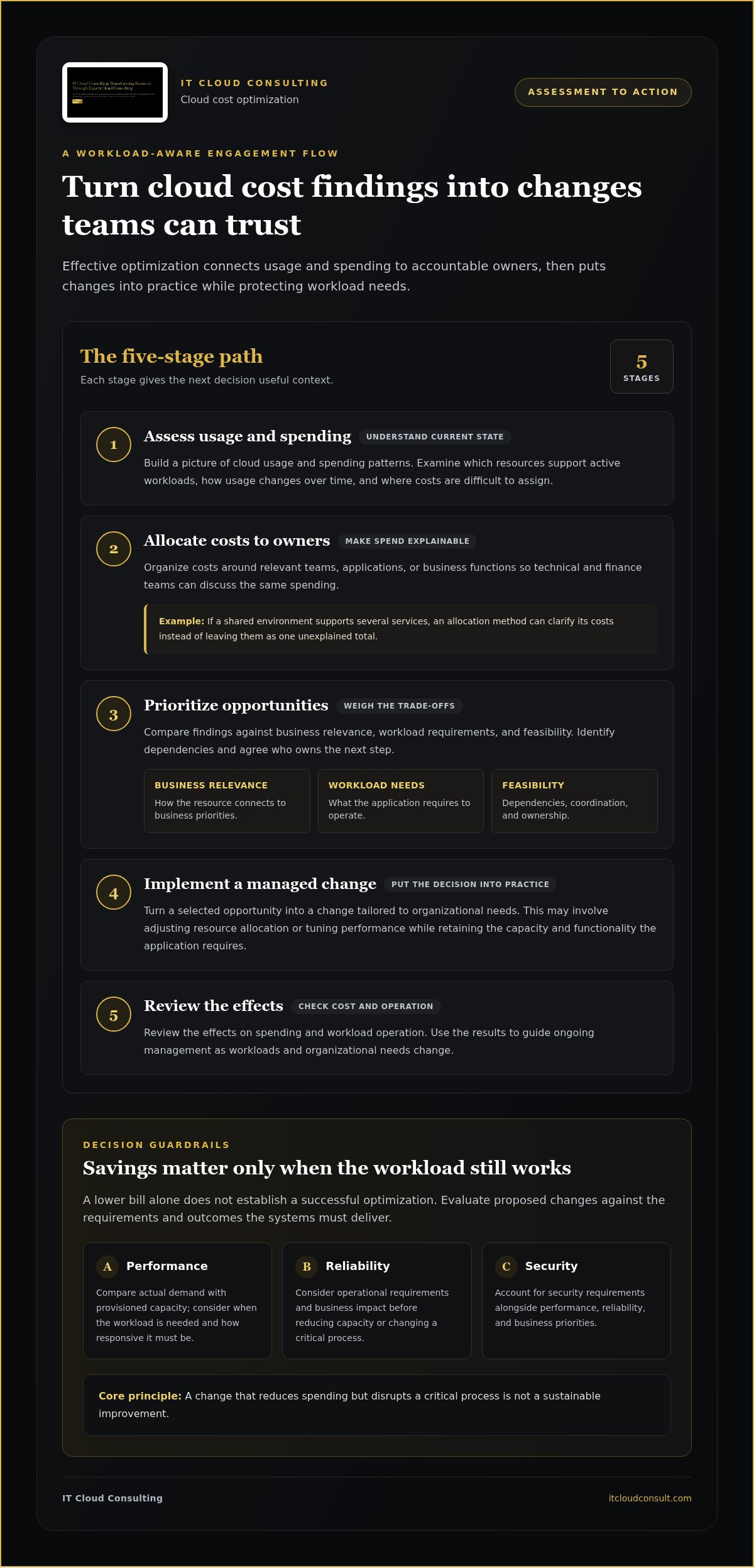
Rightsizing and resource allocation should follow evidence. Compare actual demand with provisioned capacity, then consider what the workload does, when it is needed, and how responsive it must be. A change that lowers spend but disrupts a critical process is not a sustainable improvement.
Lasting results also depend on ownership and follow-through. When teams know who is responsible for a resource, why it exists, and when its use should be reviewed, they can respond as workloads evolve instead of allowing an outdated configuration to become permanent overhead.
When an organization may need professional optimization support
Support can be valuable when cloud invoices are difficult to attribute to teams, applications, or business functions; when usage reports highlight possible waste but teams struggle to act; or when resource allocation no longer reflects current demand. These signals often point to a gap between having cost data and using it to make coordinated operational decisions.
The challenge grows across teams, applications, and multiple cloud providers. Different groups may provision resources independently, use inconsistent naming or allocation practices, or lack a shared view of how infrastructure supports organizational priorities. A structured optimization effort can clarify these relationships and turn observations into prioritized, workload-aware decisions.
Professional guidance is especially useful when potential savings need to be weighed against performance, reliability, and security requirements. IT Cloud Consulting’s cloud optimization work connects resource decisions to organizational needs through assessment, performance tuning, cost-efficient allocation, and ongoing management. For a broader view of the planning and implementation framework, explore the cloud optimization consulting guide.
What Cloud Cost Optimization Services Include, From Assessment to Action
Cloud cost optimization services should go beyond identifying possible waste. A useful engagement connects an assessment of current usage to decisions teams can implement, then reviews the effects on spending and workload operation. The sequence matters: changing a resource before understanding why it exists can create avoidable performance or reliability problems.
Cost visibility becomes actionable when spending is allocated to accountable owners who can implement and review optimization decisions. Clear allocation helps finance and technical teams discuss the same costs in terms of the applications, business functions, or teams that generate them.
Assessment, allocation, and opportunity prioritization
An assessment establishes a working picture of cloud usage and spending patterns. It can examine which resources support active workloads, how usage changes over time, and where costs are difficult to assign. Cost allocation then organizes that picture around relevant teams, applications, or business functions. If a shared environment supports several services, an allocation method can make its costs easier to understand and discuss instead of leaving them as one unexplained total.
Prioritize findings against business relevance, workload requirements, and feasibility. A potential resource adjustment may be straightforward but affect a low-priority environment; another may involve more coordination while addressing a cost tied to a critical application. Prioritization helps teams weigh those factors, identify dependencies, and agree on who owns the next step. Public-sector environments have their own governance considerations, and cloud.gov offers a reference point for thinking about cost management in that context.
Implementation, multi-cloud architecture, and optimization management
Once teams select an opportunity, implementation turns the recommendation into a managed change. IT Cloud Consulting’s Optimization & Management services include performance tuning and cost-efficient resource allocation tailored to organizational needs. Depending on the workload, this can mean adjusting how resources are assigned or tuning performance while retaining the capacity and functionality the application requires. Document the reason for each change, its accountable owner, and the operational measures used to review its effect.
Across cloud environments, multi-cloud architecture helps organizations coordinate broader design and resource decisions. Rather than treating each environment as an isolated cost problem, an organization can consider how workloads, operating needs, and architecture choices fit together. This creates a clearer basis for consistent allocation and ongoing management without assuming that every provider or application should be handled identically.
Security requirements remain part of implementation, not an afterthought. Optimization decisions should account for Zero-Trust Architecture and enterprise-grade protection while supporting obligations concerning HIPAA, PII, GDPR, and SOC2. This keeps resource changes aligned with governance needs as well as cost and performance goals.
Reviewing results closes the loop: compare the change with the original usage and spending picture, assess workload behavior, and decide whether to retain, refine, or reverse the adjustment. Organizations planning this work can explore IT Cloud Consulting’s cloud optimization services as part of a continuing approach to optimization and management.
Cloud Cost Optimization Services vs. Tools and In-House Management
Cloud cost dashboards can reveal where spending is concentrated, but visibility alone doesn’t assign responsibility or carry a change into production. The right approach depends on whether your organization needs better data, more internal capacity, or expert guidance that connects analysis to implementation. Cloud cost optimization services can support assessment and action, while standalone tools and internal teams can also play important roles.
| Approach | Interprets findings | Implements changes | Coordinates ownership and follow-through |
|---|---|---|---|
| Standalone tools | Provide reports or recommendations for people to interpret | Usually depends on internal teams and workflows | Requires organizational processes to assign owners and revisit actions |
| In-house management | Internal staff assess findings in the context of company systems and priorities | Internal teams plan and carry out changes based on their capacity | Internal owners coordinate work and maintain ongoing reviews |
| Consulting services | Consultants analyze usage and relate findings to business and workload needs | Can provide implementation support alongside recommendations | Can help align stakeholders and establish a path for continued optimization |
When a tool, internal team, or consultant is the better fit
Tools can surface spending patterns and potential opportunities, especially when the organization has people and processes ready to interpret the results. An internal team may manage optimization effectively when it has relevant cloud knowledge, decision-making authority, and capacity to coordinate changes. Consulting is a useful fit when the organization needs an expert assessment, implementation support, or strategic guidance to move from findings to decisions.
Compare actionability, fit, and continuity
A dashboard or recommendation list is only one part of the decision. Consider whether each finding connects to an accountable owner, a clear decision, and a feasible implementation path. Then assess whether proposed changes fit workload performance, operational requirements, and the existing cloud architecture. A resource adjustment that looks efficient in isolation may not suit an application’s role or dependencies.
Continuity matters, too. Usage and business needs change, so optimization needs to be revisited rather than treated as a one-time exercise. An internal team may lead recurring reviews; a consulting engagement can help establish priorities and support execution; tools can contribute ongoing visibility. In each model, people and processes determine how information becomes owned action.
Choose the approach that matches the gap you need to address: insight, capacity, implementation, or coordination. Organizations seeking expert guidance from assessment through practical optimization can explore cloud optimization consulting.
How to Measure Cloud Cost Optimization Without Sacrificing Performance
A lower cloud bill isn’t enough to show that an optimization worked. A change has value when it improves spending efficiency while the workload continues to meet its operational and service requirements. Sustainable cloud optimization measures spending alongside workload performance, so savings remain aligned with the service the business needs.
Use a repeatable review cycle to assess changes in context, assign accountability, and respond if results diverge from expectations.
- Establish a baseline. Record current spending and resource use before making changes. Where possible, organize the view by team, application, or business function, and note how the workload is operating. Without a baseline, teams can’t distinguish an intervention’s effect from ordinary changes in demand.
- Set workload guardrails. Identify the operational requirements each workload must continue to meet. These may include required functionality, expected responsiveness, and reliability needs. Guardrails help teams assess risk before adjusting resources, rather than discovering after implementation that a reduction affected a critical service.
- Prioritize actions. Compare potential changes against expected business value, workload requirements, dependencies, and implementation feasibility. Each proposed adjustment should have a clear owner and a defined way to evaluate its effect. Prioritization helps teams focus on changes they can responsibly execute instead of treating every recommendation as equally urgent.
- Implement with ownership. Assign responsibility for making and monitoring the change. Record what is being adjusted and which operational measures will show whether the workload continues to perform as required. This creates a shared reference for technical teams and business stakeholders.
- Review and refine. Compare post-change spending and resource use with the baseline, then check workload behavior against its guardrails. If a change creates an operational concern, investigate and adjust the approach. Revisit the measures as business needs and usage patterns evolve.
Set a baseline and choose meaningful measures
Choose measures that fit the workload and the decision being evaluated. Spend allocation can show which applications or business functions account for usage, while workload indicators help reveal whether a change affects service delivery. For instance, a team evaluating a resource adjustment should consider both the resulting usage pattern and whether the application still meets its operational requirements. Avoid relying on a single total or a universal target; meaningful interpretation depends on the workload’s purpose.
Review changes while protecting security and compliance
Operational review should include security requirements. IT Cloud Consulting’s security and compliance services account for HIPAA, PII, GDPR, and SOC2, with Zero-Trust Architecture and enterprise-grade protection. Include these considerations when evaluating a proposed change, alongside its cost and performance effects, so optimization supports organizational requirements rather than creating new exposure.
For a structured review of cloud spending, workload performance, and operational requirements, explore cloud optimization services.
How IT Cloud Consulting Delivers Cloud Cost Optimization Services
IT Cloud Consulting approaches cloud optimization as work that connects resource decisions to organizational priorities, not as a one-time exercise in lowering a bill. Its Optimization & Management services include performance tuning and cost-efficient resource allocation tailored to an organization’s needs. This aligns the technical choices behind cloud workloads with the demands those workloads must meet.
The work also draws on broader cloud advisory capabilities. Cloud Strategy & Planning provides context for how cloud use should support organizational goals, while Multi-Cloud Architecture helps shape decisions across cloud environments. Ongoing management and support help organizations respond as workloads and operating needs evolve, keeping optimization connected to the environment over time.
Connect optimization work to broader cloud consulting
Resource choices make more sense when considered alongside architecture and strategy. An allocation decision, for example, may depend on how an application fits into the wider environment, what it supports, and how the organization plans to use cloud services. Strategic planning and architecture provide that context, while ongoing management supports continued attention to operational needs. The approach can be tailored to the organization rather than tied to a fixed package or timeline.
Use verified results to set realistic expectations
A healthcare provider case study reports that IT Cloud Consulting migrated 200+ applications, achieved a 40% cost reduction, maintained HIPAA compliance, and improved patient data access by 65%. These figures describe that specific case study, not a guaranteed result for another organization. They illustrate why optimization outcomes should be considered alongside service and business requirements, not as savings in isolation.
IT Cloud Consulting states that it delivers 30% average cost savings through optimization. Separately, the company states that strategic resource allocation can cut IT expenditure by up to 30%. These are distinct company claims, and neither is a promised outcome for every engagement. Results depend on an organization’s environment, workloads, priorities, and the decisions it implements.
For organizations assessing what to optimize, a consulting partner can bring resource allocation, performance, architecture, and business context into the same conversation. This helps decision-makers evaluate opportunities in relation to their goals rather than applying uniform changes across different applications or environments.
If you’re considering a more deliberate approach to cloud spending, discuss your cloud optimization needs with IT Cloud Consulting.
Make Cloud Efficiency Part of What Comes Next
Cloud spending isn’t a static target. New workloads, evolving customer needs, and changing business priorities can reshape what a cloud environment needs to support. The opportunity is to make thoughtful resource decisions part of how the organization plans and grows, rather than waiting for an unexpected bill to prompt a review.
Bring cloud considerations into planning conversations early. Teams can clarify the business outcome a workload is meant to support, identify its operational needs, and establish who will remain accountable as usage changes. That shared understanding helps leaders make informed choices as services expand or priorities shift, while keeping performance and reliability in view.
With clear direction and consistent ownership, cloud cost optimization services can contribute to a more deliberate approach to technology investment. IT Cloud Consulting brings cloud optimization together with strategic guidance to support decisions shaped around organizational needs. Discuss your cloud cost optimization priorities and take a considered next step toward a cloud environment that can evolve with your business.
Frequently Asked Questions
How long does it take to see results from cloud cost optimization services?
There isn’t a universal timeframe because results depend on the environment, the quality of available usage data, and how quickly teams can review and implement changes. A clear, low-risk adjustment may show an effect sooner than a change involving several applications or approval steps. Establish a starting point and track each implemented action separately so you can distinguish its impact from normal shifts in workload demand.
Can cloud cost optimization services reduce spending without affecting performance?
They can pursue lower spending while protecting performance, but no change should be assumed safe without evaluating the workload. For example, an application used heavily during business hours may need a different resource profile from an intermittent background process. Define acceptable service requirements before changing capacity, then monitor relevant behavior after implementation. If the workload no longer meets its requirements, revisit the decision.
What information should a business prepare for a cloud cost assessment?
Gather recent billing and usage records, a list of cloud accounts or environments, and available resource ownership details. It’s also useful to document which applications support critical business functions, who maintains them, and any known demand patterns or upcoming changes. If tagging or allocation practices are already in place, include their definitions. Even incomplete records can help identify where visibility is strong and where further investigation is needed.
Are cloud cost optimization services only for large enterprises?
No. Organizations of different sizes can benefit if cloud spending is difficult to understand, resources no longer fit current usage, or internal teams need guidance acting on findings. The appropriate scope depends on the environment and the organization’s priorities, not simply its size. A smaller organization might focus on clarifying ownership for a few applications, while a larger one may need coordination across teams and cloud environments.
Can cloud cost optimization services support a multi-cloud environment?
Yes. Optimization can consider spending and resource decisions across multiple cloud environments while accounting for differences in architecture, workload purpose, and operational ownership. A practical starting point is to identify which applications run in each environment and who is accountable for them. That context helps teams compare costs meaningfully without assuming identical changes suit every provider or workload.
How can a business sustain cloud cost improvements after an initial review?
Assign an owner to each optimization decision and record the reason, expected operational effect, and measures used to review it. Revisit those decisions when application demand, architecture, or business priorities change, rather than relying on a one-time assessment. Include cloud usage in existing operational planning so teams can identify new needs early and check that past adjustments remain appropriate as the environment evolves.


