
A cloud can be secure and still fall out of compliance. Cloud compliance management aligns cloud configurations, access, data handling, and audit evidence with the laws, standards, and internal controls that apply to your organization. Across multiple clouds, responsibilities must remain visible and consistent, while customers remain responsible for securing their use of cloud services.
A cloud provider’s security measures do not cover the whole picture. Compliance also depends on your workloads, identities, data, and settings. The requirements that apply depend on the information you handle, your organization’s activities, and where it operates.
This guide explains what cloud compliance involves, how to identify relevant regulations and standards, and how reporting, audit evidence, and data controls work together. It also covers maintaining a consistent compliance posture across cloud environments, so you can determine what to manage and where to focus as your cloud use evolves.
Key Takeaways
- Match regulations and standards to the data you handle, your industry, and your business obligations rather than treating every framework as universally applicable.
- Distinguish point-in-time control assessments from reports that evaluate whether controls operated effectively over time.
- Build audit readiness into everyday operations by centralizing logs, preserving evidence, and monitoring configuration changes.
- Use data classification to guide encryption, access, retention, deletion, and storage-location controls.
- Across multiple clouds, align security baselines and access policies while accounting for each environment’s configuration and responsibilities.
Automated compliance reporting and audits
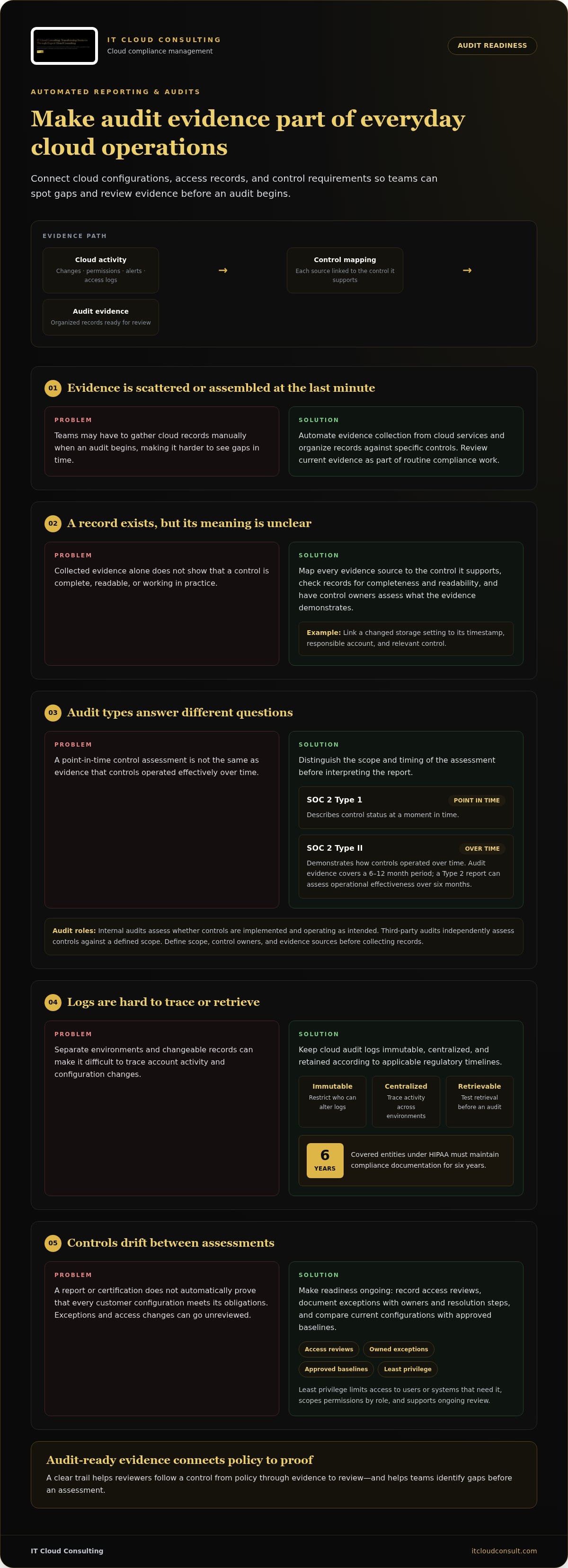
Automated reporting connects cloud configurations, access records, and control requirements to audit evidence. This gives organizations clearer visibility into gaps and makes audit preparation part of routine cloud compliance management.
Automated Audit Evidence Collection
Automated evidence collection gathers records from cloud services and organizes them against specific controls. It matters because teams can review current evidence instead of assembling records manually when an audit begins.
A collection process can capture configuration changes, identity permissions, security alerts, and access logs. For example, a report can link a changed storage setting to its timestamp, responsible account, and relevant control. Map each evidence source to the control it supports, then check that records are complete and readable. Automation improves consistency, but owners still need to assess whether the evidence shows the control working in practice.
Internal and Third-Party Cloud Audits
Internal audits assess whether an organization’s controls are implemented and operating as intended. Third-party audits independently assess controls against a defined scope. Both matter: internal reviews can identify weaknesses before an external assessment examines the same evidence.
A SOC 2 report assesses service-organization controls against the AICPA’s trust services criteria. A Type 1 SOC 2 report describes control status at a moment in time, while a SOC 2 Type II report demonstrates how controls operated over time. SOC 2 Type II audits require evidence that controls operated effectively over a 6-12 month period; a Type 2 report can assess operational effectiveness over a period of six months. Define the audit scope, control owners, and evidence sources before collecting records.
Certifications, Log Retention, and Audit Readiness
A certification or audit report can support assurance, but it does not automatically prove that every customer configuration meets its obligations. Organizations must connect the evidence to their own cloud services, data, and control responsibilities.
Keep cloud audit logs immutable, centralized, and retained according to applicable regulatory timelines. Centralized records help reviewers trace account activity and configuration changes without searching separate environments. Covered entities under HIPAA must maintain compliance documentation for six years. Create a retention schedule, restrict who can alter logs, and test retrieval before an audit begins.
Readiness also means showing that controls remain active between assessments. Record access reviews, document exceptions with owners and resolution steps, and compare current configurations with approved baselines. Least privilege limits access to users or systems that need it, scopes permissions by role, and supports ongoing review. These records help auditors trace a control from policy through evidence to review.
What Are Examples of Regulations and Standards Affecting Cloud Computing?
Applicable requirements depend on the data, services, industry, and locations involved. Build a program by identifying obligations, mapping them to controls, and reviewing vendor responsibilities.
Regulatory Frameworks and Industry Standards
Frameworks and standards define obligations or control practices for particular data, services, and industries. Selecting the relevant ones helps organizations implement consistent controls and explain their compliance posture.
For healthcare, HIPAA protects electronic protected health information and specifies administrative, technical, and physical safeguards. Covered entities must report breaches of protected health information within 60 days, according to the U.S. Department of Health and Human Services. For payment processing, PCI DSS applies to businesses handling card transactions. SOC 2 assesses service-organization controls against the AICPA’s trust services criteria, while ISO 27001 provides a foundation for information security controls. NIST SP 800-53 and FedRAMP are relevant to organizations serving federal customers.
Mapping Requirements to Controls
Control mapping links each applicable requirement to a policy, technical safeguard, owner, and evidence source. This is important because one control may support several frameworks, while a single regulation may require multiple controls.
Build the program in sequence: identify regulated data and applicable frameworks, map requirements to cloud configurations and procedures, assign control owners, then monitor evidence and close gaps. For example, link a requirement to access restrictions, a named owner, and records showing permissions were reviewed. This structure supports consistent implementation and helps teams identify where a shared control falls short.
Common risks include misconfigured cloud resources, inadequate change control, excessive access, and incomplete monitoring. These gaps can lead to regulatory enforcement, contractual consequences, or required remediation. Penalties depend on the applicable law and circumstances.
Cloud Data Residency and Privacy Rules
Data residency and privacy rules influence where covered information may be stored or processed and how organizations protect it. Their relevance depends on the data subjects, operations, and jurisdictions connected to the service.
The GDPR can apply to businesses processing data associated with EU residents and may constrain where covered data is processed and stored. In the United States, assess applicable state privacy requirements alongside federal and industry obligations. California’s CCPA and CPRA are examples identified in cloud compliance frameworks. Classify data by sensitivity and location, then document permitted processing regions and access controls.
Vendor management is part of this assessment. Review each cloud provider’s role, control evidence, and data-processing locations, then track changes that could affect your obligations. A documented control register makes those reviews easier to maintain as services evolve. For organizations aligning cloud strategy with compliance needs, cloud strategy and compliance planning can help structure the broader approach.
What is Cloud Compliance?
Cloud compliance aligns cloud workloads, data practices, and security policies with applicable requirements. Continuous monitoring checks whether controls remain effective as environments change.
Continuous Cloud Compliance Monitoring
Continuous cloud compliance monitoring repeatedly assesses configurations and activity against an organization’s policies and chosen security standards. It matters because a compliant setup can drift as teams change workloads, permissions, or cloud services.
Monitoring can scan configuration files and logs for policy violations, then flag changes for review. For example, a policy may identify a storage resource whose access settings no longer match the organization’s rules. Across cloud providers, consistent policy definitions help teams compare findings without assuming each platform uses identical controls. Payment card environments can also be assessed against PCI DSS requirements, while other workloads may follow different frameworks. Assessment results should identify the affected resource, relevant policy, and action needed to resolve the gap.
Compliance Visibility and Audit Evidence
Compliance visibility brings control status, identified gaps, and supporting records together so teams can assess workloads. It helps teams see which policies pass, where exceptions exist, and how cloud changes affect compliance.
Organizations can monitor cloud environments continuously by scanning configurations, tracking access and changes, and routing alerts to accountable owners. Automated evidence collection can preserve configuration states, access records, and change details. Teams can connect each item to a policy or control and assess whether it demonstrates the required practice. A useful assessment distinguishes a detected issue from a confirmed violation, records its owner, and tracks remediation. This gives security and operations teams a shared view across providers, rather than isolated platform reports.
Shared Responsibility for Compliance
The shared responsibility model divides cloud security tasks between providers and customers, with the division depending on the service. Understanding that boundary matters because using a provider’s compliant infrastructure does not automatically make customer workloads compliant.
Providers handle some underlying security, such as protecting physical servers that host virtual machines and storage buckets. Customers remain responsible for securing many resources they deploy, including workload configuration, identity governance, and data residency. For example, a provider may secure the physical host while the customer configures access to a deployed storage resource. Document responsibilities by service and control, then assign internal owners to customer-managed tasks. Customers still need to assess whether their cloud use meets the frameworks and obligations that apply to their data and operations.
Cloud compliance programs should continually scan configuration files and logs to detect violations of required policies. This makes review ongoing rather than limited to a single check. Examining these sources helps identify where observed configurations or recorded activity violate applicable policies, keeping detection tied to the program’s compliance requirements.
Encryption, retention, classification, and data localization
Data controls connect information sensitivity to protection, storage, and deletion practices. Documented rules help teams apply safeguards consistently across cloud services and locations.
Data Classification and Protection
Data classification assigns categories to information according to its sensitivity and applicable requirements. This helps teams tailor access and protection to the information each workload handles.
Start with a data inventory that identifies where information lives, who uses it, and which obligations apply. For example, label customer records as sensitive, then restrict access to roles with a business need. Apply the same classification logic to cloud storage, databases, and backups. Review classifications when workloads or data uses change, so security controls continue to match the information’s risk and purpose.
Encryption and Retention Practices
Encryption protects cloud data at rest and in transit, while retention policies define how long information remains available. Together, these practices reduce exposure and support consistent data handling.
Set encryption requirements for each data category, then review configurations across services and environments. Depending on the workload and security design, cloud data may also need protection in use. Document workflows for retention, archiving, and deletion, and assign owners to apply them. A customer-records policy, for instance, should distinguish active records from archived information and define how authorized teams delete data when its retention period ends.
Data Localization and Cross-Border Governance
Data localization governs where information is stored or processed, while cross-border governance addresses transfers between jurisdictions. These controls matter because legal obligations can depend on data subjects and processing locations.
The GDPR can apply to businesses processing data associated with EU residents and may constrain where covered information is processed and stored. It also requires reasonable security measures, but does not prescribe exact tools or settings. Map data flows between regions, document processing locations, and assess whether each transfer aligns with applicable requirements. Data sovereignty planning should include backups and support access, not only the primary cloud region. These records help teams explain where sensitive information moves and why.
Data Protection Across Multi-Cloud Environments
Multi-cloud data protection applies consistent safeguards across providers while accounting for each platform’s configuration. This matters because the same policy may require different settings in separate cloud environments.
Maintain a shared data inventory and control baseline, then translate each requirement into platform-specific settings. For example, a team using Google Cloud alongside another provider can compare encryption, access, and location configurations against the same internal policy. Monitor exceptions and document their owners, rationale, and resolution. This supports consistent cloud security without assuming provider tools or configurations work identically across environments.
Multi-cloud compliance management
Multi-cloud compliance management aligns controls, evidence, and monitoring across separate cloud platforms. With 80% of organizations using multiple public or private clouds, consistency matters as infrastructure and responsibilities grow.
Managing Compliance Across Multiple Clouds
Managing compliance across multiple clouds means applying shared policies while accounting for each provider’s configurations. This matters because a control gap in one environment can undermine an organization-wide posture.
Start with a common control baseline for identity, data protection, logging, and configuration. Then map each control to the settings and evidence available in each environment. For example, define who may access sensitive workloads, then compare permissions across platforms. Record exceptions with owners and remediation actions so they do not disappear inside separate provider reports.
Monitoring should detect changes against approved baselines and route findings to the teams responsible for affected resources. Review reports across providers using the same control language, then preserve the platform-specific details needed to investigate each issue. A shared view helps distinguish a broad policy failure from an individual configuration problem. Cloud compliance tools may reduce security-related workload by up to 30%, but teams still need clear ownership and review processes.
Cloud customers remain responsible for securing their use of cloud services, including workload security, identity governance, and data residency. Providers handle some underlying security, such as protecting physical servers. Document this division for each service, because infrastructure responsibilities differ from customer-managed settings.
Comparing Cloud Certifications and Compliance Tools
A meaningful comparison evaluates each provider’s evidence and tools against your workloads, applicable frameworks, and required controls. This matters because a provider’s certification does not automatically demonstrate that your configurations comply.
For AWS, Google Cloud, and other platforms in your environment, compare the services and regions in scope, the frameworks addressed, and the available compliance reports. Then assess whether each platform’s tools can detect configuration drift, monitor relevant controls, and export usable evidence. Treat each provider’s documentation as specific to its services, and check that its scope aligns with the cloud resources your organization uses.
Apply the same evaluation to third-party tools. Check whether they can bring findings from each environment into comparable reports, preserve evidence, and map results to your control baseline. A tool that covers only one platform may leave teams manually reconciling separate reports. The best fit supports your required controls across actual workloads while preserving visibility into platform-specific gaps.
To align cloud environments with operational goals, explore cloud optimization support.
Cloud configuration baselines help maintain a secure, compliant posture. Keeping them aligned across environments supports consistent reviews and helps teams identify deviations for follow-up.
IT Cloud Consulting: Strategic Cloud Adoption
IT Cloud Consulting helps organizations plan cloud adoption, optimize existing environments, and maintain ongoing support. When compliance requirements need to shape a cloud roadmap, Strategic Cloud Adoption can align technology direction with business needs and control priorities.
For organizations already operating across cloud platforms, Cloud Optimization can help refine environments and improve operational efficiency. Ongoing Cloud Support provides continued guidance as cloud needs evolve. These services connect compliance priorities with broader cloud decisions while keeping the focus on practical implementation.
If you’re planning a cloud transition or reassessing your current environment, contact IT Cloud Consulting to discuss your next steps.
Make Compliance Part of Your Cloud Roadmap
Strong cloud governance should evolve alongside your organization’s technology. Treat cloud compliance management as an ongoing design priority, so decisions about new workloads, platforms, and data use account for control requirements from the outset. This helps teams pursue modernization with clearer ownership and a more sustainable operating model.
IT Cloud Consulting offers Strategic Cloud Adoption, Cloud Optimization, and Ongoing Cloud Support to help organizations shape and advance their cloud environments. If you’re planning a transition or refining your current approach, a conversation can clarify where strategic guidance fits your next steps.
Contact IT Cloud Consulting to discuss your cloud direction. With a considered plan and the right support, your organization can move forward with greater confidence.
Frequently Asked Questions
How is Sensitive Cloud Data Defined?
Sensitive cloud data is information that could harm people or an organization if exposed, misused, or altered. Examples include protected health information, payment-card details, personal identifiers, and confidential business records. Classification depends on the information’s content, intended use, and applicable obligations. For example, a customer database containing health details needs stricter access and handling controls than a public product brochure.
What is cloud compliance management?
Cloud compliance management is the ongoing work of aligning cloud services, data practices, and organizational processes with applicable rules and standards. It connects requirements to accountable owners, operating controls, and reviewable evidence. For example, an organization can assign an owner to evaluate a new data-processing workflow before deployment, then track whether its safeguards remain effective as the service changes.
Which cloud compliance frameworks and standards apply to U.S. businesses?
The applicable frameworks depend on an organization’s sector, data, customers, and operations. HIPAA affects organizations handling electronic protected health information, while PCI DSS applies to businesses processing payment cards. SOC 2 is commonly relevant to service organizations demonstrating controls to customers. ISO 27001 and NIST guidance can structure security programs; FedRAMP is relevant to cloud services used by federal agencies. GDPR may also apply when processing data associated with EU residents.
What are the key requirements of SOC 2, ISO 27001, HIPAA, PCI DSS, and FedRAMP for cloud services?
SOC 2 assesses service-organization controls using trust services criteria, including security and availability. ISO 27001 provides an information security management framework, while ISO 27017 addresses cloud-specific controls. HIPAA requires safeguards for electronic protected health information and business associate agreements with cloud providers processing it. PCI DSS sets security requirements for payment-card data. FedRAMP uses Low, Moderate, and High authorization levels, with control baselines derived from NIST SP 800-53.
What are common cloud compliance risks, violations, and penalties in the United States?
Common risks include misconfigured cloud resources, inadequate change control, excessive access, and incomplete monitoring. Violations can lead to regulatory enforcement, contractual consequences, or required remediation. Penalties depend on the applicable law and circumstances.


