
An effective manufacturing cloud strategy does not move every process off-site. It places each workload where it best supports production. For U.S. manufacturers, cloud computing for manufacturing means using internet-accessible services, such as Infrastructure as a Service, Platform as a Service, or Software as a Service, to store and analyze data, connect systems, and adjust computing resources as needs change. The right setup can give teams a shared view of operations while keeping time-sensitive processing close to machines.
It makes sense to weigh efficiency against concerns about security, connectivity, and disruption on the factory floor. Cloud adoption can improve visibility, resource planning, and analysis, but the benefits depend on how cloud and edge systems work together and which workloads belong in each environment.
This article explains how manufacturing cloud computing works, where it can improve efficiency, and what affects its costs. It also covers practical security and connectivity considerations, cloud-edge trade-offs, and why a focused adoption strategy can be more useful than moving everything at once.
Key Takeaways
- Choose between IaaS, PaaS, and SaaS based on how much control and operational management your manufacturing systems require.
- Centralized data can give teams across sites a shared view of production and support better planning and analysis.
- Build security and connectivity considerations into the design, including clear data governance and access controls.
- Use edge computing for processes that need local, rapid responses, while cloud platforms support broader analysis and coordination.
- Start with a high-value use case and define performance measures so you can assess efficiency and guide future investment.
What is Cloud Computing in Manufacturing?
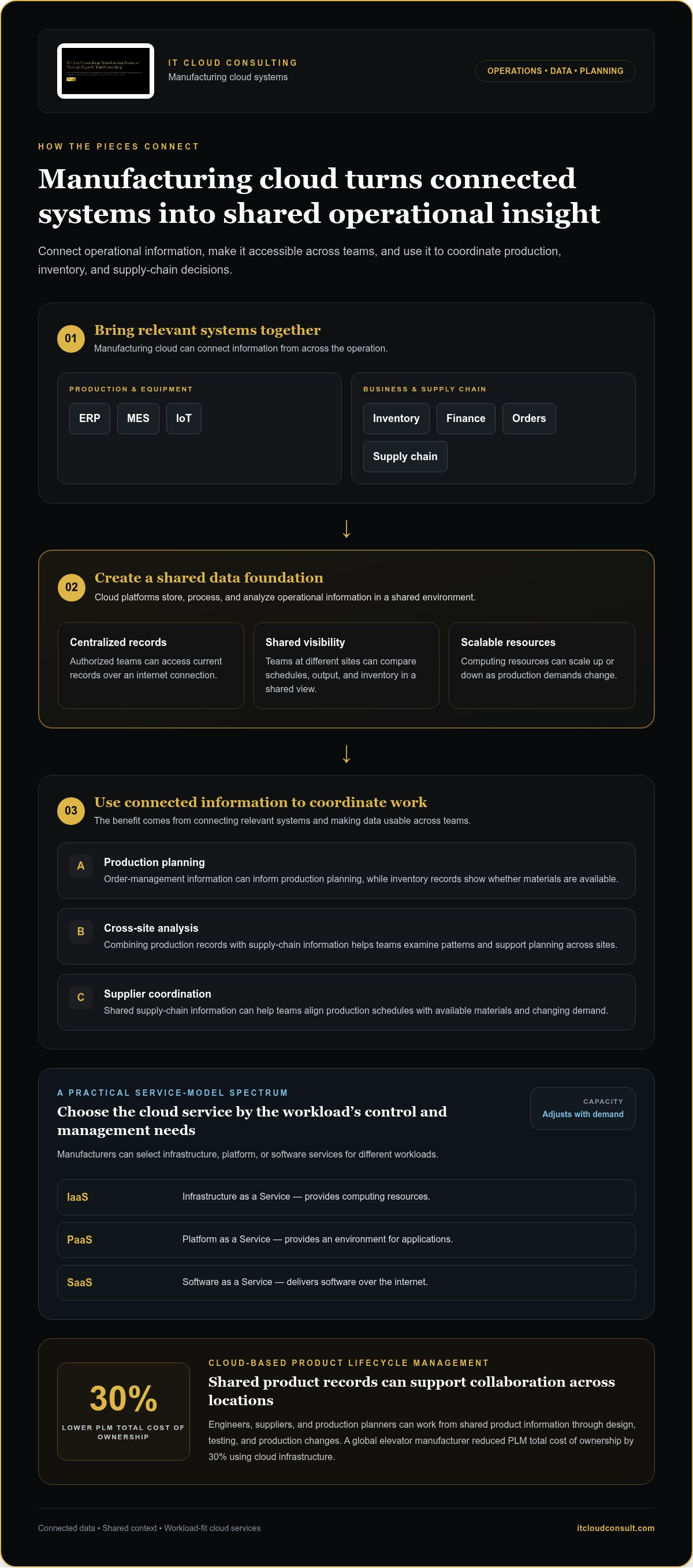
Cloud and on-premises systems differ in how their infrastructure is hosted and managed. Common manufacturing uses include connecting ERP, MES, IoT, inventory, finance, order management, and supply chain data.
Cloud computing for manufacturing gives teams internet-accessible platforms to store, process, and analyze operational information. Manufacturers can choose infrastructure, platform, or software services based on how much control and management each workload requires.
Centralized Data and Real-Time Access
Centralized data management stores manufacturing information in a shared cloud environment, where authorized teams can access current records over an internet connection. For example, production teams at different sites can compare schedules, output, and inventory in a shared view instead of reconciling separate files. Connecting ERP, MES, IoT, and supply chain systems also enables analysis across operational data, helping teams spot mismatches and coordinate decisions.
Cloud-Based Product Lifecycle Management
Cloud-based product lifecycle management (PLM) keeps product information and design workflows accessible across teams and locations. Engineers, suppliers, and production planners can work from shared product records, supporting collaboration during design, testing, and production changes. Cloud-based simulation and testing can support product development while reducing reliance on repeated physical tests. A global elevator manufacturer reduced PLM total cost of ownership by 30% using cloud infrastructure.
Service models determine how much infrastructure a manufacturer manages. Infrastructure as a Service provides computing resources, Platform as a Service provides an environment for applications, and Software as a Service delivers software over the internet. Resources can scale up or down as production demands change, allowing teams to match capacity to workloads such as seasonal planning or data analysis.
Cloud platforms can connect inventory, finance, and order management with production data. For example, an order-management system can share demand information with production planning, while inventory records show whether materials are available. Finance teams can use the same connected information to understand operational activity. This integration makes it easier to identify when a production plan, order, or stock record needs attention.
Cloud-based supply chain management extends shared information beyond a single factory. Suppliers and manufacturers can coordinate updates across multiple supply-chain tiers, improving visibility into demand, supply constraints, and delivery plans. The U.S. Environmental Protection Agency explains that electronic supply chain management systems can support collaborative information sharing across multi-echelon supply chains. This shared context helps teams align production planning and scheduling with available materials and changing demand.
Centralized storage also provides a foundation for analysis across sites, rather than limiting insights to individual machines or departments. Manufacturers can combine production records with supply-chain information to examine patterns and support planning. The value comes from connecting relevant systems and making data usable across teams, not simply moving files to a cloud platform.
Security, connectivity, and implementation challenges
Cloud security risks include unauthorized access, exposed data, and interruptions to connected processes. Manufacturers can reduce these risks through data governance, access controls, and plans for network disruptions.
Data Ownership and Safety
Data ownership and safety concern who controls manufacturing information, where it is stored, and who can access it. Depending on the system design, operational data may reside off-site on a provider’s servers, so manufacturers should define handling policies for each use case. Production data and product designs, for example, may need different access rules. Clear governance helps teams manage sharing across sites while protecting sensitive information.
Cloud Security and Compliance
Cloud security combines provider protections with the manufacturer’s own controls and practices. Providers use measures such as encryption and network firewalls; manufacturers can apply identity and access controls, encryption, continuous monitoring, and zero-trust principles across cloud and edge environments. For regulatory compliance, map applicable obligations to the data and processes involved, then align access, retention, and security policies accordingly. This helps teams assess the whole system rather than relying on a single control.
Security and Decision-Making
Security decisions affect system architecture, data access, and which workloads move to cloud infrastructure. Manufacturing respondents made 43% of critical cloud decisions in isolation, a pattern that can leave security, operations, and IT teams working from different assumptions. Bring those teams into planning together: operations can identify production dependencies, IT can assess access and network needs, and security teams can set controls. Shared decisions make it easier to connect safeguards with real processes.
Connectivity also affects how cloud systems operate on the factory floor. A network interruption can delay access to cloud data or synchronization between sites. Manufacturers can process equipment data close to its source at the edge, supporting local responses during disruptions. Filtering data locally can also reduce network demand by sending relevant insights to cloud platforms instead of every raw reading.
Workforce readiness matters because secure processes depend on how people use them. Train employees in role-based access, safe data handling, and incident reporting, using examples from the systems they operate. Production staff and finance teams, for instance, may need different permissions for the same connected platform. Documenting roles helps reduce accidental exposure and supports consistent work across shifts and locations.
Before implementation, document data flows, access responsibilities, network dependencies, and recovery procedures for each use case. A structured strategic cloud adoption plan can align these decisions with manufacturing priorities and security needs.
Cloud computing in smart manufacturing and Industry 4.0
Industry 4.0 connects machines, software, and operational data to improve manufacturing decisions. Cloud platforms can integrate industrial IoT, automation, and legacy equipment, while edge systems handle tasks requiring local responses.
Cloud Adoption in Industry 4.0
Cloud adoption in Industry 4.0 uses internet-connected platforms to support smart factory capabilities across equipment and sites. For example, manufacturers can analyze production data alongside machine and energy information to identify operational patterns. Deloitte’s 2025 Smart Manufacturing and Operations Survey found that 78% of manufacturing leaders allocated more than 20% of improvement budgets to technologies including cloud platforms, AI, analytics, and smart factory initiatives. These investments can support connected operations.
Industrial IoT and Equipment Integration
Industrial IoT integration connects sensors and machines with software that gathers and analyzes operational data. Cloud platforms can coordinate this information with automation systems, while gateways connect equipment that uses different interfaces. For example, a sensor can flag unusual vibration locally, and cloud analysis can compare that insight with equipment trends across facilities. This approach extends data capabilities without requiring every machine to communicate directly with cloud services.
Industry Cloud Recommendations
Manufacturing cloud strategies often prioritize interoperable, scalable platforms that support open standards and flexible integration. Manufacturers can start with a defined use case, such as quality monitoring, then expand as teams learn how connected data supports production. Cloud and edge systems can divide the work: edge devices capture and filter machine data, while cloud analytics identify broader patterns. This design matches computing resources to the timing and scope of each task.
Industry 4.0 also depends on applying insights to operational decisions. Cloud environments can help teams train models, benchmark performance, and coordinate workflows across locations. According to TCS’s Future-Ready Manufacturing Study 2025, 75% of manufacturing leaders expected AI to become one of the top three contributors to operating margins by 2026. Cloud infrastructure can provide a shared environment for developing and using those capabilities, while infrastructure brokers like Backplane link powered industrial sites with growing AI compute demand.
Manufacturers can connect predictive-maintenance insights to operational workflows instead of leaving them in an analytics dashboard. For example, a maintenance insight can trigger a work order in an enterprise asset management system. Cloud computing can also support quality monitoring and energy optimization by combining information across machines or plants. The value comes from linking analysis to decisions people can act on.
Cloud platforms can complement existing infrastructure as manufacturers modernize in stages. The U.S. Environmental Protection Agency Office of Inspector General notes that cloud computing can enable faster deployment, reduce the need to buy hardware or build data centers, and improve collaboration compared with current systems. A focused transition can help teams build connected capabilities around existing production processes and identify where further integration matters most.
Cost reduction and operational efficiency
Cloud manufacturing uses internet-based computing, storage, and software to support production and related operations. Instead of relying only on local servers, a manufacturer can use cloud platforms to process operational data, connect business systems, and adjust computing resources as demand changes. Efficiency gains come from matching infrastructure and workflows to actual production needs.
One potential saving comes from reducing reliance on on-premises servers, hardware, and maintenance. Cloud services can also provide more computing capacity when workloads rise and scale it back when demand falls. For example, a manufacturer could use extra capacity for production analysis during a planning cycle without maintaining that level of local infrastructure year-round. The cost impact depends on current systems, usage patterns, and integration requirements.
Efficiency improvements depend on how connected data changes operational decisions. A Wipro report found that 56% of manufacturers reported improved productivity following cloud adoption. For a plant, that can mean bringing production, inventory, and maintenance information together so teams can identify a constraint and act on it. Before a cloud initiative, define key performance indicators, such as production throughput or equipment downtime, to measure whether the system improves the intended process.
Cloud services can also support more consistent work across locations. A global elevator manufacturer using a consolidated cloud product lifecycle management system reduced standard parts duplication by 25% across locations. Shared product and process information can help engineering and production teams avoid unnecessary duplication, while giving planners a clearer source for decisions. The operational value comes from integrating systems and processes, not from storage alone.
Digital twins offer another way to improve efficiency: manufacturers can use virtual prototypes to test product or process changes before committing resources to physical trials. Cloud computing can provide the processing capacity for simulation and analysis, allowing teams to compare design options and identify potential issues earlier. This can reduce the time and resources needed for physical testing. The key measure is whether simulation improves a defined development or production decision.
Cloud systems also need to support reliable operations when connectivity is unavailable. Edge computing processes data near its source, allowing a machine to support local responses during a network interruption. For example, an edge sensor can detect unusual equipment vibration and flag it for maintenance. Local filtering can send relevant insights to the cloud when connectivity returns, while limiting unnecessary network traffic.
To assess cost and efficiency, compare the current process with the intended future workflow. Identify which hardware and maintenance tasks could change, which integrations production depends on, and which performance indicators will show progress. A cloud system should address a specific operational need, such as reducing duplicated parts, analyzing machine data, or adjusting capacity to demand. These criteria help distinguish measurable process improvements from technology adoption alone.
Cloud-edge implementation challenges and strategy
A cloud-edge strategy assigns each manufacturing workload to the location that best suits its timing, data needs, and operational purpose. Cloud platforms can analyze information across plants, while edge systems process machine data locally. This distinction matters when a production application needs a rapid response or a network connection may be interrupted. The challenge is coordinating both environments without creating disconnected data, security, or management practices.
Edge computing places processing close to machines, often on gateways or industrial computers. For example, a vibration sensor can flag an unusual reading locally so maintenance teams can respond promptly. Local processing also supports operations during unreliable network connections or outages. Cloud systems can receive selected data for broader analysis, giving teams greater visibility without requiring a continuous connection for every immediate action.
Data volume presents another implementation challenge. Sending every machine reading to the cloud can increase network demand and complicate analysis. Edge systems can filter information at its source and transmit relevant events or summaries instead. For example, a gateway can forward an unusual temperature alert rather than every routine reading. This approach reserves cloud resources for analysis across machines while keeping time-sensitive processing close to production equipment.
Workload placement should also reflect data sensitivity and application requirements. Manufacturers can keep sensitive operational or machine data on-site when they need tighter control over access and sharing. Other workloads, such as performance benchmarking across plants, may benefit from cloud analysis. Mapping each application’s latency, connectivity, and data-control needs helps avoid a one-size-fits-all design and supports deliberate integration with existing systems.
Interoperability is essential as manufacturers add platforms, devices, and applications. Prioritize scalable systems that support open standards and flexible integration, so new equipment can exchange information with existing infrastructure. Start with a high-value use case, such as predictive maintenance, quality management, or energy optimization. Define performance measures, connect only the necessary data flows, and use the results to guide further expansion.
Cloud-edge environments also need consistent governance. Apply identity and access controls, encryption, and continuous monitoring across both environments. Set data policies for each use case, then assign clear ownership for configuration and ongoing review. This helps prevent an edge gateway from becoming an unmanaged exception to cloud security processes. A coordinated design supports manufacturing innovation while keeping responsibilities and operational visibility clear.
Manufacturers managing complex workloads across cloud and edge can develop a cloud strategy for manufacturing that aligns system placement, integration, and operational priorities.
IT Cloud Consulting: Strategic Cloud Adoption
IT Cloud Consulting helps manufacturers plan cloud adoption around production priorities, system dependencies, and cloud-edge requirements. Its Strategic Cloud Adoption services help shape a clear path from selected use cases to broader implementation. Cloud Optimization can refine existing environments, while Ongoing Cloud Support helps maintain cloud operations as business needs evolve.
Turn to these services when your team needs to align technology decisions with operational goals, assess workload placement, or improve an established cloud environment. A focused approach connects infrastructure choices to practical manufacturing outcomes, such as stronger visibility across sites or better use of operational data.
Contact IT Cloud Consulting to discuss your manufacturing cloud priorities, or visit itcloudconsult.com.
Turn Cloud Decisions Into Lasting Progress
Make cloud planning an ongoing part of operational strategy, rather than a one-time technology decision. A deliberate approach to cloud computing for manufacturing can connect future investment to evolving production priorities, giving each change a clear purpose and supporting long-term capabilities.
IT Cloud Consulting offers Strategic Cloud Adoption, Cloud Optimization, and Ongoing Cloud Support. These services help manufacturers shape an adoption path, refine existing cloud environments, and sustain progress as operational needs change. The right focus depends on where your organization is in its cloud journey and which priorities matter most now.
Bring your current goals and challenges into the next planning conversation. Contact IT Cloud Consulting to explore a considered path forward. With clear priorities and informed decisions, your cloud strategy can become a foundation for continued progress.
Frequently Asked Questions
Does this mean I’m sending my data to a third party?
Often, yes. Depending on the system setup, a cloud provider stores or processes data on its servers. That alone does not determine who owns or controls the information. Define those rights in agreements and data governance policies, including who can access data, how it can be used, and how it is handled when services change. Classify information such as machine settings, employee records, and product designs so access and handling rules fit each data type.
What are the benefits and ROI of cloud adoption for manufacturers?
Cloud adoption can support efficiency, collaboration, and access to analytics, but return on investment depends on whether those gains outweigh implementation and ongoing operating costs. Set a baseline before assessing a project: measure outcomes such as scrap, order delays, inventory accuracy, or time spent preparing production reports. Then compare those measures after implementation, accounting for integration, training, and cloud usage. A clear baseline helps distinguish operational improvements from benefits that are difficult to measure.
How much does cloud computing cost for manufacturing companies?
Costs depend on resource use, data storage, software licensing, network transfer, security requirements, and the level of availability needed. Existing systems and integration work also affect migration and operating expenses. Model expected workloads, including periods of higher production demand, and track actual consumption after deployment. For consulting services, pricing depends on the project and is provided after a quote request; scope and support requirements shape the quote.
How can manufacturers migrate ERP, MES, and IoT systems to the cloud?
Start by mapping how each system exchanges data and which production processes depend on it. Clean and classify ERP, MES, and IoT data before migration, then test interfaces against representative workflows, such as releasing an order or recording machine output. Validate records and user permissions in the new environment before switching routine operations. Document a rollback approach for cutover so teams know how to restore the previous workflow if a critical process fails.
What U.S. regulations and standards apply to cloud data in manufacturing?
Applicable requirements depend on the data involved, the manufacturer’s activities, and its contractual relationships. There is no single rule for every factory dataset. Begin with an inventory that distinguishes operational telemetry from employee, customer, or controlled business information. Map relevant obligations to each data category, then document access, retention, security, and incident processes. This helps compliance and IT teams identify requirements for specific systems without treating all manufacturing data alike.
Which cloud providers and platforms offer solutions for manufacturing?
Manufacturers can use infrastructure platforms for computing and storage, SaaS applications for business functions, and industrial software platforms for production and equipment data. ERP, MES, IoT, analytics, and supply-chain applications may use different service models or connect through integrations. The useful distinction is the workload each platform supports: business transactions, machine-data processing, or analysis across sites. A manufacturing architecture can combine these categories instead of relying on a single platform for every function.
How reliable is cloud computing for manufacturing operations with latency or connectivity requirements?
Cloud services suit workloads that can tolerate network delays, such as historical reporting or analysis across facilities. Machine control and other time-critical actions should use local processing when they require an immediate response. For example, a production cell can continue its local control sequence while an edge system stores readings for later synchronization. Reliability depends on matching each application to its latency needs and designing data recovery and synchronization around factory network conditions.
What should manufacturers look for when choosing a cloud provider?
Assess whether the cloud environment supports your applications, integration needs, security controls, data governance, and operational continuity. Consider how teams will monitor resource use, manage access, retrieve data, and move workloads if requirements change. Manufacturing operations also need a clear distinction between workloads requiring a local response and those suitable for remote processing. Document these criteria before selecting a platform so technology decisions align with production priorities and long-term architecture.


