
What if stronger cloud control didn’t mean slower releases? As cloud environments expand across teams, accounts, and providers, identities, resources, and spending can quickly become difficult to oversee. The most effective cloud governance best practices 2026 set clear guardrails and ownership, then automate routine checks so teams can move quickly within defined boundaries. Governance should reduce uncertainty, not add another approval layer to every change.
That balance matters as cloud becomes a core operating model rather than simply a place to host technology. Leaders need consistent policies, practical cost controls, and evidence for security and compliance reviews, while delivery teams need room to make sound decisions. This guide explains how to prioritize controls by business risk, clarify who owns policies, resources, and exceptions, and build a continuous improvement cycle. It also covers preventive, detective, and advisory controls, and how automation and regular review can strengthen accountability without unnecessary friction. The result is a governance approach that can evolve with your organization and support secure growth.
Key Takeaways
- Use cloud governance best practices 2026 to set clear guardrails that strengthen oversight while preserving team autonomy.
- Prioritize identity, policy, and cost controls according to business risk, then assign owners for resources and exceptions.
- Choose a centralized, federated, or hybrid operating model based on the balance your organization needs between consistency and delivery flexibility.
- Build governance in phases: assess your current environment, address high-impact risks, implement controls, and review how they perform.
- Turn governance priorities into a practical roadmap, supported by strategic cloud planning, infrastructure optimization, and ongoing management.
Cloud Governance Best Practices in 2026: What They Protect and Enable
Cloud governance gives an organization a clear way to decide how cloud resources are used, who is accountable for them, and which policies and controls apply. In practice, it defines decision rights: who sets expectations, who puts them into effect, and who checks whether they remain appropriate. These foundations make risk easier to see, costs easier to attribute, and cloud operations more reliable as teams and environments grow.
Governance is related to cloud operations and security, but it isn’t a substitute for either. Operations teams provision and maintain resources; security teams implement protections; governance establishes the principles and oversight that guide those activities. The broader Cloud Management Overview describes management activities such as provisioning, automation, security, and compliance, which governance helps align with organizational priorities.
What cloud governance means for a growing organization
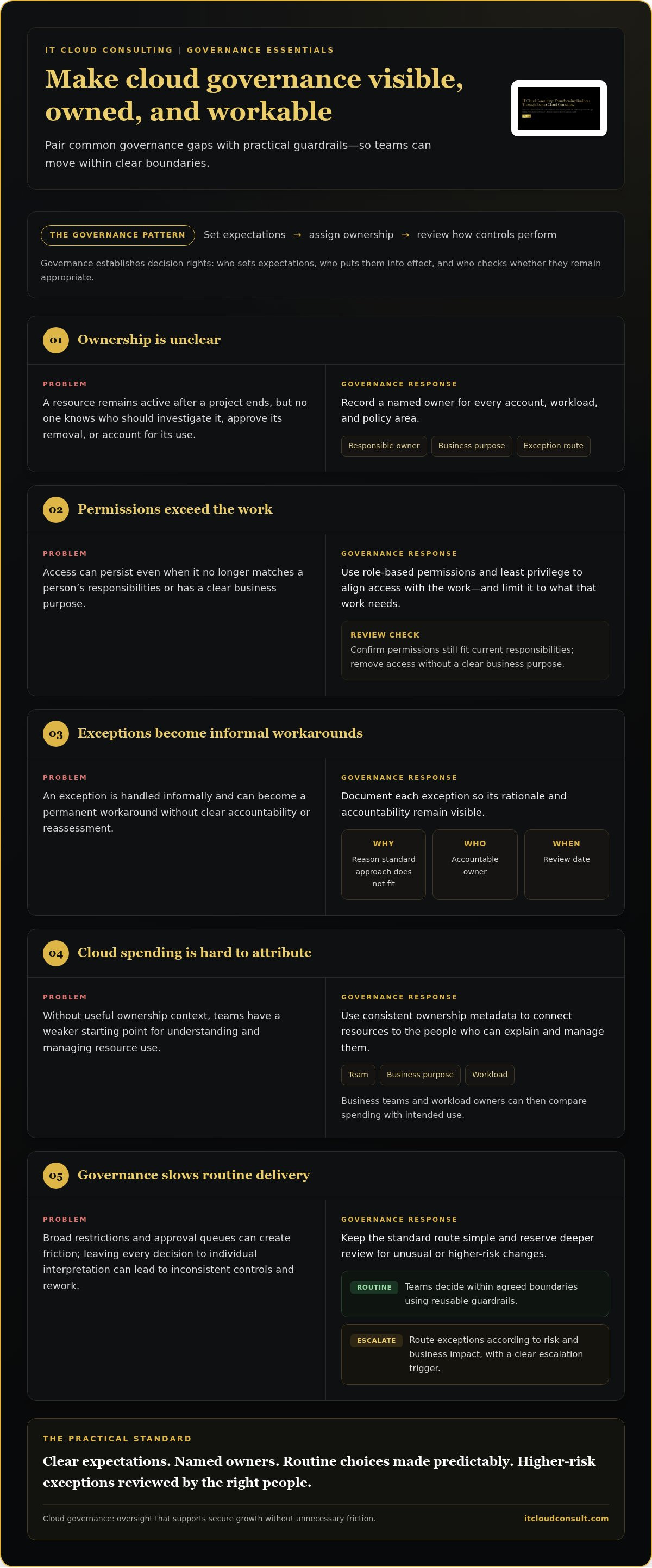
Clear decision rights turn general expectations into accountable practices. For example, a policy owner can define how resource ownership must be recorded, engineering teams can apply that standard when they deploy, and a designated reviewer can assess exceptions. Without that clarity, an unused resource might remain active after a project ends, while teams aren’t sure who should investigate its purpose, approve its removal, or account for its ongoing use. The issue isn’t only the resource itself; it’s the missing ownership path.
As cloud use scales across teams, accounts, and providers, informal agreements become harder to apply consistently. Shared policies establish a common baseline, while named owners make it possible to resolve gaps without assuming every team has the same workload or risk profile. Make ownership useful by recording who is responsible, what the resource supports, and where questions or exceptions should go.
Why governance must balance control with delivery speed
Teams can reasonably worry that governance will create approval queues or impose broad restrictions that don’t fit their work. Yet leaving every decision to individual interpretation can create inconsistent controls and rework. Reusable guardrails give teams a known path for routine choices, while a defined exception process directs unusual or higher-risk decisions to the right owners. Keep the standard route simple, and make the escalation trigger clear so teams know when a decision needs additional review.
Proportionate controls help teams deliver faster and more safely by making routine decisions predictable and reserving deeper review for higher-risk changes.
In practical terms, cloud governance best practices 2026 should:
- Set a consistent baseline for resource ownership and policy expectations.
- Allow teams to make routine decisions within agreed boundaries.
- Escalate exceptions according to their risk and business impact.
This approach doesn’t replace engineering judgment. It gives engineers clearer boundaries, helps leaders see where accountability sits, and creates a structure that can adapt as organizational needs change.
The Core Cloud Governance Practices: Access, Policy, Cost, and Accountability
Cloud governance works best as a practical set of controls adapted to an organization’s workloads, risks, and ways of working, not as a rigid framework applied identically everywhere. The cloud governance best practices 2026 come down to making access, resource ownership, policy decisions, and spending visible enough to manage. As outlined in HPE's Guide to Cloud Governance, governance connects policies and oversight with areas such as security, compliance, and automation.
Set access, ownership, and policy guardrails
Start by assigning accountable owners for cloud accounts, workloads, policies, and security responsibilities. Role-based access helps align permissions with a person’s or team’s work, while the principle of least privilege limits access to what’s needed for that work. Make review responsibilities explicit too: teams apply policies, designated owners assess exceptions, and relevant leaders can see unresolved risks.
Document exceptions rather than letting them become informal, permanent workarounds. Each exception should identify an accountable owner, explain why the standard approach doesn’t fit, and include a review date. That record makes it possible to reconsider the decision as the workload or risk changes. Keep policy language direct: state what is required, who is responsible, and what evidence demonstrates that the control is being followed. When reviewing access, check whether permissions still match current responsibilities and remove access that no longer has a clear business purpose.
- Record a named owner for each account, workload, and policy area.
- Use role-based permissions and least privilege to limit unnecessary access.
- Log exceptions with a rationale, owner, and review date.
Make cost, compliance, and operations visible
Ownership metadata, such as team, business purpose, and workload, helps connect resources to the people who can explain and manage them. Apply a consistent approach across environments so reports can distinguish resources by accountable team or purpose. This gives cost reviews a useful starting point: business teams and workload owners can compare spending with intended use, investigate unexpected changes, and discuss budgets with context rather than treating cloud costs as an undifferentiated total.
For a useful review, compare a resource’s current use and cost with its stated purpose, then route unexplained changes to the owner who can investigate. If the owner, purpose, or allocation information is missing, treat that as a governance gap to resolve rather than assuming the resource is unimportant.
Compliance evidence and operational standards also need clear owners. Define which records show that a policy is being followed, where those records are maintained, and who reviews them. Operational standards can describe expectations for maintaining resources, documenting changes, and addressing identified issues. Keep the evidence proportional to the control: a straightforward requirement should be easy to demonstrate, while higher-risk areas may warrant closer review.
Clear ownership turns cloud controls from written expectations into actions someone can apply, review, and improve. A regular review of ownership records, exceptions, spending, and control evidence can reveal where policies no longer match actual practice. For organizations translating these priorities into a broader cloud roadmap, strategic cloud planning can help align governance with business and operating needs.
Choosing a Cloud Governance Operating Model: Centralized, Federated, or Hybrid
An operating model defines who makes cloud governance decisions and where teams have authority to act. It’s an organizational choice, not a software category: the same tools can support centralized, federated, or hybrid decision-making. The right model depends on how much consistency the organization needs, how diverse its workloads are, and how decisions should be shared between central leaders and delivery teams.
Strong guardrails don’t require manual approval for every change. Organizations can establish shared standards and define which decisions teams can make independently. Routine work can proceed within those boundaries, while exceptions or higher-risk changes receive focused review. That distinction lets governance support accountability without turning central oversight into a queue for everyday engineering decisions.
When centralized governance is the right fit
In a centralized model, a core team sets common standards, oversees how they’re applied, and coordinates decisions that affect the organization as a whole. This can suit organizations that need consistent policies across many teams or want clear executive accountability for cloud risk. The trade-off appears when the central team must approve every routine choice: reviews can become bottlenecks, and teams may have less room to respond to workload-specific needs. Keep routine decisions with delivery teams where possible, and reserve central review for decisions that affect shared standards or significant risk.
How federated and hybrid governance preserve team ownership
A federated model gives teams greater responsibility for applying governance within shared organizational boundaries. It can fit organizations with distinct business units or workloads that need different implementation choices. A hybrid model divides decision rights: central leaders define enterprise-wide expectations, while workload teams determine how to meet them in their context. This can preserve local ownership without fragmenting the overall approach.
The distinction is especially useful in multi-cloud environments. An organization may use AWS, Microsoft Azure, and Google Cloud as provider examples, but the operating model should define ownership and decision rights across the environment rather than depend on a particular provider.
| Model | Decision rights | Suitable conditions | Potential trade-off |
|---|---|---|---|
| Centralized | A central function sets standards and makes or oversees key decisions. | Consistent policies and clear executive oversight are priorities. | Central review can slow routine decisions if authority is too concentrated. |
| Federated | Teams make more decisions within shared organizational expectations. | Business units or workloads need substantial implementation flexibility. | Teams may interpret shared expectations differently without clear boundaries. |
| Hybrid | Central leaders set common controls; teams make workload-level choices. | The organization needs both enterprise consistency and local autonomy. | Unclear decision boundaries can create gaps or duplicated review. |
Use the comparison to decide which choices need organization-wide consistency and which can stay with the teams closest to the work. For example, leaders might set a common requirement for ownership and review, while delivery teams choose how to apply it to their workload. Document the boundary, the owner for decisions that cross it, and the route for resolving exceptions.
The most effective cloud governance best practices 2026 align decision authority with risk and operational context. Start with the model your organization can explain and sustain, then adjust as responsibilities, workloads, or cloud use evolve. A clear division of authority makes oversight more consistent while giving teams meaningful ownership of delivery.
How to Put Cloud Governance Best Practices into Operation
Turn governance priorities into a working program through a sequence teams can understand and maintain. The cloud governance best practices 2026 are most effective when implementation starts with a clear view of current responsibilities, targets the risks that matter most, and expands as ownership and processes become reliable. Avoid trying to standardize every control at once. Build a foundation, learn from its operation, and refine it over time.
- Assess the current state. Map cloud environments, teams, and workloads, then document existing policies and control responsibilities. Note where ownership is unclear, where practices differ, and how teams currently handle exceptions. This inventory gives decision-makers a practical picture of what governance needs to address.
- Prioritize risks in context. Rank gaps by potential business impact, exposure, and feasibility of remediation. A gap affecting a sensitive or business-critical workload may deserve attention before a less consequential inconsistency. Consider operational dependencies too, so changes reduce risk without disrupting necessary work. Don’t treat a maturity score or numerical benchmark as a universal measure of success.
- Assign accountable owners. Give each priority a responsible person or team, including the authority to coordinate remediation. Clarify who can approve an exception and who will confirm that it has been addressed. Named ownership prevents findings from remaining open simply because responsibility is unclear.
- Implement high-impact controls first. Select a manageable set of actions that addresses the most material gaps, such as improving resource ownership records or clarifying policy review responsibilities. Communicate the expected behavior and how teams can raise exceptions. Expand the control set as teams demonstrate they can apply and maintain the initial practices.
- Review results and adjust. Track a small group of meaningful indicators, then use the findings to update priorities, policies, and responsibilities. The aim is to identify trends and make decisions, not to collect metrics without action.
Prioritize controls using risk and operational context
A useful priority list connects each gap to its impact, exposure, owner, and next action. For example, an unowned workload creates uncertainty about who can validate its purpose or resolve an issue. Assigning an owner and setting a review point turns that observation into a manageable action. Tailor controls to the workload and business need rather than assuming every environment requires the same sequence or level of oversight.
Establish a continuous review and improvement cycle
Set a review cadence that fits the pace of change in your environment. Revisit policies, access, ownership metadata, and exceptions; route findings to accountable owners; and record the remediation decision, including why an issue is accepted, corrected, or escalated. Useful indicators include policy exceptions and their review status, ownership coverage across resources, and unresolved control gaps. The cloud security assessment checklist can help structure a review of security-related gaps alongside the broader governance process.
IT Cloud Consulting provides strategic cloud advisory to help turn assessment findings into a tailored governance roadmap. With ongoing review and clear ownership, governance can evolve alongside cloud operations rather than becoming a one-time documentation exercise.
Sustaining Cloud Governance in 2026 with Strategic Advisory and Ongoing Support
Governance is not a document to complete and file away. It needs to keep pace with cloud adoption, changing workloads, and evolving business priorities. Internal teams may benefit from strategic planning when setting direction, implementation support when translating decisions into practice, or ongoing management when maintaining oversight competes with other operational demands. The right support can complement internal expertise while keeping governance connected to real cloud operations.
IT Cloud Consulting helps organizations assess and optimize cloud infrastructure, plan cloud transitions, and maintain environments through ongoing technical assistance and management. This work connects governance priorities with cloud plans, rather than treating oversight as a separate initiative with no clear operational path.
Connect governance priorities to a cloud roadmap
A tailored roadmap links governance actions to the organization’s adoption plans and business objectives. It can clarify which priorities should shape upcoming cloud decisions, where existing practices need attention, and how teams can coordinate responsibilities as the environment changes. The strategic cloud adoption guide provides broader context for aligning cloud transitions with organizational goals.
Advisory support is useful when leaders need to translate broad goals, such as improving accountability or strengthening cost oversight, into a coherent plan that reflects their environment. A roadmap also gives internal teams a shared reference point for making decisions and revisiting priorities as business needs shift.
Maintain governance as cloud environments evolve
Cloud environments change as workloads are updated, teams take on new responsibilities, and resource use shifts. Ongoing technical assistance, monitoring, and management can help organizations maintain awareness of those changes and keep governance practices connected to day-to-day operations. Reviews can reveal when an established policy or ownership arrangement no longer fits how a workload is being used, giving accountable teams a reason to reassess it.
Cost governance also requires continued attention. As resource needs change, infrastructure assessment and optimization can help teams examine how cloud resources are being used in relation to business priorities. For a focused discussion of this area, the cloud optimization consulting guide explores how optimization fits into broader cloud planning.
Sustaining cloud governance best practices 2026 means creating a working cycle between priorities, operational insight, and review. Internal teams remain accountable for decisions, while strategic advisory and ongoing support can provide additional perspective and capacity as the environment evolves. This helps keep policies relevant without making governance a one-time exercise.
To align cloud governance with your organization’s plans, start a conversation about your cloud priorities.
Turn Governance Priorities into Lasting Progress
Make governance part of how your organization plans and evolves its cloud environment. Treat the framework as a living capability: as business objectives shift, revisit whether decision-making, oversight, and team responsibilities still support the work ahead. That perspective helps keep governance relevant instead of allowing it to become a static set of requirements.
Applying cloud governance best practices 2026 can also be an opportunity to connect cloud decisions with a broader modernization roadmap. IT Cloud Consulting supports strategic planning and roadmap development for cloud transitions, as well as ongoing technical assistance, monitoring, and cloud management as needs change. The goal is a governance approach that fits your organization and can mature alongside its cloud use.
Start with the priority that would make the greatest difference to your teams, whether that’s clarifying ownership, improving oversight, or aligning governance with upcoming cloud plans. Discuss your cloud governance priorities and identify a practical next step. With clear direction and sustained attention, your organization can strengthen oversight while making room for responsible delivery.
Frequently Asked Questions
What are the most important cloud governance best practices in 2026?
Focus on practices that make cloud use understandable and accountable: maintain an accurate resource inventory, review who has access, connect spending to business owners, and document how policy exceptions are handled. For example, if a project changes purpose, update its owner and cost allocation rather than relying on the original setup. The cloud governance best practices 2026 that matter most are the ones teams can apply consistently and leaders can verify.
How is cloud governance different from cloud security?
Cloud security focuses on protecting systems, data, and access; governance establishes how the organization makes decisions about cloud use and oversees whether expectations are being met. For example, a security team may investigate a risky permission, while governance clarifies who owns the access policy, who can approve an exception, and how that decision is recorded. Security is one area governance guides, alongside cost responsibility and operational accountability.
Can cloud governance slow down engineering teams?
It can if controls create unnecessary manual reviews for routine work. To reduce friction, define which changes engineers can make within established boundaries and identify the conditions that require additional review. For example, a low-impact change within an approved workload pattern could follow the normal delivery process, while a change affecting sensitive data might receive closer attention. Review delays with engineering teams to find controls that add effort without reducing meaningful risk.
How do you implement cloud governance across multiple cloud providers?
Begin with shared organizational outcomes, such as knowing who owns each workload and how exceptions are handled. Then map those requirements to the practices used in each environment instead of assuming provider terminology or implementation is identical. Keep a common record of owners, policies, and review decisions so leaders can compare governance across providers. Validate each provider’s current capabilities before relying on specific features to enforce or report on a control.
Which teams should be responsible for cloud governance?
Cloud governance should be shared, with decision rights clearly assigned. Executives sponsor priorities and resolve organization-wide trade-offs; cloud or platform teams coordinate standards; security and compliance specialists advise on controls and evidence; finance supports cost oversight; and engineering teams apply requirements to workloads. A named business or technical owner should remain accountable for each workload. This structure keeps governance from becoming solely a central team’s task or an engineering responsibility without oversight.
What metrics can organizations use to measure cloud governance?
Choose measures that show whether governance is working, not just how many policies exist. Useful indicators include the share of resources with an accountable owner, spending that can be attributed to a business unit or workload, how long control findings remain unresolved, and whether exceptions receive timely review. Examine changes over time and investigate outliers. A metric is valuable when it prompts a decision, such as assigning ownership or correcting a recurring gap.
How often should cloud governance policies be reviewed?
Set a recurring review schedule that reflects the policy’s risk and how quickly the environment changes. Higher-impact policies may warrant more frequent review, while stable, lower-risk guidance can follow a lighter cadence. Also trigger a review after a material change, such as a new workload, a shift in data use, or an incident that exposes a gap. Record the review date, decision, and owner so the next review has a clear starting point.


