
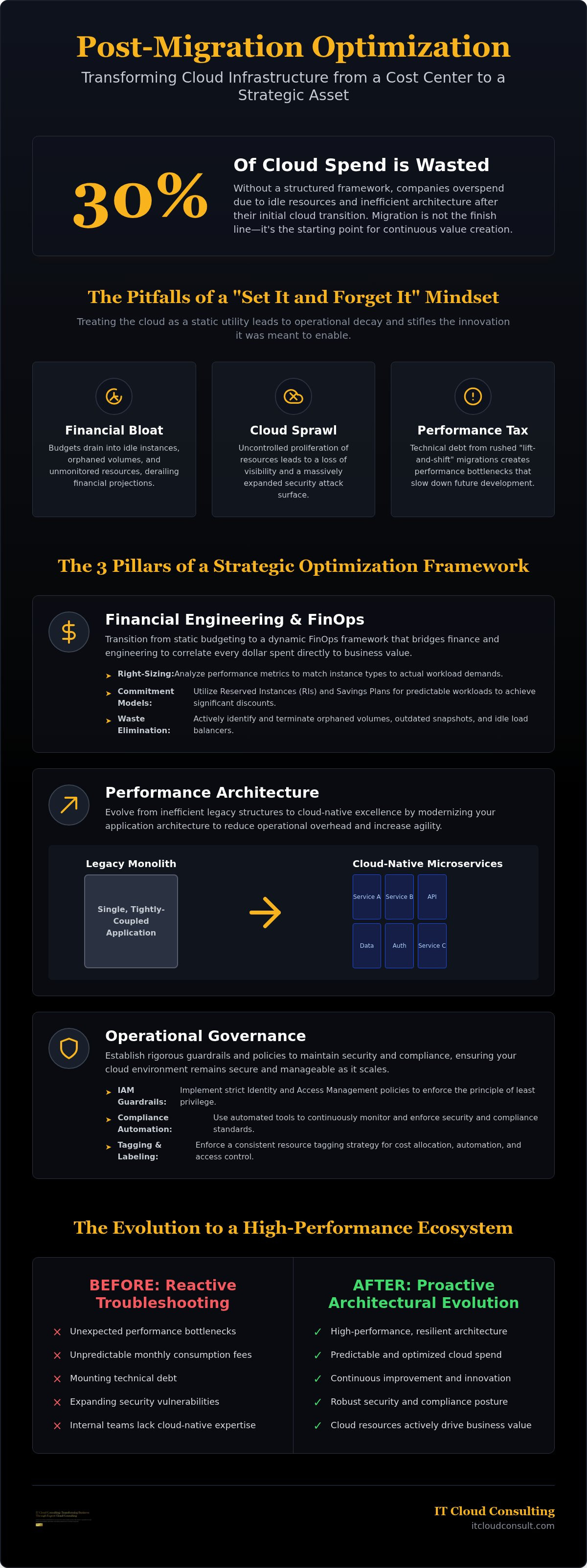
Without a well-structured framework, companies often overspend by up to 30% due to idle resources and inefficient architecture after their initial cloud transition. It's a frustrating reality when your successful deployment is met with monthly consumption fees that far exceed your initial projections. You likely expected the cloud to provide immediate agility and cost-savings, but instead, you're managing unexpected performance bottlenecks and complex native features that your internal team isn't yet equipped to handle. This disconnect highlights why a robust post-migration optimization strategy is no longer an optional cleanup phase; it's the defining factor of your long-term ROI.
We believe that your cloud journey should evolve from a mere destination into a high-performance ecosystem that actively drives business value. This guide provides a comprehensive framework to help you regain control over your architecture, positioning optimization as a necessary step in your Strategic Cloud Adoption roadmap. We'll explore how to bridge the expertise gap and use ongoing cloud support to maintain your gains. By following this strategic approach, you'll transition from reactive troubleshooting to a proactive state of continuous improvement, securing a competitive edge in the 2026 digital landscape.
Key Takeaways
- Understand why migration is a starting point rather than a destination, requiring continuous alignment between cloud resources and specific business requirements.
- Master cloud financial management through a disciplined FinOps approach, focusing on right-sizing instances to eliminate architectural waste.
- Transition from legacy monolithic structures to cloud-native excellence by leveraging microservices and managed services to reduce operational overhead.
- Establish rigorous operational governance and IAM guardrails to maintain security and compliance within complex cloud environments.
- Execute a comprehensive post-migration optimization strategy that utilizes managed support to shift from reactive troubleshooting to proactive architectural evolution.
The Post-Migration Reality: Moving Beyond Deployment to Strategic Value
Success in cloud computing isn't measured by the date you shut down your last on-premise server. True success is defined by what happens next. Optimization is the continuous, disciplined process of aligning your cloud resources with evolving business requirements through a comprehensive post-migration optimization strategy. Many organizations find that a "Lift and Shift" approach creates immediate friction. It often replicates inefficient on-premise habits in a high-cost environment, leading to performance lags and unexpected billing spikes that can derail your budget in the first quarter.
Transitioning to a mature post-migration optimization strategy requires focusing on three fundamental pillars: Cost, Performance, and Governance. Each pillar supports the others. You can't achieve high performance without efficient resource allocation, and you can't maintain cost control without strict governance guardrails. In 2026, the benchmark for success has shifted significantly. It's no longer enough to simply exist in the cloud. Forward-looking leaders must move from passive consumption to active, data-driven management to realize the latent potential of their digital investment.
Why the Migration Completion is Only the Beginning
The initial "honeymoon phase" of a migration often masks underlying structural issues. During the rush to meet deployment deadlines, teams frequently accumulate technical debt by prioritizing migration speed over architectural elegance. This debt creates a "performance tax" that slows down future development and increases the complexity of every update. Viewing optimization as a mandatory, ongoing phase within your strategic cloud adoption roadmap ensures that your deployment doesn't become a stagnant legacy system in a new location. It's about evolving your infrastructure to meet the demands of a modern workload.
The Consequences of a "Set It and Forget It" Mentality
Treating the cloud like a static utility is a recipe for operational decay and financial bloat. Without constant oversight, your environment becomes susceptible to security vulnerabilities and massive resource wastage. This neglect stifles the very innovation that the cloud was intended to provide. Cloud Sprawl is the uncontrolled proliferation of unmonitored cloud resources. When sprawl takes root, your budget drains into idle instances while your team loses visibility into the total attack surface. You're left paying for capacity you aren't using while your developers struggle with bottlenecks that shouldn't exist in a cloud-native world.
Financial Engineering: Implementing a Comprehensive Cloud FinOps Strategy
Right-sizing is the technical foundation of this effort. It involves analyzing performance metrics to match instance types and sizes to actual workload demands. Many organizations default to over-provisioned resources during migration to ensure stability. However, long-term efficiency requires shifting these workloads to Reserved Instances (RIs) or Savings Plans. These commitment models offer significant discounts for predictable, steady-state workloads, providing a level of financial stability that on-demand pricing cannot match. Balancing these commitments with on-demand flexibility is key to a resilient post-migration optimization strategy.
Identifying and Eliminating Cloud Waste
Identifying waste is the most immediate way to improve ROI. Orphaned volumes, snapshots from long-deleted instances, and idle load balancers frequently inflate bills without providing utility. Implementing automated scheduling for non-production environments ensures that development and testing resources only run during business hours, preventing unnecessary weekend or overnight charges. Engaging in cloud optimization consulting can help your team uncover these hidden cost drivers through deep-tier architectural audits that internal teams might overlook.
Advanced Cost Allocation and Visibility
Accountability is impossible without granular visibility. By implementing a sophisticated tagging strategy, you can map every line item on your cloud invoice to specific business units, projects, or individual owners. This visibility prevents the "bill shock" that often occurs at the end of a fiscal month. Utilizing real-time dashboards allows teams to monitor consumption as it happens, fostering a "Cloud Cost Center" mentality where engineers take ownership of the financial impact of their architectural choices. For organizations looking to refine these processes, our experts at IT Cloud Consulting provide the framework needed to balance high-performance architecture with fiscal responsibility.
Performance Architecture: Transitioning to Cloud-Native Excellence
Many organizations complete their initial migration only to realize their applications are merely "running in the cloud" rather than being "built for the cloud." Legacy monoliths often struggle to scale efficiently in a dynamic environment, leading to performance bottlenecks that didn't exist on-premise. A high-impact post-migration optimization strategy must address this gap by facilitating a transition toward cloud-native excellence. Moving from virtual machines to microservices or serverless functions allows for granular scaling, where only the specific components under load consume resources, drastically improving both responsiveness and cost-efficiency.
Leveraging managed services is a critical component of this evolution. Managed services like Database-as-a-Service (DBaaS) and message queues eliminate the operational burden of patching, backing up, and scaling underlying infrastructure. This shift allows your internal talent to focus on high-value feature delivery rather than routine maintenance. To ensure global performance, organizations should implement advanced caching and Content Delivery Network (CDN) strategies that move data closer to the user. When combined with intelligent load balancing, these tools provide high availability and architectural resilience without the financial waste of over-provisioning standby capacity.
Refactoring vs. Replatforming for Performance
Deciding between refactoring and replatforming depends on your long-term business goals and current technical debt. Replatforming offers a middle ground, allowing you to move to managed services with minimal code changes. Refactoring, while more intensive, involves redesigning application components to fully utilize cloud-native features like auto-scaling and event-driven triggers. This process often includes optimizing storage tiering to balance application latency with storage costs. For organizations unsure of the best path forward, engaging in cloud infrastructure consulting provides the deep architectural reviews necessary to identify high-impact modernization opportunities.
Automating the Performance Lifecycle
Consistency is the hallmark of a mature post-migration optimization strategy. By implementing Infrastructure as Code (IaC), you ensure that every environment, from development to production, performs identically and adheres to established benchmarks. Integrating automated performance testing directly into your CI/CD pipeline prevents regressions from reaching production, while AI-driven observability tools provide real-time insights. these tools proactively identify bottlenecks before they impact the end-user experience, transforming your operations from reactive fire-fighting to a state of continuous, automated improvement.
Operational Governance: Establishing Guardrails for Security and Compliance
Cloud governance serves as the strategic framework that ensures your infrastructure remains secure, compliant, and cost-effective as it scales. It's a collection of automated policies and organizational rules designed to manage cloud operations without stifling agility. A mature post-migration optimization strategy integrates governance into the very fabric of the deployment, moving away from manual oversight toward codified guardrails. This shift is essential for organizations that have moved beyond the initial migration phase and are now focused on long-term resilience and risk mitigation.
A critical component of this framework is the Shared Responsibility Model. While your cloud provider secures the underlying physical infrastructure, you remain responsible for securing everything within the cloud, including data, applications, and configurations. Identity and Access Management (IAM) represents the first line of defense in this model. By enforcing the principle of least privilege, you ensure that users and services have only the minimum access required to perform their functions. This reduces the blast radius of potential compromises and ensures that your environment remains manageable as complexity grows.
Securing the Modernized Perimeter
Transitioning to the cloud requires a fundamental shift in security philosophy. Traditional firewalls are no longer sufficient in a decentralized environment; instead, organizations must adopt a zero-trust architecture. This approach operates on the principle of "never trust, always verify," requiring explicit authentication for every session and workload regardless of its location. Regular, automated security audits are necessary to maintain this posture, ensuring that configurations haven't drifted from their intended state. For a detailed roadmap on evaluating your current defenses, consult our cloud security assessment checklist.
Policy Enforcement and Compliance Automation
Policy engines allow you to prevent non-compliant resource deployment before it occurs. By codifying your governance rules, you can automatically block the creation of unencrypted databases or public-facing storage buckets. This level of automation is transformative for regulated industries where continuous compliance monitoring is a legal necessity. Some industry professionals report that automated governance can reduce human error in configurations by approximately 40%, significantly lowering the risk of data breaches. To implement these guardrails effectively, our team at IT Cloud Consulting provides the strategic oversight needed to balance strict compliance with operational velocity.
Strategic Evolution: The Role of Managed Cloud Support in Long-Term Success
The final stage of a mature post-migration optimization strategy is the transition from initial stabilization to continuous strategic evolution. Many organizations find that while they can successfully deploy to the cloud, maintaining peak efficiency requires a level of specialized knowledge that's difficult to sustain internally. Managed cloud services bridge this gap by providing access to senior architects and engineers who specialize in the nuances of modern infrastructure. This partnership allows your business to move beyond simple troubleshooting and begin focusing on the high-level innovations that drive market differentiation.
Proactive system evolution is the key to maintaining a competitive edge as digital landscapes shift. It involves regular architecture reviews to ensure your stack remains aligned with the latest releases and feature sets from cloud providers. IT Cloud Consulting acts as a strategic partner in this process, connecting technical execution with your broader organizational vision. We don't just keep the lights on; we ensure your infrastructure is always moving toward a more optimized and advanced future state, turning technical debt into architectural equity.
Accessing Specialized Cloud Expertise
Maintaining deep expertise across AWS, Azure, and Google Cloud simultaneously is an expensive and often impractical goal for most internal IT departments. Managed support functions as a seamless extension of your team, bringing a wealth of cross-platform experience to your specific environment. This collaboration often centers on a "Cloud Center of Excellence" (CCoE) model, where best practices are standardized and disseminated across the entire organization. This model ensures that every new project benefits from the optimization gains achieved in previous phases, creating a virtuous cycle of institutional efficiency.
Continuous Modernization: Staying Ahead of the Curve
Optimization is a journey, not a destination. As we look toward 2026, the arrival of emerging technologies like Agentic AI and hyper-automation will redefine what it means to be cloud-native. A forward-looking post-migration optimization strategy must be flexible enough to incorporate these advancements as they mature. Staying ahead of the curve requires constant vigilance and a willingness to pivot when new, more efficient methodologies emerge. We invite you to contact our team today for a comprehensive cloud assessment to determine where your current architecture stands and how we can help you realize its full potential through expert Ongoing Cloud Support.
Realizing the Latent Potential of Your Cloud Investment
The transition from a successful deployment to a high-performance ecosystem depends entirely on your commitment to continuous refinement. Evolution is mandatory. By embracing a disciplined FinOps framework and evolving toward cloud-native architectures, you transform your infrastructure from a static cost center into a dynamic engine for growth. Implementing a robust post-migration optimization strategy ensures that your organization remains agile and resilient, capable of navigating the complexities of the 2026 digital landscape with confidence. This journey requires a shift in mindset, where operational governance and performance engineering become core pillars of your organizational identity.
As Strategic Cloud Adoption specialists, we provide the authoritative architecture reviews and dedicated Managed Cloud Support necessary to bridge the gap between technical execution and strategic vision. Don't let your cloud journey stagnate after the initial migration phase. Instead, empower your team to focus on high-value innovation while we manage the complexities of your environment. Elevate your infrastructure with IT Cloud Consulting’s optimization experts. We're ready to help you realize the full potential of your cloud investment and secure a prosperous digital future.
Frequently Asked Questions
What is the most common mistake in a post-migration optimization strategy?
The most common mistake is treating the migration completion as a final destination rather than the beginning of an evolutionary phase. Many teams dissolve their project groups once the initial deployment is done, leading to unmonitored resource growth. Without a dedicated post-migration optimization strategy, businesses often replicate inefficient on-premise habits in the cloud, resulting in immediate cost spikes and performance bottlenecks that erase the expected ROI of the transition.
How soon after migration should we begin the optimization process?
You should ideally begin the optimization process within the first 30 to 60 days after your initial deployment. This window allows you to gather enough telemetry data to understand real-world usage patterns without letting inefficient resource allocations drain your budget for too long. Starting early prevents technical debt from hardening and ensures that your cloud environment remains aligned with your Strategic Cloud Adoption roadmap from the very outset.
What is the difference between right-sizing and right-scaling?
Right-sizing involves matching specific instance types and sizes to the actual performance requirements of a workload to eliminate architectural waste. In contrast, right-scaling focuses on adjusting the total capacity of your environment dynamically through auto-scaling groups and load balancers. While right-sizing is often a one-time adjustment based on historical data, right-scaling is a continuous operational process that responds to real-time fluctuations in user demand and traffic patterns.
Can we automate the majority of our cloud optimization tasks?
Yes, you can automate a significant portion of your cloud optimization tasks using Infrastructure as Code and AI-driven observability tools. Modern platforms allow for automated remediation of common misconfigurations and the scheduling of non-production environments to shut down during off-hours. However, strategic decisions regarding long-term architectural shifts still require expert human oversight to ensure that automated actions align with your broader business goals and performance requirements.
How does a post-migration strategy impact our security posture?
A robust post-migration optimization strategy strengthens your security posture by enforcing strict operational governance and identity management. By eliminating orphaned volumes and idle instances, you reduce the total attack surface available to potential threats. The transition toward zero-trust architectures and automated security audits ensures that your environment remains compliant with industry standards like SOC 2 or GDPR, even as your cloud footprint expands and evolves over time.
What KPIs should we use to measure the success of cloud optimization?
Success should be measured using a mix of financial and technical KPIs, including unit cost per transaction and average resource utilization rates. You should also monitor application latency and the percentage of cloud spend covered by commitment models like Reserved Instances. These metrics provide a clear picture of how efficiently your resources are being utilized and whether your efforts are delivering the predictable, reduced spend promised in your roadmap.
Is it better to refactor applications before or after migration?
While refactoring before migration can optimize performance immediately, it often increases the risk and duration of the initial deployment. Most organizations find success by replatforming first to gain immediate cloud benefits, then refactoring high-impact components as part of a continuous post-migration optimization strategy. This phased approach allows you to use the cost savings from initial optimizations to fund more complex architectural modernizations without disrupting your ongoing business operations.
How does FinOps differ from traditional IT budgeting?
FinOps differs from traditional IT budgeting by replacing static, annual cycles with a dynamic, real-time cultural discipline. Traditional budgeting often treats IT as a fixed cost center, whereas FinOps empowers engineering teams to take ownership of their spend through granular cost allocation and tagging. This shift moves the organization from reactive cost-cutting to a state where financial decisions are made based on the real-time business value of technology resources.


