
A cloud adoption roadmap should be more than a migration checklist. It should evolve as business priorities, cloud costs, and technology change. In 2026, AI is accelerating cloud investment while adding cost, security, and governance considerations, making a fixed plan harder to rely on. A practical cloud adoption roadmap template gives teams a shared structure for turning strategic goals into decisions and sequenced work.
If you're unsure which initiative should come first, how workloads depend on one another, or who owns progress, you're not alone. The challenge isn't simply choosing cloud technologies. It's connecting each change to a business outcome and defining how teams will manage risk, spending, and results along the way.
This guide shows you how to build and adapt a roadmap with fields for objectives, initiatives, dependencies, accountable owners, timelines, governance, and measurable outcomes. You'll also learn how to compare priorities, sequence foundational work, and revisit decisions as conditions change. The result is a living plan that supports cloud adoption, optimization, and sustained business value.
Key Takeaways
- Use a cloud adoption roadmap template to connect business outcomes with initiatives, owners, dependencies, and measures.
- Capture assumptions and decision points so estimates guide planning without becoming premature commitments.
- Compare initiatives by value, urgency, risk, dependencies, and team capacity. Treat scores as prompts for discussion.
- Clarify decision rights across business, technology, security, and operations so priorities become accountable delivery.
- Review the roadmap when priorities or assumptions shift, and preserve decision history to explain changes in direction.
Why a Cloud Adoption Roadmap Template Must Start with Business Outcomes
Cloud work can quickly become a list of platform choices, migrations, and technical upgrades. Without a clear business purpose, teams may complete those tasks without knowing whether they improved customer experience, strengthened resilience, or helped employees work more effectively. A cloud adoption roadmap template starts by naming the outcomes that matter, then connects them to initiatives, accountable owners, dependencies, timing, and measures of progress.
A cloud adoption roadmap is a prioritized, revisable plan that connects business outcomes to the cloud changes needed to achieve them. It gives business and technology teams a shared basis for deciding what to do, why it matters, and what must happen first. Stakeholders can see where initiatives depend on one another, where capacity is constrained, and which decisions need attention before work proceeds.
What a cloud adoption roadmap template helps teams decide
The template helps teams turn an outcome, such as improving service availability, into defined work, ownership, and a way to assess progress. Its fields should reflect the organization’s environment, capabilities, constraints, and priorities, rather than assume every company follows the same cloud sequence. Understanding cloud computing models can help frame choices, while a broader strategic cloud adoption guide can provide context for setting direction.
Start with the outcome, not the technology. For example, if the goal is to help teams release customer-facing changes more reliably, possible initiatives might include reviewing application dependencies, improving deployment processes, or strengthening operational practices. Record the intended result and the assumptions behind the proposed work, then adjust the plan if discovery reveals new constraints.
Roadmap, migration plan, and cloud strategy: how they differ
These planning artifacts serve different purposes. Strategy sets direction by defining why the organization is adopting or evolving its cloud environment. The roadmap prioritizes change, showing which initiatives advance that direction and how they relate. A migration plan details execution for moving specific workloads, including the activities and sequence needed to complete that work.
A roadmap also differs from an architecture diagram. A diagram shows components and how they connect, but generally doesn’t explain business priority, ownership, timing, or success measures. Migration may be one roadmap initiative, but the plan can also include modernization, governance, skills development, and changes to how teams operate. This broader view prevents “move it” from becoming the only definition of progress. For example, organizations modernizing essential workplace infrastructure such as office phone and VoIP systems can reference specialist providers like nexgen.com.au to understand how cloud telephony fits into a phased transition.
- Strategy: What business direction should cloud support?
- Roadmap: Which changes come first, and why?
- Migration plan: How will a specific workload move?
Treat the roadmap as a decision tool, not a promise that every assumption will hold. Record why initiatives matter and what they depend on, then revisit those choices as evidence or business priorities change. This keeps technical activity connected to measurable organizational value.
What to Include in a Cloud Adoption Roadmap Template
A useful cloud adoption roadmap template turns broad goals into initiatives people can understand, own, and review. Keep each entry concise enough to scan but specific enough to guide decisions. The fields below offer a reusable starting point. Tailor them to your organization’s priorities and planning process.
Roadmap fields that turn goals into initiatives
Use one row per initiative. For example, a business aiming to improve the reliability of a customer-facing service might assess its recovery approach.
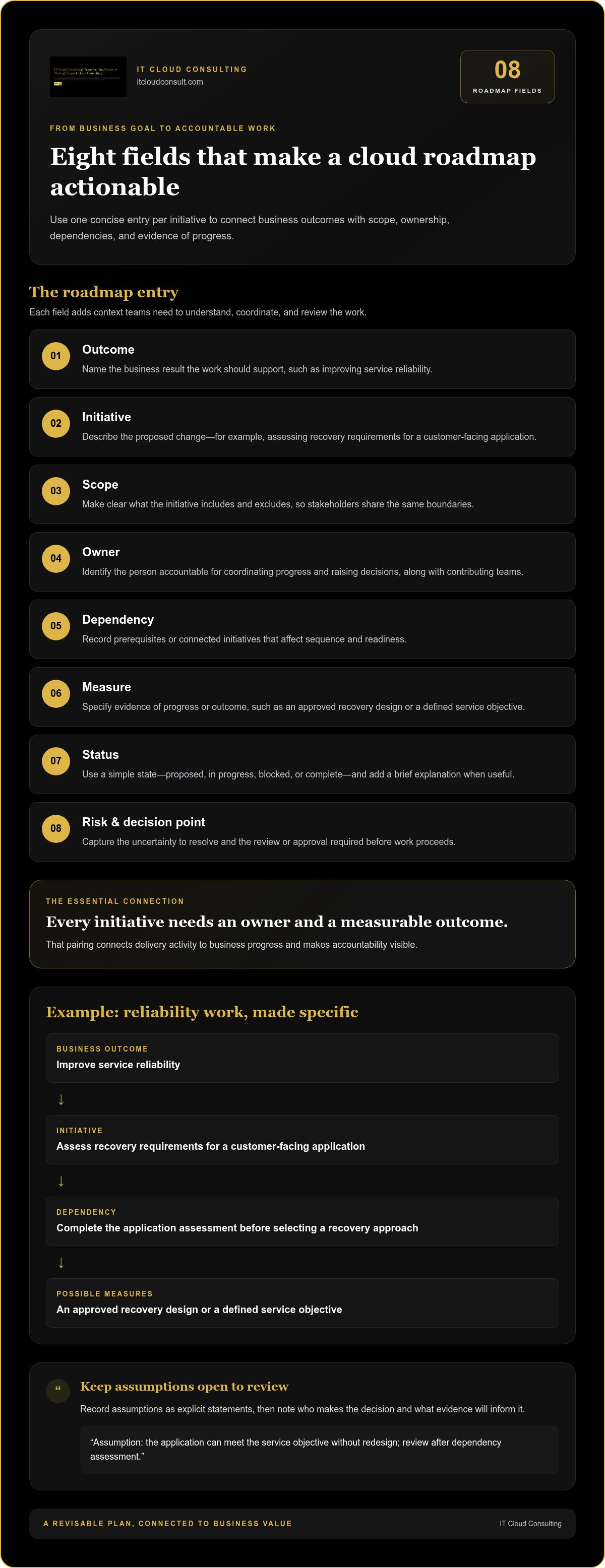
- Outcome: The business result the work should support, such as improving service reliability.
- Initiative: The proposed change, such as assessing recovery requirements for a customer-facing application.
- Scope: What the initiative includes and excludes, so stakeholders share the same boundaries.
- Owner: The person accountable for coordinating progress and raising decisions. Identify contributing teams as well.
- Dependency: A prerequisite or connected initiative, such as completing an application assessment before selecting a recovery approach.
- Measure: Evidence of progress or outcome, such as an approved recovery design or a defined service objective.
- Status: A simple state such as proposed, in progress, blocked, or complete, with a brief explanation when useful.
- Risk and decision point: The uncertainty to resolve and the review or approval needed before proceeding.
Every roadmap initiative needs an accountable owner and a measurable outcome, so teams can connect delivery activity to business progress. Capture assumptions as explicit, dated statements rather than settled facts. For example: “Assumption: the application can meet the service objective without redesign; review after dependency assessment.” Then record the decision that follows, who makes it, and what evidence will inform it.
How to set a useful roadmap horizon and level of detail
Choose a planning horizon that matches business priorities and the cadence at which leaders revisit investment decisions. A fast-changing initiative may need frequent reviews, while longer-term direction can remain visible at a higher level. There’s no universal duration that suits every organization. Keep strategic milestones on the roadmap; put configuration steps, testing tasks, and deployment checklists in delivery plans.
This distinction keeps the roadmap useful for decision-makers without turning it into a second project tracker. A milestone might be “validate workload dependencies” or “approve the target operating approach.” A delivery plan can break that milestone into assigned tasks and technical detail. If an estimate is uncertain, label it as an assumption, set a review point, and avoid presenting it as a fixed commitment.
Before sharing the roadmap, check that each initiative names its business outcome and affected stakeholders, and that dependencies and decision gates are visible. When priorities conflict or technical assumptions are difficult to validate, tailored cloud roadmap guidance can connect planning with the organization’s current environment.
How to Prioritize Cloud Initiatives Without Losing Strategic Focus
Prioritization is not a contest to identify the most attractive technology project. It helps teams decide which initiatives best advance business outcomes, what must happen first, and what the organization can realistically support. A consistent decision matrix makes trade-offs visible, so urgent work doesn’t automatically displace valuable foundational changes.
Compare initiatives using transparent decision criteria
Assess each proposed initiative against the same criteria. Use a simple label such as high, medium, or low, and add a short note explaining the judgment. Consider business value separately from technical feasibility: an initiative can be strategically important while still requiring substantial preparation. Evidence might include a documented business objective, a known deadline, a dependency assessment, risk findings, or confirmation that the right teams have capacity.
- Business value: How directly does the initiative support a stated business outcome? Use agreed objectives and input from affected stakeholders.
- Urgency: Is there a time-sensitive business need or decision? Record the reason rather than relying on a general claim that work is urgent.
- Dependencies: What must be available or completed first? Reference the related initiative, platform, data, or approval.
- Risk: What operational, security, or delivery uncertainties could affect the outcome? Note known concerns and what evidence could reduce uncertainty.
- Organizational capacity: Can the required teams take on the work alongside existing commitments? Confirm availability and relevant skills.
For an illustrative comparison, a reliability improvement might receive “high” business value but “medium” readiness if a dependency assessment remains open. A cost-efficiency initiative might be “medium” in urgency yet easier to begin because its scope is clearer. These labels prompt discussion; they are not guaranteed scores. If efficiency is a key criterion, a cloud optimization consulting guide can add context to the trade-offs.
Map dependencies before deciding what comes first
Before assigning milestones, identify shared dependencies at a high level: platforms, data access, security decisions, skills, and stakeholder approvals. An initiative may appear ready but rely on a platform decision or data assessment that hasn’t happened. Mapping these connections helps distinguish work that can proceed in parallel from work that needs a prerequisite, without assuming one cloud architecture or sequence fits every organization.
Use the matrix alongside a dependency map, then discuss exceptions openly. A lower-priority foundational initiative may need to come first if higher-value work depends on it. An unresolved assumption may instead justify a discovery milestone before the organization commits to a larger delivery date. Preserve the rationale so teams can understand why the order was chosen and revisit it when conditions change. For broader context, the enterprise cloud transformation roadmap connects initiative sequencing to organizational change.
As you refine the cloud adoption roadmap template, avoid collapsing all criteria into a single score that conceals uncertainty. Make the reasoning inspectable: identify who supplied the evidence, what remains unknown, and which decision could alter the sequence. This helps leaders protect strategic priorities while keeping the plan grounded in actual constraints.
How to Turn the Roadmap Template into an Accountable Delivery Plan
A prioritized roadmap becomes actionable when each initiative has a clear decision path, accountable people, and evidence of progress. The aim isn’t to turn the roadmap into a task tracker. It’s to give teams enough structure to move from agreed priorities to approved milestones while keeping business outcomes in view.
Use this sequence to prepare each initiative for delivery:
- Validate the priority. Confirm the intended outcome, why it matters now, and any trade-offs with other work.
- Assign ownership. Name an accountable business sponsor and an initiative owner who coordinates progress and escalates blockers.
- Record dependencies and risks. Identify prerequisite decisions, shared capabilities, and uncertainties that could affect timing or scope.
- Define a suitable measure. Select evidence that shows progress toward the initiative’s specific purpose.
- Approve milestones. Agree on decision points, milestone assumptions, and who has authority to revise them.
Assign ownership and decision rights
The business sponsor connects the initiative to its intended value and helps resolve priority questions. The initiative owner coordinates the work and reports changes, but shouldn’t be assumed to hold every approval right. Technology, security, finance, and operations stakeholders contribute the expertise needed to assess feasibility, risk, resource implications, and operational readiness.
Make decision rights explicit. Record who approves scope changes, who can reorder priorities, and who can revise milestone assumptions. For example, a technology lead may assess a proposed technical change, while the sponsor approves a material shift in business scope. The right arrangement depends on the organization. What matters is that teams know where decisions belong before a blocker arises.
Track milestones, outcomes, and material risks
Pair each milestone with an outcome measure that reflects its purpose. A resilience initiative might track whether an agreed recovery approach has been validated; an efficiency initiative could measure a defined performance or cost-efficiency objective. These are examples, not universal KPIs. Choose measures with the people affected by the initiative, and distinguish completed activity from evidence that the intended result is emerging.
At agreed decision points, review the assumptions, dependencies, risks, and evidence behind the next milestone. If a security review could change sequencing or scope, make that gate visible; a cloud security assessment checklist can help structure the discussion. Keep detailed workload migration procedures in their delivery plans. The roadmap should show the decision and milestone, not every technical execution step.
A cloud adoption roadmap template supports accountability when it makes ownership and decision-making visible without pretending uncertain dates or estimates are fixed. Strategic cloud planning support can help align cloud priorities with delivery.
Keep the Cloud Adoption Roadmap Current, and Know When to Seek Guidance
A roadmap should change when the conditions behind its priorities change. Treat review as part of managing the plan, not as evidence that the original decisions failed. Compare current evidence with the assumptions and business needs that shaped each initiative. This helps distinguish a material change in direction from ordinary delivery variation, such as a task taking longer than expected while its purpose and dependencies remain unchanged.
Set review triggers that keep priorities relevant
Review the roadmap when business objectives shift, a material risk emerges, a key dependency changes, or new evidence challenges an important assumption. The initiative owner can flag the change, while the appropriate decision-makers determine whether it affects scope, sequencing, or milestones. Assign responsibility for maintaining the roadmap and recording updates so it remains a working management tool rather than a document that becomes outdated after approval.
At each review, compare the latest progress evidence with the initiative’s intended outcome. A missed delivery estimate alone may call for adjusting a milestone, not changing strategic priority. A shift in business need or a dependency that blocks several initiatives may justify reordering work. Define review triggers in advance and apply them consistently to avoid reacting to every minor fluctuation.
Preserve decision history and rationale
Record what changed, when the decision was made, who approved it, and why. Include the previous and updated priority or sequence, along with the evidence or assumption that prompted the change. This history helps teams understand the reasoning behind current plans, prevents earlier debates from restarting without new information, and gives new stakeholders context when they join the work.
Decision history also makes it easier to learn from planning assumptions. If a dependency repeatedly takes longer to resolve than expected, the team can account for that in future sequencing. Keep the record concise and connected to the relevant roadmap item. It should explain significant decisions, not duplicate day-to-day delivery notes or technical task updates.
Where cloud consulting can support the roadmap journey
Internal teams may need additional perspective when business goals are difficult to translate into priorities, dependencies are unclear, or available capacity limits execution. Strategic guidance and roadmap development can tailor a plan to the organization’s goals and current environment. As work proceeds, implementation support and ongoing cloud management provide continuity beyond planning, while cloud optimization can address performance and cost-efficiency as needs evolve.
Use a cloud adoption roadmap template as a structure for decisions, not a fixed forecast. Keep ownership clear, revisit meaningful changes, and preserve the rationale behind the plan so it can adapt without losing strategic direction.
IT Cloud Consulting provides strategic planning and roadmap development, with implementation support and ongoing cloud management. Explore cloud consulting and strategic adoption support to shape a cloud plan around your goals.
Make Your Next Cloud Decision Count
The value of a cloud plan comes from the decisions it helps your organization make next. Choose one initiative that can move forward, confirm what evidence will show progress, and use what the team learns to refine the path ahead. That first step turns planning into momentum without treating the roadmap as fixed.
Keep your cloud adoption roadmap template connected to the outcomes your organization values, and let new evidence inform future choices. As priorities and conditions evolve, the roadmap can evolve with them, helping cloud investment remain purposeful rather than becoming a series of disconnected projects.
IT Cloud Consulting provides strategic planning and roadmap development, implementation support, and ongoing cloud management. Explore strategic cloud adoption support to take the next step toward a cloud plan shaped around your goals.
Frequently Asked Questions
Is a cloud adoption roadmap the same as a cloud migration plan?
No. A roadmap coordinates cloud-related change across an organization, while a migration plan addresses the execution of specific workload moves or transformations. For example, a roadmap might sequence several application changes around a shared business objective, with an individual migration plan detailing the steps for one application. Keeping these documents connected but distinct helps leaders track strategic progress without using the roadmap as a technical runbook.
How long should a cloud adoption roadmap cover?
There’s no fixed duration that works for every organization. Set the horizon according to business planning cycles and how often decision-makers can reassess priorities. In a cloud adoption roadmap template, near-term work can include clearer milestones, while later items remain directional until more is known. If a key dependency changes or an assumption proves wrong, revise the affected plans rather than retaining dates that no longer reflect reality.
Can one cloud adoption roadmap cover multiple cloud platforms?
Yes. A single roadmap can coordinate initiatives across platforms, provided it distinguishes shared work from platform-specific decisions. For example, an organization might track a common identity initiative alongside separate application modernization efforts. Keep platform responsibilities and operational differences visible instead of assuming every environment follows identical standards. Architecture documentation and delivery plans can hold the technical detail, while the roadmap helps stakeholders understand how the efforts relate to business priorities.
How do you prioritize cloud initiatives when information is incomplete?
Compare initiatives using the same decision criteria, then document where evidence is weak or missing. For example, if a proposed optimization depends on usage data that hasn’t been reviewed, mark the estimate as provisional and assign an owner to investigate. Decision-makers can then decide whether to fund discovery, proceed with a limited step, or defer the initiative. Revisit the ranking when new evidence arrives instead of treating an early assessment as a forecast.
Can an organization create a cloud adoption roadmap after moving workloads to the cloud?
Yes. A roadmap can start from an existing cloud environment rather than a planned migration. Begin with a current-state review: list active initiatives, operational concerns, and commitments already made. Then identify what the organization needs next, such as improving performance, reviewing governance, or supporting new business requirements. This prevents the plan from overlooking ongoing work and helps teams direct attention toward improvements that matter from their actual starting point.
What should a cloud adoption roadmap measure?
Measure whether each initiative is producing evidence relevant to its purpose. For a user-facing improvement, teams might examine feedback or service performance; for an operational initiative, they could track whether a new process is being adopted. Record the measure’s source and review cadence so stakeholders interpret results consistently. If a baseline isn’t available yet, make establishing one an early activity rather than presenting an unsupported target as a reliable benchmark.


