
What if the security controls you add to reduce cloud risk create new problems for the applications your business depends on? Choosing cloud network security services means matching coverage to your cloud architecture, operating needs, and business goals. That can be difficult when responsibilities for configuration and traffic are unclear, or when advisory, implementation, and ongoing support seem hard to compare.
The challenge is real: cloud providers secure the underlying infrastructure, while organizations remain responsible for areas such as their data, configurations, and access. A well-planned approach makes those responsibilities clearer and helps align security improvements with how your environment works.
This guide explains what cloud network security services can cover, how to compare service models against your risks and operational requirements, and how to plan a practical path from assessment to ongoing improvement. You’ll also see how strategic guidance, implementation support, and active cloud management can contribute to a secure, optimized environment that evolves with your business.
Key Takeaways
- Define the scope of cloud network security services by separating network protections from application, identity, endpoint, and data security.
- Assess architecture, access boundaries, traffic controls, and operational visibility to identify which capabilities fit your environment.
- Compare assessment-led consulting, implementation support, and ongoing assistance by ownership, client involvement, and operating cadence.
- Prepare for security changes by mapping cloud accounts, connections, critical workloads, and business dependencies before prioritizing risks.
- Align security improvements with your cloud architecture and long-term goals through strategic planning, implementation support, and ongoing management.
What Cloud Network Security Services Cover, and Why Scope Matters
Cloud network security services bring together the expertise and controls used to protect how cloud environments connect, communicate, and exchange traffic. Depending on the environment, this work can include reviewing network architecture, defining access boundaries, controlling traffic paths, and improving visibility into network activity. Cloud network security connects deliberate traffic and access controls with secure, reliable cloud operations.
Cloud adoption also changes how teams manage configurations and ownership. An organization may operate workloads across multiple accounts, environments, or service models, while different teams manage infrastructure, applications, and access. Without clear responsibilities, a network rule can remain broader than intended, or a connection can go unnoticed as the environment changes. A useful starting point is the foundational overview of Cloud Computing Security, which places network controls within the wider context of cloud protection and shared responsibility.
Which cloud network risks should a business evaluate?
Assess whether access rules allow more connectivity than workloads need, whether configurations expose resources unintentionally, and whether network boundaries separate systems with different purposes or sensitivities. Uncontrolled paths between workloads or environments can allow activity to move beyond its intended area. Visibility matters, too: teams need enough information about network activity to investigate unusual events, understand which connections are affected, and support operational continuity. Reviewing these risks together helps reveal where controls, documentation, or ownership need attention.
Where network security fits in the cloud responsibility model
Cloud providers and customers have distinct security responsibilities. Providers secure the underlying infrastructure, while customers remain responsible for areas such as their data, configurations, and access. The precise division varies with the cloud service model and the choices made when configuring an environment, so map responsibilities to actual workloads and operating practices. Moving a workload to the cloud doesn’t automatically secure its network design. Teams still need to understand which connections are required, who manages the related settings, and how changes are reviewed.
Clear scope turns these questions into practical decisions. Before selecting capabilities, identify the network environments in use, the systems they connect, and the teams accountable for changing and monitoring them. That foundation helps organizations distinguish network work from adjacent security needs, reduce unnecessary complexity, and align cloud improvements with business operations rather than treating security as a separate layer.
Which Cloud Network Security Capabilities Should a Service Include?
A useful capability review looks beyond whether a security tool is present. Ask whether the network design supports the organization’s workloads, whether permitted connections are intentional, and whether teams can see and review changes over time. Cloud network security services should connect architecture decisions with practical controls, so protection supports business operations instead of adding rules that are difficult to maintain.
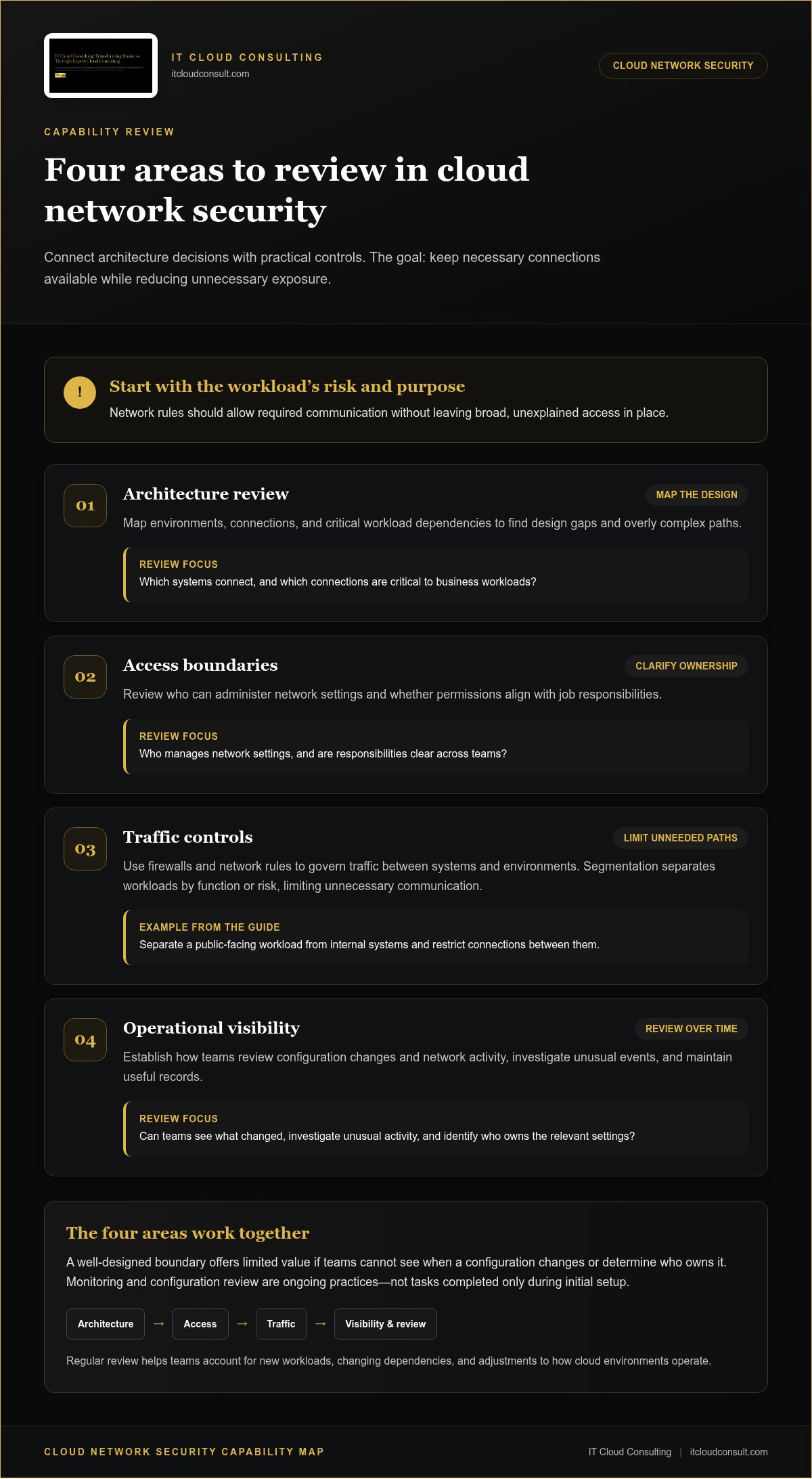
Network controls should reflect each workload’s risk and business purpose, keeping necessary connections available while reducing unnecessary exposure. Use that principle to assess four areas:
- Architecture review: Map environments, connections, and critical workload dependencies to identify design gaps and overly complex paths.
- Access boundaries: Review who can administer network settings and whether permissions align with job responsibilities.
- Traffic controls: Confirm that network rules permit required communication without leaving broad, unexplained access in place.
- Operational visibility: Establish how teams review configuration changes and network activity, investigate unusual events, and maintain useful records.
These areas depend on one another. A well-designed boundary offers limited value if teams can’t see when a configuration changes or determine who owns it. Monitoring and configuration review should therefore be ongoing practices, not tasks completed only during initial setup. Regular review helps teams account for new workloads, changing dependencies, and adjustments to how cloud environments operate.
Network controls, segmentation, and secure connectivity
Firewalls and network rules govern which traffic can pass between systems and environments. Segmentation organizes workloads into distinct areas by function or risk, limiting unnecessary communication. For instance, a business might separate a public-facing workload from internal systems and restrict connections to those required for its role. Secure connectivity also requires understanding how cloud environments communicate with existing business systems. Account for those dependencies when planning protections so that controls don’t create avoidable interruptions.
Access, visibility, and cloud-provider environments
Identity and access management affects who can create, approve, or change network controls. Clear administrative ownership helps prevent conflicting changes and makes reviews more useful. AWS, Microsoft Azure, and Google Cloud each have their own service structures and configuration approaches. Compare environments in terms of account or environment organization, connectivity patterns, access ownership, and visibility. Don’t assume a control maps identically across providers; validate implementation details against current documentation.
Monitoring should give teams enough context to relate network activity to workloads and configuration changes. Decide who reviews that information, how findings are escalated, and how changes are recorded. For an example of how a government cloud environment presents security and compliance considerations, explore cloud.gov: Government Cloud Security and Compliance. Strategic cloud adoption guidance can help connect these capability decisions to your existing architecture and broader cloud plans.
How to Compare Cloud Network Security Service Models
Cloud network security services can be delivered through strategic advice, hands-on implementation support, or continuing cloud management. The right model depends on what your internal team can own, where it needs additional expertise, and whether the work is a defined improvement or an ongoing operational responsibility. Compare the division of work, not just the service label.
Consulting, implementation support, or managed cloud support?
Consulting helps your team evaluate priorities and plan improvements. Implementation support translates agreed priorities into changes within the cloud environment, with responsibilities coordinated around internal decision-makers. Ongoing support provides continuing technical assistance and cloud management. These models can complement one another: an assessment may set direction, implementation can put changes into practice, and ongoing support can help maintain progress as needs evolve.
| Service model | Scope | Client involvement | Operating cadence | Suitable conditions |
|---|---|---|---|---|
| Assessment-led consulting | Reviews architecture and priorities, then develops recommendations or a roadmap. | Internal teams provide context, make decisions, and own agreed actions. | Defined around assessment and planning milestones. | The organization needs direction but can lead execution internally. |
| Implementation support | Helps translate agreed plans into cloud changes. | Internal owners coordinate decisions and work alongside implementation support. | Focused on planned change activities. | The organization has a clear priority but needs help moving it into practice. |
| Ongoing cloud support | Provides continuing technical assistance and cloud management. | Internal teams retain business oversight and coordinate responsibilities. | Continuing, with activities aligned to operational needs. | The environment or internal capacity calls for sustained support. |
How to judge fit without overbuying controls
Start with the complexity of your cloud environment, the capability of your internal team, and the operational impact of a security gap. Then document existing tools, controls, and owners. This prevents duplicated effort, such as adding another review process when a current one already works, while exposing gaps that existing tools don’t address. A Cloud Security Assessment Checklist can help structure that initial inventory and clarify what needs attention.
To compare proposals, translate broad assurances into specific responsibilities and outputs. Identify which environments are in scope, what work internal staff must complete, how progress is reviewed, and how unresolved issues are handled. A clear division of responsibility helps an external team extend internal capability rather than duplicate it.
- Match scope to need: Choose focused guidance for planning, implementation help for defined changes, or ongoing support when work continues beyond a project.
- Check ownership: Record who approves changes, manages existing controls, and follows up on findings.
- Define evidence of progress: Agree on concrete deliverables, such as a documented assessment, completed change plan, or regular management updates.
This comparison creates a proportionate path forward: address the most relevant needs first, build on useful internal capability, and expand support when the environment or operating model calls for it.
How to Prepare for Cloud Network Security Services
Preparation gives security work a clear starting point and helps teams make changes with business needs in view. Before engaging cloud network security services, build a shared picture of the environment, its critical workloads, and the people responsible for decisions. That context makes it easier to prioritize risks, plan changes around operational dependencies, and avoid overlooking systems that rely on existing network paths.
Build a useful picture of the current environment
Inventory cloud platforms, accounts, environments, and network connections, then map the business services and workloads that depend on them. Record who owns architecture, identity, cloud operations, and incident decisions. Include existing monitoring, policies, known configuration concerns, and any planned changes. This baseline helps teams distinguish current controls from gaps and gives everyone a common reference for planning.
- Document environments: List cloud platforms, accounts, production and development environments, and the connections between them.
- Identify critical workloads: Note which business services depend on each workload and what interruptions could affect.
- Clarify ownership: Assign internal owners for architecture, identity and access, operations, approvals, and incident decisions.
- Prioritize risks: Consider business impact, exposure, workload dependencies, and the feasibility of remediation.
- Plan changes: Define the intended outcome, implementation responsibilities, testing approach, and how teams will review results.
Set priorities and define operational expectations
Rank potential work by the consequences of a disruption, the exposure being addressed, dependencies on other systems, and the practicality of making a change. Then agree on how changes will be approved, when they can be introduced, who receives escalations, and what progress reporting should include. These expectations help internal stakeholders coordinate with implementation support and keep security work aligned with business operations.
Testing matters. Where practical, assess a proposed rule or configuration change in a lower-risk environment before applying it to a critical workload. Confirm that essential connections still function, document the result, and establish a rollback approach in case an unexpected dependency appears. Change management doesn’t eliminate disruption, but thoughtful sequencing and validation can reduce the chance that a security improvement interferes with business applications.
Teams preparing their internal planning can use a Cloud Security Assessment Checklist to organize findings and open questions. If architecture decisions need a broader review, the Cloud Infrastructure Consulting guide can help frame that planning. Use cloud planning guidance to organize security improvements around your environment, responsibilities, and business goals.
How IT Cloud Consulting Can Support Cloud Network Security
Security improvements are most effective when they fit the cloud environment they’re meant to protect. IT Cloud Consulting connects cloud strategy, infrastructure assessment, implementation support, and ongoing management, helping organizations align security priorities with existing architecture and business objectives. This approach makes security part of cloud operations rather than a separate set of changes that may conflict with them.
From cloud strategy to security-focused improvement
Roadmap development helps teams set priorities and sequence cloud changes according to business needs. An infrastructure assessment and optimization review can inform those decisions by clarifying how the environment is structured and where improvements fit. From there, implementation support helps translate agreed plans into action while keeping business and operational objectives in view. Teams can progress in stages, with a clear rationale for each improvement.
That alignment matters when a proposed security change could affect workload connectivity or day-to-day operations. Planning can account for the purpose of systems, their dependencies, and the organization’s broader cloud direction. Strategic guidance also helps connect individual improvements to longer-term goals, so decisions support a coherent cloud environment rather than adding complexity without a clear purpose.
When ongoing cloud support makes sense
Ongoing support can be useful when internal teams need continuing technical assistance, cloud management, or help maintaining oversight as environments evolve. Regular monitoring and operational attention can help teams notice changes, review the health of cloud operations, and keep security considerations integrated into everyday management. The focus is sustained support, not a one-time setup, with work tailored to an organization’s cloud journey.
For organizations weighing this model, a Managed Cloud Services buying guide can help frame questions around responsibilities, operating needs, and the level of ongoing assistance that fits. Clear expectations about ownership and how support connects with internal processes make it easier to work collaboratively and avoid overlapping effort.
A practical path may start with strategy and assessment, move into implementation support for agreed priorities, and continue with cloud management where the organization needs sustained assistance. The right mix depends on the environment, internal capacity, and business goals. IT Cloud Consulting brings these stages together through strategic cloud adoption, cloud optimization, and ongoing cloud support, helping organizations improve cloud operations while maintaining secure environments.
IT Cloud Consulting’s strategic cloud guidance and ongoing support can help shape a security improvement plan around your architecture and business priorities.
Turn Cloud Security Priorities Into a Practical Roadmap
Treat security as an evolving part of your cloud strategy, not a one-time project. As business priorities and cloud environments change, your approach can adapt too. A clear roadmap connects immediate improvements with longer-term goals and helps plan work in a way that fits your organization’s capacity.
IT Cloud Consulting can help shape that path through strategic planning and cloud roadmap development, infrastructure assessment and optimization, and ongoing technical assistance, monitoring, and management. With the right support model, cloud network security services can contribute to a well-managed environment while staying aligned with how your business operates.
Discuss a cloud strategy tailored to your business and take a considered next step toward a more secure, resilient cloud environment. Start with a plan that reflects your goals, then build on it as your organization’s needs evolve.
Frequently Asked Questions
What do cloud network security services typically include?
Cloud network security services commonly help organizations assess network design, review traffic permissions, and improve how teams manage cloud configurations. The exact scope depends on the environment and engagement. For example, a review might examine whether a development system has unnecessary access to a production database, then document a practical change. These services focus on network protections; they don’t replace application, identity, endpoint, or data security.
How do cloud network security services differ from cloud security consulting?
Cloud network security services focus on protecting network connections, boundaries, and traffic in cloud environments. Cloud security consulting is broader: it can help an organization set priorities, plan cloud improvements, or assess its overall approach. The work may overlap when a consultant advises on network risks, but consulting can also address strategic cloud adoption and optimization. Define the outcome first, then select the support that matches it.
Are cloud network security services necessary for a small business?
They can be valuable for a small business if cloud workloads handle important operations, connect to sensitive systems, or are managed by a team with limited capacity. The appropriate scope need not resemble that of a large enterprise. A focused review of key workloads and their connections may help clarify priorities. Base the decision on business impact, exposure, and available internal expertise rather than company size alone.
Can cloud network security services work across AWS, Azure, and Google Cloud?
Yes, a security approach can cover environments using AWS, Microsoft Azure, and Google Cloud, but planning must account for each environment’s architecture and configuration. Start with a shared view of workloads, business connections, and ownership, then document provider-specific differences that affect operations. This helps teams coordinate policies and responsibilities without assuming that settings or procedures transfer unchanged between platforms.
How much do cloud network security services cost?
There isn’t one fixed cost for this work. Scope, cloud complexity, the level of implementation assistance, and whether support is ongoing all affect the effort involved. A defined assessment differs from a broader program that includes planning, changes, and continued cloud management. To establish a useful scope, describe the environments involved, the outcomes you want, and the responsibilities your team expects to retain.
Who is responsible for cloud network security: the provider or the customer?
Both have responsibilities, but they cover different areas. Cloud providers secure the underlying infrastructure, while customers remain responsible for their data, configurations, and access. For example, a provider’s infrastructure protections don’t determine whether a customer’s workload is connected appropriately. Document who owns network decisions, configuration changes, and operational review so teams can address responsibilities clearly within their chosen cloud service model.
How often should a business review its cloud network security?
Review network security after meaningful changes, such as adding a workload, changing a connection, or reorganizing cloud ownership. Teams should also set a recurring review cadence that reflects the environment’s risk and rate of change; there isn’t a universal interval for every business. A change log and assigned reviewer can help ensure that permissions and configurations remain aligned with current business use.
What should a business prepare before engaging cloud network security support?
Prepare a current inventory of cloud accounts, environments, important workloads, and connections between systems. Include known concerns, existing policies or monitoring, and the internal owners responsible for decisions. A simple dependency map can reveal which business processes could be affected by a proposed change. Also outline priorities and approval expectations, so planning can begin with the context needed to shape a relevant scope.


