
Moving infrastructure to the cloud doesn’t automatically make it faster, easier to manage, or safer to change. Effective cloud infrastructure modernization starts with a practical question: which changes will improve performance and control without putting critical operations at unnecessary risk?
Legacy systems can limit scalability and slow new initiatives, while the path forward may feel difficult to define. Modernization isn’t a one-size-fits-all migration. The right sequence depends on your workloads, dependencies, operating priorities, and tolerance for disruption.
This guide explains how to assess your current environment, prioritize infrastructure changes, and compare modernization approaches and their trade-offs. You’ll also learn how to structure a phased plan, set measurable outcomes, and connect technical decisions to operational efficiency and organizational growth. A tailored roadmap, implementation support, and ongoing cloud management can help turn that plan into a sustainable path forward.
Key Takeaways
- Distinguish infrastructure modernization from simply moving workloads to the cloud by focusing on improvements to the foundation and how it’s operated.
- Use consistent infrastructure patterns and infrastructure as code to make deployment and environment management more repeatable.
- Choose a cloud infrastructure modernization approach based on workload needs, dependencies, and operational risk, not a single standard migration path.
- Build a phased roadmap that moves from assessment and prioritization to piloting, implementation, and review.
- Connect strategic guidance, infrastructure assessment, and optimization to a tailored modernization plan that supports operational efficiency and growth.
What cloud infrastructure modernization means, and when it matters
Cloud infrastructure modernization is the intentional improvement of the cloud foundation and the way teams operate it, rather than simply moving workloads into a cloud environment. Migration changes where a workload runs; modernization changes how its underlying resources are configured, managed, and aligned with operational needs. A move can be part of a modernization plan, but it isn’t modernization by itself.
This distinction matters because relocating an older system without addressing its constraints can preserve the same bottlenecks in a new environment. A focused assessment identifies which infrastructure elements affect performance, reliability, control, or the pace of change. For background on cloud service models and architecture, see Cloud computing.
Which layers belong to cloud infrastructure?
Infrastructure includes the resources and shared services that applications rely on:
- Compute provides processing capacity, such as virtual machines or other resources that run workloads.
- Storage holds application files, databases, backups, and other data.
- Networking connects resources and manages how they communicate with one another and with users.
- Identity determines which people and systems can access resources, and what they’re permitted to do.
- Shared platform services provide common capabilities that teams use across workloads, such as monitoring or deployment foundations.
These layers shape the conditions application teams work within. Inconsistent environments, for example, can make it harder to reproduce a problem or release a change predictably, even when application code stays the same. Modernizing infrastructure doesn’t require redesigning every application; it can focus on the shared foundation those applications depend on. Priorities vary by environment, workload dependencies, and operating constraints, so a pattern that suits one system may not suit another. When optimizing networking layers for distributed operations or external data workflows, teams often incorporate dedicated connectivity services like proxied.com to maintain fast, reliable routing across environments.
What signals that infrastructure needs modernization?
Look for recurring friction rather than a single incident. Repeated capacity constraints may limit growth or make demand harder to accommodate. Manual provisioning can slow delivery and create differences between environments. Unclear ownership can leave teams unsure who maintains a resource, approves a change, or responds when an issue occurs.
Other useful signals include inconsistent configurations and long waits for environments or access. These conditions can hinder delivery and make reliability harder to manage because teams spend time resolving avoidable variations instead of improving services. Record where the friction occurs, which workloads it affects, and what business process depends on them. This helps distinguish an isolated inconvenience from a pattern worth addressing.
A signal is a reason to investigate, not an instruction to redesign everything. Assess the affected layer, its dependencies, and the operational consequences of changing it. Cloud infrastructure modernization is most useful when each proposed change has a clear purpose, such as reducing recurring manual work or addressing a known scaling constraint. Keep the response proportionate, with a clear basis for deciding what to retain, adjust, or revisit later.
How cloud infrastructure modernization improves the operating foundation
A stronger operating foundation makes infrastructure changes more predictable. Consistent patterns for provisioning, access, network configuration, and monitoring help teams manage environments in similar ways. This reduces reliance on undocumented steps or individual memory and makes it easier to spot differences between environments and understand the effect of a proposed change.
Cloud infrastructure modernization can also connect day-to-day operations to business priorities. For example, a team that provisions a test environment through a documented, repeatable process may spend less time coordinating manual setup and more time validating a release. The benefit depends on designing patterns around actual workloads and responsibilities, rather than standardizing every system regardless of need.
Modernize provisioning with infrastructure as code
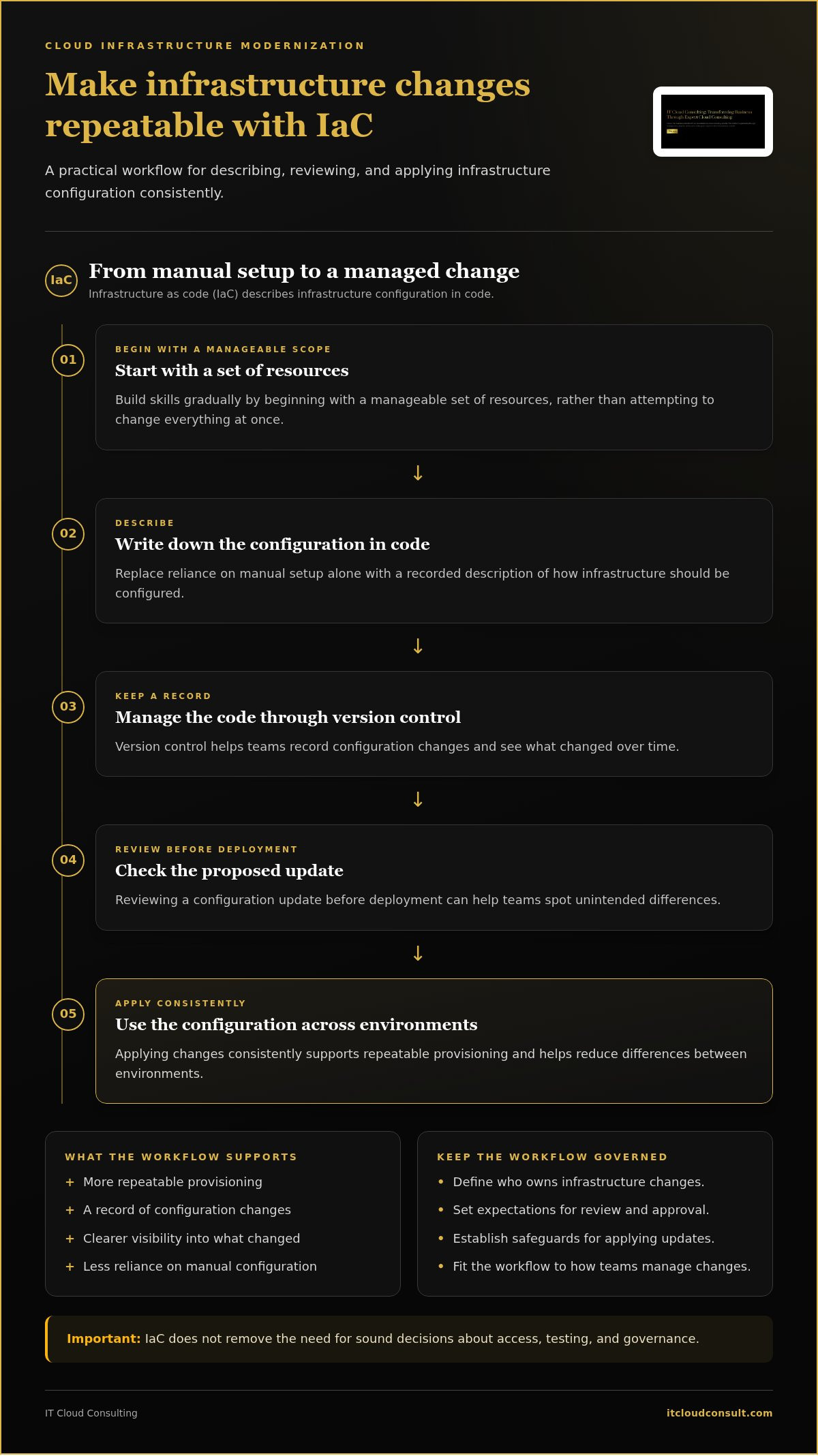
Infrastructure as code (IaC) means describing infrastructure configuration in code that teams can store and manage through version control. Rather than relying only on manual setup, teams can review, record, and apply a change consistently across environments. This supports repeatable provisioning and makes it easier to see what changed. For example, reviewing a configuration update before deployment can help teams spot unintended differences.
Adoption works best when the workflow fits how teams approve and manage changes. Define ownership, review expectations, and safeguards for applying updates, then build skills gradually by starting with a manageable set of resources. IaC can reduce manual configuration, but it doesn’t remove the need for sound decisions about access, testing, and governance.
Strengthen visibility, scalability, and operational control
Monitoring and observability help teams interpret system behavior through signals such as metrics, logs, and traces. These signals can help connect a change in response time or resource use to a workload or recent update, giving operators more context before they act. Visibility is most useful when teams know which signals matter, who reviews them, and how findings inform operational decisions.
Capacity design should reflect workload patterns and constraints. A workload with predictable demand may need different planning from one with pronounced peaks. Understanding those patterns helps inform how resources are sized and adjusted. Automation can carry out defined tasks, such as provisioning or routine configuration, while teams retain control over approvals and exceptions. Tools alone don’t ensure reliability, efficiency, or security; outcomes depend on appropriate configuration, ownership, and operating practices.
- Infrastructure as code makes configuration changes reviewable and repeatable.
- Observability gives teams context to investigate system behavior and choose a response.
- Workload-informed capacity planning aligns resources with demand instead of relying on assumptions.
- Defined governance establishes who can change infrastructure and how those changes are managed.
These practices work together, but they don’t need to arrive as a single overhaul. Assess where configuration varies, where operational visibility is limited, and which manual tasks create repeated friction. Then improve the parts of the foundation that matter most. For organizations shaping that plan, strategic cloud guidance can help connect infrastructure priorities with operational needs and support a measured path to implementation.
Which cloud infrastructure modernization approach fits each workload?
There’s no single modernization path that suits every workload. A stable system with known dependencies may need targeted improvements, while infrastructure that repeatedly blocks required scale or operational change may call for a broader redesign. Base the decision on the desired business outcome, scope of change, connected systems, and the disruption the organization can reasonably manage.
Compare options workload by workload. Retaining a component can be appropriate if it continues to meet requirements; replacing or redesigning it makes sense when its limitations create a material constraint. Use the table as a starting point for that assessment.
| Approach | Suitable conditions | Trade-offs | Decision question |
|---|---|---|---|
| Incremental improvement | The workload remains useful, and its dependencies make broad change difficult. | Limits immediate disruption, but may leave underlying constraints unresolved. | Can targeted changes address the specific operational or capacity issue? |
| Deeper infrastructure redesign | Existing patterns obstruct required scale, control, or operating changes. | Can address structural limitations, but increases scope and coordination needs. | Are the expected benefits worth the dependency and continuity risks? |
| Retain with limited intervention | The current foundation meets business and workload requirements. | Avoids unnecessary change, but requires periodic review as needs evolve. | Is there evidence that change would solve a defined problem? |
When incremental infrastructure changes make sense
Incremental work is often a sound choice when a workload still serves its purpose and its connections to other systems make change sensitive. Teams might automate a recurring provisioning task, standardize configuration across environments, or adjust capacity to better match observed demand. These changes can improve day-to-day operations without turning the project into a full redesign.
Set a clear measure before making the change. If the concern is slow provisioning, track whether the process becomes more timely and consistent. If the issue is a recurring capacity limit, assess whether the adjustment addresses it under relevant workload conditions. Without follow-up, small changes can accumulate without resolving the original business constraint.
When deeper redesign may be justified
Consider a broader redesign when current infrastructure patterns repeatedly obstruct a required operating model or future workload needs. Before expanding the scope, map dependencies, evaluate continuity requirements, and consider whether teams have the skills and capacity to operate the proposed foundation. A redesign can create a better fit, but it also adds components and decisions to coordinate.
Keep infrastructure scope distinct from application redevelopment. A workload may benefit from changes to its underlying environment while its application remains unchanged. Include application work only when the workload’s requirements make it necessary; otherwise, separating the decisions can keep the effort focused and easier to assess.
Use these criteria to guide the choice, then revisit it as requirements change. A workload-focused assessment and optimization can clarify where targeted adjustments are sufficient and where a deeper change merits planning. Cloud infrastructure assessment can support that decision with priorities grounded in the environment and its operational needs.
A phased roadmap for cloud infrastructure modernization
A useful roadmap turns modernization from a broad ambition into a sequence of decisions grounded in workload needs and operational readiness. Begin with an inventory of workloads, dependencies, operating constraints, and desired business outcomes. Use that evidence to decide what to change first, how to test it, and what results should guide the next implementation wave. For wider program planning, connect infrastructure sequencing to an enterprise cloud transformation roadmap.
- Assess the environment. Record what each workload supports, its infrastructure components, connected systems, operating requirements, and current support ownership. Note constraints such as sensitive change windows or dependencies that could affect continuity.
- Prioritize candidates. Compare business importance, dependency complexity, and the opportunity to improve performance or operations. Prioritize work with a clear purpose while accounting for the effort and risk of changing critical workloads.
- Pilot a bounded change. Select a manageable workload or infrastructure component to test the approach. Set boundaries, name owners, document dependencies and rollback considerations, and define how responsibilities will be handled during and after the change.
- Implement in waves. Use pilot findings to refine the sequence, then expand to workloads with relevant similarities. Preserve different paths where dependencies, requirements, or operating conditions call for them.
- Review and adapt. Compare results with the agreed baseline, capture lessons, and update priorities. Each review should inform whether to continue, adjust the approach, or pause before the next wave.
Prioritize workloads and plan a controlled pilot
Rank workloads by business importance, dependency complexity, and modernization opportunity rather than treating the inventory as a single migration queue. A bounded pilot can test assumptions about configuration, provisioning, or operational responsibilities without committing the wider environment to the same design. Before starting, document success criteria, accountable owners, dependencies, rollback considerations, and support responsibilities. Pilot findings should guide the next decisions, not force every workload down an identical path.
Measure results and govern each implementation wave
Set organization-specific baselines before changes begin. Useful measures may include provisioning consistency, operational effort, workload performance, and service reliability. Compare like with like: record the existing condition, define the intended result, and review the same measure after implementation. Avoid generic benchmarks that may not reflect the workload’s role or operating context.
Before expanding a successful pilot, review documentation, operational readiness, access controls, and support ownership. If the work changes security exposure or access practices, include a relevant cloud security assessment checklist in that review. Clear checkpoints help teams identify unresolved issues before extending the approach to additional workloads.
A structured assessment and tailored roadmap can turn priorities into manageable implementation waves. Plan your cloud modernization roadmap with strategic guidance and ongoing support aligned to your environment.
How IT Cloud Consulting can support sustainable modernization
Modernization needs more than technical changes. Teams must connect infrastructure decisions to organizational priorities, coordinate implementation, and sustain the resulting environment as needs evolve. IT Cloud Consulting provides strategic cloud guidance, infrastructure assessment and optimization, implementation support, and ongoing technical management. For a broader view of advisory considerations, explore this cloud infrastructure consulting guide.
This support helps organizations move from an identified constraint to a practical sequence of work. An assessment clarifies how existing infrastructure aligns with current objectives; roadmap development turns those findings into priorities teams can plan and manage. Recommendations are tailored to the organization’s environment and operating needs, rather than assuming every team should follow the same modernization pattern.
Turn modernization priorities into an actionable plan
A tailored assessment connects current infrastructure to the outcomes the organization is pursuing, such as supporting growth or reducing operational friction. It can help distinguish a specific configuration or capacity issue from a wider pattern that needs attention. A roadmap can then set priorities, identify dependencies, and sequence proposed changes so teams understand what needs to happen first and why.
Strategic cloud adoption planning provides a wider context for those choices by linking infrastructure direction to organizational objectives. This strategic cloud adoption guide offers related perspective for shaping that plan. The aim is a clear basis for action, with priorities that reflect the organization’s current environment, resources, and intended direction.
Sustain progress after implementation
A roadmap creates direction, while implementation support helps carry planned changes into operation. That transition involves more than completing a technical task: teams need to understand the updated environment, maintain clear operational responsibilities, and incorporate the change into ongoing work. Continued technical management supports maintenance and monitoring as workloads and business requirements develop. For teams deploying critical workloads on dedicated infrastructure, external hosting specialists such as snel.com offer managed server environments that reduce internal operational burden.
This continuity matters because modernization isn’t a one-time endpoint. Teams can revisit how infrastructure is operating, identify new optimization priorities, and adapt plans as needs shift. Strategic planning and ongoing support work together: one sets a considered direction, while the other helps maintain progress over time.
- Assess: Relate infrastructure conditions to business objectives.
- Plan: Establish tailored priorities and a sequence for change.
- Implement: Support planned updates as they enter operation.
- Sustain: Use ongoing management to maintain and refine the environment.
For organizations planning cloud infrastructure modernization, this advisory-to-operations approach keeps decisions connected to practical needs. Discuss your cloud modernization priorities and explore a path suited to your environment and goals.
Set your next modernization priority
Cloud infrastructure modernization is most valuable when it keeps pace with the organization it supports. As priorities shift, revisit whether the infrastructure still enables the work teams need to do. Base the next decision on current operational evidence rather than momentum alone. A clear next step can be modest: identify one infrastructure constraint, define what a better outcome would look like, and decide what information is needed to act responsibly.
IT Cloud Consulting can help shape a roadmap around your organization’s needs, assess and optimize existing infrastructure, and support implementation and ongoing cloud management. This connects planning with the work of sustaining progress, while keeping recommendations grounded in your environment and goals.
Ready to determine where to focus next? Discuss your cloud infrastructure modernization priorities and take a considered step toward infrastructure that can support what comes next.
Frequently Asked Questions
What is cloud infrastructure modernization?
Cloud infrastructure modernization is the planned improvement of cloud resources and the practices used to operate them. It can involve refining how compute, storage, network access, and shared services are configured or maintained. For example, an organization might standardize how teams set up development environments while leaving the applications themselves unchanged. The scope depends on the issue being addressed and the infrastructure’s role in supporting business operations.
How is cloud infrastructure modernization different from cloud migration?
Cloud migration moves workloads or data from one environment to another; modernization improves the infrastructure or operating practices around them. A workload can be migrated with little change to how it runs, so its existing limitations may remain. Conversely, teams can modernize infrastructure already in the cloud by improving configuration management or operational visibility. The two efforts can overlap, but they describe different objectives and shouldn’t be treated as interchangeable.
When should a business modernize its cloud infrastructure?
Consider an assessment when infrastructure repeatedly obstructs a business need or creates operational friction. Examples include teams waiting for access to environments, repeated manual corrections after deployments, or workloads encountering capacity limits as demand changes. These signals don’t automatically justify a redesign. First determine how often the issue occurs, which services it affects, and whether a targeted adjustment could address it. That evidence helps establish whether change is worthwhile and proportionate.
What are the main approaches to cloud infrastructure modernization?
Organizations can retain infrastructure that still meets requirements, make targeted improvements, or undertake a deeper redesign where existing patterns no longer fit. A team might automate a recurring setup task for one workload, while another workload with different dependencies needs a wider structural change. Choose based on business needs, dependency complexity, team readiness, and continuity requirements. The most extensive approach isn’t automatically the best if a smaller change solves the problem.
How can organizations modernize infrastructure without disrupting operations?
Reduce disruption by controlling the scope and timing of each change. Start with a lower-risk workload or a clearly bounded infrastructure component, define who owns the work, and document how the team will respond if results differ from expectations. Consider dependencies and sensitive operating periods before scheduling implementation. After the change, review service behavior and operational feedback before extending the approach. This creates opportunities to adjust plans before more workloads are affected.
How do you measure the success of cloud infrastructure modernization?
Measure success against the problem the change was meant to address. If teams struggled to provision environments consistently, compare the process before and after the update. For a capacity concern, track relevant workload performance under comparable conditions. Operational effort, reliability, and consistency may also be useful measures when they relate to the goal. Establish a baseline and agree on how to interpret results, rather than relying on a generic benchmark that may not fit.
Can cloud infrastructure modernization help improve cost efficiency?
It can support cost efficiency when assessment identifies resources or operating patterns that don’t match workload needs. For example, reviewing resource use may reveal capacity that is consistently underused or a configuration that creates avoidable operational effort. Evaluate any adjustment alongside its effect on performance, reliability, and business requirements. Modernization doesn’t guarantee lower spending, so compare relevant usage and operational measures before and after changes.
What role does infrastructure as code play in cloud modernization?
Infrastructure as code lets teams describe and manage infrastructure configuration through version-controlled files rather than relying only on manual setup. A proposed change can be reviewed and recorded, making it easier to see how environments differ and how a configuration evolved. For instance, a team can use defined settings as a reference when creating a new test environment. Effective use still requires appropriate review workflows, ownership, skills, and governance.


