
The biggest risk in choosing a cloud consulting partner isn’t selecting the wrong platform. It’s starting an engagement without clear ownership of strategy, delivery, and ongoing operations. Provider claims can sound alike, but differences emerge when you ask who makes decisions, who implements agreed changes, how knowledge is transferred, and what support continues after launch.
Cloud transformation can affect more than infrastructure. Decisions influence costs, security, operational performance, and business continuity, so assess whether a partner connects its work to outcomes your organization can track. This guide offers a practical way to evaluate strategic and technical fit, clarify delivery responsibilities, and set expectations for support as your needs evolve. It also explains how to assess whether planning, implementation support, optimization, and ongoing management form a coherent engagement rather than disconnected projects. These criteria can help you choose a partner and define how the relationship will support your business goals over time.
Key Takeaways
- Cloud partner decisions can shape architecture, delivery risk, operational readiness, and your organization’s future flexibility.
- When choosing a cloud consulting partner, assess how well its approach aligns with your business goals, current environment, and technical needs.
- Compare engagement models by clarifying ownership, client decisions, deliverables, and measures for each phase.
- Use a weighted scorecard to evaluate strategic alignment, technical fit, delivery, communication, and operational support.
- Establish governance and performance measures that keep implementation and ongoing improvement connected to business priorities.
Why choosing a cloud consulting partner shapes more than migration
Cloud decisions can shape how your organization works long after systems move to a new environment. A cloud consulting partner can advise on direction and collaborate on delivery, connecting business priorities to cloud planning, implementation support, and ongoing operations. These activities are related, but they serve different purposes. Consulting establishes direction; implementation support helps put agreed plans into practice; managed support provides technical assistance and operational oversight over time.
That distinction matters because decisions about architecture and delivery can affect operational readiness and your ability to respond to future needs. For an introduction to cloud service models and architectural concepts, see this Cloud computing overview. The right engagement depends on your objectives, existing systems, and internal capabilities, not on a standard migration template.
What should a cloud consulting partner help your business achieve?
Begin with the outcome you need. You may want to improve operational efficiency, create room for new initiatives, or build a stronger foundation for growth. Assessment and planning can help identify which systems and priorities to address first, where constraints exist, and what sequence of work is practical. This gives leaders a basis for decisions before implementation begins.
Choose measures that show whether the work is advancing those priorities, not just whether tasks were completed. Depending on the goal, measures might track operational performance, readiness for a planned capability, or progress against an agreed roadmap. Define how each measure will be assessed before delivery starts.
When does external cloud expertise add value?
External expertise can help when a migration involves complex dependencies, existing infrastructure needs improvement, or internal teams have limited capacity for planning and delivery. A structured assessment can map how systems relate to one another and help shape a practical path forward. Since scope and duration depend on the work, define the objective rather than assuming every organization needs the same engagement.
External expertise should strengthen internal ownership, not replace it. Your team remains essential to business decisions, priorities, and knowledge of day-to-day operations. Make responsibilities clear and build knowledge transfer into the work. This helps your organization manage the environment after implementation support ends or continue with technical assistance when ongoing support is part of the plan. In practice, choosing a cloud consulting partner means assessing whether the relationship can connect planning, execution, and operations while staying focused on business outcomes.
How to assess a cloud consulting partner’s strategic and technical fit
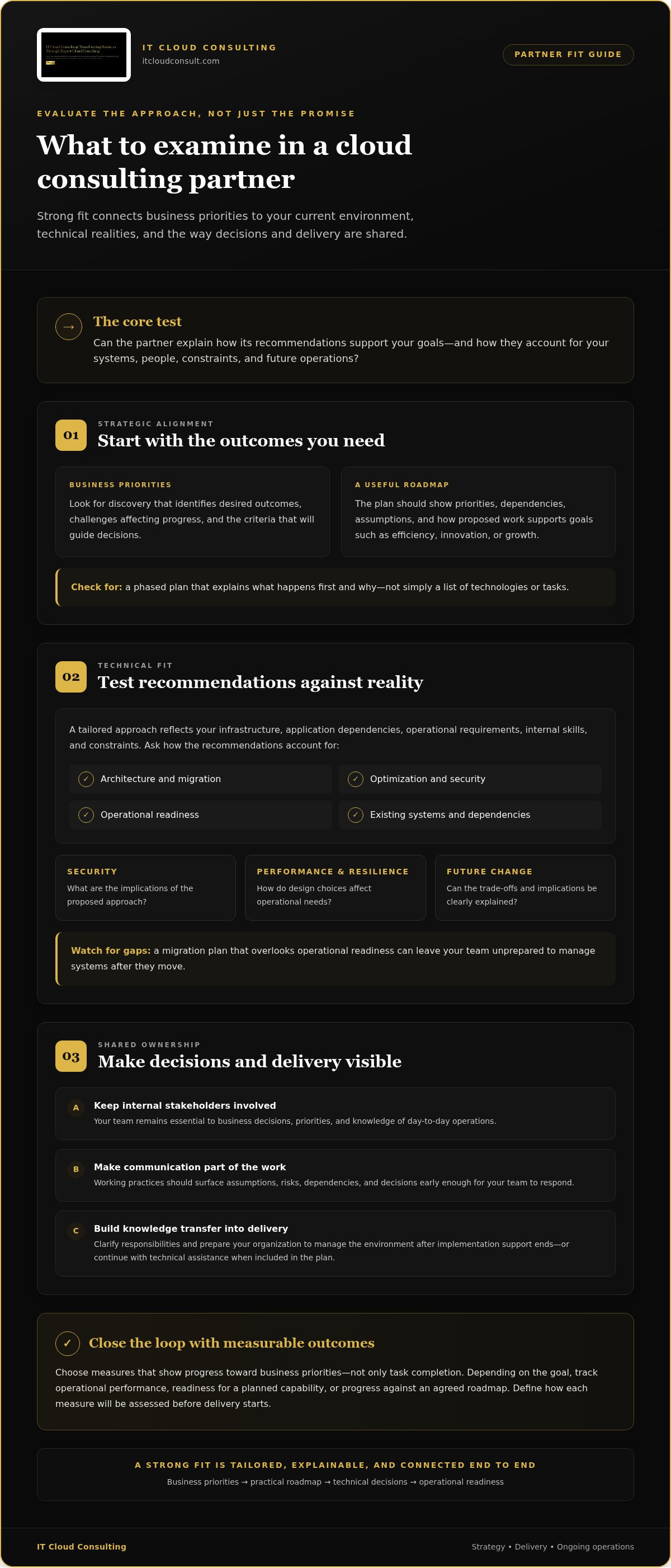
Strong fit starts with understanding your organization, not prescribing a preferred design. A partner should connect business objectives to discovery of your current environment, then account for existing systems, internal skills, operational constraints, and decision-making responsibilities. This helps distinguish a roadmap built around your needs from a generic sequence of technical tasks.
Strategic planning should account for people and processes as well as technology. A phased roadmap makes priorities, dependencies, and decisions visible, so teams understand what happens first and why. For more context on shaping that roadmap, read this strategic cloud adoption guide.
Does the partner connect cloud strategy to business priorities?
Look for a discovery process that identifies the outcomes you want, the challenges affecting progress, and the criteria that will guide decisions. Those findings should inform a phased plan with clear priorities, not just a list of possible technologies. A useful roadmap explains how proposed work supports goals such as operational efficiency, innovation, or growth. It also makes assumptions and dependencies clear enough for leaders to evaluate.
Can the partner support the technical realities of your environment?
Technical fit depends on how well the proposed approach reflects your infrastructure, application dependencies, and operational requirements. Architecture choices involve trade-offs, so recommendations should explain implications for security, performance, resilience, and future change rather than present one design as right for every organization. For an example of a government-focused cloud resource, the GSA’s Cloud services for government agencies can provide useful context for considering how cloud adoption intersects with security and organizational needs.
Assess how recommendations account for architecture, migration, optimization, security, and operational readiness. The partner need not perform every activity in the same way, but its plan should show how these areas affect one another. For example, a migration plan that overlooks operational readiness may leave your team unprepared to manage systems after they move.
Communication is part of technical fit. Effective working practices make assumptions, risks, dependencies, and decisions visible early, giving your team time to address issues before they disrupt delivery. As you’re choosing a cloud consulting partner, look for a clear role for internal stakeholders and shared understanding of the work, rather than treating technical decisions as separate from business ownership.
A tailored assessment and roadmap can turn these fit criteria into practical priorities. Explore strategic cloud adoption planning to connect business goals with the systems and capabilities needed to advance them.
Compare cloud consulting engagement models, ownership, and evidence
The engagement model determines where advice ends, where delivery begins, and who is responsible for operations afterward. Advisory work can set priorities and create a roadmap; implementation support helps execute agreed changes; ongoing management provides technical assistance and operational oversight. Organizations can combine these models or shift between them as priorities and internal capabilities change.
Clarity helps your organization retain control. External expertise doesn’t mean handing over business decisions or system ownership. Define who recommends, who approves, who performs each task, and who maintains the resulting environment. For optimization-specific considerations, see this cloud optimization consulting guide.
Which engagement model fits your cloud initiative?
Match the scope to the work and your internal team’s capacity. Advisory work may suit an organization that needs assessment and direction; implementation support can help move an approved roadmap forward; ongoing management can help sustain operations as needs evolve. A combined approach can connect these phases, but each still needs defined boundaries, decision rights, and handoffs.
Before work begins, map responsibilities in a simple working document:
- Assessment and planning: The partner leads discovery and recommendations; your team sets business priorities and approves direction. Deliverables include findings and a roadmap, measured against agreed priorities.
- Implementation: The partner supports execution within the agreed scope; your team makes business and change decisions. Deliverables include completed work and transition information, measured against defined requirements and readiness criteria.
- Ongoing operations: Document responsibilities for technical assistance, maintenance, monitoring, and management; your team retains appropriate oversight. Measures reflect the operational outcomes your organization has prioritized.
This makes assumptions visible before they become delivery gaps. It also gives your team a clear role in decisions, approvals, and knowledge transfer.
What evidence can make a partner’s claims more credible?
Look beyond broad claims or credentials presented without project context. A useful case study explains the organization’s starting point, the work performed, the constraints that shaped the approach, and the outcomes that were documented. It should also explain how success was measured, rather than treating completed activity as proof of business impact.
As you’re choosing a cloud consulting partner, assess whether the evidence is relevant to your initiative, such as in its objectives, environment, or operational complexity. Discuss lessons learned and how the approach would adapt to your constraints. An example can’t guarantee the same result for another organization, but clear context helps you judge whether the experience is relevant and the delivery approach credible.
How to evaluate cloud consulting partners before making a decision
A consistent evaluation process helps reveal whether a partner’s approach can deliver outcomes for your organization. Set criteria before reviewing proposals so presentation style doesn’t outweigh fit, accountability, and evidence. Define the results you need, compare partners against the same requirements, test their reasoning with a realistic scenario, and document responsibilities before selecting an engagement model.
A weighted scorecard gives the decision structure. The example below is a starting point, not a universal formula. Adjust the weights to reflect your priorities, and decide what evidence earns each score before comparing candidates. Separate essential requirements from preferences so trade-offs are explicit.
- Strategic alignment, 25%: Does the proposed work connect to defined business outcomes and reflect your organization’s constraints?
- Technical fit, 25%: Does the approach address your environment, dependencies, security, and operational needs?
- Delivery accountability, 20%: Are responsibilities, deliverables, decisions, and measures clearly defined?
- Communication and transparency, 15%: Will assumptions, risks, dependencies, and changes be visible and discussed?
- Knowledge transfer and support continuity, 15%: Does the plan help your team understand the work and sustain operations?
Identify evidence for each category in advance. For example, require a roadmap tied to stated outcomes to assess strategic alignment, or a responsibility map showing who approves and performs key tasks to assess accountability. Score each partner against the same criteria and record the reasons for each rating. A high overall score shouldn’t override a gap in an essential requirement.
How can you test the working relationship before commitment?
Use a realistic scenario from your initiative, such as a system with important dependencies or a requirement that changes during planning. Ask the partner to explain its reasoning, the trade-offs it sees, and what additional information it needs. The goal isn’t to get a complete solution in a meeting. It’s to see how clearly the team analyzes uncertainty and involves your stakeholders in decisions.
Notice whether the discussion makes risks, assumptions, dependencies, and decision ownership explicit. A practical evaluation should also establish how the parties will work together:
- Agree on outcome measures and what evidence will demonstrate progress.
- Document communication cadence, escalation paths, and review points.
- Clarify how changes in requirements affect priorities, approvals, and responsibilities.
- Define knowledge transfer and operational handoffs within the scope.
This structure makes choosing a cloud consulting partner a decision based on comparable evidence, not impressions alone. To connect your evaluation criteria with a practical adoption roadmap, explore strategic cloud adoption planning.
What a cloud consulting partnership should deliver after selection
Selection is the start of a working relationship, not the finish line. The partnership should translate agreed priorities into phased work, maintain clear decision ownership, and review progress against measures that matter to your organization. The sequence depends on your environment and objectives, but each phase should make next steps, dependencies, and expected outcomes visible.
How should a partner move from roadmap to execution?
Translate the roadmap into practical priorities, responsibilities, and review points. As implementation progresses, you and the partner should surface risks, dependencies, and decisions early, then assess delivery against agreed business and operational measures. If conditions or requirements change, governance gives stakeholders a structured way to revisit priorities without losing sight of intended outcomes.
Clear governance also supports internal capability. Documented decisions, useful operational guidance, and planned knowledge transfer help your team understand what changed and how responsibilities carry forward. This reduces reliance on informal handoffs and keeps ownership clear as work moves from implementation into day-to-day operations.
Why should cloud support continue after implementation?
Cloud environments change as workloads, performance expectations, and business needs evolve. Ongoing monitoring and maintenance help teams identify operational issues and respond to changing needs. Optimization reviews can assess whether the environment continues to support efficiency and performance goals. Continued support should complement internal ownership, with responsibilities and review measures defined so technical work stays connected to business priorities.
IT Cloud Consulting connects strategic planning and roadmap development with implementation support, cloud optimization, and ongoing technical assistance, maintenance, monitoring, and management. This continuity can help organizations move from initial priorities to sustained operational improvement while adapting the scope to their needs. For considerations when assessing ongoing support, read the managed cloud services buying guide.
A thoughtful approach to choosing a cloud consulting partner includes considering how the relationship will support your organization after the initial work is complete. If you’re ready to align planning, implementation, and ongoing support with your goals, discuss your cloud priorities with IT Cloud Consulting.
Build a Cloud Partnership Around Lasting Outcomes
Strong cloud partnerships connect business priorities to accountable delivery and support that evolves with your organization. When weighing your options, look beyond technical capability: assess whether there is a clear roadmap, defined ownership, and measures that show whether the work is advancing your goals. That’s the foundation for choosing a cloud consulting partner with confidence.
IT Cloud Consulting brings these stages together through strategic cloud planning and roadmap development, infrastructure assessment and optimization, and ongoing technical assistance, monitoring, and management. This connected approach helps organizations move from informed decisions to implementation and continued operational improvement, while keeping business needs at the center.
Take the next step by aligning your cloud priorities with a practical path forward. Discuss your cloud priorities with IT Cloud Consulting and explore how planning, optimization, and ongoing support can contribute to your organization’s goals. With clear outcomes and shared ownership, your cloud strategy can keep moving forward as your needs change.
Frequently Asked Questions
What should I look for when choosing a cloud consulting partner?
Look for a partner that connects business goals to a clear cloud plan and defined responsibilities. Assess its approach to discovery, architecture, implementation support, optimization, security, and operational readiness. Strong communication matters too: assumptions, dependencies, risks, and decisions should be visible. Review relevant evidence in context, and clarify deliverables, success measures, knowledge transfer, and the support your organization will need after implementation.
How do I know whether a cloud consulting partner is right for my business?
A partner is a stronger fit when its recommendations reflect your objectives, existing systems, organizational constraints, and internal capabilities. Ask how proposed priorities address your needs, what trade-offs are involved, and how progress will be assessed. A relevant approach should adapt to your situation rather than follow a one-size-fits-all template, with your team retaining a clear role in business decisions and operational ownership.
What questions should I ask a cloud consulting partner?
Ask how the partner will assess your current environment, connect recommendations to business priorities, and identify dependencies and risks. Clarify who makes decisions, who performs the work, and what deliverables your team will receive. Discuss how success will be measured, how knowledge will be transferred, and what support can continue after implementation. These questions surface assumptions before they become gaps in scope or accountability.
Should a cloud consulting partner also provide ongoing support?
It depends on your internal capacity and operational needs. Some organizations need strategic guidance or implementation support for a defined initiative; others value continued technical assistance, monitoring, maintenance, and management as their cloud environment evolves. These scopes can connect, but they aren’t interchangeable. Decide what your team will own after implementation and whether ongoing support would help maintain performance and respond to changing requirements.
How can I compare cloud consulting partner proposals fairly?
Set decision criteria before reviewing proposals, then apply the same weighted scorecard to each. Compare strategic alignment, technical fit, delivery accountability, communication, knowledge transfer, and operational support. Define what evidence supports each rating, and separate essential requirements from preferences. Review scope, responsibilities, deliverables, assumptions, and measures side by side. This makes differences easier to assess and prevents a polished presentation from outweighing practical fit.
How do cloud consulting partners measure success?
Success measures should reflect agreed business and operational outcomes, not just completed tasks. Depending on your goals, measures might track progress against a roadmap, operational performance, or readiness for a planned capability. Establish the measures before work begins, define how progress will be reviewed, and clarify what information will support each assessment. This creates a shared basis for evaluating whether technical work is advancing the intended priorities.
Can a cloud consulting partner work with an internal IT team?
Yes. A cloud consulting partner can complement your internal IT team with strategic guidance, implementation support, optimization, or ongoing technical assistance. Define how responsibilities and decision rights are shared so external expertise strengthens, rather than replaces, internal ownership. Include knowledge transfer and operational handoffs in the working plan. Your team’s understanding of business processes and day-to-day requirements helps shape practical decisions and sustain capability over time.


