
29% of cloud spending is wasted, up from 27% in 2025, according to Flexera’s 2026 State of the Cloud Report. That reversal after five years of improvement makes cloud waste reduction an urgent priority, but cutting spend indiscriminately can put performance, security, and delivery at risk.
If cloud bills are difficult to explain across teams and environments, you’re not alone. Idle resources, oversized capacity, and unclear ownership can hide avoidable spend, while fast-growing AI workloads add new complexity. The goal isn’t simply to spend less. It’s to ensure cloud resources support the right business outcomes.
This guide shows you how to identify and validate sources of waste, then prioritize changes by savings potential, effort, risk, and business value. You’ll also learn how FinOps practices, clear ownership, and ongoing visibility can keep waste from returning across hybrid and multi-cloud environments. The focus is continuous optimization, not a one-off cleanup, so teams can improve efficiency without compromising the services people rely on.
Key Takeaways
- Separate avoidable cloud consumption from capacity intentionally reserved for resilience, growth, and recovery.
- Look beyond compute to find potential waste in storage, networking, licensing, and duplicated services.
- Prioritize cloud waste reduction by weighing potential impact against confidence, effort, and operational risk.
- Use a documented workflow to establish a baseline, validate opportunities, implement changes safely, and measure results.
- Assign clear ownership and schedule recurring reviews to keep cost visibility and optimization part of ongoing operations.
What Cloud Waste Reduction Means, and Why Cutting Spend Is Not Enough
A lower cloud bill may look like progress, but it doesn’t tell you whether the right resources are supporting the right outcomes. A cost reduction that weakens resilience, slows a critical workload, or introduces security risk can create more business impact than it saves. Effective cloud waste reduction focuses on value, not simply on reducing consumption.
Cloud waste is spend on resources that, given their utilization, ownership, and purpose, fails to deliver proportionate workload or business value. The definition matters because unused or lightly used capacity isn’t automatically waste. Some capacity is intentionally provisioned to handle demand spikes, maintain service objectives, support recovery, or leave room for planned growth. The task is to distinguish purposeful investment from consumption that no longer serves a clear need.
How to distinguish waste from useful cloud capacity
Evaluate a resource in context before changing it. Ask what workload it supports, who owns the decision, how it’s used over time, and what service objectives it must meet. A lightly used instance could be waste if its workload has ended, but low average utilization may be appropriate for a critical system that must absorb sudden demand. Storage retained for recovery may also serve a deliberate purpose even if it’s rarely accessed.
Treat idle or underused capacity as a signal to investigate, not proof that it should be removed. Check workload patterns across relevant periods, confirm dependencies, and understand the consequence of scaling down or deleting the resource. The goal is to validate whether the capacity contributes to performance, resilience, or another business requirement, then document that rationale.
Why cloud waste reduction needs shared accountability
Cloud spend crosses organizational boundaries, and each team sees a different part of the picture. Engineering teams understand architecture and operational trade-offs. Finance teams need costs allocated clearly enough to plan and explain them. Leadership weighs investment against business priorities. Without shared ownership, a charge can remain unexplained, while teams may hesitate to act because the cost or risk sits elsewhere.
Assigning clear owners to budgets, workloads, and exceptions makes investigation faster and decisions more informed. It also creates a path for raising trade-offs: a technical team can explain why capacity is necessary, while finance and leadership can assess whether that need remains aligned with current priorities.
FinOps brings these perspectives together as a collaborative practice for managing cloud finances. It connects usage and cost information with engineering decisions and business value, rather than treating cost control as a finance-only task. A useful FinOps frameworks overview can help establish the broader cloud context. With shared language and accountability, organizations can reduce avoidable consumption while preserving capacity that supports reliable services and strategic plans.
Where Cloud Waste Hides Across Resources, Storage, and Services
Waste rarely appears in one obvious place. It can accumulate across compute, storage, networking, software licenses, and routine operational choices, especially when environments span multiple teams or cloud platforms. A useful inventory looks beyond individual charges to connect each resource with its workload, owner, and business purpose. That context helps teams turn billing signals into validated opportunities rather than risky assumptions.
Which compute and storage patterns deserve investigation?
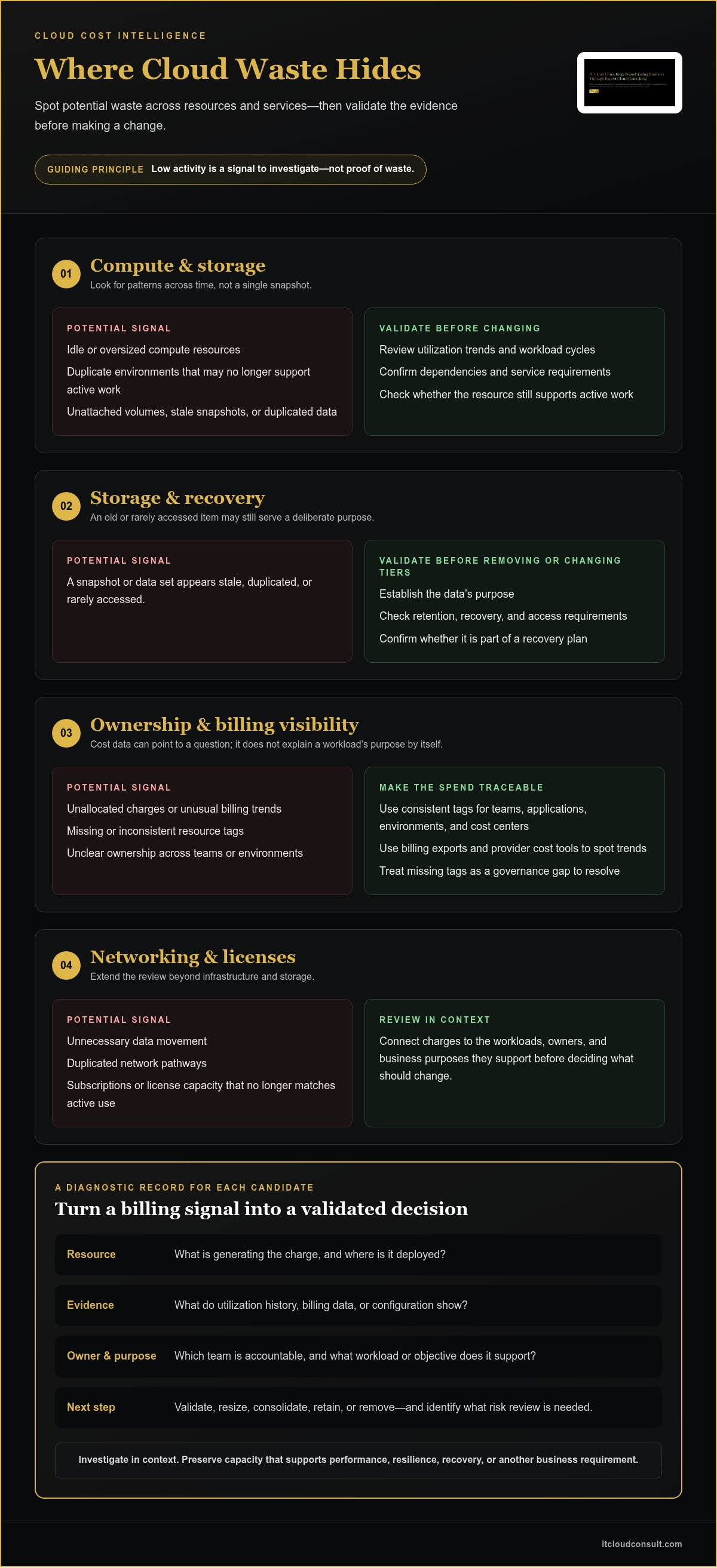
Review utilization trends over time, not a single snapshot. Compute candidates include idle instances, oversized resources, and duplicate environments that may no longer support active work. Storage signals include unattached volumes, stale snapshots, and duplicated data. Low activity is a prompt to investigate; workload cycles, dependencies, and service requirements may explain why a resource remains necessary.
Storage cleanup calls for particular care. Before removing data or changing its tier, establish its purpose and check retention, recovery, and access requirements. A snapshot that appears old may still be part of a recovery plan. Cost optimization should account for the value of availability and recovery, a balance explored through a Cloudonomics perspective.
How tagging and billing data reveal ownership gaps
Consistent tags for teams, applications, environments, and cost centers make it easier to trace spending to decisions. Billing exports and provider cost tools can reveal unusual trends or unallocated charges, but they don't explain the workload’s purpose on their own. Missing or inconsistent tags add investigation work and make accountability harder, so treat them as a governance gap to resolve.
Build a diagnostic record for each candidate before taking action. Include:
- Resource: What is generating the charge, and where is it deployed?
- Evidence: What do utilization history, billing data, or configuration show?
- Owner and purpose: Which team is accountable, and what workload or objective does it support?
- Next step: Should the team validate, resize, consolidate, retain, or remove it, and what risk review is needed?
Apply the same discipline beyond infrastructure. Review networking charges for unnecessary data movement or duplicated pathways, and check licenses for subscriptions or capacity that no longer match active use. Operational patterns matter too: repeated environments, unclear shutdown practices, or resources left behind after testing can sustain avoidable spend. This broader view makes cloud waste reduction more reliable because teams can see both where charges originate and why a proposed change is appropriate.
If ownership or architecture makes findings difficult to validate, an assessment of cloud infrastructure and optimization opportunities can help connect cost evidence with workload needs and business priorities.
How to Prioritize Cloud Waste Reduction Without Sacrificing Performance
Finding a possible cost reduction is only the start. Teams also need to know whether the evidence is reliable, how difficult the change will be, and what it could mean for workload performance or resilience. A balanced prioritization framework helps direct attention to changes that are valuable and safe, rather than simply choosing the largest apparent savings.
Decision rule: prioritize evidence-backed changes that preserve agreed workload outcomes. Compare each opportunity by estimated impact, confidence in the finding, implementation effort, and operational risk. Then consider workload criticality and service-level objectives. A low-priority test environment with a clearly expired resource may be an easy first action; a core service with strict availability needs calls for stronger validation and approval, even if its potential savings appear larger.
Which optimization opportunities should teams address first?
Start by investigating clearly idle resources and expired assets, since their purpose may be easier to verify than that of a complex architecture. Next, assess options such as scheduling non-production environments or resizing capacity against usage patterns collected over time. Commitment options may suit stable, predictable demand, but can be a poor fit for variable workloads. No single action works for every profile.
Separate low-risk housekeeping from changes that affect dependencies, architecture, or service behavior. A configuration adjustment might need a controlled test; a redesign may require broader review, a rollback plan, and formal approval. Match the validation to the consequence of failure.
How to compare savings, effort, and operational risk
Record each candidate in a comparison table or shared decision log. Keep forecasts distinct from confirmed results: an estimate is a hypothesis, while post-change billing and workload measures show what actually happened. Use a validation measure that checks both cost and service outcomes, such as whether the change reduced the relevant charge while keeping performance within agreed objectives.
Opportunity: Schedule a non-production environment. Evidence: Usage history shows recurring periods of inactivity. Owner: The application team. Effort: Low to moderate. Risk: Confirm no testing or deployment depends on the environment during shutdown. Validation: Compare the relevant spend and confirm required work still runs on schedule.
Opportunity: Resize a production resource. Evidence: Sustained utilization data and workload review support a smaller configuration. Owner: The service team. Effort: Moderate. Risk: Test against performance objectives and define rollback criteria. Validation: Review billing alongside service metrics after implementation.
Use this approach to make cloud waste reduction a sequence of informed decisions, not a blanket instruction to shrink resources. For a broader view of how optimization connects to architecture and business value, see the cloud optimization consulting guide.
A Practical Cloud Waste Reduction Workflow for Safe, Measurable Changes
A repeatable process turns cost findings into controlled improvements. For each proposed change, assign an owner and record the evidence, intended action, potential risks, and expected outcome. This creates a clear decision trail and makes it easier to verify whether the change improved efficiency without weakening workload performance, availability, security, or recovery.
What should a cloud cost baseline include?
Establish a baseline before making changes. Record the billing periods, workload and environment in scope, resource owner, relevant usage patterns, and any known operational context. Separate recurring consumption from one-time charges, such as a temporary increase tied to a deployment or migration. Compare like with like: a post-change period should reflect a comparable workload and billing window before you attribute a cost difference to the optimization.
How can teams reduce waste without creating service risk?
Set guardrails before implementation. Define the performance, availability, security, and recovery outcomes that must remain intact, then decide how to test the proposed change. A nonproduction environment can help validate some adjustments; other changes need a staged rollout, explicit approval, monitoring, and a documented rollback plan. For security-related considerations, consult this cloud security assessment checklist.
- Establish the baseline. Capture current spend and workload measures for the defined scope and period.
- Document the proposal. Name the owner, evidence, intended change, expected result, and operational risks.
- Set safeguards and approval. Agree on success measures, testing requirements, decision-makers, and rollback conditions.
- Test and implement carefully. Validate in a suitable environment when possible, then roll out material changes in stages.
- Monitor and measure. Check billing and workload behavior against the same scope and comparable baseline, watching for unintended effects.
- Review the result. Record what changed and whether the evidence supports keeping, adjusting, or reversing it.
Don't label a forecast as a confirmed saving. First account for billing-period timing, workload changes, and one-time charges; then compare actual post-change consumption with the baseline and confirm that service outcomes remain within agreed guardrails. This evidence-led workflow makes cloud waste reduction safer and more credible over time.
For support connecting cost findings with architecture and business priorities, explore cloud optimization support.
Make Cloud Waste Reduction Continuous With Clear Ownership and Expert Support
Cost improvements can fade when teams don’t own the decisions that created them. A sustainable model gives finance, platform teams, application owners, and leadership defined responsibilities, then brings them together to review spend alongside utilization and service outcomes. This makes cloud waste reduction part of operational management, not a periodic cleanup exercise.
What should a sustainable cloud cost governance model include?
Set decision rights that match each team’s expertise. Finance can coordinate budgets, investigate variances, and help communicate cost trends. Platform teams can maintain tagging standards and shared infrastructure practices. Application owners can explain workload needs and approve resource changes. Leadership can resolve cross-team priorities and align investment with business plans.
Make the process clear when something falls outside the expected pattern. Unexplained charges, resources without owners, missing tags, and budget variances should have a named path for investigation and escalation. Record the decision, responsible owner, and follow-up action so exceptions don’t become permanent blind spots.
Reviews should consider more than billing. Examine spend trends alongside utilization, workload health, service performance, and recovery needs. Track verified cost changes separately from forecasts, and review forecast accuracy, unresolved exceptions, and workload outcomes over time. Use those findings to inform architecture decisions and cloud adoption plans, so governance supports the organization’s direction rather than restricting necessary growth.
When can cloud optimization consulting add value?
External expertise can help when billing signals are difficult to connect with technical context, ownership is fragmented, or internal teams need support turning findings into a practical roadmap. An independent assessment can examine cloud infrastructure, relate cost patterns to workloads and business priorities, and help distinguish opportunities from capacity that serves an important purpose.
Implementation support can then help teams plan and carry out prioritized improvements, while ongoing technical management sustains visibility as workloads and requirements change. The aim is a durable operating approach: clear owners, informed decisions, and regular checks that confirm optimization remains aligned with service outcomes.
For tailored guidance on assessment, implementation, and continued cloud optimization, discuss your cloud optimization needs.
Turn Cloud Cost Findings Into Lasting Progress
Effective cloud waste reduction isn’t about making every workload smaller. It’s about aligning resources with business purpose, validating opportunities before acting, and keeping cost decisions connected to performance, security, and resilience. A clear baseline and accountable owners help teams distinguish verified improvements from forecasts and catch waste before it returns.
Make the next step practical: identify a cost pattern that needs attention, assign an owner, and agree on how you’ll measure both financial and service outcomes. Repeat that discipline through regular reviews, and optimization becomes part of how your organization plans and manages its cloud environment.
IT Cloud Consulting can support this work through cloud infrastructure assessment and optimization, strategic planning and roadmap development, and ongoing technical support and management. Discuss a practical cloud optimization approach and explore how to connect cost findings with your architecture and business priorities. With clear evidence and sustained ownership, your team can improve efficiency while continuing to support the services and plans that matter.
Frequently Asked Questions
What is cloud waste reduction?
Cloud waste reduction is the process of identifying and addressing cloud spend that doesn’t deliver proportionate workload or business value. It involves reviewing resource use, ownership, and purpose, then making evidence-based changes while protecting agreed service outcomes. The goal isn’t to remove all spare capacity: resources reserved for resilience, recovery, or expected demand may be valuable. Teams should verify a resource’s role before deciding whether to resize, retain, or remove it.
How can I identify wasted cloud resources?
Compare billing and usage data over time, then connect potential waste to a workload and its owner. Look for idle or oversized compute, unattached storage, stale snapshots, duplicated environments, unused licenses, and unexpected networking activity. Treat these as investigation leads, not automatic grounds for removal. Document the evidence, business purpose, risk, and proposed next step for each finding, then validate it with the team responsible for the workload.
Can cloud costs be reduced without affecting performance?
Yes, teams can often reduce avoidable consumption while preserving performance, provided they assess workload requirements before changing resources. Establish service and security guardrails, review utilization patterns, and test material changes before rolling them out. For example, resizing a resource should include monitoring relevant service measures and a rollback plan. Compare actual billing with a consistent baseline, while checking that availability, performance, and recovery needs remain satisfied.
What is the difference between cloud waste reduction and cloud cost optimization?
Cloud waste reduction focuses on spend that lacks a clear workload or business purpose, such as an abandoned resource or capacity that exceeds a workload’s needs. Cloud cost optimization is broader: it considers how architecture, usage, and purchasing decisions balance cost with performance, resilience, and growth. Waste reduction can be one part of optimization, but a sound optimization decision may retain capacity when it supports important service outcomes.
How often should an organization review cloud waste?
Set a recurring review cadence that fits your billing cycles, workload change rate, and internal decision process. A monthly review can help teams examine spend trends, utilization, ownership gaps, and exceptions, while significant architecture or workload changes warrant a timely check outside that cadence. The review should assign actions and owners, then track whether changes affected both actual consumption and service outcomes. Consistency matters more than a one-time cleanup.
Does cloud waste reduction mean deleting idle resources?
No. An idle resource deserves investigation, but low utilization alone doesn’t prove it is waste. It may support recovery, a critical workload, scheduled activity, or bursts in demand that averages don’t reveal. Confirm dependencies, ownership, workload patterns, retention needs, and service objectives before acting. Depending on the evidence, the right response might be to retain, resize, schedule, consolidate, or remove the resource.
What metrics should teams use to measure cloud waste reduction?
Use a combination of financial, utilization, ownership, and service measures. Track actual spend against a comparable baseline, resource utilization over time, forecast accuracy, and the share of resources with clear owners and tags. Also monitor relevant workload outcomes, such as performance, availability, and recovery readiness. A cost decrease alone isn’t proof of success; confirm that consumption changed as intended without undermining the service requirements the resource supports.
When should a business use cloud optimization consulting?
Cloud optimization consulting can help when billing patterns are difficult to explain, resource ownership is unclear, or teams need technical context to prioritize changes safely. IT Cloud Consulting supports organizations with cloud infrastructure assessment and optimization, strategic planning and roadmap development, implementation support, and ongoing technical management. This can help connect cost findings with architecture and business priorities, then sustain visibility as workloads and requirements evolve.


