
A lower cloud bill does not automatically mean a better return. To assess cloud migration ROI, compare the full cost of migration and ongoing cloud operations with the value the move creates over time. That value may include lower infrastructure overhead, more efficient work, and the ability to scale as business needs change.
Infrastructure and labor costs are a practical starting point: they shape the investment and help show where savings may come from. A useful assessment also accounts for operating expenses, implementation effort, and business benefits that do not appear as a simple reduction in monthly spending.
This guide explains how to build a balanced comparison, calculate returns over a multi-year horizon, and test the assumptions behind your estimates. You will learn to weigh cloud costs against efficiency, scalability, and business value to make a more informed migration decision.
Key Takeaways
- Build a complete cost picture by accounting for infrastructure, labor, migration work, and ongoing operations.
- Assess value beyond monthly savings, including productivity, scalability, and the business impact of faster delivery.
- Compare costs and benefits across a multi-year horizon to reveal how refresh cycles and recurring expenses affect the result.
- Use clear success measures and a phased implementation approach to manage risk and strengthen the return over time.
Cloud infrastructure, labor, and operational costs
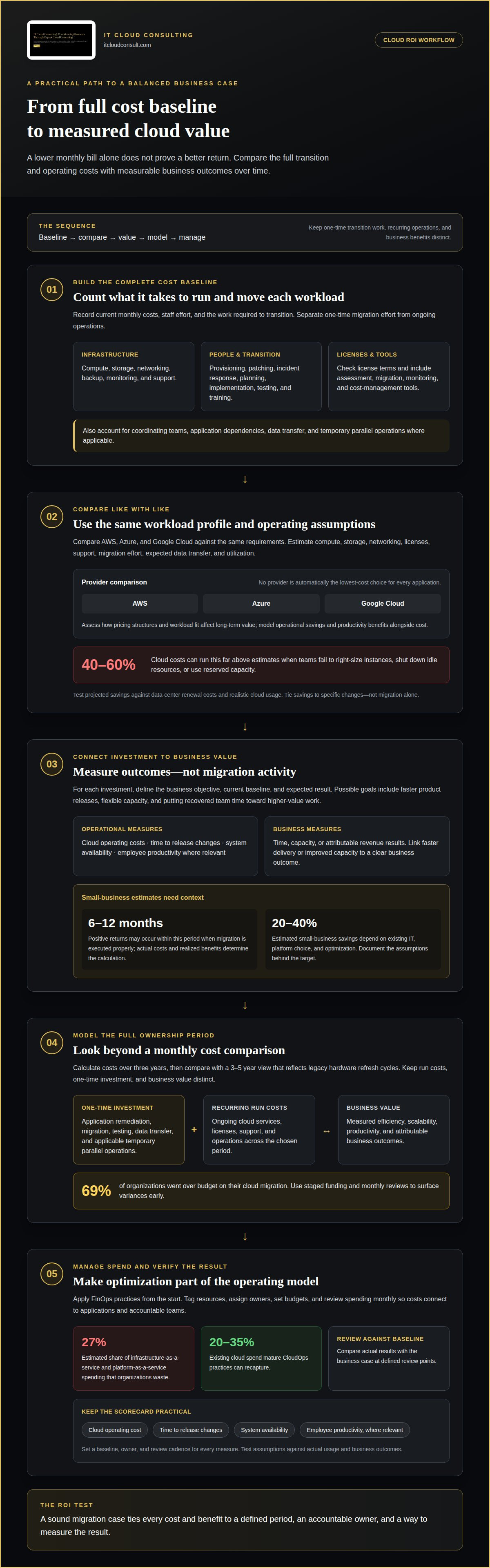
Build a cost baseline before comparing cloud services with your current data center. Include recurring expenses, migration effort, and operational changes so your ROI model reflects the full transition.
-
List Infrastructure and Operational Costs
Record monthly compute, storage, networking, backup, monitoring, and support costs for each workload. Include staff time for provisioning, patching, and incident response.
-
Account for Planning and Tooling Costs
Before calculating returns, map migration planning, implementation labor, testing, training, licenses, and tooling. Check whether existing software licenses transfer to the destination environment, require different terms, or need replacement. Include assessment, migration, monitoring, and cost-management tools, as well as time spent coordinating teams and resolving application dependencies. Separate one-time transition work from recurring operations. This prevents you from comparing a temporary migration expense with just one month of cloud services.
-
Compare Cloud Provider Migration Costs
Compare AWS, Azure, and Google Cloud against the same workload profile and operating assumptions. Estimate compute, storage, networking, licenses, support, and migration effort for each option; then assess how pricing structures and workload fit affect long-term value. No provider is automatically the lowest-cost choice for every application. Include expected data transfer and utilization, since cloud costs can run 40-60% above estimates when teams fail to right-size instances, shut down idle resources, or use reserved capacity. Model the operational savings and productivity benefits alongside those costs.
Test the model against data-center renewal costs and realistic cloud usage. Treat projected savings as the result of specific changes, such as retiring hardware or optimizing idle capacity, not as an automatic effect of migration.
Long-term efficiency, scalability, and business value
Connect each cloud investment to a business objective, then define a baseline measure and target outcome. This keeps your case focused on measurable organizational value.
-
Align Investments With Business Objectives
Map each proposed investment to a specific goal, such as faster product releases or more flexible capacity. If your enterprise is expanding, assess whether cloud resources can support changing demand without a matching increase in fixed infrastructure. Identify the initial business measure, its current baseline, and the outcome leadership expects. Migration itself is not the objective; the business result is what makes the investment meaningful.
-
Calculate Small-Business Migration ROI
Use comparable monthly costs and include measurable benefits. Add migration investment and any productivity value separately, then calculate returns over the chosen period. Small businesses may see positive returns within 6-12 months when migration is executed properly, but the calculation depends on actual costs and realized benefits.
-
Quantify Operational and Business Benefits
Translate operational improvements into measures of time, capacity, or revenue. Track whether teams put recovered time toward higher-value work. For revenue outcomes, link faster delivery or improved capacity to attributable business results instead of counting projected growth without a clear connection.
-
Set Measurable Success Metrics
Choose a compact scorecard before migration, with a baseline, owner, and review cadence for each measure. Track cloud operating costs, time required to release changes, system availability, and employee productivity where relevant. Compare actual results with the business case at defined review points. A small-business estimate of 20-40% savings depends on existing IT, platform choice, and optimization, so document the assumptions behind the target.
Organizations defining cloud investment around business outcomes can use Strategic Cloud Adoption to shape priorities and success measures.
Three-to-five-year total cost of ownership
Model total cost of ownership over a consistent period, then test how operational changes affect the result. A three-year view can reveal trade-offs that a monthly comparison misses.
-
Budget Migration Costs
Separate one-time migration spending from recurring cloud costs, and assign each amount to a budget owner. Include application remediation, testing, data transfer, and temporary parallel operations where applicable. A three-year model should also account for the risk of overruns: 69% of organizations went over budget on their cloud migration. Use staged funding and monthly reviews to surface variances early, rather than treating the initial estimate as fixed.
-
Assess Total Cost of Ownership
Calculate costs over three years, then compare them with a 3-5 year view that reflects legacy hardware refresh cycles. Keep run costs, one-time investment, and business value distinct so the comparison remains transparent.
-
Control Ongoing Cloud Spend
Apply FinOps practices from the start: tag resources, assign ownership, set budgets, and review spending monthly. These controls help teams link computing costs to each application and its accountable owner. Cloud waste can erode efficiency; organizations waste an estimated 27% of infrastructure-as-a-service and platform-as-a-service spending. Mature CloudOps practices can recapture 20% to 35% of existing cloud spend, making optimization part of the ongoing cost model.
Test assumptions against actual usage and business outcomes. A three-year comparison is useful only when each cost and benefit has a defined period, owner, and measurement method.
How to Evaluate and Maximize Cloud Migration ROI?
Workload type and migration strategy affect costs, benefits, and how long it takes to realize returns. Estimate cloud migration ROI with a business case that compares total investment with measurable financial and operational benefits.
-
Estimate ROI With a Calculator or Business Case
Use this formula: (total cloud value minus investment value) divided by cloud migration investment cost, multiplied by 100%. Include implementation, operating costs, and quantified benefits over the same period. Build a base case that discounts estimated benefits by 10%-20%, then test a worst-case model using a 30%-40% discount. This shows whether expected returns depend on optimistic assumptions.
-
Assess Workload and Migration Strategy Factors
Classify each application by usage pattern, dependencies, and business criticality before choosing a migration approach. A steady, predictable workload may have different cost drivers from a variable workload with changing demand. Migration strategy also affects labor, testing, and parallel operations. Compare options using consistent workload assumptions, then identify how each approach changes implementation effort and time to market.
-
Count Financial Benefits and Cost Savings
Measure direct savings alongside labor and administration changes. Physical hardware maintenance accounts for 20-30% of IT overhead, while experienced resources can spend 70% of their time on patching, hardware management, and provisioning. Estimate how monitoring and automation could redirect that effort. Cloud migration can reduce IT support tickets by 60-80%, which may lower routine workload and free teams for higher-value tasks.
-
Measure Time-to-Market and Implementation Savings
Track release timelines before and after migration, then link faster delivery to a specific business outcome. For example, record how earlier access to infrastructure affects product launches or customer onboarding. Distinguish realized revenue from projected opportunity, and include audit preparation and security administration only when your team can measure reduced effort. A clear baseline makes claimed savings easier to distinguish from expected benefits.
Build a practical evaluation with cloud ROI planning support to connect migration choices with financial and operational outcomes.
IT Cloud Consulting
IT Cloud Consulting helps organizations connect cloud decisions with practical business priorities. Its guidance can help you shape a migration plan, find opportunities to optimize cloud resources, and maintain progress after adoption.
With Strategic Cloud Adoption, Cloud Optimization, and Ongoing Cloud Support, IT Cloud Consulting helps businesses assess their direction and strengthen cloud operations. The focus is on aligning infrastructure choices with measurable goals, managing costs, and improving operational efficiency as needs evolve.
To discuss your cloud migration priorities, contact IT Cloud Consulting.
Turn Your Cloud Strategy Into Measurable Progress
A sound cloud decision should support the organization you are building, not simply relocate existing systems. Treat cloud migration ROI as an ongoing management discipline: establish clear ownership, review results against business priorities, and adjust your approach as workloads and needs evolve. This keeps the investment connected to the outcomes that matter.
The next step is to turn your assessment into a practical plan. IT Cloud Consulting can help shape cloud adoption, identify optimization opportunities, and provide ongoing support as your environment develops. With a clear plan and continued attention, cloud infrastructure can support deliberate, sustained business progress.
Contact IT Cloud Consulting to discuss how your cloud priorities can support your next stage of growth.
Frequently Asked Questions
Common Mistakes in Cloud ROI Evaluation and How to Avoid Them?
Do not evaluate a migration using cloud bills alone. Teams may overlook parallel-running environments, data-transfer charges, staff time, or application changes, then compare results against an incomplete baseline. Another common mistake is counting forecast revenue as a realized benefit. Keep assumptions visible, assign owners to estimates, and update the model with actual usage after each migration wave. This makes cost variances easier to investigate and address.
What Is Cloud ROI and Why Should You Measure It?
Cloud ROI measures the value gained relative to the investment in moving and operating workloads in the cloud. It helps decision-makers determine whether the change supports business priorities, not just whether infrastructure has moved. For example, an organization can assess whether staff capacity freed up by the move is being applied to priority work. Review financial outcomes and operational results to guide future cloud decisions.
What Is the Difference Between Cloud Migration ROI, TCO, and Payback Period?
Migration ROI compares the value delivered with the investment required. Total cost of ownership, or TCO, captures the full cost of an environment over a defined period, including migration and ongoing operations. The payback period shows how long it takes for accumulated benefits to offset the initial investment. Use all three measures together: TCO establishes the cost base, payback shows the timing, and ROI expresses relative value.
What Outcomes Count as ROI?
Count outcomes that can be linked to migration and measured against a baseline. Cloud migration ROI may include lower operating effort, faster delivery, increased employee capacity, or revenue tied to a new business capability. For example, measure whether teams spend less time resolving routine infrastructure issues and how they use the recovered time. Keep direct savings separate from strategic benefits.
What Time Horizon Should You Be Looking At?
Use a period that captures both transition costs and the benefits expected to follow. A 3-5 year model can show how recurring operations, planned infrastructure changes, and business outcomes accumulate. Also review nearer checkpoints, such as 12, 24, or 36 months, to compare actual progress with the forecast. Keep the same assumptions across each period; otherwise, the comparison can obscure when value appears.
Who Owns ROI?
Business and technology teams should share responsibility for ROI. A business sponsor defines the outcomes, finance validates investment and benefit assumptions, and IT tracks delivery and operating measures. Workload owners can explain application-specific changes that affect results. Assign one accountable lead to coordinate these contributions and report progress, so responsibility for the business case does not disappear after migration.


