
The cloud is only as useful as the connections between its workloads. Cloud networking services use virtual network components and configurations to connect applications across cloud platforms, on-premises data centers, and edge environments. They include capabilities such as virtual networks, routing, load balancing, and secure connections.
That connection layer is easy to overlook. Cloud computing provides resources such as compute and storage, while cloud networking manages how those resources communicate and how traffic moves between them. This distinction matters when an organization needs to connect existing systems with cloud workloads or coordinate applications across different environments.
This guide explains what cloud networking is, which services it includes, and how public, private, and hybrid models differ. It also covers practical benefits, common uses, and how hybrid cloud networking links on-premises infrastructure with cloud resources, so you can understand the role these services play in a broader cloud strategy.
Key Takeaways
- Understand how virtual networks, routing and load balancing connect cloud resources with on-premises systems.
- Use traffic monitoring and routing insights to pinpoint bottlenecks and improve application performance.
- Assess how rapid provisioning, resilience and simplified network management can support operational goals.
- See how hybrid networking links on-premises infrastructure and cloud resources while coordinating connectivity and security.
What Is Cloud Networking?
Cloud networking uses virtual infrastructure to connect applications and workloads across cloud platforms, data centers, and edge environments. Its design shapes how users reach services and how data moves.
Cloud Networking Definition and Connectivity
Cloud networking uses virtual network components and configurations on a provider’s physical infrastructure to connect workloads. Applications need reliable paths between cloud resources, users, and existing systems. IT Cloud Consulting experts note that cloud networking services can include routing, virtual networks, and load balancing. To troubleshoot performance, teams trace traffic paths, monitor for bottlenecks, and review DNS routing. These checks help pinpoint where connectivity slows or fails.
Cross-Cloud Networking
Cross-cloud networking connects applications and workloads across multiple cloud environments, sometimes alongside on-premises infrastructure. In the United States, major public cloud providers offer networking within their own environments. Compare them by how their connectivity, routing, security controls, and management fit your workloads. A multicloud design can support shared access across platforms, but it also requires coordinated network policies and visibility. Consistent policies help teams manage connections without treating each cloud as an isolated network.
Direct Public Cloud Connections
A direct connection provides a private, dedicated network path between an organization and a public cloud provider. Unlike internet-based connectivity, it can support workloads that need a predictable route to cloud resources. To set up a cloud network, define the virtual network, its IP ranges, subnets, and routes, then choose how it connects to other environments. Apply access and security controls, and monitor traffic for performance issues. The right configuration depends on workload needs and the existing network design.
Hybrid Connectivity and Data Mobility
Hybrid cloud connectivity links on-premises infrastructure with cloud resources, allowing workloads and data to move between environments. A VPN can provide secure communication and resource access, while a dedicated connection offers a private path. Plan these links around the applications that exchange data, where systems run, and how traffic should route. When users report delays, monitoring traffic paths and bottlenecks helps isolate the affected connection. This makes hybrid connectivity more efficient and supports operational reliability across the data center and cloud.
Cloud networking benefits
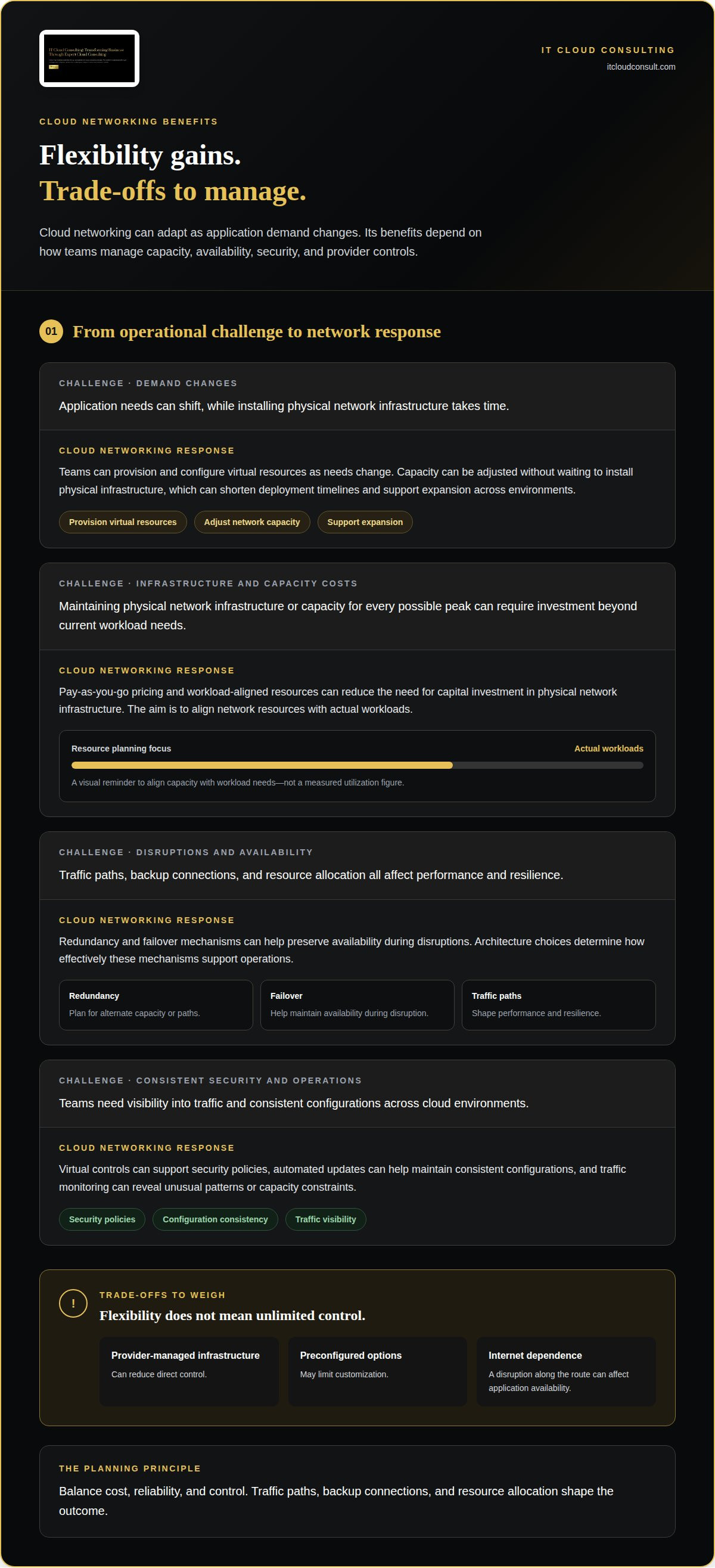
Virtual network architecture can adapt as application demand changes. Its benefits depend on how teams manage capacity, availability, security, and provider controls.
Scalability and Flexibility
Cloud networks let teams provision and configure virtual resources as application needs change. For example, a business launching a service can adjust network capacity without waiting to install physical infrastructure. This flexibility can shorten deployment timelines and support expansion across environments. Centralized software controls and automation also simplify network changes, while monitoring shows whether resources and traffic match demand.
Cost and Availability Benefits
Cloud networking can reduce the need for capital investment in physical network infrastructure and offer pay-as-you-go pricing. Organizations can align network resources with actual workloads instead of maintaining capacity for every possible peak. Redundancy and failover mechanisms can help preserve availability during disruptions. These advantages support efficient operations, but depend on architecture choices: traffic paths, backup connections, and resource allocation all affect performance and resilience.
Security and Operational Limits
Virtual controls can support security policies across cloud environments, while automated updates can help maintain consistent configurations. Traffic monitoring can reveal unusual patterns or capacity constraints, improving operational visibility. However, provider-managed infrastructure can reduce direct control, and preconfigured network options may limit customization. Cloud connectivity also depends on internet access, so a disruption along the route can affect application availability. Weigh these constraints alongside flexibility and resilience.
For organizations reviewing resource use and network design, cloud optimization can help align cloud capacity with operational needs. The goal is a considered architecture that balances cost, reliability, and control rather than maximizing one benefit in isolation.
Hybrid cloud networking
Hybrid cloud networking connects cloud resources with an organization’s on-premises infrastructure. Public, private, hybrid, community, and multicloud models describe different ways to organize network access.
Public and Private Network Types
A public cloud network uses infrastructure and services shared among customers, while a private cloud network is reserved for one organization. A private cloud can run on-premises or in a provider’s data center. A hybrid network connects private and public environments, helping an enterprise place workloads where operational needs are best met. A community cloud serves organizations with shared requirements, offering a model between exclusive private infrastructure and a broadly shared public platform.
These models shape control, access, and how resources connect. For example, an organization might keep selected systems in a private environment while connecting cloud applications through a hybrid design. Workload and data placement determine which network paths need coordination. A community environment, by contrast, can support a defined group that shares infrastructure and operating needs. Choose a model based on how users and applications need to communicate.
Multicloud Networks
A multicloud network connects resources across multiple cloud providers and may also connect on-premises systems. It differs from hybrid networking: hybrid describes links between cloud and on-premises environments, while multicloud focuses on connections across providers. An enterprise using both approaches needs consistent access and security policies across its environments. This coordination makes workloads easier to manage and helps maintain reliable connectivity as applications span different platforms.
For example, a business could run an application component in one public cloud and use another provider for a separate workload. The network design then needs clear routes between those resources and aligned user-access policies. A multicloud strategy can reduce dependence on a single provider, but it also introduces multiple control environments. Consistent monitoring and application-aware policies help teams manage that complexity without treating each cloud as an isolated source of connectivity.
Cloud networking definition and services
Cloud networking connects cloud-based resources through virtual infrastructure and managed network controls. Its services shape how applications communicate, reach users, and exchange data with on-premises systems.
Cloud Networking Services
Cloud networking services combine the components that connect and manage workloads, including virtual private clouds, routing, software-defined networking, and load balancing. Together, these tools help teams deploy applications across cloud providers and connect them with storage or on-premises systems. Cloud computing supplies compute, storage, and networking resources; cloud networking focuses on communication paths and network operations. This distinction helps organizations identify whether a challenge concerns application resources or how those resources connect.
The service model also affects responsibility. In IaaS, a provider supplies servers, storage, and networking, while the customer manages platform and application software. In PaaS, the provider or enterprise manages infrastructure for the development environment. SaaS gives users access to cloud-hosted software, whether or not an application is installed locally.
Service Security Features
Security features can protect data and limit access between workloads. Encryption protects data at rest and in transit, while network segmentation and microsegmentation establish boundaries that can restrict lateral movement. Virtual firewalls and VPNs help control traffic and secure access; the National Institute of Standards and Technology also identifies virtual intrusion detection and prevention systems as typical mechanisms.
Automated network security can deploy patches and enforce policy-based controls. For example, an organization can use segmentation to separate application tiers, then apply firewall rules to allow permitted traffic. These controls matter because an exposed database or unrestricted firewall can create vulnerabilities. Network monitoring adds visibility into traffic and helps teams identify configuration or performance issues affecting applications.
For a cloud architecture that aligns connectivity with security and operational needs, plan your cloud strategy with IT Cloud Consulting.
IT Cloud Consulting
IT Cloud Consulting helps organizations plan and optimize cloud environments through strategic guidance, implementation support, and ongoing management. If you’re assessing how networking fits into a wider cloud roadmap, Strategic Cloud Adoption can help shape that direction. Cloud Optimization can address network resource use and operational efficiency, while Ongoing Cloud Support helps maintain cloud environments as workloads and requirements evolve.
This guidance is useful when applications span public and private environments, network performance needs attention, or teams are refining cloud operations. The focus is aligning cloud decisions with business priorities, rather than treating connectivity as an isolated technical change. This gives your organization a clearer basis for managing cloud infrastructure and planning future improvements.
Contact IT Cloud Consulting to discuss your cloud networking priorities.
Shape Your Next Cloud Decision
Treat network design as an evolving part of your cloud roadmap. As applications change, new dependencies emerge, and workloads move, the connections supporting them need to keep pace. A clear view of business priorities helps determine which network changes deserve attention first, rather than making isolated adjustments without a broader direction.
Use this perspective to frame the decisions ahead: which workloads need to communicate, where flexibility matters, and how network operations should support future growth. The right cloud networking services strategy connects these choices to how your organization plans to operate, not just the infrastructure it uses today.
IT Cloud Consulting can help you turn those priorities into a considered cloud plan, refine existing environments, and support ongoing development. Start a conversation with IT Cloud Consulting about the direction you want your cloud environment to take. A deliberate next step can create a stronger foundation for what comes next.
Frequently Asked Questions
What Is the Difference Between a Direct Connect and a Cloud Connect?
A direct connect uses a private, dedicated network connection, while a cloud connect uses the public internet. This distinction helps organizations choose a route based on workload needs and existing infrastructure. For example, teams can assess whether an application needs a dedicated path or can use internet connectivity, then consider traffic patterns, security controls, and how the connection fits their network architecture.
What Makes a Successful Multicloud Networking Strategy?
A successful multicloud strategy coordinates access, security, and performance across cloud environments. Map which applications communicate across providers, then define consistent routing and security policies. For example, an application spanning two clouds needs clear traffic paths and shared monitoring, helping teams identify connection issues across platforms. Governance and workload requirements should guide the design, so operations teams can manage each environment as part of a coherent network.
What Are Cloud Networking Services?
Cloud networking services manage communication between cloud resources, users, and connected systems. They direct application traffic and separate workloads according to operational needs. For example, a company launching a customer portal may use routing and traffic distribution to connect its application components. These services complement compute and storage by controlling how those resources exchange information across connected environments.
What Types of Cloud Networking Services Are Available?
Options include virtual private clouds, software-defined networking, routing, load balancing, VPNs, monitoring, and security controls such as encryption and segmentation. Each supports a distinct network need. A virtual private cloud creates an isolated network space, while a load balancer distributes requests across servers. Monitoring tools help teams investigate traffic conditions, and VPNs can secure connections for remote users or linked environments.
How Do Cloud Networking Services Work?
They use software-defined configurations to establish network boundaries and direct traffic between resources. Teams define network ranges and routes, apply access policies, and connect workloads to users or other environments. For example, DNS directs an application request toward a service, while routing determines its network path. Monitoring provides traffic and performance information, helping operations teams identify bottlenecks or configuration problems.
How Much Do Cloud Networking Services Cost?
Cost depends on the project and is provided after a quote request. Factors include the number and complexity of connected environments, network architecture, traffic requirements, security controls, and ongoing management needs. Connecting one cloud workload differs from coordinating applications across providers and on-premises systems. These considerations shape the scope of planning, implementation support, optimization, and ongoing network operations.


