
Cloud spending is not only a finance issue; it is an operating decision shared across teams. FinOps brings engineering, finance, and product teams together to understand cloud costs and make informed choices about usage. Cloud FinOps consulting can help put this shared approach into practice, especially when Kubernetes workloads make it harder to trace costs to the teams and services driving them.
Cloud cost management should do more than flag a rising bill. A practical FinOps approach connects usage data to ownership, budgets, and ongoing optimization, so teams can manage costs without losing sight of performance and business needs. This article explains how FinOps works, why Kubernetes spending can be challenging to manage, and what a maturity assessment can reveal. It also covers how workshops build internal capability, what ongoing support involves, and how to choose a next step for your organization.
Key Takeaways
- Learn how right-sizing resources and reviewing reserved instances can help align cloud capacity with actual demand.
- See how cost allocation, forecasting, and governance can make Kubernetes spending more visible and accountable.
- Understand how maturity assessments and practical workshops can identify gaps and strengthen internal FinOps capabilities.
- Explore how ongoing cloud support can help teams carry cost-management practices into day-to-day operations.
Your Cloud Cost Optimization Partner?
FinOps connects cloud spending decisions with financial accountability. An effective consulting engagement assesses cost visibility, allocation, and optimization practices, then turns the findings into steps teams can implement.
Right-Sizing and Reserved Instances
Right-sizing compares resource capacity with actual demand, helping teams reduce idle or oversized instances without compromising workload needs. Reserved instances can suit predictable, sustained usage, while flexible workloads may call for different purchasing decisions. A consultant should examine usage patterns, workload requirements, and commitment flexibility before recommending changes. Expected savings depend on those choices, not on a universal ROI figure.
Cost Management and Billing Alerts
Cost management combines cloud cost analysis with budgets, allocation, and billing alerts. AWS, Azure, and Google Cloud differ in their billing data and commitment options, so compare how each environment supports your reporting needs. Consultants typically charge based on project scope and cost factors, with pricing provided after a quote request. Engagement length likewise depends on cloud complexity, goals, and whether ongoing support is included.
Spending Inefficiencies and Cost Transparency
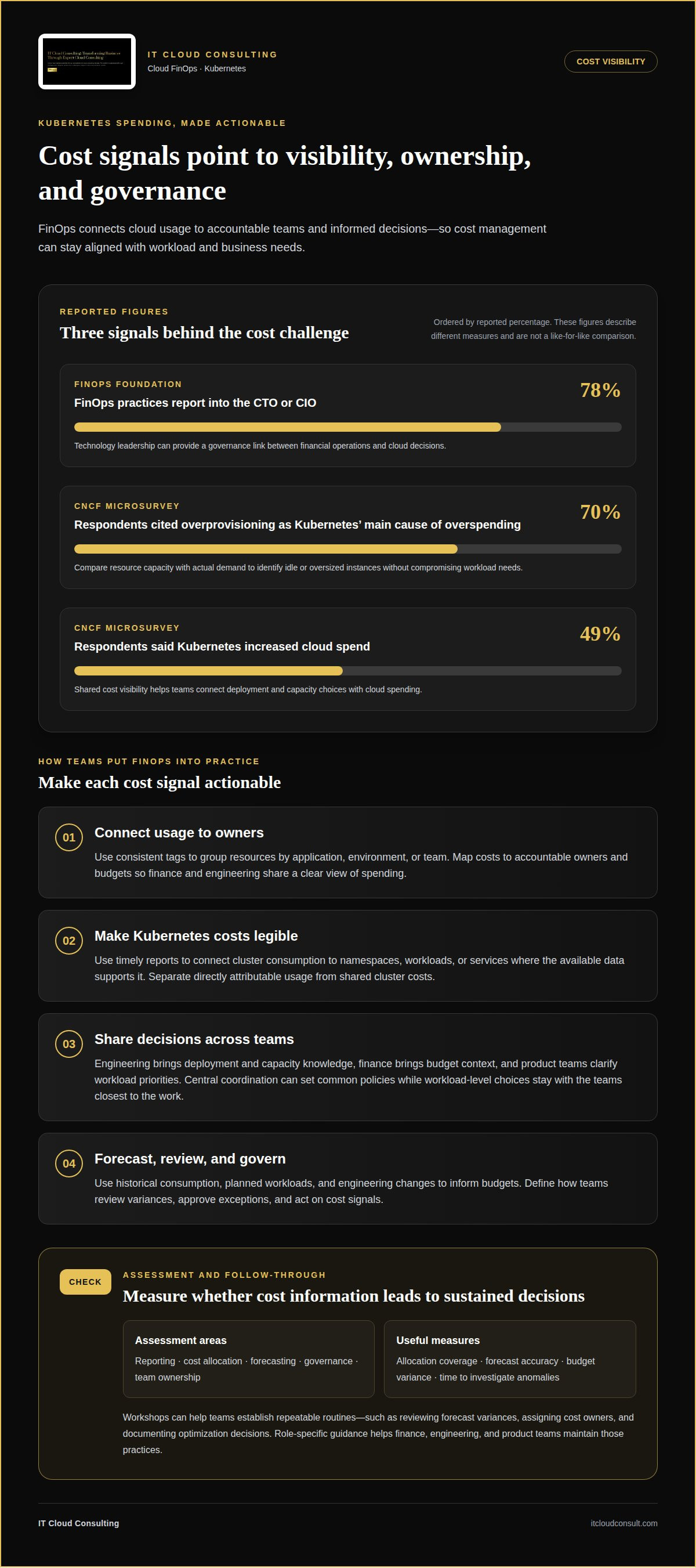
Without timely reports, teams may miss unused resources or overprovisioned services. A CNCF microsurvey found that 70% of respondents cited overprovisioning as Kubernetes’ main cause of overspending. Better visibility helps teams connect usage to decisions and identify optimization opportunities. Savings and ROI depend on the inefficiencies found and the changes teams implement; risks include recommendations that lack clear ownership or disrupt workloads if performance needs are overlooked.
Allocation, Tagging, and Accountability
Tags can group resources by application, environment, or team, giving finance and engineering a shared view of spending. Assess whether tags are applied consistently, then map costs to accountable owners and budgets. When choosing a consulting firm, look for a clear method for assessment, governance, and follow-through across your cloud environment. Evaluate relevant experience and a defined approach to reporting and accountability, rather than relying on a generic “highly rated” list.
Can FinOps consulting work for Kubernetes workloads?
Yes. FinOps applies shared financial accountability to Kubernetes, where engineering, finance, and product teams can connect workload decisions with cloud spending. A CNCF microsurvey found Kubernetes increased cloud spend for 49% of respondents.
Shared Financial Accountability
The FinOps Foundation describes a practice built on collaboration, not finance acting alone. In Kubernetes, engineers understand deployment and capacity choices, while finance brings budget context and product teams clarify workload priorities. A practical operating model gives decisions to the teams closest to each workload, with central coordination for common policies. This keeps technical choices connected to business value without making one team responsible for every cost.
Cloud Spend Visibility
Visibility starts with timely usage and cost reports that teams can interpret. In a Kubernetes environment, reporting should connect cluster consumption to namespaces, workloads, or services where the available data supports that view. Shared cluster resources can complicate allocation, so use a clear method to distinguish directly attributable usage from shared costs. Teams can then identify who owns a change and understand how deployment activity affects spending.
Forecasting and Governance
Forecasting uses historical consumption, planned workloads, and engineering changes to inform budget decisions. Governance defines how teams review variances, approve exceptions, and act on cost signals. A centralized FinOps function can coordinate these practices while engineering teams retain responsibility for workload-level choices. According to the FinOps Foundation, 78% of FinOps practices report into the CTO or CIO, illustrating how governance can connect financial operations with technology leadership.
For organizations aligning cloud strategy with Kubernetes operations, cloud optimization support can help translate cost visibility into coordinated decisions.
FinOps maturity assessments and enablement workshops
An assessment shows how consistently teams connect cloud usage, financial decisions, and business outcomes. Workshops turn those findings into repeatable forecasting and optimization practices.
FinOps Maturity Assessment
A useful assessment examines reporting, cost allocation, forecasting, governance, and team ownership. It identifies where information becomes actionable and where processes still depend on individual effort. A maturity assessment can help organizations understand how their FinOps practices develop over time.
Workshops can turn identified gaps into practical routines. For example, teams can agree on how to review forecast variances, assign cost owners, and document optimization decisions. Improvements may fade after a consulting engagement unless internal teams can maintain the practices. Enablement should therefore include role-specific guidance for finance, engineering, and product stakeholders, not just a presentation of assessment findings.
KPIs for Measuring Maturity
KPIs should show whether teams can use cost information to make and sustain decisions. Useful measures include allocation coverage, forecast accuracy, budget variance, and the time taken to investigate anomalies. The right indicators depend on organizational priorities and available reporting; a growing public-cloud estate may need different views from a tightly governed enterprise environment.
Workforce findings also provide context. In the FinOps Foundation’s 2021 survey, more than 90% of respondents said FinOps was definitely or maybe part of their career path. About 15% said their organization had reached the “run” stage. In the 12 months before that survey, the average FinOps team grew from four to seven people. These figures point to the value of building internal capability alongside process improvements.
Consultant credentials can demonstrate knowledge of FinOps frameworks, but certification alone does not establish delivery experience. Look for practical experience in cloud cost analysis, forecasting, governance, and workshops that help teams own ongoing improvements.
Cloud FinOps consulting and support
Effective FinOps work links assessment, implementation, and ongoing review. A practical framework establishes cost visibility, prioritizes optimization, assigns owners, and tracks whether changes improve cloud value. This gives finance, engineering, and product teams a shared operating rhythm instead of a one-time list of savings ideas.
During assessment, consultants examine cloud usage and cost data, allocation practices, budgets, and governance. They can identify optimization opportunities such as idle infrastructure, oversized resources, or workloads with changing demand. Each recommendation should connect a technical action to an accountable team and a business purpose. For example, an engineering team might review a consistently underused service before changing its capacity.
Implementation turns findings into operational decisions. Teams can define cost owners, establish reporting routines, and incorporate spend reviews into planning. For organizations using multiple providers or supporting global operations, consistent allocation principles help compare usage across environments. Provider-specific billing structures still matter, so reporting should preserve useful detail rather than flatten meaningful differences.
Ongoing support sustains the process as infrastructure and priorities evolve. Regular reviews can track forecast changes, investigate anomalies, assess completed actions, and surface new optimization opportunities. Support also helps teams maintain governance as workloads move or product demand shifts. The aim is not simply to reduce a bill, but to help teams make informed trade-offs among cost, performance, and business requirements.
Before work begins, align on the scope, data access, decision owners, and intended outcomes. Then define how findings will become assigned actions and how progress will be reviewed. This handoff matters: consulting can accelerate early progress, but internal teams need clear ownership to maintain improvements after an engagement ends. For help connecting cloud strategy with practical cost optimization, discuss your cloud cost priorities.
IT Cloud Consulting
IT Cloud Consulting helps organizations connect cloud decisions with operational priorities through strategic guidance, optimization, and ongoing support. Turn to the team when cloud costs are difficult to explain, Kubernetes spending needs clearer ownership, or cost-management practices must continue beyond an initial assessment. Support can align cloud adoption with business goals, identify optimization opportunities, and establish practical ways to sustain progress as workloads change. Discuss your current cloud environment, the cost questions your teams need to answer, and the outcomes you want FinOps practices to support. Contact IT Cloud Consulting to discuss how its cloud consulting services can support your organization.
Make Cloud Cost Decisions Part of How You Grow
Cloud financial management becomes more valuable when it evolves alongside your workloads, teams, and business priorities. Turn your current cost questions into a focused plan: clarify which decisions need ownership, where better visibility would help, and how teams will sustain improvements. This gives cloud FinOps consulting a practical role beyond short-term savings, connecting cloud investment with the outcomes your organization is working toward.
IT Cloud Consulting supports that progress through Strategic Cloud Adoption, Cloud Optimization, and Ongoing Cloud Support. These offerings can help organizations build a cloud approach that fits their goals and continue refining it as needs change. If you’re ready to discuss the cloud cost and operational priorities your teams need to address, contact IT Cloud Consulting. A clear starting point can help your organization move forward with confidence.
Frequently Asked Questions
What is FinOps?
FinOps is a collaborative operating practice that connects cloud usage decisions with their financial impact. It gives engineering, finance, and product teams a shared way to discuss trade-offs, rather than treating cloud bills as finance’s concern alone. For example, an engineering team can explain why a workload needs extra capacity, while finance evaluates how that decision affects forecasts and spending priorities.
What are the pain points being addressed?
FinOps addresses unclear ownership, unpredictable spending, and difficulty linking cloud usage to business activity. A $40,000 anomaly, for example, can take time to resolve if no team owns the affected resources. Unallocated spending also makes it harder to understand which projects drive costs. Better visibility and clear ownership help teams investigate changes and decide what action makes sense.
What should a FinOps consultant deliver in the first 30 days?
A useful early deliverable is a documented view of the current cost-management process, its data inputs, and the teams involved. A consultant can identify priority gaps, propose measurable objectives, and agree on owners for initial actions. For example, a decision register can record each cost issue, its accountable team, business context, and next review point.
When should you hire a FinOps consultant vs doing it in-house?
Internal management may suit organizations spending less than $50K per month on cloud, which may be able to use native AWS, Azure, or Google Cloud tools. External expertise becomes useful when teams lack time, cost ownership is fragmented, or a complex environment makes analysis difficult. The deciding factors include cloud complexity, internal skills, reporting needs, and the capacity to sustain improvements.
Where does FinOps stand today?
FinOps is an ongoing practice, not simply a response to rising bills. The FinOps Foundation describes its lifecycle as Inform, Optimize, and Operate: teams establish useful information, act on opportunities, then embed decisions into routine operations. This structure helps organizations build repeatable processes as cloud environments change, while keeping financial accountability connected to technical and business priorities.
What does cloud FinOps consulting include?
A FinOps engagement can review current practices, identify governance and reporting needs, and shape an improvement plan around business priorities. A well-scoped engagement clarifies the decisions it will support, the stakeholders involved, and how progress will be evaluated. Recommendations may address cost visibility, allocation, forecasting, or optimization, with a practical handoff so internal teams can continue applying the agreed approach.


