
A cloud migration case is only as persuasive as the assumptions behind its numbers. A business case explains the strategic rationale, compares current costs with projected cloud costs, and estimates the investment required for the transition. A cloud business case template organizes these inputs so decision-makers can assess how the case holds up under different conditions.
A potential saving or attractive forecast is not enough. A useful business case makes its assumptions visible, accounts for transition costs, and shows how results may change when adoption, spending, or timing shifts. This clarity helps leaders evaluate the opportunity and make an informed decision.
This guide explains what a business case includes, how to model base, optimistic, and pessimistic scenarios, and how to check the finished case. You’ll learn how to compare costs and benefits, account for less visible investments, and assess whether assumptions are clear, credible, and aligned with business priorities.
Key Takeaways
- Connect the proposed cloud investment to clear business priorities so decision-makers can see why the change matters beyond technology.
- Compare base, optimistic, and pessimistic scenarios; stress-test the case by modeling adoption 20% lower, costs 15% over budget, and a timeline extended by 3 months.
- Build a financial model that compares current and future costs while accounting for transition investments and benefits across a consistent time horizon.
- Strengthen the case with traceable assumptions, quantified benefits, and a final review for overlooked costs and unsupported projections.
What is a Business Case?
A business case explains why an investment matters, what it requires, and how it supports organizational goals. Build it around strategic alignment, the cost of inaction, and risks that could affect expected outcomes.
-
Align Drivers with Strategy
Map each cloud business driver to a specific strategic goal, such as improving resilience, enabling faster service changes, or supporting expansion. Then identify the business outcome each goal should produce and the evidence that will demonstrate progress. For AWS customers, the 2018 IDC survey found business agility benefits were over five times the benefits from infrastructure cost reduction. Use that finding to test whether your case values agility, not only lower infrastructure costs.
-
Set the Strategic Context
Describe the current environment, the business pressure prompting change, and the consequences of maintaining the status quo. A composite manufacturer example involves a 14-year-old legacy ERP platform that will be unsupported from 2027. Use the example’s logic, not its figures, to identify your own dependencies, constraints, and decision points. Explain how inaction could affect operations, risk exposure, or strategic plans, then compare those effects with the proposed transition.
-
Identify Risks and Mitigation Strategies
List risks that could undermine business outcomes, such as delayed adoption, disruption during migration, or underestimated operating needs. For each risk, name an owner, a mitigation action, and an indicator that shows whether the response is working. For example, phase migration around application dependencies and define rollback criteria before moving a workload. This makes risk management part of the decision, rather than a general warning at the end.
-
Define the Decision and Evidence
State what approval the business case seeks and which alternatives decision-makers should compare. Include the assumptions, affected teams, and measures that connect the investment to strategic goals. The IT Governance Institute’s Val IT Framework 2.0 offers a named context for linking IT investments with business value. Use that principle to keep the case focused on organizational outcomes, not technology deployment alone.
Base, optimistic, and pessimistic scenarios
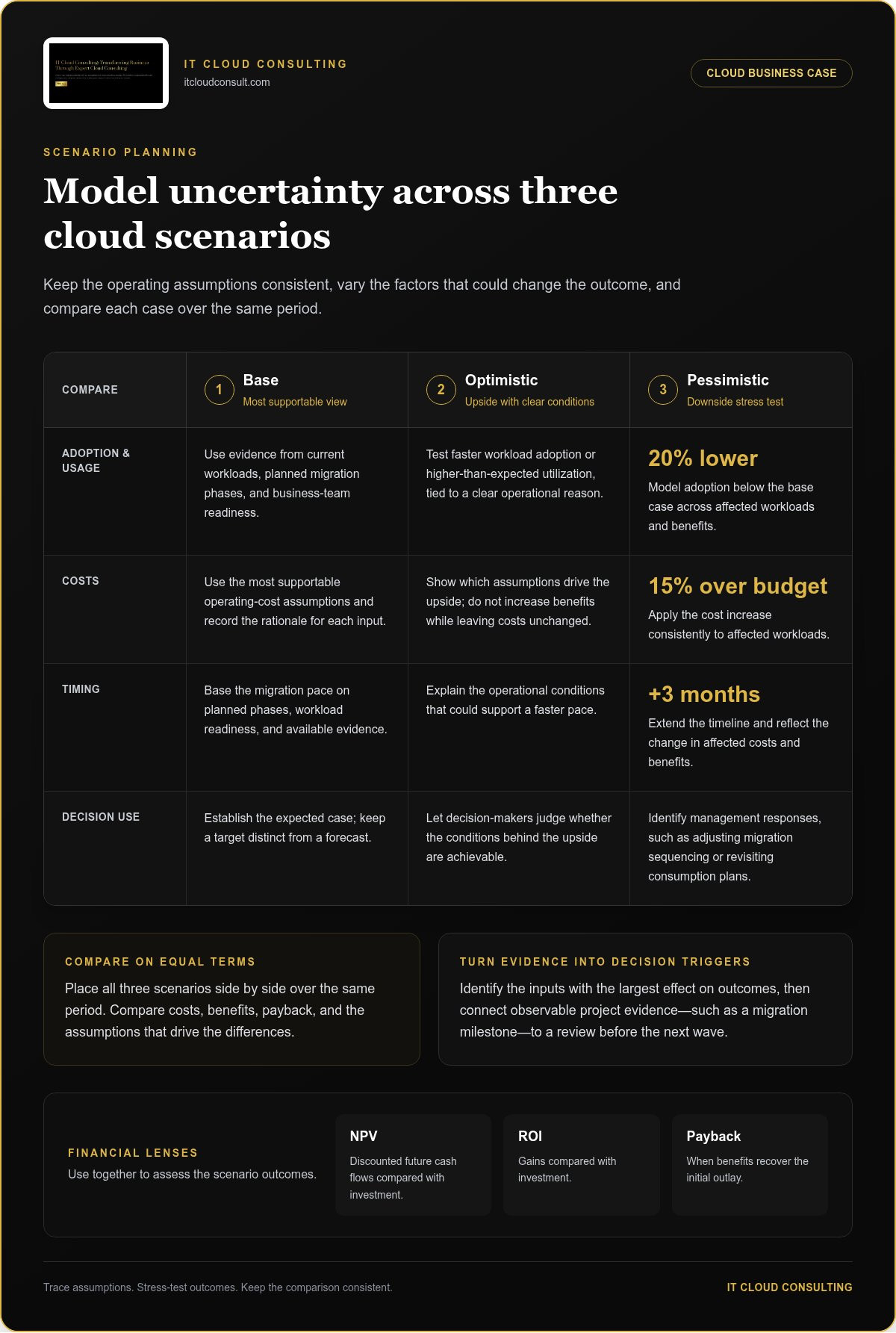
Build three scenarios using the same operating assumptions, then vary the factors that could change the outcome. This makes uncertainty visible instead of disguising it as a single forecast.
-
Define the Base Scenario
Set the base case as your most supportable view of adoption, migration pace, usage, and operating costs. Use evidence from current workloads, planned migration phases, and business-team readiness to justify each assumption. Keep the baseline distinct from desired outcomes: a target is not a forecast. Record the rationale beside each input so reviewers can trace how you built the expected case.
-
Develop the Optimistic Scenario
Model an optimistic case by identifying specific conditions that could improve results, such as faster workload adoption or higher-than-expected utilization. Tie each improvement to a clear operational reason, such as teams adopting a standardized platform sooner. Avoid increasing benefits while leaving costs and timing unchanged. Show which assumptions drive the upside so decision-makers can judge whether those conditions are achievable.
-
Develop the Pessimistic Scenario
Stress-test the case with a pessimistic scenario: model adoption 20% lower, costs 15% over budget, and a timeline extended by 3 months. Apply these changes consistently across affected workloads and benefits. Then identify what management could do if those conditions emerge, such as adjusting migration sequencing or revisiting consumption plans. This turns a downside forecast into a practical response plan.
-
Compare Outcomes and Decision Triggers
Place the three scenarios side by side and compare their costs, benefits, payback, and key assumptions over the same period. Identify which inputs create the largest difference between outcomes, then define decision triggers linked to observable project evidence. For example, a migration milestone can prompt a review of adoption assumptions before the next wave begins. For structured cloud adoption planning, connect scenario assumptions to practical migration decisions.
Building a financial model
Build the model by comparing current and future costs, then adding transition investments and projected benefits. Estimate staffing based on the work required, migration sequencing, and internal capacity. Use NPV, ROI, and payback period together: NPV discounts future cash flows, ROI compares gains with investment, and payback shows when benefits recover the initial outlay.
- Establish the baseline. Inventory current infrastructure, applications, support, and operating costs, then map each item to its future-state equivalent. Separate one-time transition spending from ongoing costs so the comparison remains clear. Model benefits over a consistent 1-year, 3-year, or 5-year period; a 5-year view can reveal costs and returns that a shorter horizon misses.
- Estimate transition time and staffing. Break migration into workstreams, sequence applications by dependencies, and estimate duration from complexity, readiness, and available capacity. Include internal staff time: a transformation cost model can allocate 20-30% of full-time capacity for 6-12 months. Add training, change management, testing, and contingency as separate assumptions, rather than hiding them inside a general project estimate.
- Calculate financial measures. Use NPV to compare discounted future cash flows with investment, applying the company’s weighted average cost of capital as the discount rate. Calculate ROI against total investment and net benefits. Divide initial investment by annual net returns for simple payback; a $250,000 project returning $25,000 per year has a 10-year payback period.
- Review the model’s decision value. Show yearly costs, benefits, cash flows, and assumptions so finance and technology leaders can trace each result. Test whether the payback period aligns with the organization’s investment expectations; cloud decisions generally target 3 years or less. Keep the model usable for negotiations by presenting the underlying figures and their drivers, not only a final total.
Cloud business case quality checks
Compare cloud providers and deployment models using the same workloads, service assumptions, security needs, and operating responsibilities. You can create a free cloud business case template in a spreadsheet, with fields for assumptions, evidence, costs, benefits, and scenario results.
- Trace each benefit to evidence. Connect every projected benefit to a named data source, baseline metric, and accountable business owner. Harvard Business Review research found that cases with quantified benefits tied to named sources and baseline metrics were approved 2.7 times faster than cases using qualitative descriptions. Replace claims such as “improved agility” with a measurable outcome and its calculation method.
- Reconcile costs against the migration plan. Check that infrastructure, migration, internal staff time, training, change management, and ongoing operations appear in the model. Compare each cost with a workstream, owner, and timing assumption. Deloitte reported that 68% of rejected business cases fail at the cost-benefit stage, often because costs are undercounted. Review the model for missing categories before presenting its totals.
- Test assumptions and document risk. Confirm that workload usage, adoption, timelines, and expected benefits match the scenario assumptions. For each material assumption, record its evidence and explain what changes if it proves inaccurate. Gartner research found that business cases over 40 pages have lower approval rates. Keep supporting detail available, while making the decision, key evidence, and risks easy to locate.
- Make the model reviewable. Ask finance, technology, and business stakeholders to trace a sample benefit from source data through calculation to the final result. Record disagreements and revise unsupported inputs before approval. A reusable spreadsheet template should include version details, assumptions, evidence, and scenario outputs. For help strengthening cloud adoption planning, get support reviewing your business case.
IT Cloud Consulting: Strategic Cloud Adoption
IT Cloud Consulting helps organizations turn cloud business case decisions into a structured adoption plan. If your model is ready but migration priorities, dependencies, or business alignment need further definition, Strategic Cloud Adoption can connect the investment rationale with implementation planning. As workloads move and actual usage becomes clearer, Cloud Optimization can align cloud resources with evolving requirements. Ongoing Cloud Support helps teams maintain continuity and focus as the cloud environment develops. These services can help your organization move from financial analysis toward a practical cloud roadmap. Contact IT Cloud Consulting to discuss your cloud adoption plans.
Turn the Business Case Into a Decision Framework
A cloud investment case should continue to guide decisions after approval. Treat a cloud business case template as the foundation for an operating document, not a file to set aside once funding is secured. As priorities, workload needs, and actual usage evolve, revisit the original assumptions and use updated evidence to inform the next steps.
This creates a clearer link between strategy and execution. Teams can recognize when planned outcomes are taking shape, identify assumptions that need attention, and make adjustments with the original business rationale in view. The model can then support ongoing governance, rather than serving only as an approval tool.
For organizations ready to translate their case into a practical cloud roadmap, contact IT Cloud Consulting. A considered next step can help your team move forward with greater clarity and purpose.
Frequently Asked Questions
How do you build the financial model?
Compare each workload’s current operations with its proposed cloud design. Start with an inventory, then account for variable consumption, data movement, and costs that differ by workload. A cloud business case template should identify who owns each assumption and the evidence supporting it. This makes updates traceable as demand changes or workloads move in phases.
How do you handle benefits that are difficult to quantify?
Use a measurable proxy that reflects the benefit’s effect on work or customers. For example, assess whether a more accessible application reduces manual steps or whether improved service resilience reduces disruption to business processes. Record the baseline, measurement method, and responsible team. Keep qualitative outcomes separate from financial benefits until you can connect them to defensible evidence.
How do you move beyond cost savings to real business value?
Link the investment to a strategic outcome, then identify how teams will recognize progress. If a business goal is to launch services faster, examine whether cloud capabilities remove a specific delivery constraint. For resilience, assess how the change supports continuity of critical operations. This connects technology decisions to organizational priorities instead of treating lower infrastructure spending as the only measure of success.
How do you quantify the financial impact of cloud?
Separate direct financial effects from operational improvements, then show how each affects business performance. For example, estimate the value of reduced manual effort only when teams can explain how they will use that capacity. Distinguish gross benefits from net benefits after operating and transition costs. Document calculation methods so finance reviewers can follow how each assumption contributes to the overall result.
How quickly can you expect ROI from cloud?
Many organizations see measurable ROI from cloud within the first year. In your case, timing depends on when benefits begin and when they offset transition and ongoing operating costs. Distinguish the migration completion date from the point when business teams realize the benefit. Track actual outcomes against the model so leaders can see whether value is emerging as planned.
Is cloud always cheaper than on-premises?
No. Cloud costs depend on workload usage, architecture, data movement, licensing, and operational requirements. A workload with steady demand may have a different cost profile from one with significant variation. Compare each workload’s full operating needs rather than assuming a move will automatically reduce spending. A sound decision accounts for cost alongside performance, resilience, and strategic fit.


