
Cloud spending creates value only when its full cost is weighed against the business outcomes it enables. A cloud economic assessment compares the costs and operational demands of cloud adoption with potential benefits, including flexibility, productivity, and more efficient resource use. It gives decision-makers a clearer basis for choosing whether to migrate, optimize, or take a phased approach.
Pay-as-you-go pricing can reduce the need for upfront infrastructure investment, but costs still depend on how resources are used and managed. FinOps connects cloud spending with usage and business value, helping teams assess more than the bill alone. This article explains the main components of cloud economics, how FinOps and consumption-based pricing affect costs, and where cloud computing can deliver economic benefits.
Key Takeaways
- Build a fuller view of cloud value by accounting for customer costs across cloud services, SaaS, and other business expenses.
- Use FinOps to connect cloud usage with operational outcomes and choose cost measures that reflect how customers use your services.
- Pay-as-you-go pricing can align spending with demand, but active cost management helps prevent usage from drifting beyond business needs.
- Assess whether cloud capacity and operating costs support your goals, rather than assuming that moving workloads will automatically reduce spending.
What is Cloud Economics and Why is it Important?
A cloud economic assessment compares cloud costs with operational needs, security, compliance, and expected business value. It helps decision-makers evaluate migration options by considering total cost, customer demand, and potential revenue impact.
Cloud Cost Scope
Cloud cost scope covers the full expense of serving a customer across cloud infrastructure, SaaS, and related business operations. This matters because a low infrastructure bill can hide costs elsewhere. Include data transfer, storage, software licensing, and support, as well as planning, migration, architecture, and ongoing operations. For example, a customer’s cost may include cloud storage, a SaaS subscription, and support labor. Compare that total with the revenue or service value associated with the customer.
Include data-transfer charges, storage use, licensing, and support in one cost model instead of relying on basic cloud pricing alone. Add application integration and testing, security, compliance, and staff training where relevant.
Cost Data Ownership and Transparency
Cost data ownership assigns responsibility for collecting cloud usage, SaaS, and operating-cost information to the teams best placed to explain it. Clear ownership matters because finance, engineering, and business teams need a shared view of spending. A central analysis can combine invoices, usage records, and cost allocations, then link each expense to a service, team, or customer.
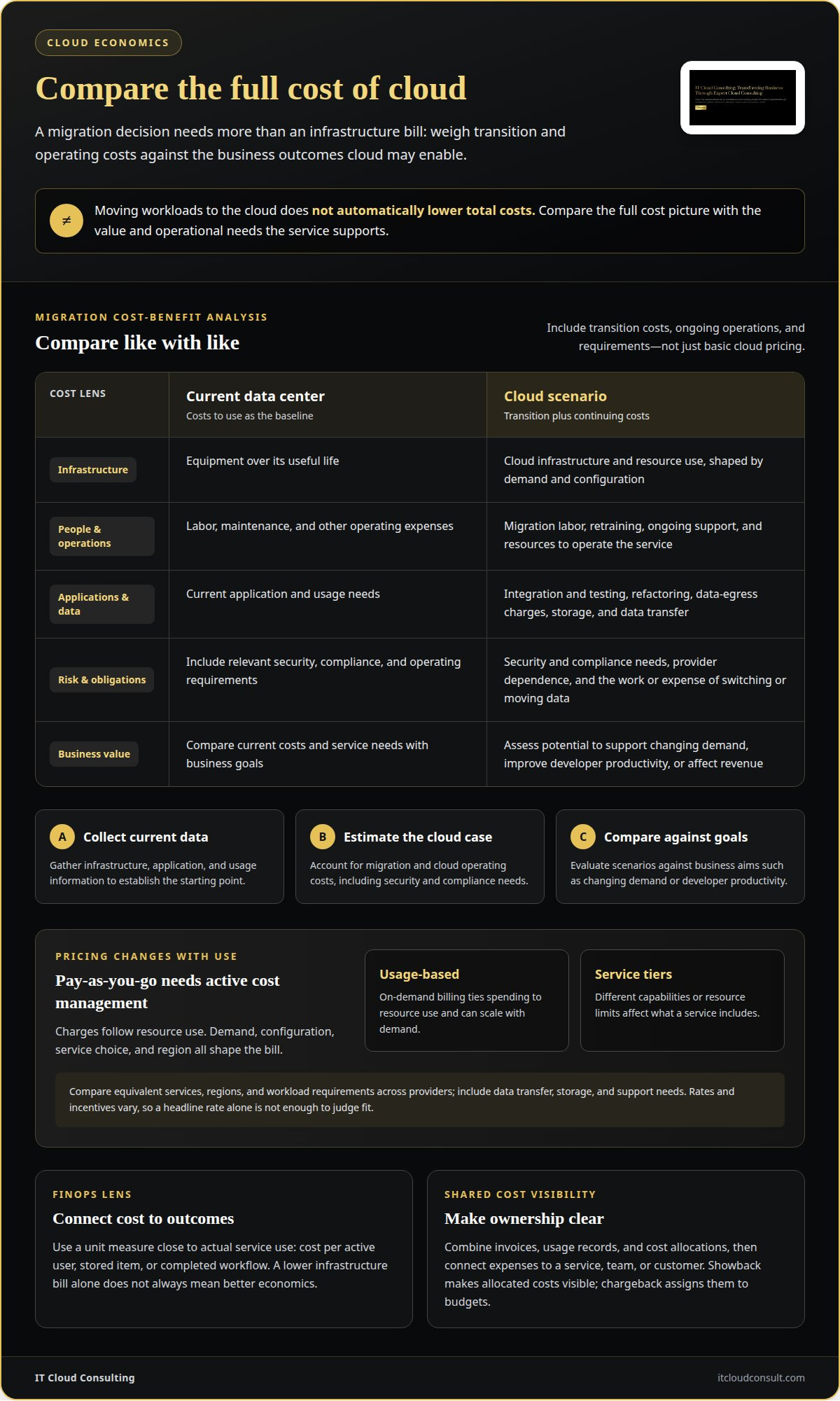
Showback reports make allocated costs visible to the teams using resources; chargeback assigns those costs to their budgets. Either approach can clarify trade-offs and support strategic alignment. For example, a product team can compare infrastructure costs with customer demand and revenue before expanding a service.
Migration Cost-Benefit Analysis
Migration cost-benefit analysis weighs transition and operating expenses against the benefits a cloud architecture may enable. Moving workloads does not automatically lower total costs. Include labor, application integration and testing, refactoring, retraining, data-egress charges, and ongoing support. Then compare cloud scenarios with current data-center costs, including equipment over its useful life, labor, maintenance, and other operating expenses.
A practical assessment starts by collecting current infrastructure, application, and usage data. Next, estimate migration and cloud operating costs, including security and compliance needs. Finally, compare scenarios against business goals, such as supporting changing demand or improving developer productivity. Security exposure, compliance obligations, and provider dependence can also affect the economics. Include the resources needed to manage security and compliance, and consider how switching or moving data could add work and expense.
FinOps and cloud economics
FinOps connects cloud spending with operational performance and business outcomes. It helps an organization make infrastructure decisions using shared financial and engineering insight.
Cloud Unit Economics
Cloud unit economics ties infrastructure spending to a measurable business output, such as weekly active users. FinOps uses that relationship to guide decisions beyond the invoice total. Teams can track cost per active user, stored item, or completed workflow, choosing a measure close to actual use. Lower infrastructure consumption does not always mean better economics. If compression reduces storage needs while serving the same number of items, cost per item may reveal value more clearly than cost per gigabyte.
Cloud Cost Estimation and Optimization Tools
Cloud cost management tools use usage and billing data to estimate expenses and detect anomalies. They help teams review resource patterns, compare scenarios, and identify workloads that may be poorly sized. Workload sizing can reduce the risk of overprovisioning or underprovisioning cloud infrastructure. Anomaly alerts can flag unexpected changes for investigation. Treat estimates as decision inputs, then assess proposed changes against service performance and business objectives.
FinOps depends on collaboration among finance, engineering, and operations. Finance can explain budget priorities, while engineers connect resource use to workload behavior and developer productivity. Operations teams contribute information about reliability and support needs. Together, they can set unit-cost objectives, review performance, and decide which optimization work deserves attention. For example, an engineering team might evaluate a storage change by comparing its effect on cost per stored item and application performance. This approach makes cloud cost decisions part of ongoing product and infrastructure planning.
Organizations building these practices into everyday decisions can use Cloud Optimization to align infrastructure choices with usage and operational goals.
Pay-as-you-go cloud pricing
Pay-as-you-go pricing ties charges to resource use, so demand and configuration shape the bill. A sound pricing strategy considers workload patterns, service tiers, and cost controls together.
Provider, Region, and Workload Pricing
Provider, region, and workload pricing describe how service choices and resource use influence cloud charges. Comparing AWS, Azure, and Google Cloud requires matching equivalent services, regions, and workload requirements. Rates and incentives vary, so a headline rate alone cannot show which option fits. For example, steady processing demand and occasional data-heavy workloads may favor different configurations, even within one provider.
Typical models include on-demand, usage-based billing and service tiers with different capabilities or resource limits. Current AWS, Azure, and Google Cloud rates depend on the chosen service, region, workload, and applicable pricing terms. Compare the same workload assumptions across providers, then include data transfer, storage, and support needs.
On-Demand Pricing Risks
On-demand pricing lets organizations scale resources with demand, but variable use can make spending difficult to predict. Workloads may run longer than intended, or resources may remain active after demand falls. The example shows why active monitoring matters.
Cost optimization pairs usage visibility with ownership and controls. Teams can set budgets, review alerts, and investigate unusual consumption before it becomes persistent. For instance, an unexpected increase in processing demand should prompt a review of workload duration and resource sizing. These checks help align flexible capacity with business needs.
Service tiers also affect pricing strategy. A higher-capability tier may suit a workload requiring specific performance or support, while a less demanding service may meet another workload’s needs. During migration planning, compare tiers with workload requirements and expected usage, not just the listed rate. Revisit the comparison as demand changes, since the best-fit tier can shift with application behavior. Tracking choices by workload makes later cost reviews more useful and gives engineering and finance teams a clear basis for refining cloud usage.
Economic benefits of cloud computing
Cloud computing can change both how an organization funds technology and how it responds to demand. Traditional IT systems often require buying and maintaining capacity ahead of need, leaving some equipment unused. Cloud elasticity lets teams scale resources as requirements change, aligning computing capacity more closely with actual workloads. The economic benefit comes from matching resource use to business needs, not simply moving infrastructure.
Cloud adoption also shifts spending from capital expenses to operating expenses. Instead of owning excess equipment, an organization pays for the cloud services and resources it uses. That shift can support more flexible planning, but it changes how finance teams forecast and track expenses. For example, a business with fluctuating demand can adjust capacity instead of maintaining the same peak-level hardware during quieter periods.
Productivity is another factor in the economic case. Cloud services can give developers and engineers access to infrastructure for building, testing, and releasing work. An assessment should consider whether those capabilities improve workflows, not only whether they reduce direct costs. For example, if a team spends less time maintaining infrastructure, it can devote more effort to product improvements or customer needs. Include those operational gains alongside financial measures.
Sound decisions connect cloud costs with a clear unit of business value. A company might track cost per active user or per completed transaction, then compare that measure with service performance and demand. This shows whether added computing capacity supports more customer activity or simply increases expenses. It also helps leaders compare cloud scenarios against organizational priorities, such as responsiveness, development capacity, or growth, rather than judging each option by total spend alone.
Cloud benefits are clearest when teams connect capacity, productivity, and business outcomes in one analysis. Explore a strategic cloud adoption approach to evaluate how cloud computing can support your organization’s objectives.
IT Cloud Consulting
IT Cloud Consulting helps organizations turn cloud cost findings into practical adoption and optimization decisions. When an assessment identifies migration trade-offs, unclear workload costs, or opportunities to improve existing infrastructure, Strategic Cloud Adoption and Cloud Optimization can shape the next steps. Ongoing Cloud Support helps sustain cloud operations as needs evolve.
The right next move may be a phased migration, adjustments to current resources, or further analysis before changing workloads. The focus is aligning cloud decisions with your organization’s objectives, operating demands, and measures of value, rather than treating migration as an automatic cost reduction.
Contact IT Cloud Consulting to discuss how your cloud economics findings can inform your next decision.
Turn Cloud Economics Into a Forward Plan
A cloud economic assessment can do more than inform a migration decision. It can establish a lasting framework for connecting technology choices with organizational priorities as demand, services, and goals evolve. The next step is to turn that framework into decisions teams can own, revisit, and refine as cloud use changes.
IT Cloud Consulting supports that progression through Strategic Cloud Adoption, Cloud Optimization, and Ongoing Cloud Support. Whether you’re planning a transition or improving an existing environment, align the work with the outcomes your organization values and the operational realities your teams manage. This creates a practical foundation for sustainable cloud decisions without treating a single forecast as the final word.
Contact IT Cloud Consulting to discuss how to move from assessment to a cloud plan that supports your business objectives. A clear next step can help your organization build confidently toward what comes next.
Frequently Asked Questions
How many metrics are needed?
There’s no fixed number of metrics that suits every organization. Select a focused set that connects technology performance to business decisions, such as service reliability, customer activity, and delivery speed. For a customer-facing application, a team might track cost per transaction alongside response quality. Add a metric only when it helps explain a decision, expose a trade-off, or show whether an initiative is meeting its objective.
Transformation in the cloud | at what cost?
The cost of cloud transformation depends on the workloads, architecture, and organizational changes involved. A data-heavy application may require more transfer planning, while a tightly connected legacy system may need additional integration work. Training, security controls, and changes to operating processes also affect the effort. Model these factors against expected outcomes, then consider whether a phased transition better fits the organization’s priorities and capacity.
What are the 4 pillars of a cloud value framework?
A practical four-part framework can assess financial efficiency, business agility, operational resilience, and innovation capacity. Financial efficiency examines resource use; agility considers how quickly teams can respond to demand. Resilience looks at continuity needs, while innovation capacity considers whether cloud capabilities help teams deliver useful services. These categories provide a planning structure, not a universal standard, so adapt them to the outcomes your organization values.
What is a cloud economic assessment?
A cloud economic assessment evaluates whether cloud adoption or a particular cloud design makes sense for an organization’s objectives and operating conditions. It considers technology expenses alongside business effects, including productivity, demand, and the resources needed to manage the environment. The results help leaders compare options, identify trade-offs, and decide whether to migrate, adjust the plan, or retain existing arrangements.
What costs should a cloud economic assessment include?
Include more than infrastructure charges. Account for storage, networking, backup, security, data transfer, software licensing, support, and the staff time needed to operate cloud services. Migration may also involve application integration, testing, refactoring, and training. For example, a workload with frequent data movement can incur transfer expenses that a compute-only estimate misses. Include these categories to build a useful picture of ongoing and transition costs.
How do you calculate total cost of ownership for cloud vs on-premises infrastructure?
Use the same workloads, evaluation period, and service requirements for both scenarios. For on-premises infrastructure, include equipment costs across its useful life, labor, maintenance, facilities, and operating expenses. For cloud, include service usage, migration, integration, testing, operations, and data transfer. Add architecture and continuity requirements to both models, then compare total costs and relevant business outcomes using consistent assumptions.


