
A data platform can move to the cloud and still leave data difficult to secure, govern, or use. Cloud data platform modernization means moving data from legacy systems into scalable cloud or hybrid environments while improving security, processing efficiency, and analytics. The goal is not simply to relocate data, but to build a stronger foundation for using it with confidence.
This broader change matters because data often sits in disconnected systems, while older infrastructure can slow access and complicate oversight. Modernization brings cloud computing and big data technologies together in a coordinated platform, with governance and security built into data management.
This article explains what data modernization involves, how governance and security protect information, and how cloud technologies support integration, scale, and analysis. It also explores the choices that shape a modernization roadmap, helping you understand how to evolve a data platform to meet your organization’s needs.
Key Takeaways
- Recognize when legacy systems, data silos, or slow performance signal a need to modernize, and distinguish a relocation from a broader platform transformation.
- Build governance and security into data management through clear policies, controlled access, and consistent safeguards.
- Match cloud and big data technologies to the work your platform needs to support, from integration and analytics to flexible storage and processing.
- Shape a migration roadmap around data quality, governance, validation, and a cutover approach that fits your systems and goals.
What is Data Modernization?
Data modernization updates an organization’s data infrastructure so it can support secure, efficient operations and changing demand. It may include cloud migration, improved governance, data cleansing, and redesigned analytics.
Migration and Modernization Distinctions
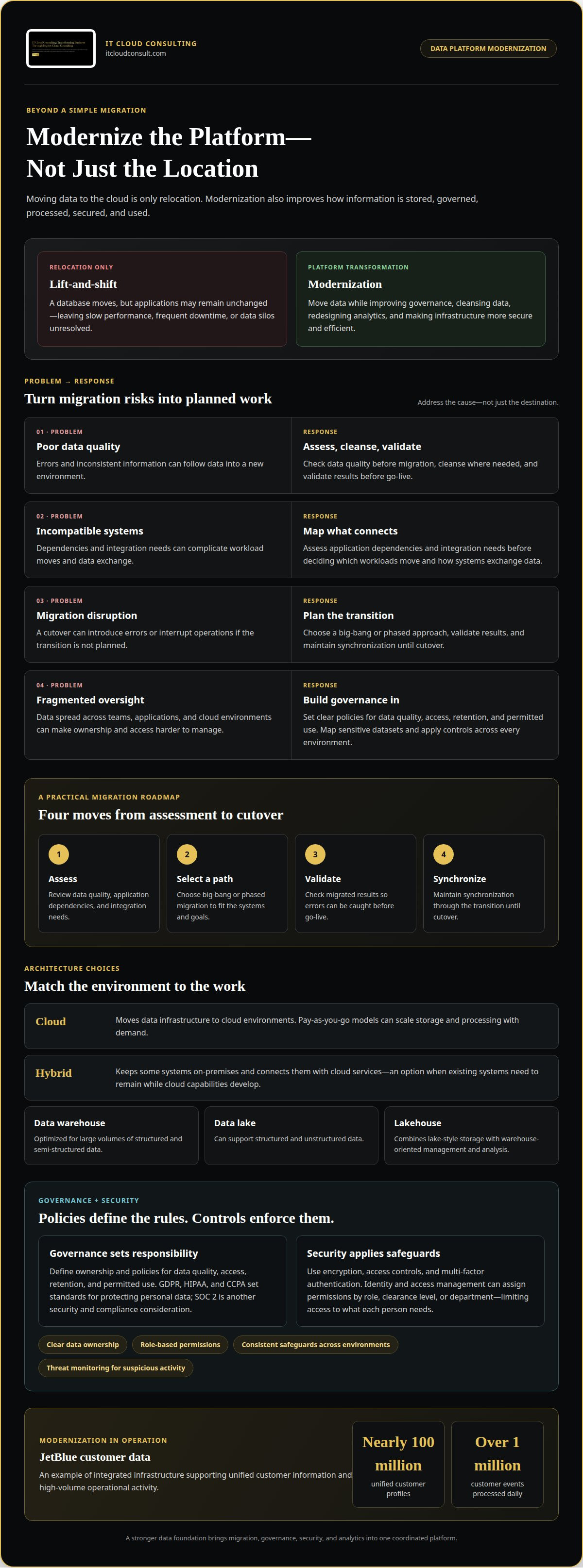
Data migration moves information between systems; modernization also improves how an organization stores, governs, processes, and uses it. Cloud migration can be part of modernization, but a lift-and-shift may simply relocate a database while leaving applications unchanged. The distinction matters: modernization should address problems such as slow performance, frequent downtime, or data silos instead of reproducing them in a new environment.
Cloud and Hybrid Migration Paths
A cloud path moves data infrastructure to cloud environments, while a hybrid path keeps some systems on-premises and connects them with cloud services. Hybrid architecture can suit organizations that need to retain existing systems while developing scalability and cloud-based capabilities. For an SAP S/4HANA migration, teams can assess data quality, application dependencies, and integration needs before choosing which workloads move and how systems will exchange data.
Modernization Roadmaps and Costs
A roadmap assesses data quality, selects a big-bang or phased migration, validates results, and maintains synchronization until cutover. These steps help teams catch errors before new systems go live. Cloud pay-as-you-go models can scale storage and processing with demand. Migration and ongoing-operation costs depend on data volume, complexity, integration, and support needs; service pricing is provided after a quote request.
Customer examples show what modernization can enable. JetBlue maintains nearly 100 million unified customer profiles and processes over one million customer events daily. These figures illustrate how integrated data infrastructure can support customer information and high-volume operational activity.
Common risks include poor data quality, incompatible systems, and migration disruption. Teams can reduce these risks by cleansing data, mapping dependencies, validating results, and maintaining synchronization through cutover.
Data governance and security
Data governance defines how an organization manages and protects information across its infrastructure. Clear policies assign responsibility for data quality, access, retention, and permitted use. Without these controls, legacy systems and expanding workloads can make oversight harder as data moves among teams, applications, and cloud environments.
Governance also shapes how organizations address requirements for sensitive information. GDPR, HIPAA, and CCPA set standards for protecting personal data, while SOC 2 is another consideration for organizations managing security and compliance needs. Policies and procedures help keep information secure, accurate, and compliant. They also clarify who owns each dataset and how staff should handle it.
Security controls put those policies into practice. Encryption protects data, while access controls limit who can view or change it. Multi-factor authentication adds an identity check. Identity and access management can assign permissions by job role, clearance level, or department, restricting access to what each person needs. For example, a finance team member may need financial records but not unrelated customer data.
Automated controls reduce repetitive manual work and apply consistent rules across data assets. Threat monitoring can alert teams in real time to suspicious activity or potential incidents. These capabilities matter during modernization because a new cloud architecture may connect previously separate systems and workloads. Teams should map sensitive datasets, define access rules, and apply controls across every environment, including hybrid systems.
Aging infrastructure also deserves attention. The U.S. Environmental Protection Agency notes that aging information technology can threaten information security and limit information-management capacity. When reviewing legacy systems, organizations can prioritize security weaknesses alongside operational needs. That assessment helps teams design an enhanced architecture where authorized users can access governed data without making every dataset broadly available.
For organizations aligning cloud architecture with governance priorities, a structured cloud adoption strategy can help connect platform decisions with security objectives.
Cloud computing and big data technologies
Cloud computing gives an enterprise flexible environments for storing and processing data as demand changes. Big data technologies help manage varied, high-volume information and support analysis across sources. Data modernization became a significant focus in the late 2000s and early 2010s, as organizations sought infrastructure better suited to integration, intelligence, and innovation.
Architecture should reflect the data and workloads an organization needs to manage. A data warehouse is optimized for large volumes of structured and semi-structured data. Data lakes and cloud data warehouses can support structured and unstructured data. A lakehouse combines lake-style storage with warehouse-oriented management and analysis, making it an option when teams need both flexibility and organized access.
Data integration connects separate sources, such as customer relationship management and enterprise resource planning systems, to create a unified view. Analysts can then examine related information together instead of working across disconnected environments. For example, combining sales and inventory records can help an enterprise understand how stock levels relate to customer demand.
Distributed SQL databases can distribute and replicate data across nodes and regions, supporting high availability and fault tolerance. Managed database services shift database maintenance and management to a third-party provider. Modern platforms can also automate data cleansing, transport, and reporting. These capabilities reduce manual processing and help teams move information efficiently from source systems into analytical workflows.
Technology choices should reflect the work the platform needs to support. A warehouse may suit structured reporting, while a lake can accommodate varied data types; a lakehouse can bring those needs together. Cloud pay-as-you-go models let organizations scale storage and processing more precisely. This flexibility supports changing workloads, but integration and data management still require deliberate architectural planning.
What are the steps in a cloud data platform modernization roadmap?
A roadmap connects business goals with migration decisions, technical design, and operational readiness. For example, a reporting project may prioritize trusted metrics, while a customer analytics initiative may require integrated data and faster access.
- Set outcomes and scope. Identify the decisions or workflows the new platform must support. Map source systems, dependent applications, data owners, and workloads so the team can define boundaries and priorities.
- Assess data and dependencies. Review data quality, formats, access patterns, and system connections. Record how applications exchange information, since overlooked dependencies can disrupt operations during a move.
- Design governance and architecture. Assign data ownership, establish access policies, and define how information will move between environments. Plan for future modernization so the first migration does not lock the organization into a narrow design.
- Select the migration approach. Choose a big-bang move when coordinated cutover fits the systems, or a phased approach when workloads can transition in stages. Set synchronization requirements for systems that must remain aligned during the transition.
- Test, validate, and cut over. Compare migrated records with source data, test application connections, and resolve discrepancies before cutover. Keep synchronization active until the transition is complete, then monitor data quality and operational workflows.
Governance and validation belong throughout the roadmap, not just at launch. A phased migration, for example, can uncover data-mapping issues in an early workload before later systems move. Teams can use those findings to refine controls and migration methods, then apply the improvements to subsequent workloads.
Cloud modernization timelines range from a few months to over a year, depending on organizational size, complexity, goals, and migration and integration needs. A defined scope and dependency map help teams plan around those factors. For support shaping a cloud transformation roadmap, develop a strategic cloud adoption plan with IT Cloud Consulting.
IT Cloud Consulting: Strategic Cloud Adoption
IT Cloud Consulting helps organizations plan cloud adoption and optimize cloud environments as their data platforms evolve. Its Strategic Cloud Adoption offering supports teams in setting migration priorities, target architecture, and an approach aligned with their goals. Cloud Optimization helps refine existing environments, while Ongoing Cloud Support provides continued assistance as operational needs change.
Consider this support when your team is weighing migration paths, aligning workloads with business priorities, or planning how a modernized platform will operate over time. A structured cloud strategy connects these decisions and helps teams move from assessment to implementation with clearer direction.
To discuss your cloud adoption needs, contact IT Cloud Consulting.
Set Your Data Platform’s Next Direction
The next phase of cloud data platform modernization starts with a clear decision about what your data infrastructure should make possible. Identify the business priorities that matter most, then align platform changes with the teams and decisions they need to support. This gives technical planning a purpose beyond moving systems and keeps future choices connected to organizational goals.
IT Cloud Consulting offers Strategic Cloud Adoption for organizations planning their cloud direction, Cloud Optimization to refine cloud environments, and Ongoing Cloud Support for operational needs. Each offering can contribute at a different stage of the cloud journey, from planning through continuous improvement.
Consider which platform decisions would help your organization move forward with greater clarity. Explore your cloud modernization options with IT Cloud Consulting, and take the next step toward a data platform that can evolve alongside your goals.
Frequently Asked Questions
What is Cloud Modernization and Consolidation?
Cloud modernization improves how an organization’s technology supports its work, while consolidation reduces duplication across systems or environments. They can happen together but serve different purposes. For example, a company might modernize its reporting platform while consolidating overlapping databases used by separate departments. Defining each goal helps teams avoid treating a smaller system footprint as proof that the underlying platform is ready for future needs.
What is cloud data platform modernization?
Cloud data platform modernization is the broader evolution of a cloud-based data environment to support an organization’s changing analytical and operational needs. It involves more than transferring records: architecture, data access, and platform operations also shape the outcome. For example, a company can redesign its data environment for a new forecasting workflow while keeping existing business reports available during the transition.
What are the main benefits and business drivers of modernizing a data platform in the cloud?
Common drivers include making trusted information more useful for decisions, accommodating changing workloads, and enabling new analytical projects. A retailer, for example, might want its planning team to compare sales and inventory information when adjusting product orders. A modernized platform can provide a foundation for that work, while the organization defines success through the decisions, processes, or services it wants to improve.
What tools and services support cloud data migration, integration, governance, and analytics?
Organizations use migration utilities, data connectors, integration pipelines, governance controls, and analytics tools. Choose them based on practical requirements: source-system compatibility, data transformation needs, access rules, and traceability from source to report. For example, a pipeline supporting a finance dashboard should preserve key measure definitions, so teams can understand how reported figures were created and maintain consistency across analyses.
What security, privacy, compliance, and data residency requirements apply to cloud data platforms in the United States?
Requirements depend on the information handled, the organization’s sector, applicable laws, and contractual commitments. HIPAA, GDPR, and CCPA address protection of sensitive personal data in relevant contexts; SOC 2 is a control framework, not a law. Organizations should classify data, identify applicable obligations, and document where information may be stored or processed to guide architecture and access decisions.
How can organizations measure the success and ROI of a cloud data platform modernization project?
Set a baseline before work begins, then measure outcomes against the project’s goals. Useful indicators include platform operating costs, time needed to prepare analysis, data-quality issues, service interruptions, and adoption of new reporting capabilities. For example, a team focused on faster forecasting can compare the time required to produce forecasts before and after implementation, alongside the resources needed to maintain the process.


