
A cloud computing implementation plan succeeds when it links a clear business need to a governed, phased migration. Define the use case and measurable goals first. Then assess infrastructure, application dependencies, security requirements, and internal skills before prioritizing workloads.
Moving systems to the cloud can create new opportunities, but technology alone does not determine the outcome. A roadmap gives teams a shared basis for decisions, helps manage risk and costs, and clarifies responsibilities as services change.
This guide covers how to build that roadmap, from readiness and workload planning to migration governance, least-privilege access, and ongoing optimization. Staged delivery, appropriate safeguards, and clear ownership can make cloud adoption a deliberate business transformation rather than a series of disconnected technical moves.
Key Takeaways
- Give employees access only to the cloud files and applications their roles require, and build encryption, recovery, and auditability into security design.
- Use migration governance to clarify decision rights, manage application dependencies, and validate workloads through a controlled test before launch.
- Compare cloud providers against workload needs and review service-level agreements for support, escalation, and resolution terms.
- Turn business goals into a phased roadmap with measurable outcomes, clear ownership, readiness reviews, and plans for employee adoption.
Cloud security and least-privilege access
A secure cloud environment combines restricted access, protected data, and controls aligned with business obligations. Include these safeguards in the cloud computing implementation plan before moving workloads.
Security and Compliance Integration
Security and compliance integration means designing access controls, encryption, monitoring, and recovery around the organization’s data and obligations. It matters because controls added after migration can leave gaps between how teams use technologies and how sensitive information must be protected. Map relevant frameworks, such as HIPAA, PCI DSS, GDPR, or SOC 2, to architecture requirements, then assign owners for each control.
Privacy and Cloud Safety
Cloud privacy and security protect personal information and help keep services recoverable during disruption. Customers remain primarily responsible for processing personal data, even when a cloud provider handles it as an external processor. Organizations accessing cloud servers across jurisdictions should comply with the laws that apply in each jurisdiction. For sensitive data, assess geographic restrictions and compliance needs when selecting cloud services.
Apply least privilege by giving each employee access only to the files and applications their role requires. For example, a finance analyst may need billing records but not production systems. Review permissions when roles change, remove access that is no longer needed, and use separate accounts for routine and administrative work. These steps limit unnecessary exposure if credentials are misused.
Build protection into the application design. Encrypt data in transit and at rest, including backups, and use audit trails to record access and important changes. Plan business continuity and data recovery around the systems the enterprise depends on most. Cloud threats can exploit exposed services, weak credentials, or excessive permissions, so monitor infrastructure and application activity. Test recovery processes to confirm teams can restore data and resume operations. Together, these controls make a cloud deployment safer to operate and easier to govern.
Why is cloud governance important during cloud migration?
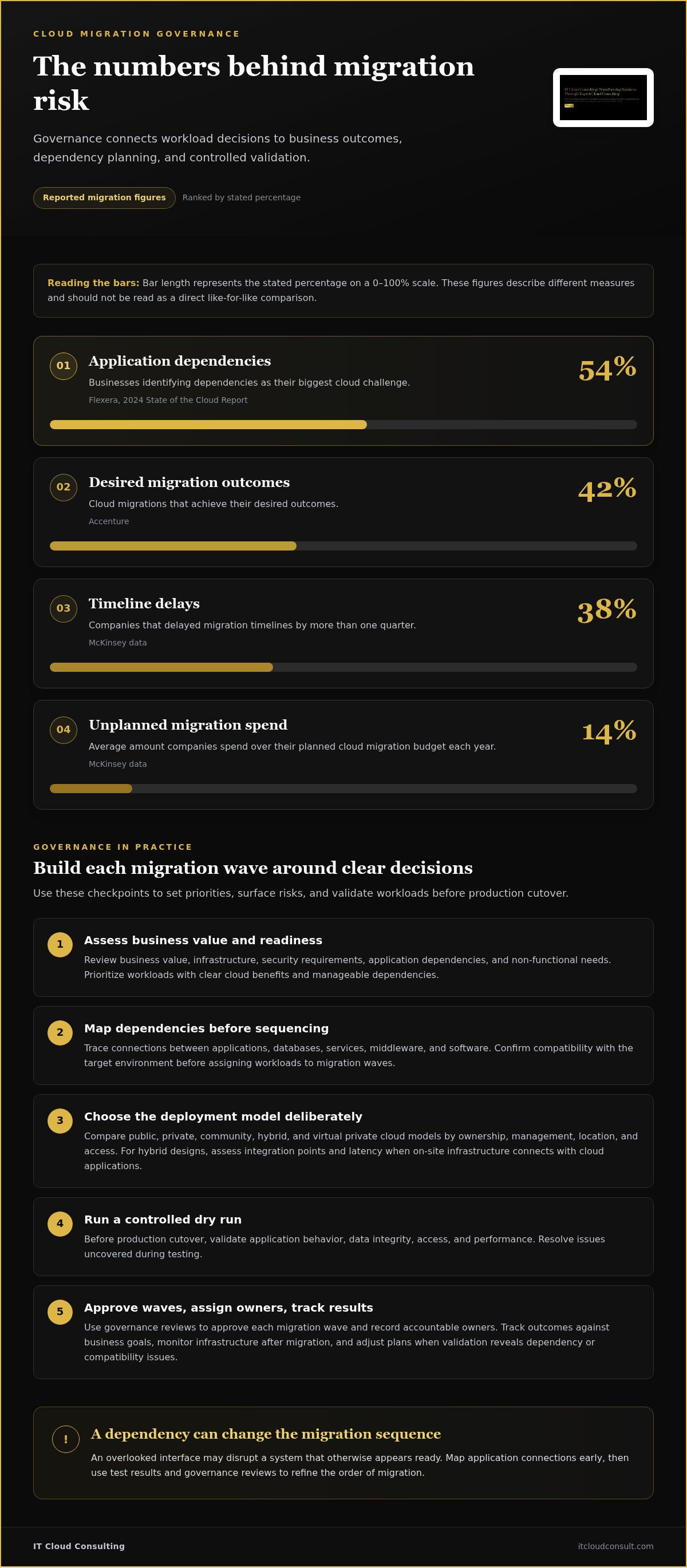
Governance gives migration teams clear decision rights, workload priorities, and validation criteria. Accenture found that 42% of cloud migrations achieve their desired outcomes, underscoring the need to connect technical delivery with defined business results.
Assess workloads by reviewing business value, application dependencies, infrastructure, security requirements, and non-functional needs. Which applications should move first? Prioritize those with clear cloud benefits and manageable dependencies, then confirm that their middleware and software will work in the target environment.
Dependencies often shape the migration sequence. Flexera reported that 54% of businesses consider application dependencies their biggest cloud computing challenge in its 2024 State of the Cloud Report. Map connections between applications, databases, and services before assigning migration waves; an overlooked interface can disrupt a system that otherwise appears ready.
Governance also helps teams manage risk and choose a suitable deployment model. Public, private, community, hybrid, and virtual private cloud models differ in ownership, management, location, and access. A hybrid design, for example, may keep some infrastructure on-site while connecting cloud applications. Assess integration points and latency before moving workloads.
Test before launch. Run a controlled migration dry run, validate application behavior, data integrity, access, and performance, then resolve issues before production cutover. Track outcomes against business goals and monitor infrastructure after migration. McKinsey data shows that 38% of companies have delayed migration timelines by more than one quarter, while the average company spends 14% more on its cloud migration than planned each year.
Use governance reviews to approve each migration wave, record owners, and adjust plans when validation uncovers a dependency or compatibility issue. A structured cloud migration planning approach can help teams align these decisions and refine execution as workloads move.
How to implement cloud computing?
Migration costs depend on data transfer volumes, software licenses, workload design, and ongoing operations. Estimate each category separately, since architecture and usage patterns shape the total.
Cloud Provider Selection
Provider selection matches a cloud service’s capabilities, controls, and support terms to workload requirements. Compare public cloud providers on compatibility, security evidence, service scope, and how they handle customer data. Review independent audit reports, including whether documented procedures are followed. When evaluating providers, review independent audit evidence to assess whether documented procedures are followed.
Federal environments may also require formal approval. The DoD Inspector General reviewed three DoD cloud computing contracts and found that components had not obtained waivers to use non-DoD-approved cloud service providers. The DoD Chief Information Officer lacked a detailed written waiver process. The Inspector General recommended waiver applications for the relevant contracts and detailed published guidance on how to apply.
Service-Level Agreements
A service-level agreement (SLA) defines a provider’s commitments and processes for a cloud service. Review how it describes service availability, support responsibilities, escalation, and issue resolution. Escalation and resolution may depend on the stated timeframe, so compare those terms with operational needs.
For example, a customer-facing application may need a clear route for escalating an outage, while an internal test environment may have different support priorities. Assign internal owners to track provider incidents and document team response procedures. This makes the SLA part of operational planning, not just a contract review.
Cloud Migration Costs
Build a cost model around the workloads being moved. Include data transfer, license changes, cloud consumption, and ongoing operations such as monitoring and administration. Costs vary with data volumes, application dependencies, service choices, and resource usage.
Separate one-time migration work from recurring cloud usage, then compare projected consumption with actual usage after deployment. An application with steady demand, for example, may need a different resource plan from one with sharp traffic peaks. Review the model as workloads change so teams can adjust configurations and avoid paying for resources that no longer support business needs.
Cloud strategy and implementation roadmaps
A roadmap turns cloud strategy into sequenced decisions, connecting each technology investment to a business need. Start by defining the use case, such as improving software delivery or supporting a new digital service. Set specific, measurable goals, then identify the actions, owners, and milestones needed to achieve them.
Choose a planning horizon that fits the transformation. A roadmap can span one-year, two-year, and three-year horizons, with near-term work establishing architecture and foundations before later phases expand capabilities. Small- to mid-scale cloud implementations typically take three to six months. Enterprise-scale multicloud transformations with compliance requirements often take 12 to 18 months through phased delivery.
Readiness determines what belongs in each phase. Assess workloads, infrastructure, application dependencies, security needs, internal skills, and existing software. A business-critical application with complex integrations, for example, may need compatibility work before migration, while a self-contained development environment may be a better early candidate. Include provisioning and deprovisioning automation in the architecture to make recurring IT processes more efficient.
Build governance into delivery rather than treating it as a final review. Existing technology steering committees or enterprise architecture groups can guide design choices, resolve ownership questions, and keep teams aligned. Use stage gates to assess readiness, authorize each release, and check whether outcomes meet the strategy’s measures. This creates a controlled path for innovation while keeping operational requirements in view.
People and operating practices belong on the roadmap too. Plan employee adoption, training, and strategic hires alongside technical milestones. A cloud innovation group can test practical ideas, then share useful patterns across teams. Keep phases small enough to incorporate lessons before expanding, and revisit priorities as business needs or workload constraints change. Develop a cloud adoption roadmap that connects business goals with architecture, phased delivery, and lasting operational capability.
IT Cloud Consulting: Strategic Cloud Adoption
IT Cloud Consulting helps organizations translate cloud priorities into a structured adoption approach. Turn to its Strategic Cloud Adoption offering when you need to align business objectives, workloads, and migration decisions into a coherent direction. As your cloud environment develops, Cloud Optimization can help refine how resources support operational needs, while Ongoing Cloud Support provides continuing guidance for cloud operations.
IT Cloud Consulting’s support is relevant when internal teams need strategic direction, a clearer path through adoption, or ongoing help managing and improving cloud technologies. The right focus depends on your organization’s goals, existing environment, and priorities for change. As a practical next step, identify the challenges your roadmap needs to address and explore which cloud consulting service best fits your plans.
Contact IT Cloud Consulting to discuss your cloud priorities.
Make the Roadmap Your Next Operating Advantage
A cloud roadmap should evolve with the business, not remain fixed after the first migration wave. Treat it as a decision tool: revisit priorities when customer needs, application demands, or operating models change, and use those shifts to guide the next investment. This keeps the cloud computing implementation plan aligned with the organization’s direction, rather than simply tracking completed tasks.
IT Cloud Consulting supports this next phase through Strategic Cloud Adoption, Cloud Optimization, and Ongoing Cloud Support. These offerings help organizations set adoption priorities, refine their cloud environment, and sustain progress as requirements develop. Choose the focus that matches your team’s challenge, whether setting direction or improving an established environment.
Discuss your cloud priorities with IT Cloud Consulting and take a considered next step toward your organization’s goals.
Frequently Asked Questions
How can businesses assess cloud readiness before moving to the cloud?
Assess readiness by creating an inventory that connects each application to its users, data, integrations, and operational owner. For example, note whether a customer portal depends on a local database or a specific software version. Then identify gaps in skills, monitoring, and recovery processes. This gives decision-makers a practical view of which workloads are ready, need remediation, or should remain unchanged for now.
What are the key phases of a cloud computing implementation plan?
A cloud computing implementation plan typically moves through strategy, readiness assessment, architecture design, pilot migration, phased rollout, and continuous improvement. Set an approval point between phases so decision-makers can resolve issues before the next workload proceeds. A pilot, for instance, can test deployment procedures and team handoffs. After rollout, review operational measures and update priorities as business needs and technology choices evolve.
How do you build a cloud architecture and select regions, services, and deployment models?
Build architecture around workload needs, data sensitivity, performance, and existing systems. Select regions based on user proximity, latency, and applicable geographic restrictions. Choose SaaS, PaaS, or IaaS according to how much of the software stack the organization wants to manage. A public, private, or hybrid model should reflect access, ownership, and integration requirements, rather than a preference applied to every workload.
What security, privacy, and compliance requirements apply to cloud implementations in the United States?
Requirements depend on the data handled, the organization’s industry, and the services selected. HIPAA, PCI DSS, GDPR, and SOC 2 are frameworks organizations may need to address through architecture and operating controls. Identify which apply to the workload, document data flows, and assign control owners. For personal data, clarify the organization’s responsibilities and account for geographic restrictions when services process or store sensitive information.
How should an organization plan cloud migration, testing, cutover, and rollback?
Plan cutover with a named decision owner, a change window, and agreed success criteria. Before switching users, compare migrated records with source data and test critical workflows, permissions, and integrations. Define rollback triggers in advance, such as failed transactions or unavailable dependencies, and document how teams will restore the previous service. Rehearse these actions in a nonproduction environment so responsibilities are clear during the transition.
What cloud staffing, skills, governance, and change management are needed for implementation?
Assign clear owners for architecture, security, workload operations, finance oversight, and business acceptance. Teams need practical skills in cloud configuration, identity management, monitoring, and incident response, supported by role-based training. A technology steering committee can resolve cross-team decisions and track exceptions. Explain what changes for employees, provide task-specific guidance, and collect feedback after each migration wave to improve training and operating procedures.


